
Proper thinning of beetroot is essential knowledge for every gardener and summer resident when growing this crop in their garden. The importance and necessity of this agricultural technique stems from the crop's demand for soil conditions, particularly the space needed for proper root development.
Features of thinning
Beet seeds contain 2-6 seeds and, with good germination, several sprouts are produced from one such fruit (nut), some of which are removed.
Therefore, no matter how far apart the seeds are placed in the garden bed, thinning cannot be avoided; otherwise, due to a lack of light and nutrition, the root crops will grow small and deformed.
Timing and necessity of the procedure
The crop must be thinned twice during the entire growing season:
- The first thinning is done after the seedlings emerge from the seeds and develop their first pair of full leaves (2-3 true leaves). However, if the seedlings are uneven, thinning is delayed until 3-4 true leaves appear.
- The second thinning is performed when the plants have 5-6 leaves and a small root crop up to 3 centimeters in diameter. This is usually done 2-3 weeks after the initial thinning.

In some cases, 2-3 weeks after the second, a third thinning is also performed, designed to increase the mass and size of the root crops.
Rules of the event
To avoid harming the plant, thinning must be done correctly, taking into account certain points.
Before thinning, beet beds in open ground are watered generously. Well-moistened soil allows the desired plants to be easily removed from the soil.

For these purposes, gardeners use a trowel, which is used to slightly lift the soil with several shoots, and carefully remove the excess plants.
- During the first thinning, all weak and excess plants are removed from the bunch, leaving only the most vigorous plant. The distance between thinned plants is usually 4-5 centimeters. After this, the root zone (the crown) of the plants is covered with a layer of soil, creating a shallow ridge. The optimal distance between adjacent plants is determined based on the shape and size of the ripe roots of different varieties. For varieties with round and cylindrical ripe roots, the distance between adjacent plants is no more than 5-6 centimeters, while for larger varieties with rounded, flat roots, this distance is increased to 7-8 centimeters.
- To obtain larger root crops, beetroots need to be thinned a second time, increasing the distance between adjacent seedlings to 10-15 centimeters. Beetroots prefer sufficient space to develop. However, experienced vegetable growers advise against leaving large distances between adjacent plants in a bed, as this can cause the roots to grow too large, causing excessive ringing and fibrous growth, which can lead to poor shelf life.
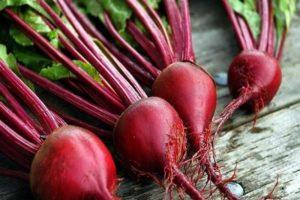

If you don't have a garden trowel, remove the seedlings that are crowding the bed by hand. To do this, grasp the seedling as close to the ground as possible and pull it out of the soil without jerking or making any sudden movements.
Is it possible to transplant beets when thinning?
The shoots removed during thinning, if they have well-developed leaves and a healthy root system, can be transplanted to another location.
- The shoots removed during the first thinning are immediately planted in a new location or temporarily dug in in a semi-shaded place with loose and fertile soil.
- Before planting, the tops are torn off by 1/2, and the root is pinched, removing 1/3 of its length.
- The plants obtained after thinning can be transplanted either into a prepared bed or between rows or along the perimeter of raised beds with other vegetable crops (for example, onions, cabbage, and carrots). They are planted in holes 3-3.5 centimeters deep, dug with a finger or the handle of a hoe. The distance between plants in a row with this method of thinning is 10-12 centimeters.
- If all the above conditions are met, the transplantation of young thinned seedlings is painless, they quickly take root and grow.
 Please note: Plants removed after the second (final) thinning are not suitable for further replanting.
A method for planting beets without thinning
There are several methods for growing beets, which can be used to grow this crop without thinning:
- Transplanting ready-made seedlings into open ground is a method of growing this crop, allowing you to transplant plants grown in a greenhouse or indoors at an optimal distance to ensure normal growth and development of root crops.
- Use single-seeded beet varieties (one beetroot sprouts from one nut). The most common varieties are Bordeaux single-seeded, Russian single-seeded, and Virovskaya single-seeded.
These methods allow you to grow beets without thinning, thereby saving time and money on purchasing more expensive double-sprout seeds.

Recommendations from an experienced gardener
When growing beets, you should also consider the following recommendations from experienced gardeners:
- You can thin out beets early in the morning or in the evening, as well as on a cloudy, warm and windless day.
- To prevent the accumulation of specific pathogens and pests, avoid growing plants in the same spot for more than one season. It's best to plant cucumbers, tomatoes, and beans in the same bed where beets were grown next season.
- To compare growing conditions, experienced gardeners recommend planting single- and double-sprout beet varieties. This variety will help each gardener understand from personal experience which varieties are most productive and suitable for growing in the specific soil and climate conditions of their plot.
- When thinning varieties with cylindrical root crops, the removed excess shoots are not replanted - even minimally damaged roots will not be able to ensure normal root formation in the future, and such replanting will be useless.
- During the first thinning, beets are moderately fed with nitrogen fertilizers and humus.
- To reduce evaporation, the soil surface around the sprouts is mulched with humus and dry grass.
Take a look Also

Related posts:
 Growing and caring for beets in open ground: step-by-step agricultural technology
 TOP 10 recipes for delicious beetroot caviar for the winter – finger-licking good!
 How and when to properly plant beet seeds in open ground
 Reasons why beet leaves turn yellow, care mistakes, what to do, and how to treat them
 Description of sugar beet varieties, cultivation technology and growing conditions
 Description and characteristics of 35 best beet varieties, planting and care rules
 How often should beets be watered in open ground, the rules and timing of the procedure
 Description of beetroot diseases, their control and treatment with medications and folk remedies