
- We decide on the variety and purchase high-quality seeds
- Sorting and calibration of seed material
- Ways to increase the germination rate of future seedlings
- Preparing containers and soil
- When to sow seeds
- Planting: step-by-step instructions
- In peat tablets
- In a container or other vessel
- Sowing in a diaper
- Caring for tomato seedlings at home
- Watering
- Backlight
- Temperature conditions
- Dive
- Top dressing
- Hardening
- What are the most common errors encountered and how to solve them?
Academics and amateur gardeners debate the proper method for planting tomato seedlings for gardens and home gardens. Each has their own unique method, and sometimes it yields the expected results. While they disagree on the specifics, they agree on one thing: the key to success is healthy tomato seedlings. Weak, stunted plants won't grow into strong, fruit-bearing plants. Consequently, their harvest will be disappointing. Today, we'll take a master class on seedlings.
We decide on the variety and purchase high-quality seeds
Selecting a variety appropriate for the region and climate zone determines the specific results. Experimenting with seedlings is good, but not at the high cost of unharvested fruits, poor germination, or other similar "surprises." Equally important is purchasing the "right" seeds—from a legitimate producer, with guaranteed quality, and genuine tomatoes, not some weeds in gray packets.
Thus, the main criteria for success with seedlings can be defined in the following components:
- seed variety;
- suitability for the landing site (climate);
- legal, verified suppliers;
- confidence in one's own abilities and knowledge.
The remaining "little things" are: not confusing tomato seeds for outdoor planting with greenhouse ones, determining the desired bush height, and preparing the soil for sowing. This will be discussed in detail later..
Sorting and calibration of seed material
The first law of agricultural technology states: the larger the seeds, the higher the chances of producing healthy seedlings. This is because large fruits, accordingly, contain a significant supply of nutrients and microelements, which nature provides for the full development of a mature tomato plant.
That's why seed sorting is necessary. Don't throw away the small ones; they'll still be useful. A simple and effective method of "natural selection" of seeds is to soak the berries in a weak solution of table salt. The heavy (full and viable) seeds will sink to the bottom, while the small (empty) ones will float.
The latter are carefully examined once again, those potentially suitable for seedlings are selected, and the ultimately rejected seeds are discarded.
Ways to increase the germination rate of future seedlings
Raise tomato seed germination It's possible. To do this, you need to choose one of the appropriate methods:
- Soaking the seed in a solution of potassium permanganate (potassium permanganate). This is a universal method long used by gardeners for various plant species. Soaking time is up to 15 minutes.
- Seed treatment in structured (frozen) water for 6-18 hours, followed by soaking in Zircon or Immunocytophyte. The soaking time depends on the type of solution.
- Roasting seeds at 50 degrees Celsius for up to 25 minutes also has a positive effect on germination. This method is often combined with treatment with aloe vera juice, Zircon, or Epin.
- Saturation of seeds with oxygen (bubbling)
What to pay attention to when working with seeds: Soaking in water precedes disinfection. The next step is the application of active biological additives (at a temperature no higher than 20 degrees Celsius). This sequence guarantees the overall effectiveness of the procedure and will not result in loss of time, effort, or harvest.
Preparing containers and soil
Growing seedlings depends not only on the choice of seeds, but also on the right soil composition and the size and depth of the containers. Seedling containers should meet the following requirements: they should allow the root system to develop fully and should not be too spacious or too cramped. The recommended pot depth is at least 10 centimeters.
A mistake in choosing pots for seedlings is not as critical as an inappropriate composition of the soil mixture.
Gardeners have several options for providing their future tomato seedlings with high-quality soil. Most often, this involves purchasing a ready-made, balanced set of components from the store. This eliminates the need to calculate proportions and mix soil with nutrients. Everything the seedlings need is already added to the soil by the manufacturer in the correct quantities, packaged, and pre-packaged.
If you've chosen the difficult route of creating your own seedling soil mix, don't despair. The process isn't as complicated as it seems. The soil should be thick enough to retain water (but not oversaturated). The soil pH should be between 6.5 and 7 (neutral).
Microelements, minerals, and active substances will also be needed to nourish the seedlings during growth. The soil should be free of mycelium (spores), pests (both adult and larval), poisons, and other similar contaminants. Therefore, soil should not be collected near roads, gas stations, or man-made structures—this should be clear without any arguments. A forest, park, or grove—places where plants thrive and thrive—are suitable as a soil donor.
Clay impurities in the soil are undesirable. Suitable organic matter includes turf, rotted leaves (they contain a ready-made set of micronutrients), peat, ash, and crushed eggshells. River sand, perlite, vermiculite, expanded polystyrene granules, and expanded clay are suitable for drainage. These additives "liquefy" the mixture, making it permeable.
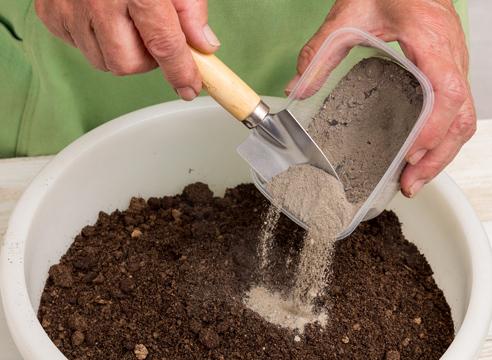
There are countless recipes for preparing potting soil for seedlings, so you can choose any one you like. The key is to be able to implement it.
When to sow seeds
Planting timing, including the month in which to sow seeds, can influence the success of the project just as much as other factors. Generally, sowing is done at the end of March (May is sometimes mentioned). Specific timing depends on two factors: the climate zone (the onset of spring) and the tomato's growth period. Each seedling variety has its own development period, ranging from 45 to 65 days.
Temperature and humidity are important for tomatoes; below 15 degrees Celsius is critical.
In a warm, draft-free room (apartment, private house, greenhouse), planting is done based on seed germination and the expected time of transplanting to the open ground. Theoretically, this can be done even in February, but overgrown seedlings that aren't planted on time are more difficult to acclimate to new conditions.
Planting: step-by-step instructions
Before planting, it's a good idea to treat the seeds. There are plenty of ways to do this, so choosing the right one is easy. Then, proceed directly to planting the seeds:
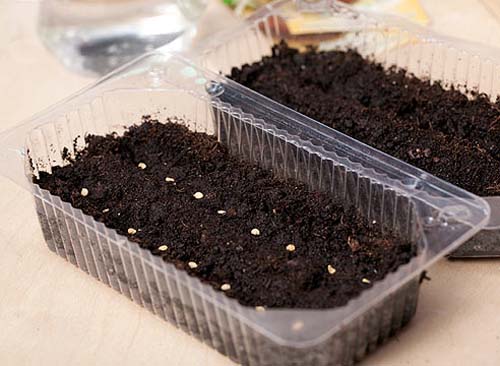
- Prepared soil is poured into boxes, trays, or pots (at least 10 centimeters high). The seed is planted to a depth of up to 1 centimeter.
- The seedlings are covered with film (plastic sheet, mineral glass). It's important to create greenhouse-like conditions for the seedlings—constant temperature and humidity.
- As soon as germination begins, lighting is added. Tomatoes are extremely light-loving and will require almost 24-hour light (at least 12-16 hours a day).
- Once all the seedlings have sprouted, the boxes are transferred to harsher conditions, with temperatures no higher than 16 degrees Celsius. The seedlings live here for seven days, hardening off, and then returning to their familiar warmth.
- The seedlings require regular watering with room-temperature water (not cold), but don't overdo it. A spray bottle can be used to evenly moisten the leaves. Afterward, reduce the watering regime to once a week.
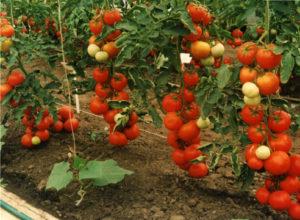
- Seedlings are transferred to open ground after warm, windless weather sets in and they have reached the desired development stage. Overly weak seedlings transferred to soil may die.
In peat tablets
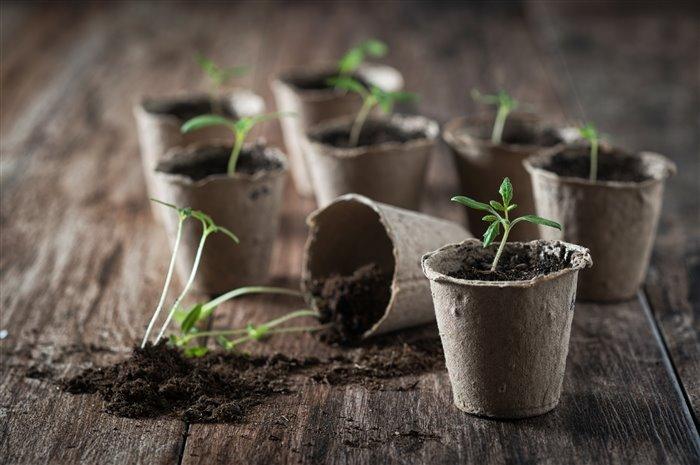
There are various ways to plant tomato seeds: in boxes, directly into open ground, or using peat nutrient tablets. The latter method is useful because it allows the seedlings to be transplanted without damaging their root system. In recent years, it has become popular among gardeners due to its simplicity and effectiveness.
To implement this plan, you'll also need a special box with compartments (or a used muffin container). Tablets, which are highly hygroscopic (good for seeds), are placed inside. Pre-selected seeds (sometimes soaking them before planting is recommended) are lightly pressed into the surface of the peat disk. The process is then monitored, maintaining a constant temperature and humidity.
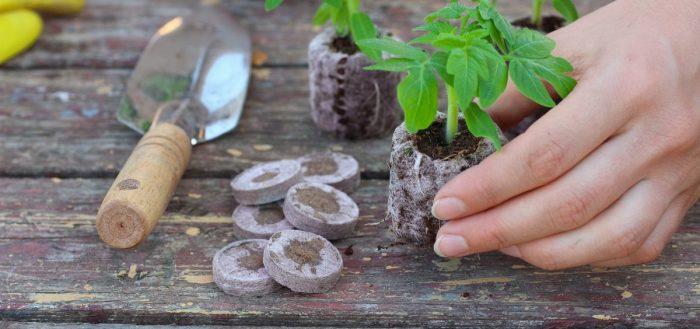
Pros: Peat contains all the minerals and components needed by the seed. Cons: A special sectional tray is required. However, it can then be used for several seasons.
In a container or other vessel
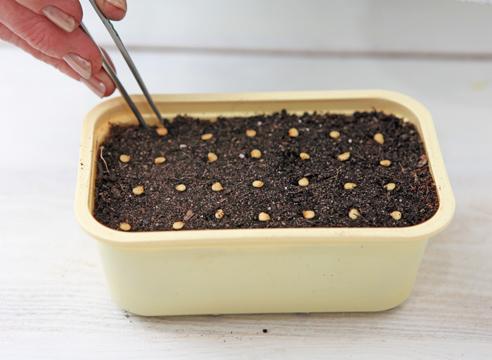
The most reliable, traditional method is to grow seedlings in a pot. The container must be at least 100 millimeters deep. This can be a long, narrow box or tray. Fill the container with a ready-made or homemade potting mix—your choice. Next, press the seed shallowly, about a centimeter or so, into the soil. Cover with a lid and plastic wrap, and place in a warm, draft-free spot. Then wait for the seeds to sprout, remembering to keep the soil moist.
Sowing in a diaper
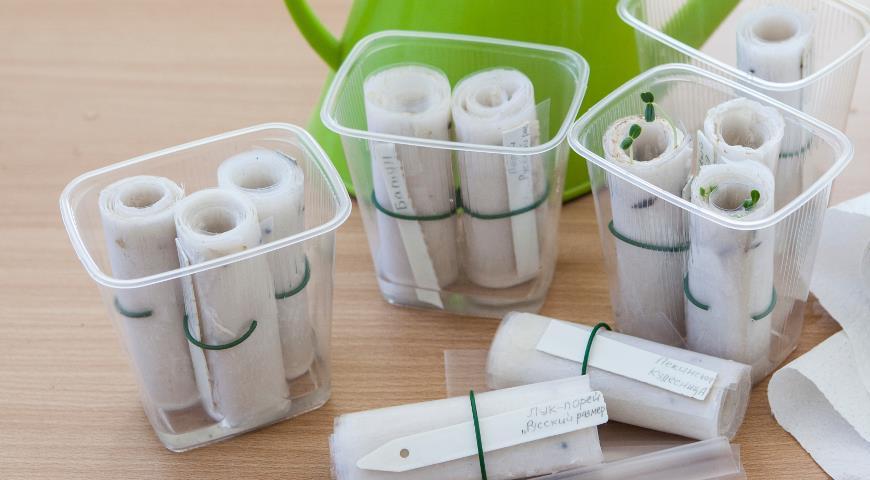
This method allows you to plant tomato seeds while saving soil and space. It's ideal for small apartments. Soil is poured into a plastic bag or plastic wrap, rolled into a cone, and then the seeds are planted in this makeshift pot. Advantages: for transplanting, simply unroll the plastic wrap.
There's a more modern method: germinating seedlings without soil. The seeds are wrapped in absorbent material, filter paper, or napkins.
Caring for tomato seedlings at home
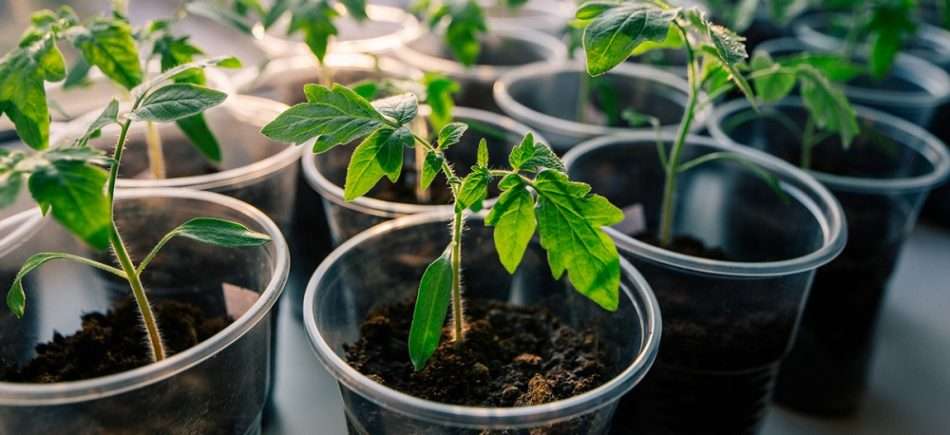
When growing seedlings indoors, two key requirements must be met: humidity and temperature. Lighting and nutrient supply for the future tomatoes must also be considered. This applies to all options, including diaper or soilless. Otherwise, healthy seedlings won't grow even from premium seeds.
Watering
Seedlings need water, but not so much that it causes root rot and death. Misting the plant, preventing the leaves and soil from drying out, is sufficient.

Backlight
Tomato seedlings require long hours of daylight—16 hours a day. This requires a powerful grow light that will replace the sun, providing warmth and light. Initially, the light can be left on overnight.
Temperature conditions
The ambient temperature is maintained at 15 degrees Celsius (the lower limit). It's also important not to overheat the seedlings. By covering the seed trays with glass, the microclimate in this "greenhouse" is controlled by periodically lifting the lid. Once the seedlings have emerged and become stronger, they are hardened off by lowering the temperature (to 14 degrees Celsius for 5-7 days), then returning it back to the previous temperature.
Dive
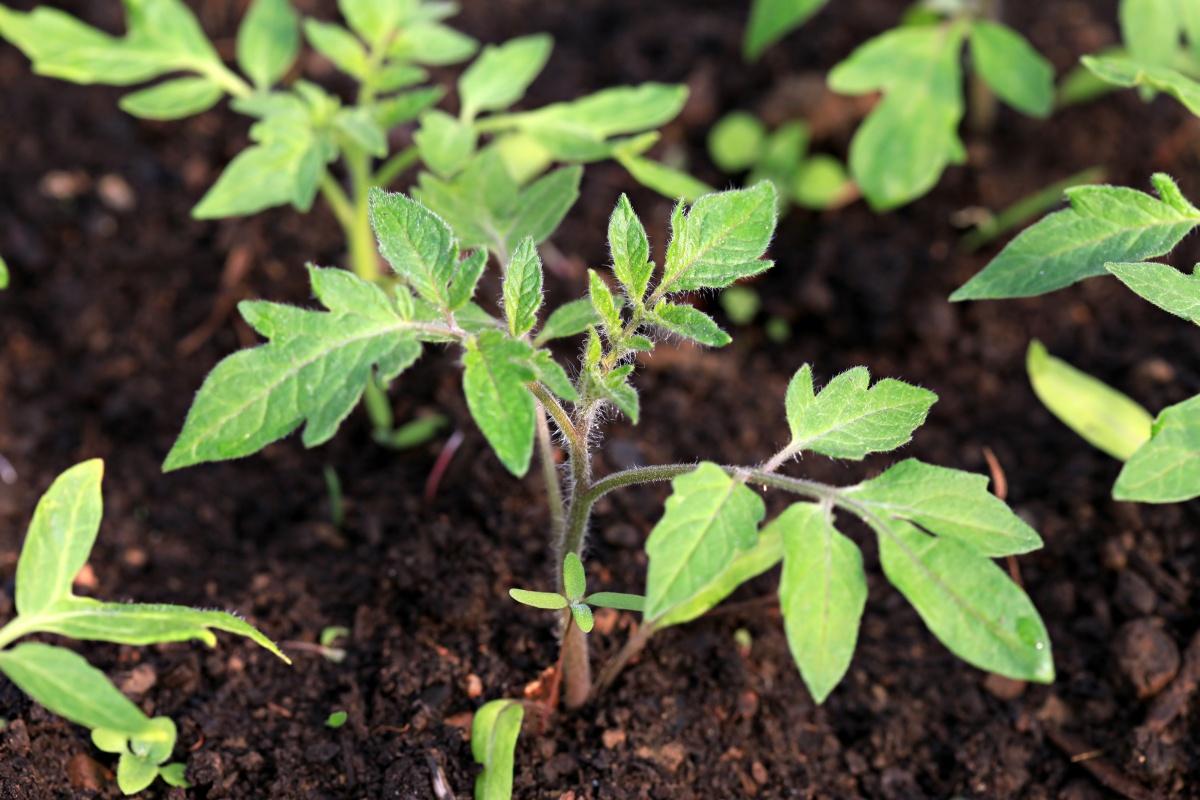
Growing indoors is combined with transplanting. There are several options for this procedure. Sometimes it's recommended to transplant seedlings several times, periodically pinching the lateral roots (this strengthens the central root). An alternative method is to transplant the central root.
Top dressing
Growing tomatoes require a lot of nutrients. To achieve this, they are fed with special mixtures.
Experienced gardeners treat seeds with stimulants containing biologically active additives, providing seedlings with a supply of "health" for the entire growth period.
Tomatoes require two essential minerals: nitrogen and phosphorus. To ensure adequate nutrition, any complete fertilizer can be used, following the recommended application and dosage.

Hardening
This involves gradually lowering the temperature in the room containing the seedlings. It is applied carefully, maintaining the correct watering regime. It is most often performed in April or May, depending on the region.
What are the most common errors encountered and how to solve them?
Beginning tomato growers are not immune to mistakes. Our goal is to highlight the most common ones and suggest solutions.
- Buying a "pig in a poke" means buying seeds from strangers. In the worst case, nothing will grow at all. In the best case, after treating the seeds with potassium permanganate, they're ready to use.
- Soaking the seeds. A procedure lasting more than 20 hours inevitably leads to the death of the embryo. Meltwater is very good, but the time of the procedure must be recorded.
- Early sowing of seeds. Despite the age limit for seedlings (they must be planted on time, without over-seeding), "old" ones are always inferior to "young" ones. The optimal development period is 45-50 days. If adequate light is not available, it is best not to sow seeds in February.
- Soil errors. A mixture that's too acidic, poorly permeable, low in minerals, or infested with pests is unsuitable. Adding sand, lime, and calcining will help solve the problem.
- Premature hardening. Until the seedlings have emerged and become strong, lowering the temperature is out of the question. Weak seedlings will die and not survive.
Related posts:
 Is it possible to soak treated cucumber seeds before planting and how to do it correctly?
 What is the best way to feed tomato seedlings to make them plump?
 The best eggplant varieties for growing in a polycarbonate greenhouse: planting and care
 Carrot care guidelines for outdoor cultivation to ensure a good harvest
 TOP 10 tips on how to properly plant and grow basil from seeds at home for seedlings
 How to prepare tomato seeds for planting seedlings
 Planting, growing, and caring for eggplant seedlings at home
 How to properly plant peas in a greenhouse and open ground