To get a good tomato harvest, you need to grow your seedlings properly. O. A. Ganichkina recommends performing this crucial step, transplanting tomatoes, in two stages.
Why do you need to transplant tomatoes?
In most regions of Russia, growing tomatoes is only possible using seedlings. Even ultra-early modern varieties begin to yield only 80 days after germination. Given the short summer, sowing these seeds directly into the soil will yield the first fruits at the very end of the season. Seedlings must be grown for 2-2.5 months before planting in the beds. However, in a small amount of soil and with insufficient light, young plants become elongated and weak.
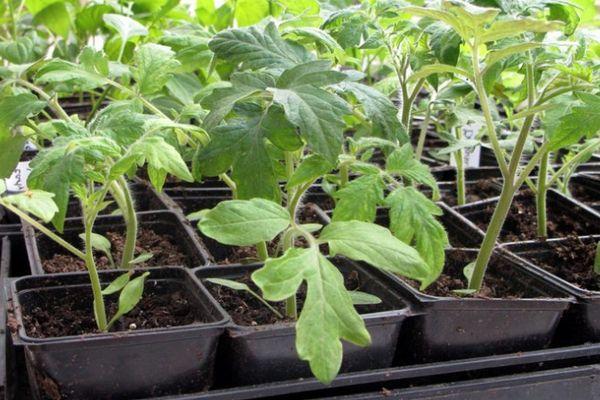
Pricking out seedlings of tomatoes, peppers, eggplants, and other nightshade crops is essential. It is performed for several purposes:
- reduce the growth of green mass (the above-ground part of the tomato) so that the bushes do not stretch out before planting in the ground;
- to strengthen the growth of the root system, which provides nutrition to the plant and ensures good formation and filling of fruits;
- provide the growing roots of the bush with sufficient space, and the above-ground part with an abundance of nutrients.
Pricking out is a stressful situation for the plant. After this, the growth of the aboveground part stops.
The root system suffers the most. Even with the most careful repotting, some of the smallest roots are torn off. Water and dissolved minerals are absorbed through the root tips. When these roots are torn off, the plant is deprived of nutrition and stops growing. However, the plant's vital regulatory system is designed in such a way that even a slight shortage of nutrients triggers the rapid growth of new roots. A strong root system ensures adequate nutrition for the above-ground portions.
When transplanting tomatoes, the roots of the seedlings are not only torn off during transplantation. It is recommended to specifically pinch off the longest, central root by approximately 1/3 of its length. Pricking out using O. Ganichkina's method involves simply removing the seedlings with a knife. When growing large quantities of seedlings, this method is less labor-intensive than pinching, but it serves the same purpose: removing part of the root system.
How to transplant tomatoes using Ganichkina's method?
After the seedlings appear, O. A. Ganichkina recommends feeding the young plants twice:
- in the phase of appearance of 1 true leaf with Agricola-Forward fertilizer (1 teaspoon per 1 liter of water for irrigation);
- when 3 true leaves are formed, apply the preparation “Effekton-O” (1 tbsp per 1 liter of water), fertilize 3 hours before picking.
To transplant seedlings, prepare containers 8-10 cm in diameter (approximately 0.5 liters in volume) in advance. You can use peat pots or plastic ones designed for growing seedlings. Fill the containers with a store-bought soil mix with peat, suitable for tomatoes and other vegetable crops. Water the soil with a weak solution of potassium permanganate.
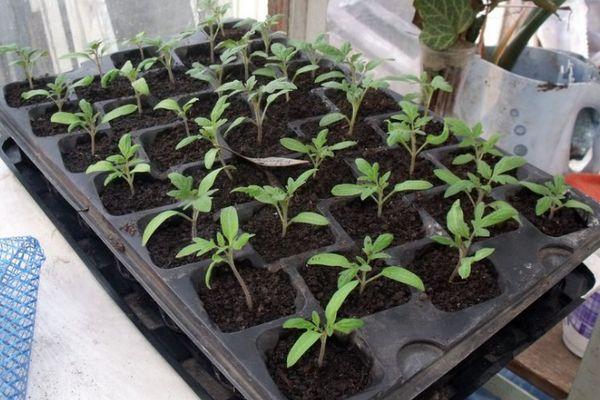
The first picking of seedlings is carried out in the following sequence:
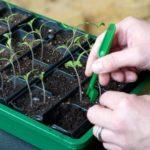
- Remove the seedlings from the box using a blunt-tipped knife. Insert the tool into the soil at an angle, close to the seedlings.
- When lifting the bush with a knife, hold it by the cotyledon leaf, being careful not to break the thin stem. Remove the plant from the soil.
- Make a hole in the pot with a knife and place the tomato there so that part of the stem (approximately up to the cotyledons) is in the hole.
- Press the soil around the stem and roots, closing the hole.
When replanting seedlings, select the most developed, strong, and healthy plants. If signs of blackleg are visible (the lower part of the stem has turned black), discard the plant.
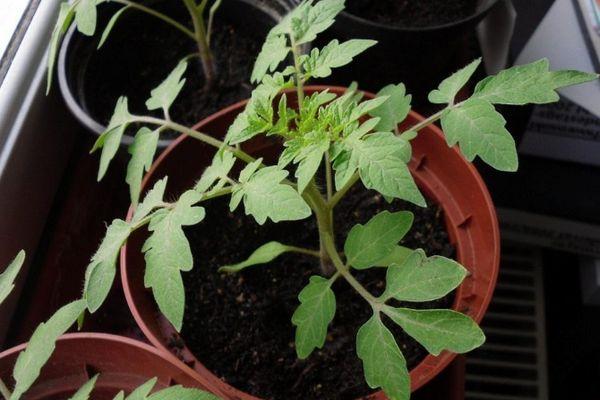
The soil is sufficiently moist, so additional watering is not necessary. You can water the transplanted tomatoes as the top soil dries out.
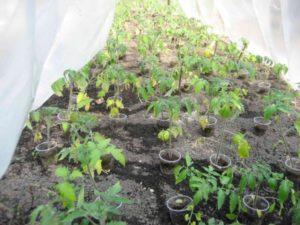
O. Ganickina recommends another feeding 12 days after transplanting. To do this, dissolve 1 tablespoon of Agricola-Forward in 10 liters of irrigation water. Apply 0.5 cups of the solution to each plant. After this, care for the seedlings is limited to timely watering: the soil should dry out to a depth of 1 cm, but remain moist inside the pot.
The second stage of tomato transplantation using Ganichkina's method
The seedlings should remain in their pots until about 30 days before they are ready to be planted in a greenhouse or outdoors. At this point, another transplant is performed. This is less traumatic than the previous one and serves to provide the root system with more room to grow.
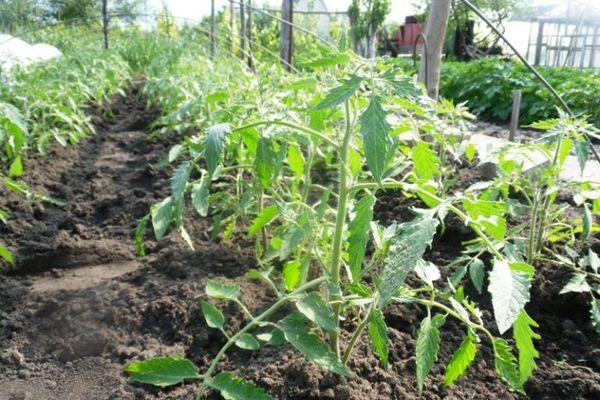 For replanting you will need containers with a diameter of 12-15 cm. In each of them, you need to add a little soil to the bottom so that the soil level in the smaller pots does not have to be changed, that is, the tomato bushes should not be buried too deep when transplanting.
If the first transplant was into peat pots, there's no need to remove the tomatoes from them. The material these containers are made of will soak in the damp soil, and the roots will grow right through the sides. Place the peat pot inside the larger container and carefully fill the gaps between the sides with soil. Water thoroughly and return to their usual location.
The bushes will have to be taken out of the plastic pots:
- take the pot so that the stem of the seedling is between the index and middle fingers;
- turn the container over and lightly press or tap on its bottom;
- remove the container from the root ball.
Don't shake the soil off the roots. If some of it falls off on its own, that's okay. Place the root ball in a larger container, fill the space around it with new soil, water it, and return it to the same place where the tomato was growing.
Further care for the seedlings consists of watering (approximately once a week). After two weeks, feed the young tomatoes with Agricola tomato fertilizer (1 tablespoon per 10 liters, 1 cup per plant). Repeat this feeding again before planting the tomatoes in the garden.
Related posts:
 What is the best way to feed tomato seedlings to make them plump?
 What fertilizers and when to use for feeding tomatoes in a greenhouse
 What is the best way to mulch tomatoes in open ground and greenhouses?
 The best eggplant varieties for growing in a polycarbonate greenhouse: planting and care
 How to prepare tomato seeds for planting seedlings
 When and how to properly transplant tomato seedlings, the best days in 2025
 The best and most productive tomato varieties for greenhouse cultivation in the Urals, with descriptions
 Description and characteristics of the best indeterminate tomato varieties for greenhouses