
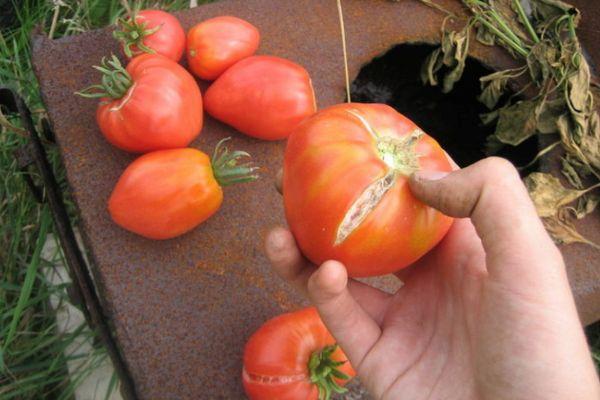
Those who work in their gardens and dachas often wonder why tomatoes crack. The unsightly appearance of the fruit makes it difficult to sell them at market. Typically, such tomatoes are eaten directly. Is it just the appearance, or do the cracks pose other hidden dangers? Why do tomatoes crack, and how can they be prevented? These are the main questions that concern gardeners.
Why are cracks dangerous?
The problem is that when a tomato bursts, its flesh remains exposed for a while until a hard, dark skin forms. During this period, various bacteria and fungi, dangerous to humans, can enter. Therefore, it's important to remember to treat your greenhouses for pests—this reduces the risk of fruit infestation.
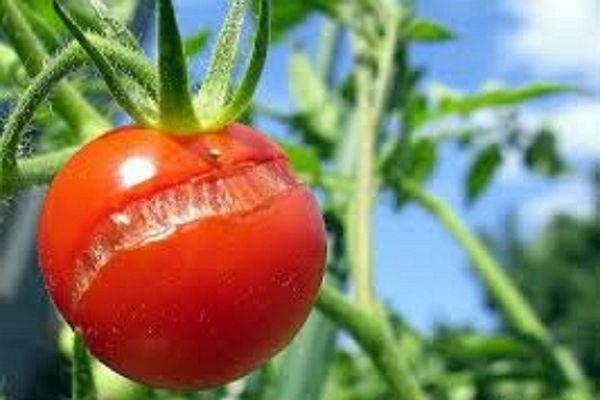
Fortunately, a protective crust forms quickly over the crack, preventing bacterial access. The tomato continues to grow and retains its overall nutritional value. Most of these tomatoes can be eaten raw or preserved for the winter.
Causes and solutions
First of all, cracked tomato skin is a sign of a growing error. So why do tomatoes crack?
Firstly, tomatoes require a specific microclimate in a greenhouse. Oddly enough, frequent watering during hot weather is the main mistake new gardeners make. It would seem that the hotter the sun, the more water the plants need. However, since the soil in the greenhouse dries out significantly during hot weather, and any moisture that falls on it quickly drains to the roots, greenhouse tomatoes begin to grow vigorously, causing cracks to appear. For this reason, cracks can be found even on unripe tomatoes.

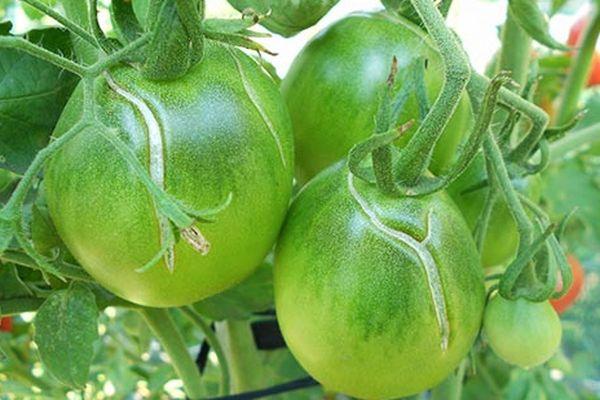
The second reason why tomatoes crack is improper temperature conditions. In the summer heat, greenhouse air reaches very high temperatures (50°C or more), causing the fruits to grow more slowly. If tomatoes grow slowly, their skins become rougher, losing their elasticity. Later, as they fill out and grow, the fruits begin to split.
Therefore, it's important to protect them from direct sunlight. Lime milk, which will shade the plants when applied to the greenhouse glass, works well for this purpose.
The third reason why greenhouse tomatoes often crack during ripening is excessive leaf picking. In this case, the plant has nowhere to release the excess juices, and they flow into the fruit. The fruit begins to grow rapidly and crack.
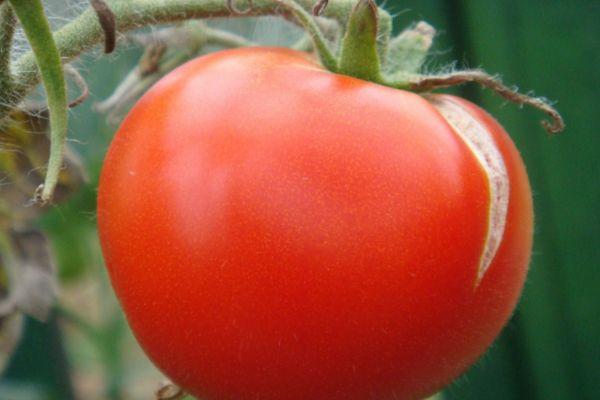
Few people think about it, but choosing the right tomato variety for growing in a greenhouse is important if you don't want to spend time searching in vain for the reason why cracks appeared.
Varieties with a medium ripening period, such as hybrids, are well suited for growing in greenhouse conditions:
- Bohemia A1 (large fruits up to 140 g, long shelf life and easy to transport);
- Grushovka (a variety with elongated fruits weighing up to 120 g, unpretentious, resistant to storage);
- Raspberry Vicomte (fruit weight up to 130 g, unpretentious);
- Pink honey (very large fruits up to 500 g);
- Asteroid (weight up to 180 g, disease resistant);
- Lady fingers (the fruits are small, up to 60 g, not juicy, but are excellent for pickling).
In addition to the external causes listed above, there are also factors related to soil fertilization. Some gardeners don't fertilize their soil at all, or they use the wrong fertilizers.
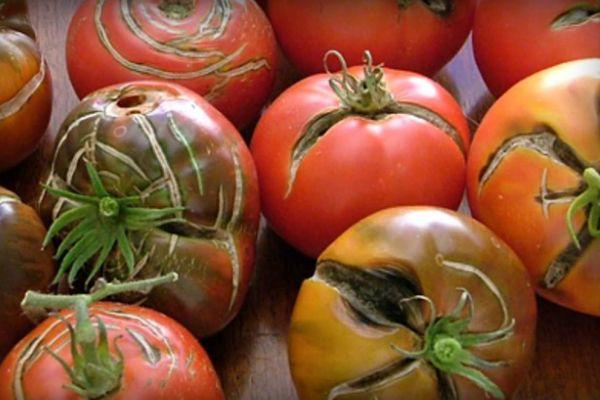
For example, if tomatoes crack and grow slowly, and a purple tint appears on the leaves, this means there is not enough phosphorus.
If there is not enough nitrogen, the leaves on the bushes turn pale, and the fruits remain small in size, although they ripen quickly.
If the bushes with cracked tomatoes have wilted leaves and few inflorescences (and consequently, fruits), it means there is a copper deficiency in the soil.
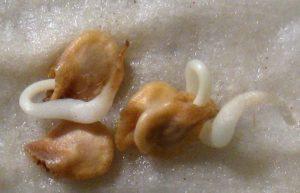
Calcium deficiency can also occur. In this case, the leaves turn yellow, and over time, the plant itself dries out.
A potassium deficiency will cause the leaves to appear scorched in places. The foliage will then turn yellow, and dark veins will appear on the fruit.
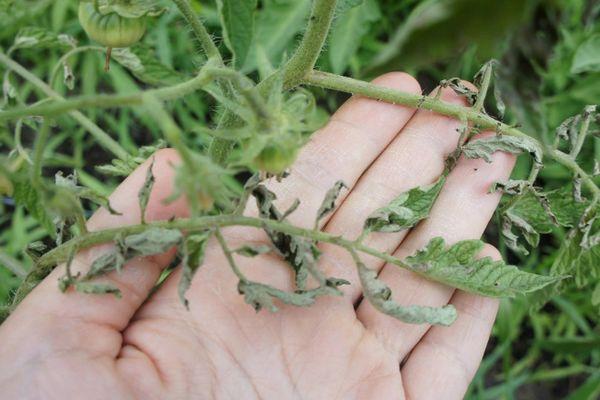
Magnesium deficiency is manifested by yellowing of leaves and their falling off.
If areas of dead tissue appear on the fruits themselves, it means they are lacking boron. In this case, the growing point also dies.
It's difficult to distinguish external factors related to humidity and temperature from deficiencies in certain elements. If tomatoes in a greenhouse are splitting, carefully monitor their growth, taking all factors into account. After all, if an element is missing, leaves will fall off, and if there's insufficient shade, tomatoes may begin to crack. All factors influence each other, so don't ignore any of them and carefully monitor any changes in growth.
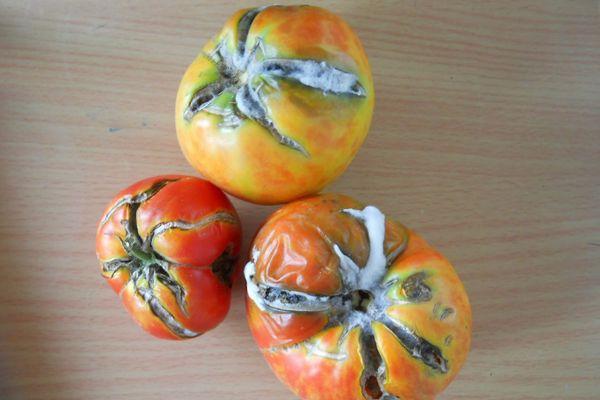
Things get much worse when cracks are caused by diseases. The most common are:
- Blossom-end rot. A black top appears at the stem end of the tomato while the fruit itself is still green. This disease develops as a result of a severe calcium deficiency.
- Gray mold. This disease is caused by a fungus that thrives in wet, cool weather and attacks fruits and stems. It can be recognized by its gray spots.
Prevention
It's quite difficult for non-professional gardeners to distinguish the signs and determine the causes of cracks on tomatoes. Therefore, it's essential to take preventative measures against the disease. This doesn't take much time, but it can be quite effective in combating tomato diseases.
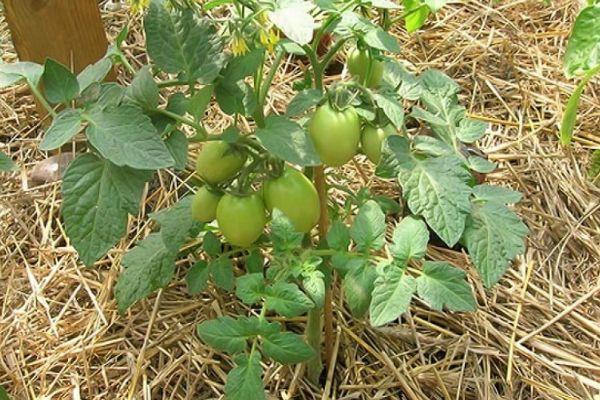
In the fall, clean the greenhouse, removing even the smallest remains of tops and fruit, as this can allow pathogens to survive the winter. Also, avoid planting plants from the Solanaceae family (potatoes, eggplants, and peppers) near the greenhouse, as these plants are known to transmit tomato diseases.
Regularly inspect your bushes for signs of disease and ensure they are properly watered. During hot weather, water them twice a week, in the evening, directing the stream directly at the roots. During rainy seasons, once a week, in the middle of the day, is sufficient.
Some gardeners recommend burying a cut-off plastic bottle upside down near the root and pouring water into it like a funnel. This will direct the moisture directly to the roots with minimal loss.
 Place mulch (a mixture of sawdust, compost, husks, etc., or manure) around the bushes; it will nourish the roots with useful minerals and retain moisture in the soil.
Monitor the temperature—ventilate the greenhouse during hot weather. Don't forget to provide shade. Fertilize and water the plants twice a month.
By following these simple recommendations, you will grow a good harvest - the fruits will be perfect.
Related posts:
 Description of the best varieties of black tomatoes for open ground and greenhouses
 The best grape varieties for growing in the Urals, planting and care rules in summer
 What varieties of tomatoes are best to plant in a polycarbonate greenhouse?
 The best eggplant varieties for growing in a polycarbonate greenhouse: planting and care
 80 Best Eggplant Varieties for Different Regions with Descriptions and Characteristics
 Delicious recipes for canned tomatoes with honey for the winter, preparation steps
 Descriptions of the 20 best cherry varieties for the Moscow region, their planting and care
 TOP 17 recipes for pickled sweet tomatoes for the winter