
When a sudden shake causes clouds of gnats to rise from plants, vegetable growers begin to worry about how to get rid of whiteflies in the greenhouse, especially on tomatoes and other crops. These tiny insects resemble aphids and cause similar damage by sucking the juices from fleshy leaves. But tomatoes aren't the only ones to suffer from them.
What is a whitefly?
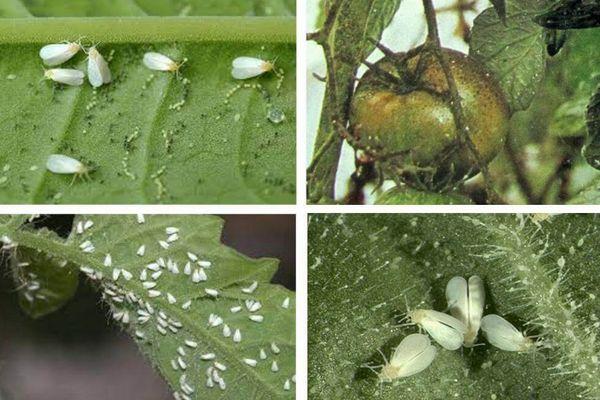
This insect is a species of Homoptera. An adult is no larger than 3 mm, and when examined through a magnifying glass, opaque white wings and a light, almost colorless body become visible. A flying whitefly resembles an aphid or a small moth.
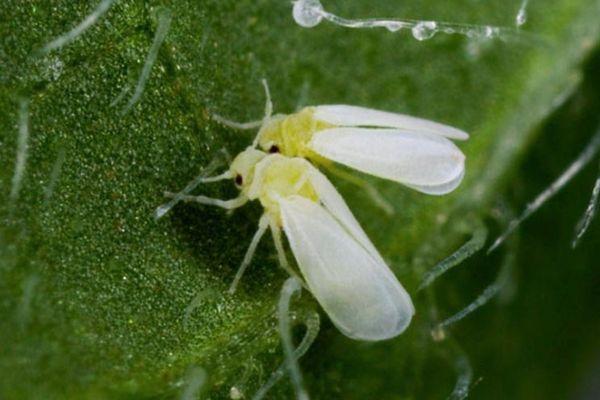
When several mature insects enter greenhouses and hotbeds, it is quite difficult to notice them, so the gardener pays attention to the consequences of the larvae's activity:
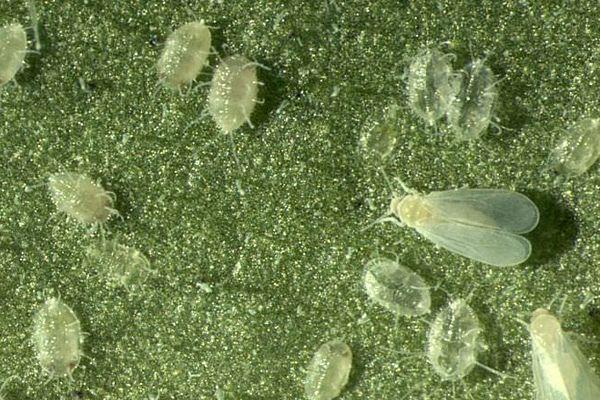
- Tomato seedlings are developing twisted or deformed leaves that are smaller than normal. On the undersides, you can see small caterpillars (about 1-2 mm) or traces of their presence: remnants of cocoons and secretions in the form of transparent, glue-like scales.
- Affected plants lag behind in growth and have a stunted appearance.
- On mature bushes, the ovaries stop filling and ripening normally, acquire a pale shade or become covered with a dark coating.
- Whiteflies can already be seen when they reproduce. They swarm among the tomatoes and fly off the plant when shaken.
- Over time, dark spots form on the leaves where the larvae and their excrements were observed. This is the appearance of sooty mold, which thrives on the nutrient medium formed by the insects' excrements.
If you notice signs of whitefly infestation, get rid of the pest immediately. If left untreated, the larvae will pupate and transform into new flying insects, each female capable of laying over 200 eggs.
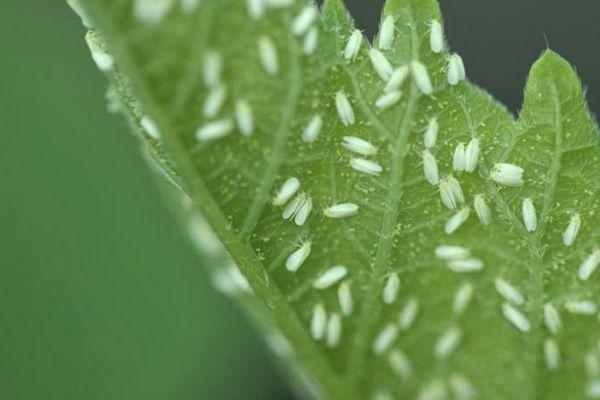
Flying insects are easiest to kill. Larvae on the undersides of leaves are less susceptible to pesticides. When spraying bushes, you need to take into account their habitat and try to treat the leaves from the underside.
Once the caterpillars pupate, they are virtually impossible to eradicate. Therefore, whitefly control on tomatoes should be carried out several times in a row, at intervals of 5-7 days, during which time the pupae transform into adult flying insects.
Methods of insect control
Methods for controlling whiteflies on tomatoes can be divided into mechanical, chemical, and biological. All of these can be quite effective if applied correctly and treated multiple times. These methods are capable of destroying both the adult and larval stages.

There are also folk remedies for whitefly control. They are relatively harmless to humans, but may be ineffective if the pests have already proliferated. Folk remedies are aimed more at repelling the insects than at completely eradicating them, so it's best to use such treatments as a preventative measure if there's even the slightest suspicion of whitefly presence in the greenhouse.
Chemical methods of protection
Insecticides are a last resort for controlling whiteflies in greenhouses growing tomatoes and other vegetables. All insecticides are toxic, and spraying aerosols indoors can be harmful to the grower. However, for severe whitefly infestations, any method is effective.

When choosing a plant treatment, you can opt for specialized insecticides against sucking pests. These will kill not only whiteflies, but also aphids, mites, bugs, and other insects that suck plant sap by piercing the plant with their proboscises. Products to choose from include Actellic and Aktara, Cypermethrin and Permethrin, Malathion, Neudosan, and others.
Kra-Deo Super aerosol is designed for flying insects. It's best to keep the greenhouse closed for at least a few hours, preventing anyone from entering. It's best to treat the greenhouse at night. Biotlin also has a similar effect.

Chemicals must be used strictly according to the instructions. Tomatoes should not be sprayed 20 days before harvest or during ripening. However, this is the most reliable way to control whiteflies on tomato seedlings, their larvae, and adults on young plants.
Mechanical methods
The simplest methods involve collecting the affected leaves along with the larvae and washing them off with soapy water by hand. This is labor-intensive, but quite feasible when the larval colonies are small. Curled leaves can be torn off and burned. To combat the larvae, use a sponge soaked in a solution of laundry soap, gently rubbing it along the underside of each affected leaf.

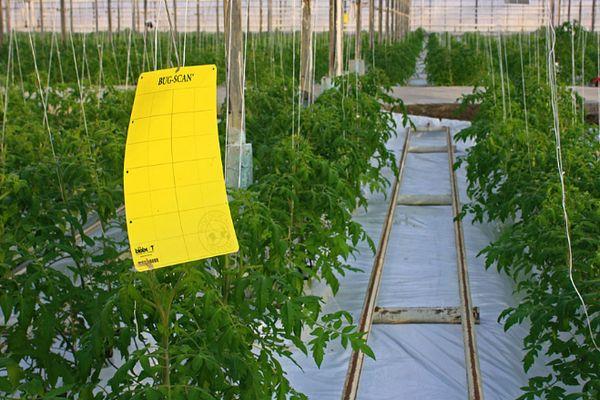
Sticky traps should be used for flying insects. For small numbers of insects, fly tape can be used. However, if whiteflies are in large numbers, it's best to use special traps.
American entomologists discovered that whiteflies are attracted to the colors yellow and blue. This behavioral characteristic of adult insects prompted the development of a method for trapping them. To attract the pests to traps, they are painted in these colors. The trap can be made from a piece of cardboard or plywood.
So, let's get rid of whiteflies on tomatoes using the most advanced method. For this, we recommend:
- paint a sheet of cardboard yellow or blue (A4 format will be enough for 1-2 m³);
- make a hole for hanging, thread the cord through;
- apply a layer of Vaseline to the surface (you can mix it with honey);
- hang the Velcro strips around the greenhouse area at a height of 1.5-1.7 m.
Flying whiteflies will be attracted to bright surfaces and will stick to the sticky mass. Clean the traps periodically, scraping off the mass along with the flies. Afterwards, apply a new layer of Vaseline and hang the cardboard in the greenhouse.
Biological methods
Whiteflies have natural enemies that feed on their larvae and adults. Among the most common are lacewings and ladybugs. These predatory insects consume not only aphids but also many small pests. Greenhouse whiteflies on tomatoes are no exception. An easy way to remove these pests from your garden is to collect seven-spotted ladybugs (the red bugs familiar to everyone from childhood) or the similar two-spotted beetles. A standard 2x6 m greenhouse will require about 10 of these protectors.
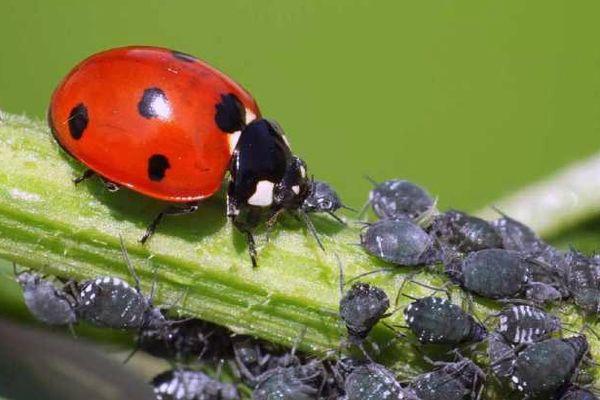
Aphid lions, or lacewing larvae, can also be seen on plants. These are small gray insects with baggy bodies, resembling wingless beetles. Aphid lions often adhere the husks of aphids they've eaten to themselves. You can transfer lacewing larvae to the greenhouse or look for their egg clutches: yellowish balls about 1 mm in size on long, thin "legs" protruding perpendicular to the leaf. Adult lacewings, which are also predators, are also easy to catch. This graceful greenish creature has large, transparent wings and expressive golden eyes.
Take a look Also

In large greenhouses, you can try purchasing encarsia, a miniature parasitoid wasp that lays eggs in the bodies of whitefly larvae. Release the insects from the test tube in your greenhouse. These little helpers will take care of the pest control themselves.
Traditional methods
A good way to get rid of whiteflies in a greenhouse is to fumigate the room with smoke. This can kill flying whiteflies and larvae, but the cocoons will remain intact, so the treatment will need to be repeated when the next generation hatches. To fumigate, place sawdust on a baking sheet, moisten it with water, and place the entire thing on an electric stove.
To repel whiteflies that have recently entered the greenhouse, spray with herbal infusions:
- Take about 100 g of yarrow herb, chop it, and add 1 liter of water. Let it steep for 2 days.
- Chop the dandelions together with the roots, take 100 g of the mass and leave it in 1 liter of water for 2-3 days.
- Mince 1 head of garlic, add 0.5 liters of water and leave for 2-3 days.
- Instead of garlic bulbs, you can use the scapes removed from the garden beds. You'll need about 100 g of the scape pulp and 1 liter of water.
Spray the resulting infusions on tomato plants and other greenhouse plants to mask their odor with unpleasant aromas. If the whitefly doesn't find its food, it will leave the greenhouse.
Related posts:
 Causes and treatment of eggplant pests and diseases, how to combat them at home
 The best eggplant varieties for growing in a polycarbonate greenhouse: planting and care
 Carrot care guidelines for outdoor cultivation to ensure a good harvest
 How to control carrot flies with medications and folk remedies
 Is it possible to soak treated cucumber seeds before planting and how to do it correctly?
 How to properly plant peas in a greenhouse and open ground
 Methods for planting and propagating cherries at home
 How to control onion flies using natural and chemical methods