
The Chocolate Striped tomato was developed by American breeders. Russian gardeners grow this variety for its high yield and unique appearance. Chocolate Striped tomatoes are eaten fresh and used in various salads. Most farmers grow this tomato commercially. The Chocolate Striped tomato can be canned for winter storage. When grown during extreme heat or drought, the skin cracks. Tomatoes can be grown both in greenhouses and outdoors.
Briefly about the plant and its fruits
The characteristics and description of the Striped Chocolate tomato variety are as follows:
- The vegetative period from sprout to full-fledged fruit of a plant lasts from 95 to 105 days.
- The Chocolate Striped tomato bush reaches a height of 150-160 cm when grown outdoors. When grown in a greenhouse, some varieties of this tomato grow up to 200-250 cm.
- The tomato has a strong and powerful stem, and the bushes have a moderate amount of foliage.
- The root system is developed and highly branched. The leaves are medium-sized and clearly wrinkled.
- To obtain a good harvest, bushes are formed from 1-2 stems.
- Tomato fruits are classified as "maxi" fruits. Their diameter is approximately 150 mm. Individual specimens weigh approximately 1.0-1.5 kg. The average berry weight ranges from 0.5 to 0.6 kg.
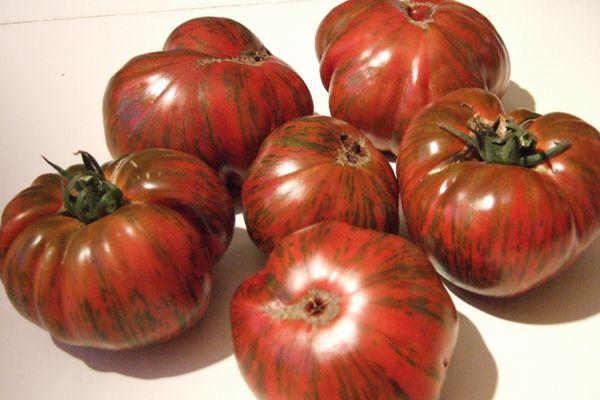
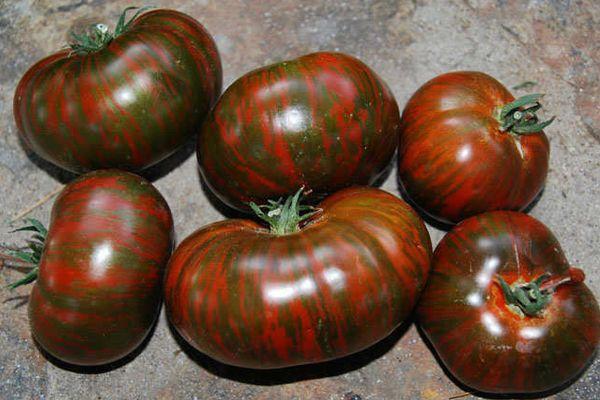
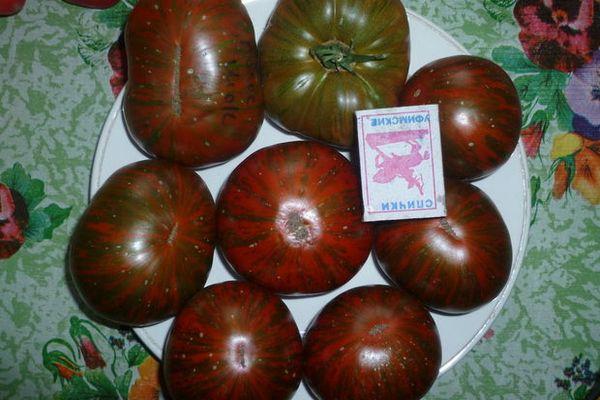
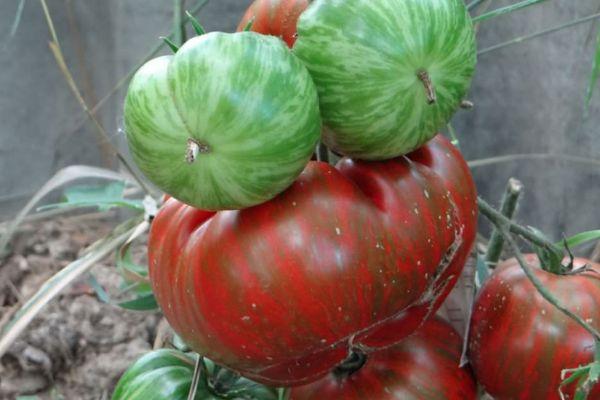
- The shape of the fruit resembles a slightly flattened sphere, with chocolate-colored stripes on the sides. When ripe, the tomatoes turn chocolate or burgundy. Unripe tomatoes are green or red. The skin is shiny and dense.
Farmer reviews indicate that the Striped Chocolate yield is up to 8 kg per square meter of bed. When following all agricultural practices and breeder recommendations, gardeners can obtain 4-5 kg of berries per bush. Harvesting continues throughout the season.

Farmers note the plant's resistance to garden pests and various diseases that destroy nightshade crops. Striped chocolate is resistant to late blight, powdery mildew, various types of rot, and tobacco mosaic virus.
Despite these qualities of tomatoes, breeders advise gardeners to treat the bushes with complex preparations that destroy parasites and fungal infections 1-2 times during the entire growing season.
Growing Striped Chocolate seedlings
Seeds for planting are prepared in the last week of February or the first ten days of March. First, they are tested for germination by soaking them in water for 10-15 minutes. Unproductive seeds float to the surface of the liquid and should be removed. Next, the soil is prepared. This requires garden soil, peat, and sand. All components are used in equal proportions.
The seeds are planted in prepared boxes. The planting density is 2 to 3 seeds per 1 square centimeter. The seeds are covered with moist peat, and then the boxes are covered with plastic film (a sheet of glass can be used). The containers are placed in a warm room. The first sprouts will appear in 4 to 8 days. The plastic film is removed, and the boxes are moved under special lamps.
Fertilize the seedlings 15 days after emergence with nitrogen-containing fertilizer. Water as needed, as this type of tomato is sensitive to high humidity.
The seedlings are pricked out after they have developed 2-3 leaves. The plants are transplanted into the greenhouse when they are 50-60 days old. Before transplanting, the seedlings are hardened off for 10-12 days. If transplanting to open ground, they are covered with plastic film to prevent the risk of freezing.
Caring for Striped Chocolate
The bushes are planted in well-lit areas. However, direct sunlight is not recommended. The plants are spaced 0.5 x 0.5 m apart. Remove any excess side shoots from the bushes. This procedure begins 14-15 days after planting.

Because tomatoes grow tall, they need to be tied to sturdy supports. A trellis can also be used. Otherwise, the branches will break under the weight of the fruit. It's recommended to mulch the soil under the plants. This will prevent garden pests from invading the seedlings.
Water tomato plants as needed, 1-2 times every 7 days. This is done with warm water after sunset. The soil under the plants is loosened the following day. Tomato fertilizing is done 3 times per season. For this purpose, nitrogen, organic or complex fertilizers are used.
If the plants are planted outdoors, the harvest ripens in mid-July. In well-heated greenhouses, the first tomatoes are harvested 1-2 weeks earlier. Harvesting continues until early September.
Related posts:
 How to propagate and grow peas, cultivation technology, and care in open ground
 Description of varieties of sowing peas and cultivation, to which family they belong
 How to properly plant peas in a greenhouse and open ground
 When and how to properly transplant tomato seedlings, the best days in 2025
 The best eggplant varieties for growing in a polycarbonate greenhouse: planting and care
 Causes and treatment of eggplant pests and diseases, how to combat them at home
 Description and characteristics of the best seeds of pea varieties and types
 Description of the Kira cherry tomato and growing the hybrid using seedlings