
The Great Warrior tomato was developed about 10 years ago. Since then, it has earned well-deserved popularity among lovers of large-fruited tomatoes. Its excellent taste has left no one indifferent who has grown these tomatoes.
Characteristics of the Great Warrior tomato
This large-fruited variety, bred in Siberia, is recommended for cultivation in all regions of Russia. This tall, indeterminate tomato grows equally well in greenhouses and open ground. The main stem can reach 2 meters in height.
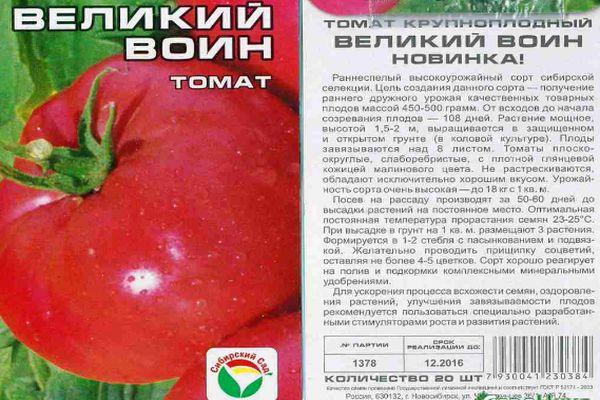
Description of the plant:
- The bushes are powerful and well foliated.
- To provide reliable support for the heavy plant, it is recommended to tie it to a trellis. The first tie should be made under the first flower cluster, and then each new inflorescence should be secured in the same manner.
- The brushes are capable of producing 5-7 large fruits weighing 200-300 g each.
- The total load on the stem of the brush can be more than 1.5 kg.
- It is necessary to tie up each new inflorescence.
- The first fruits are usually larger than the rest.
- To obtain an even harvest, some of the last ovaries need to be removed.
- Reviews from gardeners indicate that the remaining 4-5 pieces can grow up to 500 g.
Characteristics of the Great Warrior tomato
The characteristics and description of the Velikiy Voin variety make it a mid-season tomato. The period from germination to harvesting ripe fruits takes 110-120 days. The variety is highly productive, with each bush yielding approximately 10 kg of tomatoes (see video).
Great Warrior tomatoes have a round, flattened shape. The ribbing is subtle. Unripe tomatoes have a dark green spot near the stem, as shown in the photo. This disappears as the fruit ripens. The skin of a ripe tomato is a rich crimson hue; unripe tomatoes have a pinkish tint. The flesh is pink and firm. Fruit of this type is considered a fleshy tomato.
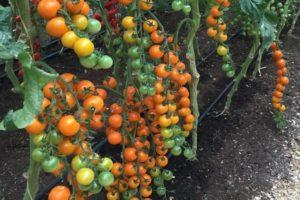
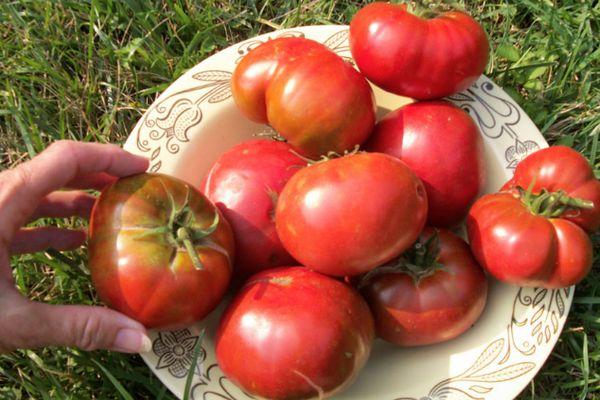
The Great Warrior tomato is best eaten fresh, in salads, and as an appetizer. The fruit is also suitable for juice and puree, but is not suitable for whole-fruit canning. The thick skin is resistant to cracking, so even in challenging weather conditions, gardeners can preserve the entire harvest.
The sweet and sour flavor of the Great Warrior tomato makes it a wonderful addition to summer salads. Its balanced flavor and strong tomato aroma are appreciated by many, which is why it has attracted a large following of growers. The early maturity of the Great Warrior tomato allows you to harvest your first fruits in late June and enjoy these magnificent vegetables throughout the season. When grown in a greenhouse, fruiting can be extended until late fall.
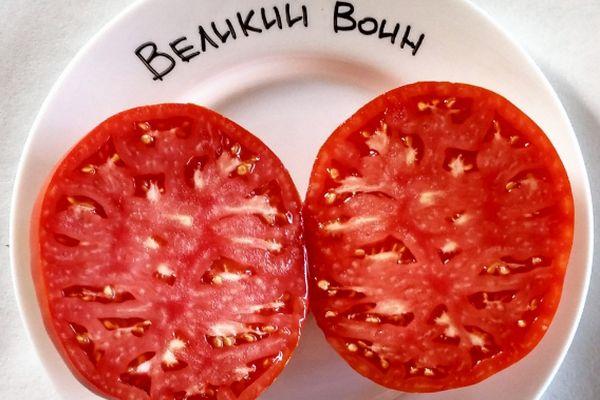
In Siberian conditions, some plump tomatoes have to be picked unripe. They ripen well in a warm room, but this method reduces their sugar content and makes them more tart.
Rules for growing seedlings
For sowing, it's recommended to use a commercial potting mix for peppers and tomatoes. If you're using garden soil, thoroughly water it with boiling water with potassium permanganate (pink color). This simple measure will protect the seedlings from disease and allow you to save most of the seedlings.
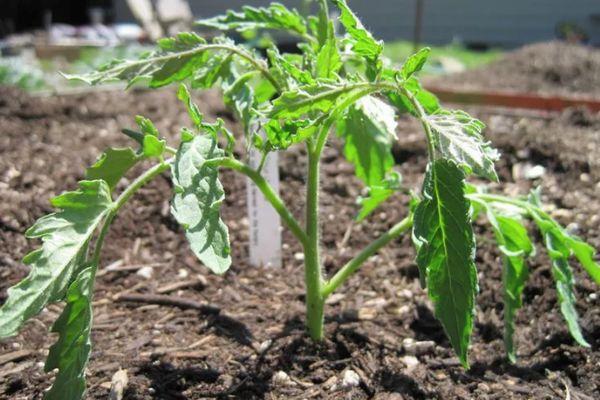
Once the soil has cooled to room temperature, you can sow the seeds. They are spread over the surface at a distance of 2-3 cm from each other and covered with 0.5 cm of dry soil. Before germination, it is better to cover the box with glass to avoid the formation of a dense crust on the soil.
Seedlings will emerge within 7-10 days. After two leaves have formed, the seedlings should be spaced 7-10 cm apart. Sowing occurs in late March, and by the time of planting (early or late May, depending on the cultivation method), the plant should have 6-8 leaves. Some plants also develop their first flower clusters by this time.
Tomatoes can be planted in a greenhouse in early May, once the sheltered area has reached a suitable temperature for the plants. They are planted outdoors after the first wave of spring frosts. The first nitrogen fertilizer application should be done no earlier than one week after transplanting.
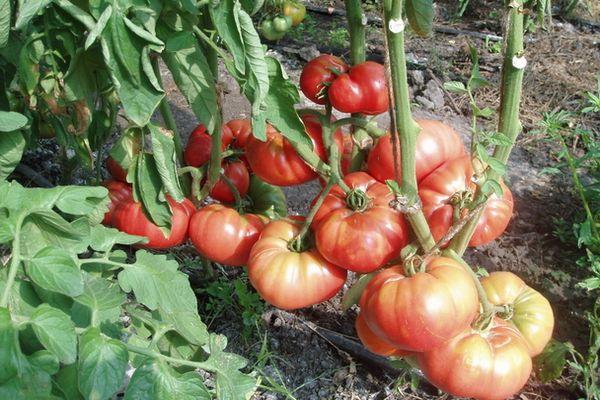
Once the seedlings begin to grow, they need to be tied to a support and then trained into 1-2 stems. The bushes will produce numerous side shoots; these lateral shoots should be removed promptly to prevent the bushes from becoming too dense.
To ensure a good harvest, it is recommended to apply two additional fertilizers after the flower clusters have formed. The first is applied when the bush has 1-2 inflorescences, but not earlier than 3 weeks after repotting. For these applications, use a phosphorus-potassium mixture according to the fertilizer instructions.
Growing large-fruited tomatoes requires optimal soil moisture levels. Water as the soil dries to a depth of 2-3 cm.
Related posts:
 Description and rules for growing the Anthony the Great grape variety
 Description of the Peter the Great F1 tomato, technical data and growing instructions
 Description and characteristics of the best indeterminate tomato varieties for greenhouses
 When and how to properly transplant tomato seedlings, the best days in 2025
 How to propagate and grow peas, cultivation technology, and care in open ground
 Description of varieties of sowing peas and cultivation, to which family they belong
 How to properly plant peas in a greenhouse and open ground
 Description of the best and most productive tomato varieties for northern regions