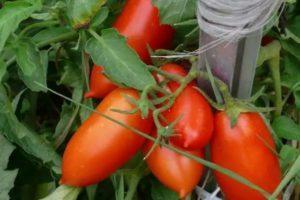
The Bulat tomato, whose characteristics and description classify it as an ultra-early hybrid, is characterized by high yields. The plant is recommended for growing in both protected and open ground.
Advantages of the variety
The Bulat tomato combines many positive qualities, making it suitable for commercial cultivation. The Bulat F1 tomato is a first-generation hybrid with an ultra-early ripening period. It takes 79-85 days from germination to fruiting.

During the growing season, a bush grows to a height of 80-90 cm with a medium amount of foliage. The leaves are thin and light green.
The first flower stalk is formed at the level of the 5th to 6th leaf, and subsequent clusters are formed at intervals of 1 to 2 leaves. A single cluster produces 5 to 6 fruits, weighing 110 to 200 g.
At biological maturity, tomatoes acquire an intense red color. The fruits are round, with a glossy surface and firm flesh. They are aromatic, juicy, and sweet in taste. Thanks to their dense skin, they are resistant to cracking during ripening and easily withstand long-distance transportation.

Standard yields reach 93%. The yield from the first two harvests is 5.2 kg per square meter. Over the course of the season, 12-14 kg are harvested per square meter. The hybrid's potential yield reaches 15-17 kg per square meter.
Vegetable growers' reviews indicate that this variety can be grown both outdoors and in greenhouses. The hybrid is resistant to Alternaria, tobacco mosaic virus, and bacterial black spot.
In cooking, the fruits are used fresh, processed into paste, and sauce. When canned, the tomatoes retain their shape.
Cultivation techniques
Sow seeds for seedlings 50-60 days before the expected planting date. Place the seeds in a container with prepared soil mixture at a depth of 1-1.5 cm, lightly compact, water with warm water, and cover with plastic wrap.

To ensure uniform germination, the seed container is moved to a warm location and maintained at a temperature of 23 to 25°C. Hybrid seeds have a thick seed coat, so maintaining consistent warmth is important, as this affects germination.
Seedlings require good lighting. To extend daylight hours, it is recommended to use a fluorescent lamp.
When one or two true leaves have formed, transplant the seedlings into individual containers. Peat pots are recommended for transplanting to their permanent location.
 To ensure normal development of seedlings, they are periodically fertilized with complex fertilizers according to the manufacturer’s instructions.
Seedlings are transplanted into open ground after the end of spring frosts, when they are 55-70 days old. Before planting, compost is added to the holes, and the plants are planted after watering.
It is recommended to plant 5-6 bushes per square meter. For an early harvest, the plant should be trained into 2-3 stems. Remove excess shoots before the first cluster.
Caring for the crop involves regular watering with warm water at the roots, periodic fertilization with mineral fertilizers containing nitrogen, phosphorus, and potassium.

To prevent stems from becoming deformed during bush formation and fruit ripening, it is recommended to tie the plants to a support.
To ensure a balance of air and moisture around the root system, the soil is loosened and the plants are hilled. To control weeds, the soil is mulched with black non-woven fiber.
Using last year's grass and chopped straw as mulch serves as an additional source of organic nutrition for plants.
Related posts:
 Methods for planting and propagating cherries at home
 The best grape varieties for growing in the Urals, planting and care rules in summer
 The best methods for growing grapes from seeds at home
 Planting and caring for cherries, feeding and growing rules
 Growing and caring for hazelnuts in open ground, rules for planting hazelnuts
 Descriptions of the 20 best cherry varieties for the Moscow region, their planting and care
 The best eggplant varieties for growing in a polycarbonate greenhouse: planting and care
 Description and rules for growing Solaris grapes