
- Clematis: Features and Secrets of Growing
- The most popular varieties
- Alpine
- Mountain
- Jacqueman
- Whole-leaf
- Tangut
- Clematis flammea
- Step-by-step planting instructions
- Site selection and preparation
- Timing and schemes for planting seedlings
- In the spring
- Autumn
- Can I plant in summer?
- Caring for a flower in open ground
- Features of watering
- Fertilizer application scheme
- Pest and disease control
- Installation of the support
- How to care for the crop after flowering
- Trimming
- Shelter for the winter
- Reproduction
- Seeds
- Autumn cuttings
- Layering
- Care errors and how to fix them
In ornamental gardening, the Ranunculaceae family is represented by clematis. These beautiful climbing plants are a popular choice among landscape designers, as they are perfect for decorating terraces, verandas, and arched roofs. Planting and caring for clematis outdoors is easy, making them a popular choice for beginning gardeners.
Clematis: Features and Secrets of Growing
Many gardeners try to allocate a small space to growing the ornamental perennial clematis. This vine-like shrub can be adorned by planting it near a veranda or terrace. A living, blooming wall of vibrant inflorescences or an arch will create a haven in the garden, delighting with its pleasant aroma. Clematis decorates the garden throughout the summer. However, these easy-to-grow plants need to be grown properly. It's important to know the type of plant you're choosing:
- In the first group of varieties, inflorescences may form on last year's branches. Therefore, they should not be pruned for the winter, otherwise they will never bloom.
- In the combined clematis group, double and large flowers will appear on last year's shoots. However, new buds will also appear.
- The most unpretentious type of plant will be able to bloom continuously if the branches are completely pruned in the fall.
The main characteristic of clematis is that they bloom well in full sun, although the lower parts of their stems can be shaded. Proper care is essential for profuse flowering, especially with fertilizing and pruning.
Both experienced and novice gardeners can grow this ornamental perennial.
The most popular varieties
There are a wide variety of clematis species and cultivars. Some bushes have small flowers and short stems. However, flowering giants are also grown, covering tall arches and walls. This perennial's inflorescences delight with their colors and shapes. The plants bloom at various times, from May to August.
Alpine
This large vine, 3 metres long, is prized for its large, bell-shaped flowers. There are varieties with fragrant yellow-white flowers that have taken root in areas with cold climates. Large-flowered plants with blue and purple petals are beautiful. The Carmine Rose variety is popular. This clematis has pink petals with dark crimson stripes. This plant blooms in May and June.

Mountain
This perennial is cultivated in gardens and used to decorate public parks. It prefers warm climates. The mountain variety is distinguished by its large flowers. Each buttercup measures 5-6 centimeters in diameter. Buds appear in May. As the white flowers with yellow stamens open, a subtle vanilla aroma emerges. The beauty of the blooms is enhanced by the dark, lacy foliage.
Clematis grandiflora mountain vine reaches a height of 7-8 meters, and the bush can be 3 meters wide. Over the summer, the vine completely covers the veranda with a flowering blanket.
Jacqueman
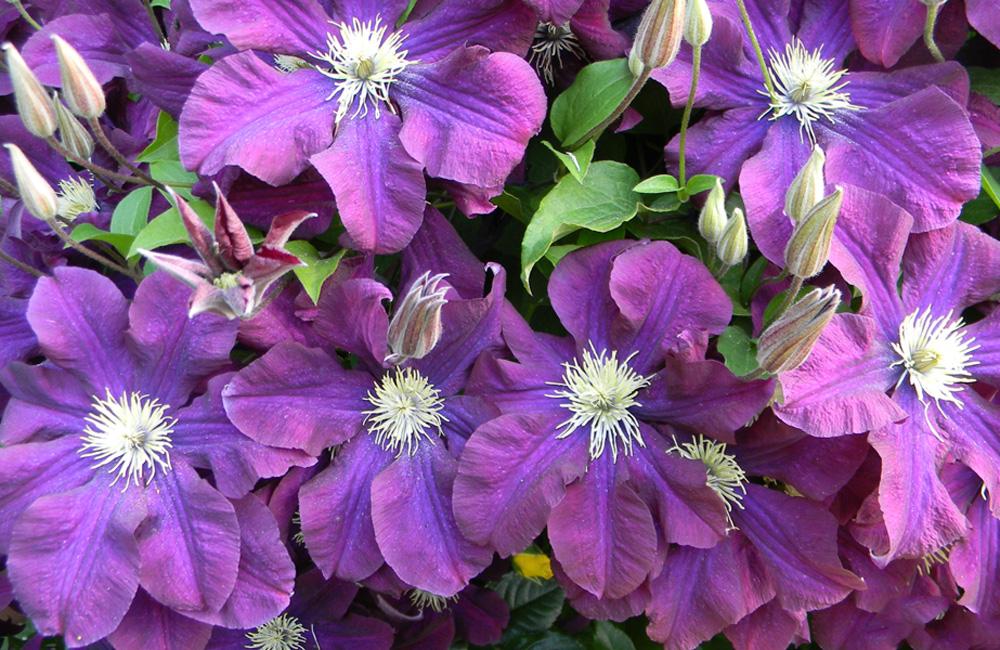
This species is a shrubby vine with large flowers. Flowers can reach 8-15 centimeters in diameter. The petals typically range in color from purple to violet. Clematis blooms from late May to September. Jackman's clematis is noted for its ease of care and tolerance to moderate temperatures.
Whole-leaf
Bushy clematis, or Clematis integrifolia, is a perennial plant native to European Russia and the North Caucasus. This variety's stems reach up to a meter in height. The slender shoots require support. The bell-shaped flowers are blue. A thin white stripe runs along the edges of the petals. Each stem can have up to 7-8 flowers. Popular hybrids include Alenushka, Alba, and Sapphire Placer.

Tangut
This variety of clematis is common in Mongolia and China. In the wild, the flowering vine is short, but cultivated plants reach 3-4 meters. This climbing, small-flowered perennial has a robust root system and fast-growing shoots. Leaves on long petioles cling to supports, creating beautiful, lacy walls. The flowers are adorned with long yellow petals and cream-colored anthers. In temperate climates, clematis tangutica blooms in June, continuing to delight with its lushness and fragrance until September.

Clematis flammea
This common clematis is easy to grow. It grows so luxuriantly that it can eventually cover a wall of 15 square meters. The flower has only four long petals, shaped like a cross. Up to 400 flowers can form on a single shoot per season. The scent of almond and vanilla permeates the garden from the blooming clematis.
Step-by-step planting instructions
Proper planting is crucial to the subsequent development of this perennial. Both the planting location and the timing are crucial. Each region has its own time for planting clematis.
Site selection and preparation
Anyone wishing to plant ornamental shrubs in their garden should decide on a location for the flowers. Clematis is best suited to the following locations:
- well lit by the sun, possibly with a little shade;
- protected from cold winds and drafts;
- with loose and nutritious soil;
- where groundwater does not come close to the surface.

If choosing a site isn't possible, it's worth creating suitable conditions on the existing soil. Excess moisture can be drained by digging a trench and covering it with sand. To protect the roots of clematis from moisture, you should create a mound of soil and place the seedling there.
Timing and schemes for planting seedlings
Clematis can be planted in either spring or fall. The timing depends on the region. In the south, August to October is suitable. In colder climates, May is the best time to plant. Prepare planting holes 70 centimeters deep in advance. Place a layer of crushed stone at the bottom. Fill the hole two-thirds full with a nutrient-rich substrate. This is made from the topsoil removed when digging the hole, along with humus. Add a little slaked lime if the soil is too acidic.
Maintain a distance of 25-40 centimeters between ornamental seedlings. They should be planted at a distance of 50 centimeters from buildings. This will prevent soil erosion from rainwater runoff from roofs.
To plant clematis correctly, consider the soil composition. If the soil is depleted, add superphosphate and potassium salt to the hole, mixing them with the soil first.
In the spring
Spring planting is used for clematis varieties that will need to adapt to new conditions. Over the summer, the plants will develop a strong root system and become accustomed to the soil and climate. However, it's important to follow the planting timing. Delay, and the clematis will not develop fully. In temperate climates, planting can be done in April, before bud break. In northern regions, planting should begin in May.

For spring planting, prepare the hole in the fall. The seedling will grow well if the root collar is buried 7-12 centimeters deep. The depth is determined by the age of the seedling. For young clematis, 5 centimeters is sufficient, while two-year-olds require a depth of 14 centimeters. This will encourage the plant's stem to branch more quickly.
Autumn
Clematis can be planted in the fall. However, it's important to observe the planting timing. Early planting will cause the clematis to grow prematurely, which can lead to winter death. It's best to plant before the first frost in September. Ideally, choose a site elevated so that the groundwater level is deeper than 1.2 meters. The soil should have a pH of 7.0-8.0.
Can I plant in summer?
Clematis are planted in May–June in areas where winter sets in early. However, August is the best time to prepare seedlings for planting. This will give the plants time to harden before the cold weather sets in.

Caring for a flower in open ground
After planting clematis, water them generously and mulch the soil around them with a layer of sawdust. This ornamental plant will not bloom in the first year. Steps should be taken to prevent the bush from blooming. After all, the plant needs to develop a strong root system, not waste energy on budding. The shoots should grow vigorously. The clematis will bloom the following year. The bush's fullness will depend on proper care.

Features of watering
The correct way to water this ornamental shrub is to avoid pouring water directly into the center of the shoots. Dig holes 30 centimeters apart. The water should be settled and at room temperature. Apply up to a bucket of water per plant. Watering frequency depends on weather conditions. During rainy seasons, once every 2-3 weeks is sufficient. In dry weather, water twice as often. Too much moisture in the soil is detrimental to clematis.
Fertilizer application scheme
From the 2nd-3rd year of life, liana-like bushes need to be fed 4 times per season:
- In spring, feed with bird droppings or urea. Nitrogen will help the clematis branch faster and the shoots grow.
- During the budding period, apply Fertika or Agricola. These fertilizers provide a balanced composition of phosphorus, potassium, and nitrogen. This fertilizer promotes lush flowering.
- After 10-14 days, repeat the feeding procedure.
- In the fall, apply a solution that requires one tablespoon of superphosphate and potassium sulfate per bucket of water. This is enough for one plant.

With proper fertilization, clematis will delight you with long-lasting flowering.
Pest and disease control
Improper care leads to pests and diseases affecting ornamental plants. Among the dangerous pests of clematis are aphids and spider mites. During wet summers, slugs and snails can also attack the plant. While these can be collected by hand, smaller pests require other methods. Aphids and spider mites are controlled by spraying with insecticides.
Nematodes, invisible worms, cause significant damage to flowers. They can be controlled with Karbation and Nemagon. Timely application of ammonia-based mineral fertilizers to the soil will help prevent pest attacks. Planting marigolds, coriander, and dill next to clematis repels nematodes.
Fungal infections, such as rust, gray mold, and powdery mildew, are dangerous for clematis. To prevent these, treat the plants with a 1% Bordeaux mixture. Fungicides such as Topaz, Fundazol, and Fitosporin are also used.
Over-fertilization with nitrogen and overgrowth of weeds can cause clematis to develop wilt disease. This causes plants to wilt and die. The pathogen spreads rapidly when the air temperature is above 25°C (77°F) and humidity is high. In the early stages, wilt can be controlled by spraying with a copper sulfate solution. Dissolve 20 grams of copper sulfate in 10 liters of water and add 200 grams of shavings of laundry soap.

Installation of the support
Climbing shoots require support, as clematis stems cannot maintain a vertical position on their own. Flowering shoots look beautiful on arches or fan-shaped structures. Cylindrical and pyramid-shaped supports are also used. In addition to supporting the stems, the planned floral arrangement is considered when selecting supports. The structures should be made of durable material, as profusely flowering shoots are quite heavy.
How to care for the crop after flowering
Clematis blooms in July and August. However, care for the plant should not be interrupted. Continue loosening the soil around the bushes. Feed with nitrogen fertilizer to ensure the soil is enriched with beneficial elements over the winter. Don't forget to water the plant, loosening the soil after it has become moist. Pruning is an important part of care.
Trimming
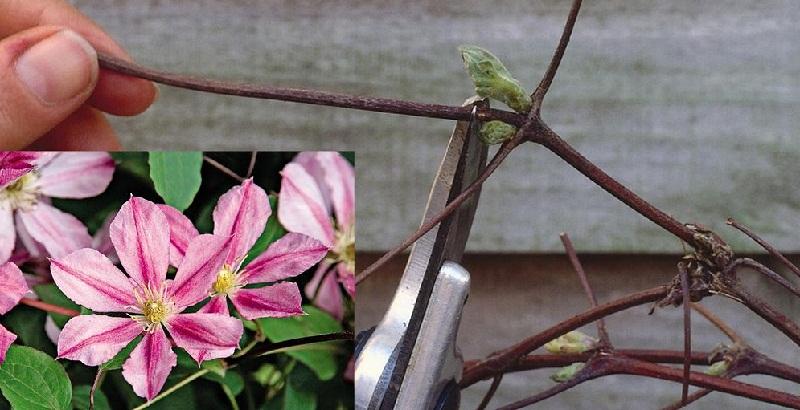
Clematis are divided into pruning groups. If buds are forming on last year's shoots, weak, diseased stems should be removed first. Part of the bush is cut to the ground, while the rest is shortened. Leave a shoot length of 1-1.5 meters. Plants that can produce flowers on both young and old stems require careful pruning. In late summer, those shoots from last year that bloomed this year should be pruned. In September, thin and frail branches should be removed, and young shoots are shortened. Some are short, while others are up to 1 meter long.


The third group of clematis is being completely pruned, where buds are formed on new growth.In spring, frozen branches are removed, and in summer, those that thicken the bushes.
Shelter for the winter
Preparation for winter includes:
- top dressing with ammonium nitrate, wood ash;
- covering shoots laid on the ground with dry grass, sawdust, non-woven material;
- watering plants.
Clematis should be covered so they can breathe. And in the spring, remove the material promptly to prevent the stems from rotting.
Reproduction
To landscape a garden, you need to increase the number of plants of a particular variety. Vegetative propagation is an option. This method is accessible to beginning gardeners.
Seeds
Flowers can be propagated from seeds. These are purchased from reputable producers. The best time to plant seeds is in March. Germinate them in soil for 2-4 weeks. Large-flowered clematis seeds require more time to grow, so they are planted in the ground in November.

Spread the flower seeds on the surface of the pre-moistened nutrient mixture. Then, spray them with a spray bottle and cover them with glass or plastic wrap. The clematis box should be kept in a well-lit area with a temperature of 25 degrees Celsius. Ventilate the plantings daily and water as needed. As soon as the flower seedlings emerge, remove the plastic wrap. Lower the room temperature slightly to room temperature.
Seedlings should be pricked out when they have three true leaves. They are transplanted outdoors once the threat of frost has passed.
Autumn cuttings
In August, clematis cuttings are prepared for planting. They are taken from strong shoots 10 centimeters long. Each shoot should have two buds. After dipping the cuttings in a Kornevin solution, they are planted in loose soil. Cover the top with a container. The plantings are aired daily. After the cuttings have rooted, they can be planted outdoors after a month. However, the survival rate for clematis is low, ranging from 10-60%. This method is suitable for experienced gardeners.
Layering
Propagation is accomplished by selecting a strong shoot from an ornamental shrub. After removing the leaves, bend the stem toward the ground and press it down with a staple. To ensure successful rooting, prepare a small trench with a layer of nutritious soil.
Since propagation takes place in the fall, the cutting is covered with soil for the winter and insulated with spruce branches. In the spring, the rooted cutting is separated from the mother plant.
Care errors and how to fix them
When growing clematis in your garden, select varieties appropriate to the growing region. The beauty and lushness of the plant depend on a well-chosen planting location and proper care. The upper, flowering portion of the vine should be exposed to full sun. The lower portion can be kept in the shade.
Monitor the depth of the clematis's growing tip. When it reaches the soil surface, earth up the stems. Only then will the seedling begin to branch. Avoid watering at the roots or in the center of the plant. This will cause the plant to become diseased and die. It's better to dig a hole nearby and water it.
Related posts:
 How to propagate clematis at home: timing, methods, and technologies
 Description of the best varieties of Tangut clematis, planting, growing and care
 Description of Jackman's clematis varieties and pruning group, cultivation and propagation
 Description and pruning group of clematis Cardinal Wyszynski, cultivation and care
 Description and pruning group of clematis Ashva, the subtleties of growing and care
 Description and characteristics of the clematis variety Comtesse de Bouchaud, planting and care instructions
 Causes and symptoms of clematis diseases, treatment methods and prevention
 Rules for propagating clematis by seeds at home, planting and care