
- Varieties of Potentilla
- Dwarf
- Large-flowered
- Rowan-leaved (tansy-leaved)
- Gray-haired
- Silvery
- Strawberry-shaped
- Goldenflower
- Long-leaved
- Low (lying)
- Sandy
- Outstretched
- Multi-cut
- Forked cinquefoil
- Intermediate
- Galangal (upright cinquefoil, erect)
- Terry
- Herbaceous
- Shrub
- Hybrid
- Siberian and Kuril
- Classification of varieties by color
- White and cream
- Yellow and orange
- Pink and red
- Tips and recommendations for choosing
Flowering plants are the main decoration of the garden. Cinquefoil is an ornamental plant that delights the eye with its abundant blooms for a long time. The variety of Cinquefoil varieties allows for the creation of original compositions in landscape design. The vast majority of plants are undemanding regarding soil and watering, and are resistant to low temperatures and pests.
Varieties of Potentilla
The genus Potentilla includes 350 species that differ in the structure of the stem, leaves, shape and flowers.It is primarily a perennial herbaceous plant with yellow petals. However, there are also annual and biennial varieties with woody stems (subshrubs or shrubs). Hybrid forms have flowers in shades of orange, burgundy, white, and cream. The corolla ranges from 1 to 5 centimeters in size. The number of petals is five, with the exception of one species—the erect cinquefoil.
Potentilla has all types of stems:
- creeping;
- erect, not branched;
- erect branched.
From one to three single shoots or many, forming a leafy "cushion," may arise from the root. Stem length varies from 1 centimeter to one and a half meters. Stem shape can vary within a single species, for example, from prostrate to erect. The shape of the leaf blades near the base often differs from those at the apex. Potentilla can have pinnate, forked, or five-fingered leaves.
On the underside, they may be whitish-tomentose. Pubescence of stems and leaves is observed in many plant species.
The plant's second name, cinquefoil, stems from its most common leaf shape, reminiscent of a human palm. Leaf blade size varies widely and is independent of stem height.
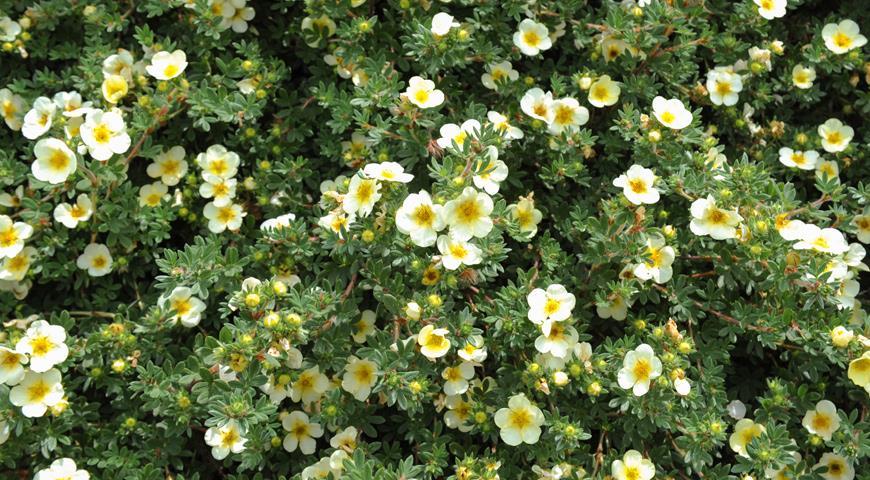
Two species of cinquefoil are considered medicinal plants: goosefoot and erect. They are successfully used in folk medicine to treat gastrointestinal ailments. Fifty species of cinquefoil are cultivated, including 15 in Russia. In the wild, cinquefoil is most often found in forests and alpine meadows.
Some varieties grow in the tundra, on the rocky slopes of the Himalayas and the Apennines. This explains the plants' tolerance of adverse conditions.
The fruits of the cinquefoil, with the exception of the false strawberry, resemble small nuts. Ripening occurs at the end of the growing season (September-October). Flowering lasts, on average, two months: from June to July. There are varieties that bloom profusely until October.
Dwarf
Low-growing herbaceous plants grow stems 5 to 35 centimeters above the ground. For example, Potentilla apennina. This perennial has erect stems (up to 15 centimeters tall) with silvery leaflets and a white/white-pink corolla 1.5 centimeters in diameter. It is planted between rocks in rock gardens. Flowering begins in early August and continues until October.
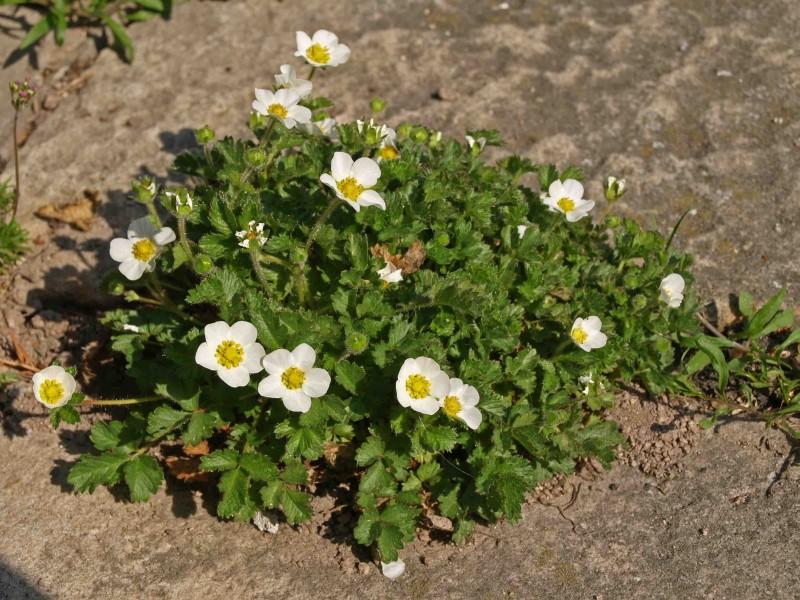
Other varieties of cinquefoil with stem lengths of no less than 5 and no more than 35 (dimensions are given in centimeters):
- Altai (height - 10-35, leaves are pubescent, 0.5-2.5 long; flowers are yellow, single, corolla size is 1.0-1.5);
- Arctic (stems – 12-18, flowers are bright yellow);
- white (leaves and stem are pubescent, height - 8-25, flowers are white, collected in inflorescences of 5 pieces, corolla size - 3);
- snow-white (stems, leaves and sepals of corollas are pubescent, height - 3-30; flowers are single, on long peduncles, yellow, diameter 1.2-2.0).
Dwarf varieties of cinquefoil look good in alpine gardens and along borders.
Large-flowered
Potentilla grandiflora is endemic to Sakhalin, the Kuril Islands, and Japan. It is a herbaceous perennial with prostrate and ascending stems up to 20 centimeters tall (on average). The leaves are trifoliate and rounded with a serrated margin. In spring, the young leaves are adorned with a white, fuzzy margin.
The average number of flower stalks is 5 to 8. The bright yellow corolla is 35-45 millimeters in diameter. It blooms in late May or early June. The flowering period lasts 21 days. It does not shed its leaves in winter. The leaves are replaced in the spring, after the new leaflets have emerged. It prefers rocky soils.
Rowan-leaved (tansy-leaved)
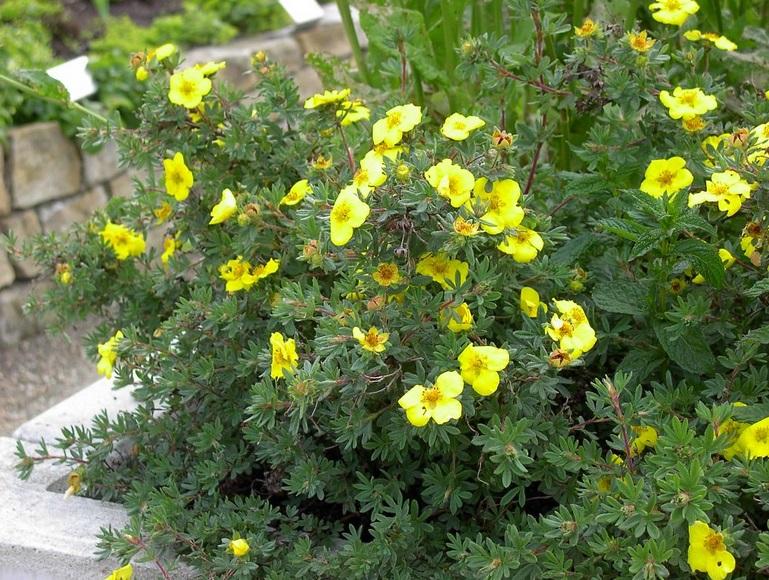
A wild species found in forest clearings and forest edges in the Siberian and Far Eastern taiga, in the steppes of Mongolia, and on the rocky slopes of northern China. Tanacetum-leaved cinquefoil has erect stems ranging from 10 centimeters to half a meter. The leaves are pinnate, uniformly green, and range from 1 to 4 centimeters in length. Flowers are clustered in inflorescences of eight. The corolla diameter ranges from one centimeter to 18 millimeters.
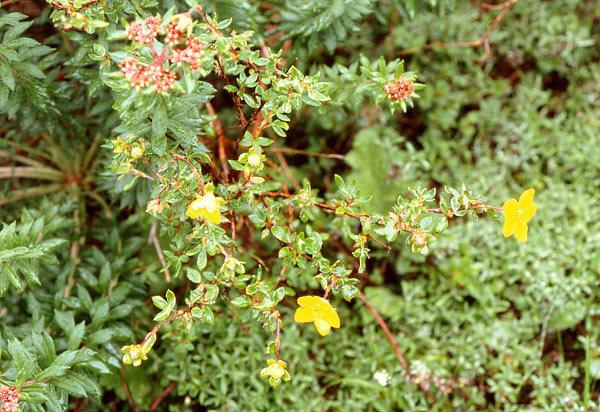
Gray-haired
This herbaceous perennial plant grows in Eastern and Western Siberia, European Russia, and the Caucasus. Its name derives from the color of the underside of the leaf blade: grayish-tomentose. The upper surface is green and slightly pubescent.
The height of the erect stems varies depending on soil, moisture, and light: from 0.1 to 0.7 meters. Yellow petals and sepals form a corolla up to 20 millimeters in diameter. The buds open from July to August.
Silvery
A herbaceous perennial. The stem is erect, 0.1 to 0.5 meters tall. The stem, petioles, pedicels, and undersides of the leaves are covered with dense, curly hairs. The upper surface of the leaves is dark green and glossy. The flowers are lemon-yellow, gathered in sparse inflorescences (3 flowers each). The diameter is 1.0-1.2 centimeters. In Russia, it grows in Eastern and Western Siberia.
Strawberry-shaped
The false strawberry is called Indian cinquefoil. It closely resembles strawberries in leaf structure, propagation method (runners), and fruit appearance. The differences lie in the flowers (yellow, not white) and the taste of the fruit (flavorless). Indian cinquefoil, when planted near strawberries, does not cross-pollinate.
Goldenflower
Native to the mountain ranges of France, Spain, and Italy, this shrubby plant grows to a height of 0.2 meters and a crown of 0.3 meters. The yellow flowers, with a golden sheen, are clustered in dense, sparse inflorescences. The corolla diameter is 20 millimeters. Flowering period: summer and September.
Long-leaved
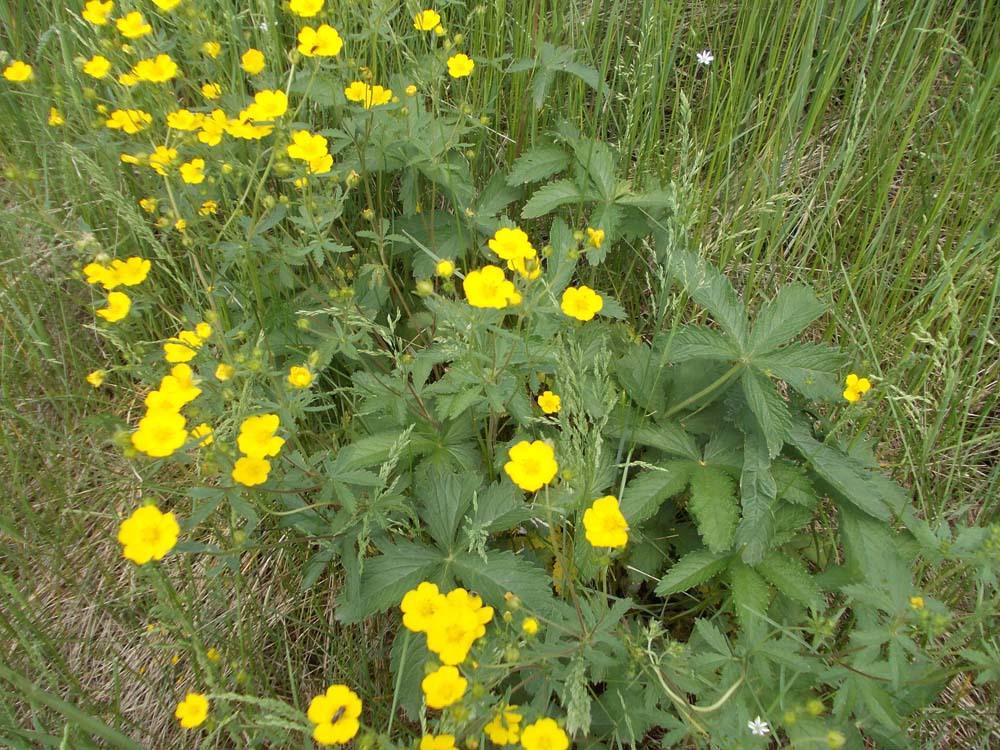
A tall, herbaceous plant. Three to five erect stems emerge from the root. Height: up to 0.75 meters. Large, dark green leaves, decoratively serrated. Few flowers can form a dense inflorescence (6-8) on a single long peduncle, or bloom singly. The corolla is yellow and five-petaled. Native to Altai and Mongolia. The plant thrives in open, sunny areas.
Low (lying)
Potentilla biflora is a low-growing species. It is a subshrub. The stem is woody near the base, leafless. Numerous shoots extend from the roots, forming a dense ground cover up to 3-8 centimeters high. The leaves are narrow and small (up to 2 millimeters wide, 12 millimeters long). Blooms profusely. Yellow petals form a corolla 1.2-1.7 centimeters in diameter.
Potentilla supina (Cinquefoil) is a herbaceous annual to quadrennial plant. It has 1 to 3 above-ground shoots and grows 0.15 to 0.4 meters tall. The shoots are prostrate or ascending, branched. The leaves are pinnate at the base of the stem, and trifoliate and petiolate near the top. Flowers are up to 1 centimeter in size. The corolla consists of 5 yellow petals. The entire plant is covered with sparse hairs containing small glands.
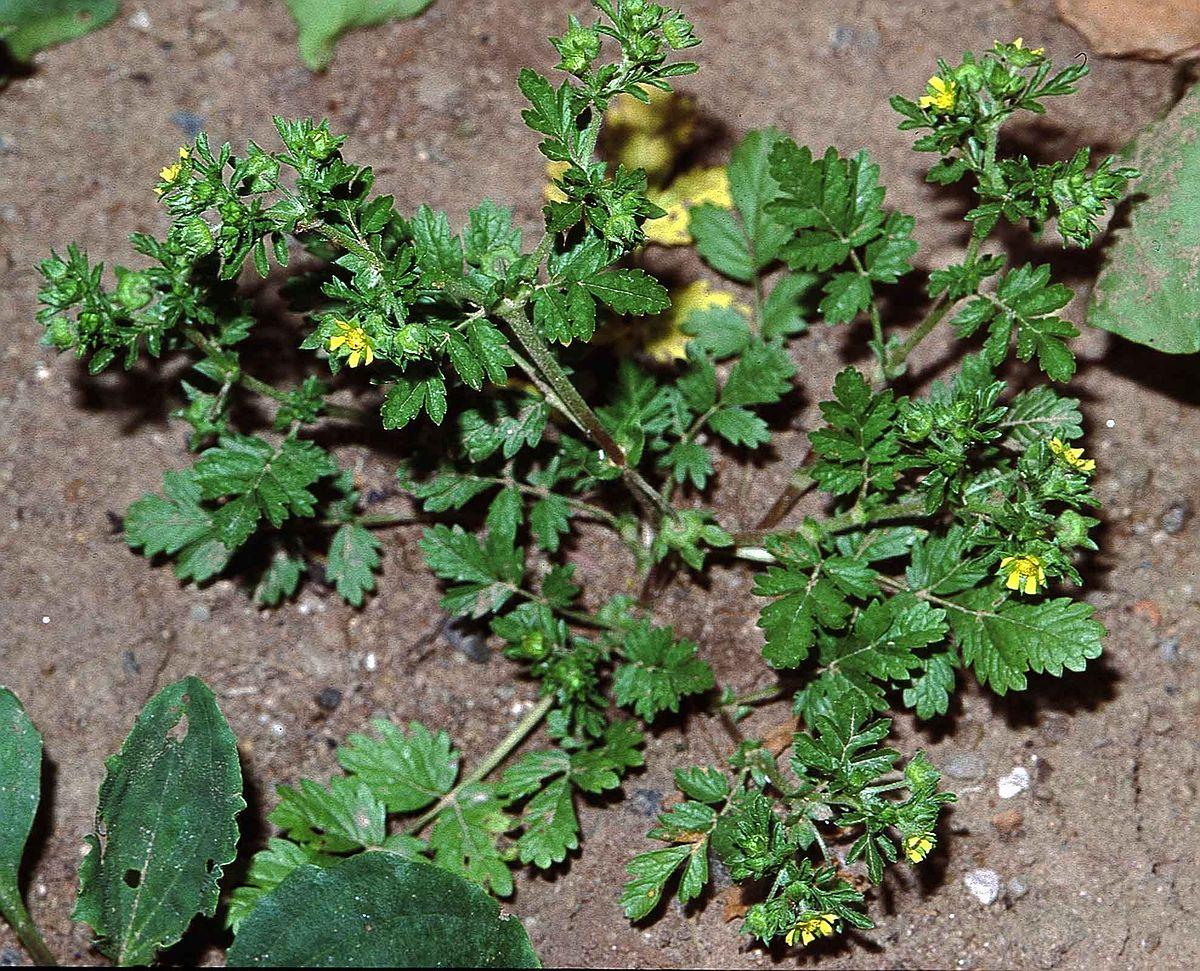
Flowering: July-September. It is native to Central and Southern Europe, North America, Siberia, and the Far East. Habitats: sandy soils along riverbanks, wastelands.
Sandy
Potentilla scalyx (Cinquefoil). A perennial plant native to Europe. Its creeping, branched stems, up to 15 centimeters long, never rise more than 8 centimeters above ground level and are covered with long, star-shaped hairs. Numerous yellow flowers, 15 millimeters in diameter, bloom in April and June. The palmate leaves, with a serrated margin, are covered in an ash-colored felt. It grows in sandy soils of pine forests and on mountain slopes, and does not tolerate shade.
Outstretched
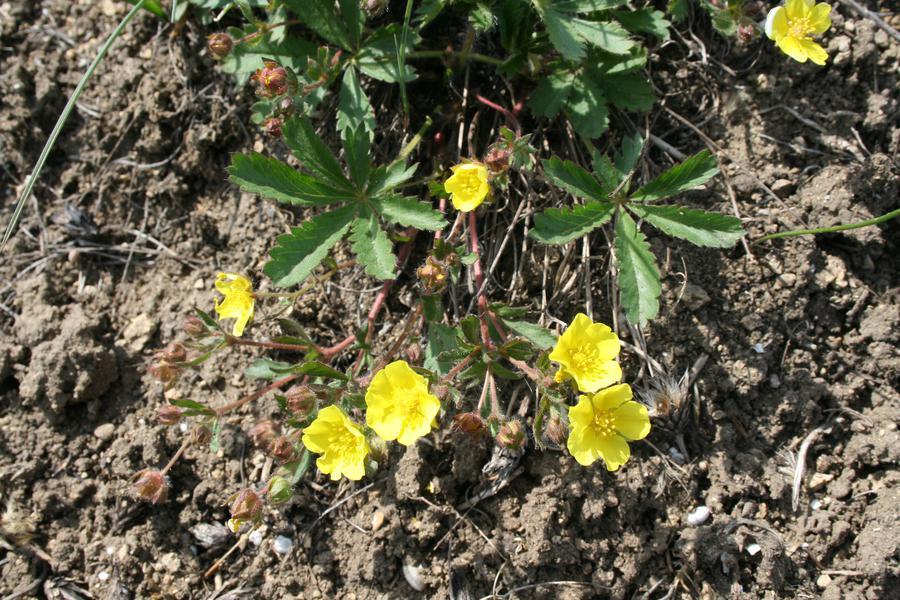
Potentilla acaulis (Cinquefoil acaulis) is a native of alpine meadows. It grows on rocky, gravelly soils in sunny locations with sufficient humus and moisture. It is a groundcover plant. Stems range from 1 to 6 centimeters. Leaves are trifoliate and pubescent. Flower diameter is 10-17 millimeters.
Multi-cut
The plant (P. multifida) is distinguished by the shape of its leaf blades. The narrow, paripinnate leaves are green on top, slightly pubescent or glabrous, and have a thin white-gray felt coating on the underside. The stems are erect or slanting, ranging from 10 to 40 centimeters above the ground. The flowers are pale yellow, small, and borne on thin peduncles.

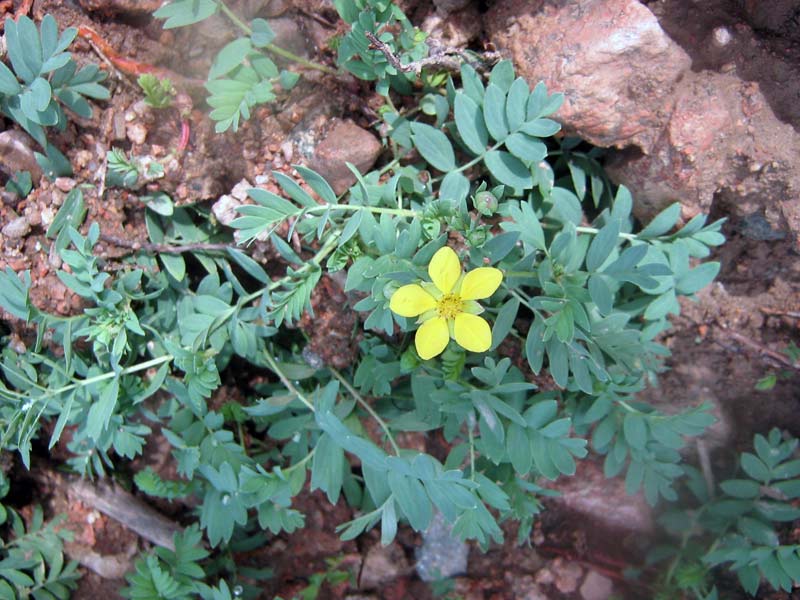
Forked cinquefoil
A perennial subshrub with a woody stem growing up to 25 centimeters. The stems, petioles, and leaves are covered with hairs. The leaves are odd-pinnate, with 2-7 pairs of lateral leaflets. The leaf blades are oblong or wedge-shaped, double-notched (the central apical blade is triple-notched).
Dark green leaves turn orange in autumn and fall the following spring. The yellow, five-petaled flowers, 8 to 15 millimeters in size, are gathered in elegant clusters and appear in early summer. The flowering period lasts the first two months of summer. It grows in the steppe zone on clay and rocky soils, in meadows, and pastures.
Intermediate
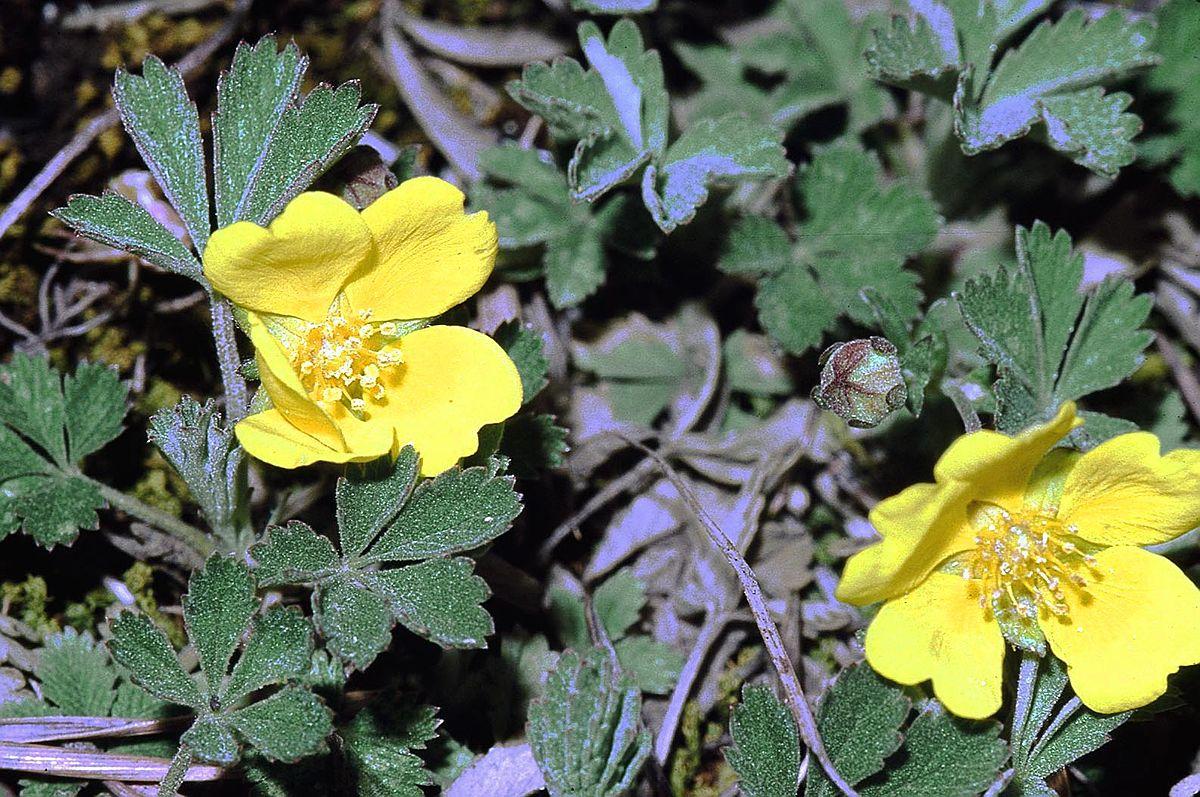
A biennial or perennial plant, it is endemic to Europe. The sturdy, sloping, branched stem grows to 15-50 centimeters. The leaves are five-fingered at the base of the stem, becoming trifoliate and pubescent near the top. The leaf margins are irregularly serrated. The flowers are pale yellow, collected in inflorescences. The flowering period is June to September. It is native to Europe. It grows in wastelands and roadsides.
Galangal (upright cinquefoil, erect)
The plant is undemanding in terms of growing conditions. It grows in the tundra, at forest edges, and along rivers and streams. This herbaceous perennial has an erect stem, no more than 20 centimeters tall. It is used in folk medicine. It distinguishes itself from non-medicinal species by its four-petaled, yellow corolla, measuring 10 millimeters. It blooms from early June to early September.
Terry
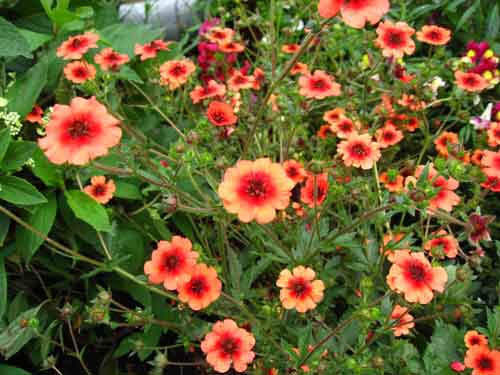
The general name hybrid cinquefoil encompasses a large number of cultivars derived from different wild species. For example, the double-flowered Vulcan cultivar is a cross between Nepalese, silver, and dark blood-red cinquefoils. The hybrid grows to a height of 0.6 meters. The leaves are trifoliate and pointed. The flowers are red, semi-double, and 40 millimeters in diameter. The flowering period is from June to late August.
Herbaceous
Herbaceous species predominate among cinquefoils. They can be annual, biennial, triennial, or perennial. Their growing range extends across Europe, Siberia, the Far East, and North America. Stem height and shape vary from 1 to 80 centimeters. Shoots can be prostrate, ascending, erect, and branched or unbranched.
The leaf blades at the base and top of the stem often differ. In most species, the stem and leaves are covered with whitish hairs. Wild species bear yellow flowers, either clustered in inflorescences or solitary, on long peduncles.
Shrub
Bush-shaped hybrids can grow up to 150 centimeters.
Popular plant varieties:
- Goldfinger (up to 80 centimeters);
- Princess (up to 80 centimeters);
- Ray Ice (up to 50 centimeters);
- Sunset (up to 50 centimeters).
The color range of the listed shrubs:
- deep yellow;
- pink;
- orange;
- red.
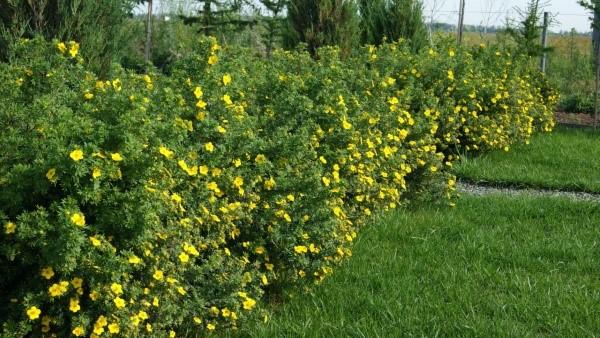
Shrub species, ranging in height from 20 to 40 centimeters, are considered low-growing. The native species is the cinquefoil (Potentilla fruticosa), which has two varieties, from which 130 cultivars have been developed. Ornamental species have spreading, spherical, cushion-shaped, or creeping crowns.
Hybrid
Hybrid cinquefoil was created through selective breeding by crossing different species. This perennial herbaceous plant has a tall (0.8-0.9 m) stem, straight at the base and branching toward the top. The leaves, gathered in a basal rosette, are dark green, with 3-5 teeth. The flowers are large (up to 40 mm in diameter), with corollas ranging in color from yellow to red to pink.
Siberian and Kuril
Kuril tea is a bush-shaped variety of cinquefoil (Potentilla fruticosa). The wild species is found on the Kuril Islands and in Eastern Siberia. Another name is cinquefoil. The name derives from the medicinal properties of the tea-like infusion and the palm-shaped leaves.
This shrub, 10 to 150 centimeters tall, forms a spreading, leafy crown. The bark peels off at the base. Young shoots are slightly pubescent. The leaves are pinnate. The petals range in color from light yellow to deep yellow. The corolla is up to 4 centimeters long.
Cinquefoil is an easy-to-grow plant, resistant to low and high temperatures and drought. It grows in one place for up to 20 years without replanting. During the growing season, the plant produces abundant growth. In early spring, pruning excess branches creates a spherical or pyramidal crown.
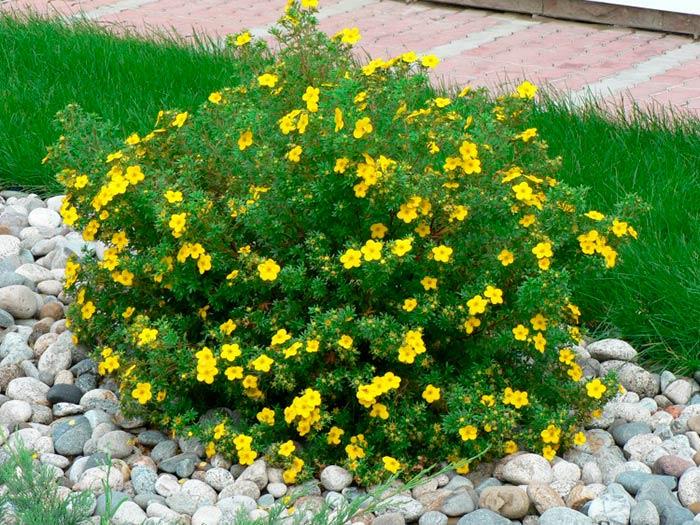
Classification of varieties by color
The main feature by which flowers are selected to decorate a garden is the color of the corollas.
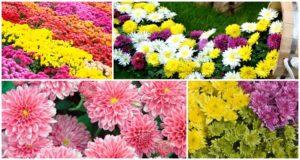
White and cream
Flowers with this coloring are among the most spectacular. After rain, the petals appear waxy and slightly phosphorescent in the dark. Hybrid varieties with this corolla color include Daydawn, Veitchii, and Snowbird.
Yellow and orange
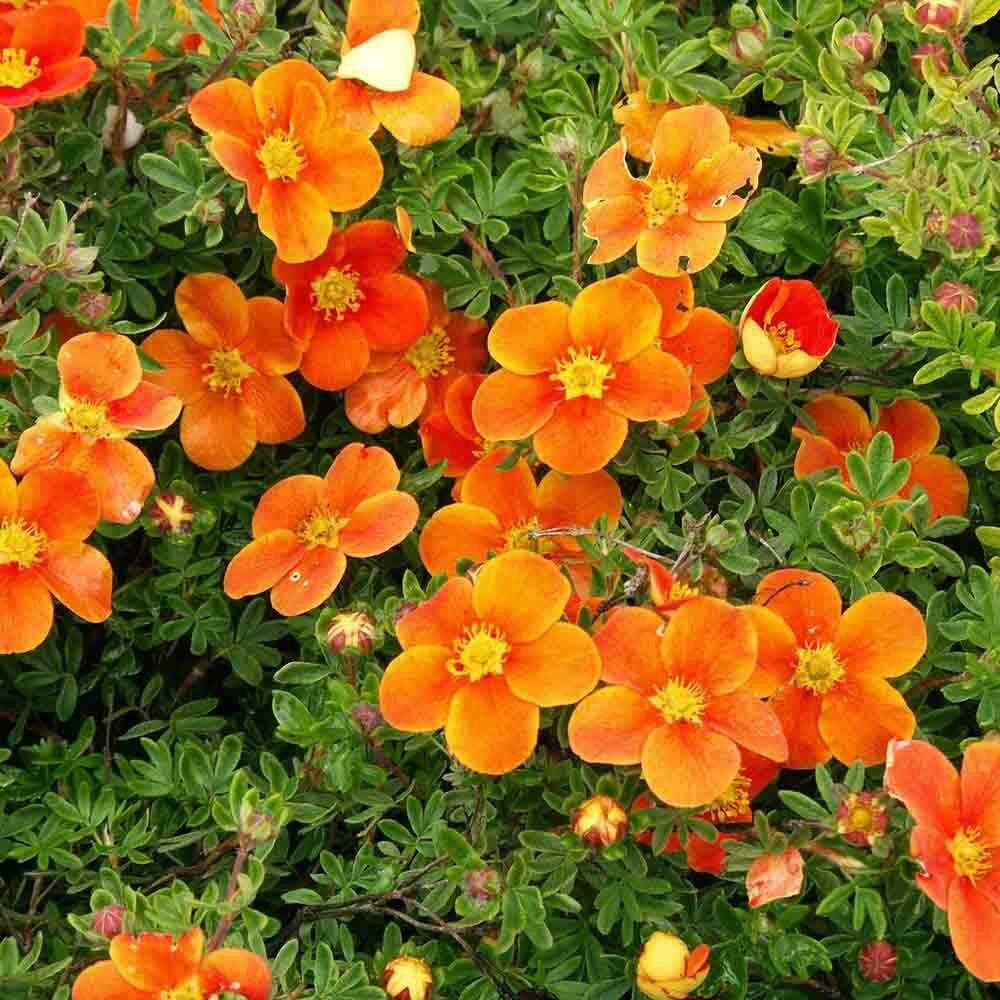
Shades of yellow found in hybrid varieties include fawn, cognac, and gold. A hybrid of Nepalese and English cinquefoils, Potentilla tonga, has an unusual coloring. Flowers grow on long, trailing stems. The orange-yellow petals are burgundy in the center. This characteristic makes it suitable for growing in rock gardens and hanging baskets.
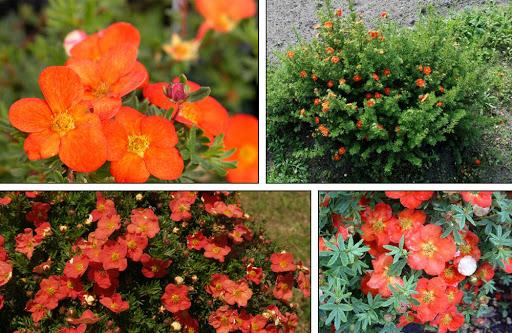
Pink and red
A herbaceous perennial native to the Himalayas with large, pinkish-scarlet flowers in loose inflorescences, Potentilla atrosaguinea, meaning "dark blood-red cinquefoil," is named for its trifoliate, toothed leaves. The leaf blades are light green on the upper side. The underside is hairy and white. The flowering period is 1.5 months.
Pink and red petal shades are predominantly found in hybrid varieties, for example:
- Master Floris;
- Emilia;
- Captivity;
- Volcano;
- Red Ice.
The shape and height of stems vary. They can be tall or low-growing shrubs, herbaceous bushes with voluminous or compact crowns.
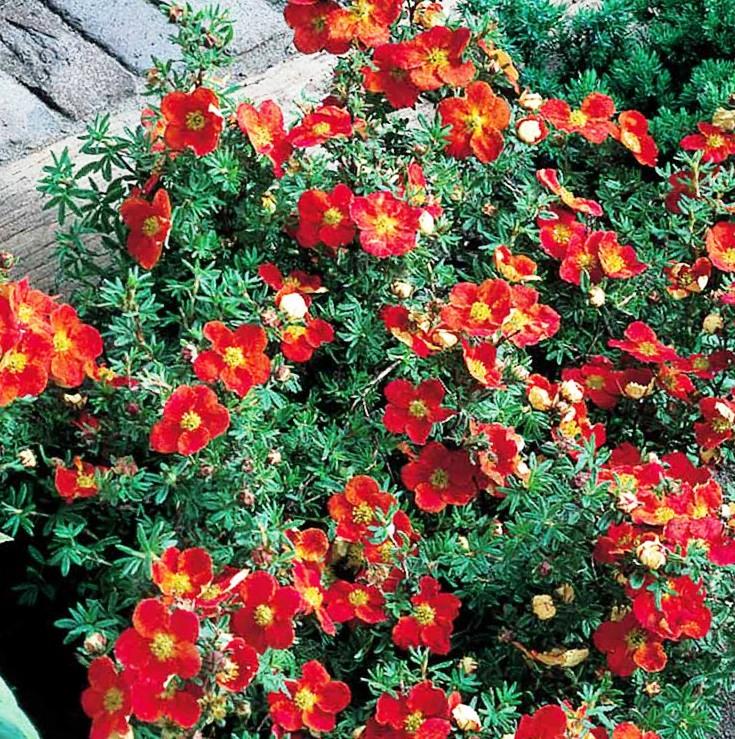
Tips and recommendations for choosing
All species and varieties of cinquefoil are undemanding when it comes to growing conditions. The exception is the pink-flowered cinquefoils, which are more demanding in terms of light and soil. They require structured, humus-rich soil. During flowering, they require feeding and watering. In bright sunlight, the petals fade, which reduces the cinquefoil's decorative appeal. These plants are less frost-hardy and require shelter during the winter.
Hybrid varieties also require more care than their wild counterparts. Pests include aphids and rust, which cause shoots to deform and dry out. Fungicides, insecticides, and folk remedies are used to combat infection and pests. Dead stems are removed.
Of the pink-flowered plants, the most demanding is the cinquefoil. It requires a sunny, south-facing site. Sandy soil should be mixed with limestone gravel and rich in humus. The reason for this lies in its habitat: the limestone slopes of the Alps and the Apennines.
Deep shade causes all species and varieties of cinquefoil to stop blooming. White-flowered cinquefoils are grown in partial shade. Loamy soil is optimal for most ornamental plants. In this type of soil, cinquefoils bloom more profusely and for longer.
Spring fertilization with a complex fertilizer will influence the size and brightness of the petals. Moistening the above-ground shoots during hot weather will be beneficial for cinquefoil.
Branched shrubs are pruned in the spring to remove dead shoots, thin out the crown, and shape it. In summer, care consists of loosening the soil and weeding. Propagation depends on the species: shrubs are propagated by cuttings in June, herbaceous plants by root division in September, and by seed in early spring.
Flowers are used:
- in mixborders;
- rock gardens;
- ampelias.
Shrubby cinquefoils are best suited for multi-row and multi-tiered flowerbeds. Their upright stems, bearing bright clusters of yellow or pinkish-scarlet flowers that bloom all summer, can serve as the foundation for the color scheme and shape of a mixed border. Tall bushes with branching crowns are planted as solitary specimens.
For alpine gardens, low-growing subshrubs are selected that are suitable for low-fertility soils, for example:
- golden;
- silver;
- white.
Indian cinquefoil is suitable for creating rock gardens and shaping tree trunks. Galangal (upright cinquefoil), a plant used in traditional folk medicine, can be planted in marshy soil.
Related posts:
 Rules for planting and caring for cinquefoil in open ground, growing and pruning
 Planting, growing, and caring for white cinquefoil in open ground
 Useful properties and contraindications of Potentilla erecta
 Nepalese cinquefoil varieties, their cultivation and use in landscape design
 Description and rules for growing the Red Ice cinquefoil variety, planting and care
 Useful properties and contraindications of white cinquefoil, rules of application
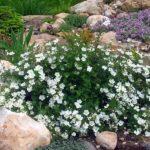 Description of the shrubby cinquefoil variety Abbotswood, planting and care instructions
 Description and methods of using Potentilla Goldfinger, planting and care rules