
- History and description of the Tahiti variety
- Application in landscape design
- Pros and cons of growing
- Agricultural technology and plant care
- Site preparation
- Planting dates and patterns
- Watering and fertilization regime
- Protection from insects and diseases
- Pruning and care after flowering
- Peculiarities of flower transplantation
- Reproduction technique
- Gardeners' reviews of daffodils
Daffodils, perennial bulbous plants in the Amaryllis family, are among gardeners' most beloved primroses. Their undemanding growing conditions and wide variety of cultivars have earned them such popularity. Among the varieties bred, every gardener can find a specimen to suit their taste. The Tahiti daffodil is an early bloomer that graces flowerbeds and front gardens with the arrival of the first warm days.
History and description of the Tahiti variety
The Tahiti daffodil, a double variety, was developed by Dutch breeders. It's used not only as a garden decoration but also as a cut flower—the flowers last a long time in a vase without losing their freshness. However, it is important to note that daffodils of this variety emit a rather strong and sweet scent, so people with allergies should not leave the flowers indoors for a long time.
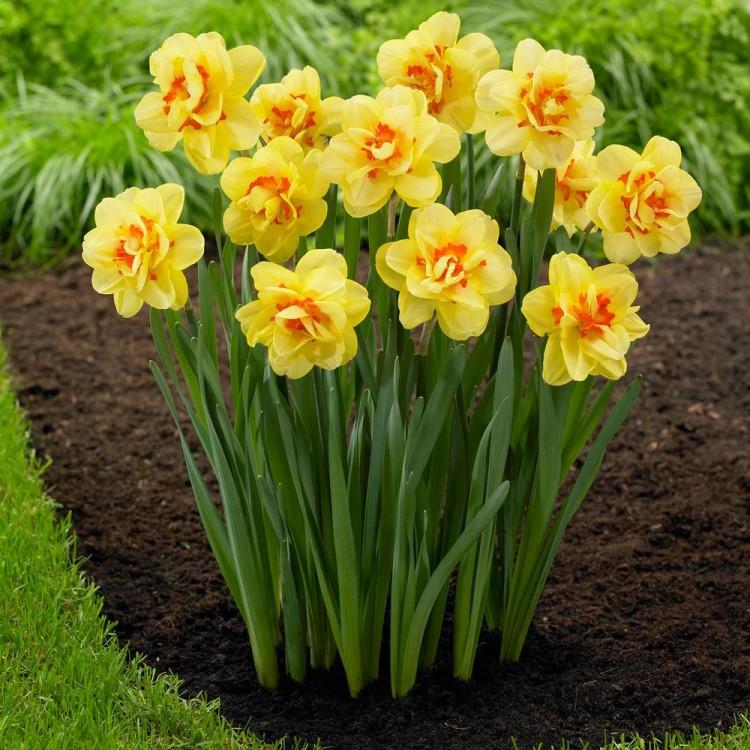
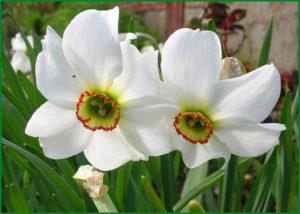
Tahiti daffodils grow to a height of no more than 40 cm and feature large buds—up to 10 cm in diameter. One or more flowers form on a single stem. The petals of the buds are golden-yellow with red highlights, making the entire area appear bathed in sunlight. The corona of the daffodil is ruffled and measures approximately 10-11 cm.
The Tahiti variety blooms in late April and lasts for about three weeks. By the end of the blooming period, the petals lose their vibrant color, but the pleasant scent remains. In place of the faded buds, a three-valved capsule forms, containing numerous seeds.
When collecting seeds, gardeners should remember that they quickly lose their viability and should be used within a year. Store seeds in cheesecloth or cardboard bags in a location away from direct sunlight and high humidity.
Application in landscape design
Thanks to its high decorative qualities, the Tahiti daffodil is widely used to decorate plots, both by professional landscape designers and amateur gardeners.
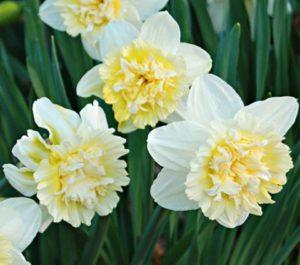

Possible uses of the plant:
- For decorating rock gardens and rockeries, for creating borders.
- In joint plantings with other primroses: purple hyacinths and snow-white snowdrops.
- As contrasting spots on a green lawn.
- Tahiti daffodils look spectacular in combination with hostas, geraniums and alchemillas.
Pros and cons of growing
Before purchasing Tahiti daffodil bulbs, it's worth considering all its advantages and disadvantages. The latter are few, but they do exist.
The advantages of growing these flowers include:
- High decorative characteristics of daffodils.
- Large buds with bright colors.
- Pleasant aroma.
- Unpretentiousness to the growing site.
- Possibility of propagation by seeds and bulbs.
- Life expectancy in one place is up to 7 years.
Gardeners note the following disadvantages:
- Narcissus require regular watering.
- Need for a sunny area.
- Without prevention, there is a risk of damage from pests and diseases.
Agricultural technology and plant care
When growing the Tahiti variety, the key is choosing the right planting site, preparing the soil and bulbs, and providing the plants with proper care. This includes watering, weeding, loosening the soil, preparing the flowers for winter, and preventative treatments against diseases and insect pests.
Site preparation
The Tahiti variety requires full sun, so shaded locations are unsuitable for growing it. At the very least, select a site with light afternoon shade. The site should also be protected from drafts, such as nearby shrubs, fences, or building walls.
Like all daffodil varieties, Tahiti doesn't respond well to waterlogged soil, so drainage should be provided in advance. Fertile, light-textured, neutral soil with good drainage and aeration is ideal for growing daffodils.
At least two weeks before planting the bulbs, dig up the soil in the selected area, adding humus or compost. Fresh manure is not recommended for top dressing, as it attracts insect pests and promotes disease. When digging, remove weed roots to prevent them from choking out the flower beds.
Before planting, daffodil bulbs are soaked for half an hour in a manganese solution or a rooting stimulator such as Epin.
Planting dates and patterns
The exact timing of planting bulbs outdoors depends on the climate of the growing region. In the south, gardeners do this from late August to October. Before the cold weather sets in, the bulbs will have time to establish roots in their new location and survive the winter without problems. If you're planting in northern regions, it's best to do so in May or June. You won't be able to admire the buds this season, but next spring, daffodils will delight you with a profusion of blooms.

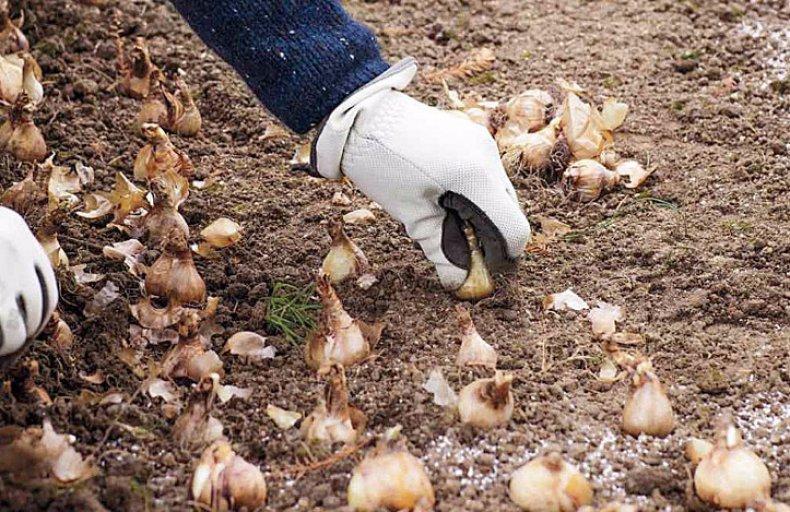
Planting operations are carried out according to the following instructions:
- Holes are dug at a distance of 20 cm from each other; their depth depends on the size of the bulbs and varies from 10 to 20 cm.
- Add a little river sand to the bottom of each hole to absorb excess moisture. You can also add a little wood ash.
- Place the bulbs, press them lightly and cover with the remaining soil.
- Water and lay a layer of organic mulch, which will prevent freezing during the winter.
Watering and fertilization regime
The Tahiti daffodil requires adequate and regular watering. If the top and middle layers of soil remain dry for long periods, the buds will be small. Use settled water for irrigation, watering the flowers 2-3 times a week, depending on the weather. Growing large buds is impossible without fertilizer, so apply nutrients according to the following algorithm:
- As soon as the first shoots appear, use fertilizer with a high nitrogen content.
- When forming flower stalks, add complete mineral fertilizer.
- As soon as the buds begin to form, use fertilizers containing phosphorus and potassium.
- During the period of active flowering, mineral fertilizer for flowering plants will be useful.

Protection from insects and diseases
To protect plants from pathogens, the most dangerous of which is fusarium, preventative treatments with copper-containing products are carried out. The first spraying is carried out as soon as the first shoots emerge from the soil. The second treatment is carried out on daffodils when the flower stalks are forming.
To prevent attracting insect pests, promptly remove fallen leaves and weed regularly. If pests do infest your flowers, use an insecticide, such as Aktara.
Pruning and care after flowering
Once the buds have faded, they are carefully cut from the flower stalks. The stems themselves are shortened to 10 cm above the ground only in midsummer, as they contain the nutrients the bulbs need to survive the winter. Irrigation continues until autumn.

Peculiarities of flower transplantation
If for some reason the daffodil isn't suited to its current location, transplant it to another site. Carefully dig up the bulbs, shake off the soil, treat them with a fungicide, and transfer them to another flowerbed.
Reproduction technique
There are two ways to propagate Tahiti daffodils: from bulbs and from seeds. The first method is the simplest and most convenient. The offspring are separated from the mother bulb and planted in a new location.
The second method is rarely used because it takes time, and there's no guarantee the new seedling will have the same qualities as the mother plant. The seeds are sown in containers indoors; once they sprout and become strong, they are transplanted into individual containers.
Gardeners' reviews of daffodils
Galina Petrovna Potapova, 65: "I've been growing the Tahiti variety in my garden for three years now. During this time, I haven't had any particular problems; the main thing is to water and fertilize the plants regularly."
Related posts:
 80 Best Eggplant Varieties for Different Regions with Descriptions and Characteristics
 Description and characteristics of the best seeds of pea varieties and types
 The best grape varieties for growing in the Urals, planting and care rules in summer
 How to propagate and grow peas, cultivation technology, and care in open ground
 Description of the Velika grape variety, cultivation and care tips
 Description of the 23 best pear varieties for the middle zone, planting and care rules
 The best eggplant varieties for growing in a polycarbonate greenhouse: planting and care
 The best and most productive tomato varieties for greenhouse cultivation in the Urals, with descriptions