
- Description and Features
- History of selection
- Properties
- Caloric content
- Benefits and harms
- Acidity
- Bush characteristics
- Vine
- Bunch
- Productivity
- Taste qualities
- Winter hardiness and drought resistance
- Disease resistance
- Applications of berries
- How to plant correctly
- Recommendations for choosing deadlines
- Site selection and preparation
- How to select and prepare planting material
- Planting diagram
- Care instructions
- Watering
- Top dressing
- Mulching
- Garter
- Disease prevention
- Alternaria
- Anthracnose
- Mildew
- Oidium
- Gray rot
- Protection from birds and pests
- Preparing for winter
- Pruning and shaping
- Methods of reproduction
- Grafting onto other varieties
- Grafting using woody cuttings
- Cuttings
- Advantages and disadvantages of the variety
- Harvesting and storage
- Tips and advice from experienced gardeners
The Velika table grape variety not only looks delicious but is also perfect for garden decoration as an ornamental plant. It also produces large, aromatic berries with a taste that everyone loves. With a good yield, the clusters retain their attractive appearance for a long time. Let's take a closer look at the properties, characteristics, and growing guidelines for this remarkable variety.
Description and Features
Gardeners leave numerous positive reviews about the Velika grape variety. They appreciate the small seed count, the size, and the firmness of the berries. Besides its culinary qualities, it also has valuable ornamental properties.
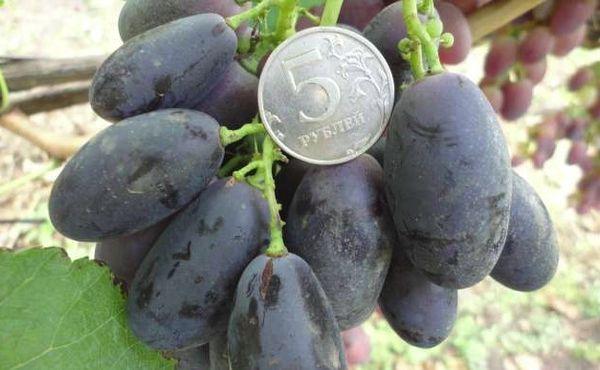
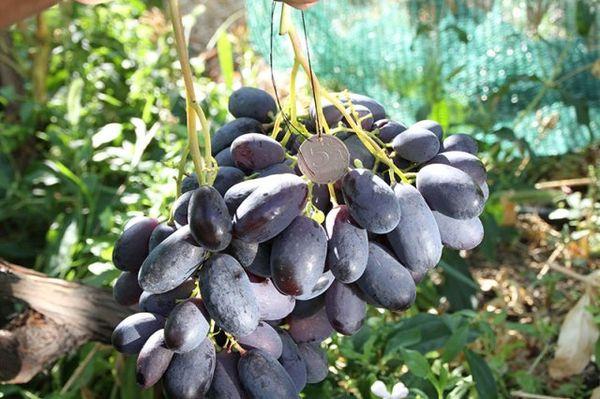
The fruits of this variety are distinguished by their record-breaking size and the following features:
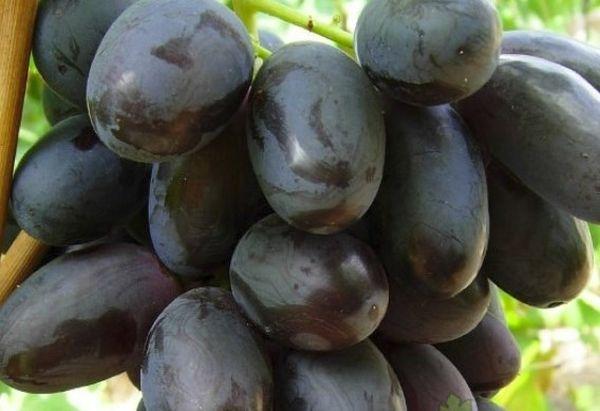
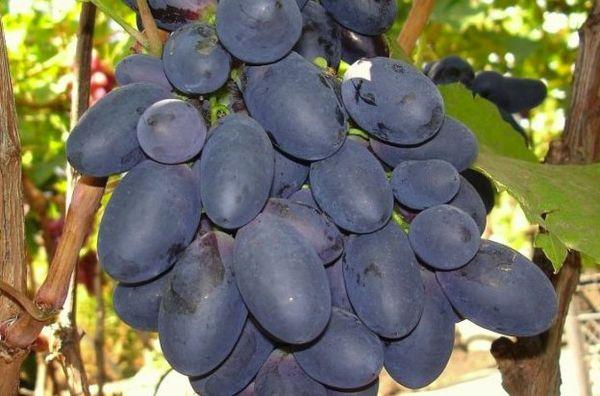
- The grapes are up to 39 mm long and 25 mm wide.
- Weight of berries: 15 g.
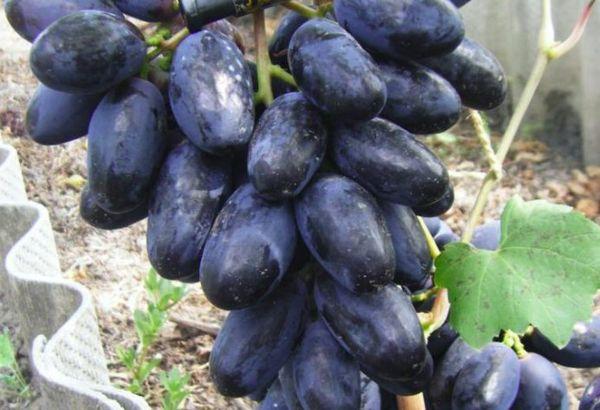
- The characteristic shape of the fruit of this variety is elongated, oval, and pointed towards the end.
- When ripe, the grapes are dark blue with a burgundy hue.
- The berries of the Velika variety are coated with wax, which protects them from damage and fungal diseases. This is why they have a dull, lustrous appearance.
Bisexual flowers of grapes provide the variety with guaranteed pollination.
The leaves are rounded and deeply notched, appearing small compared to the bush itself. The blade is smooth on top and rough on the underside. The number of lobes can reach seven.
History of selection
Velika was first mentioned in 1987. Renowned Bulgarian breeder Ivan Todorov crossed the common Bolgar and Alphonse Lavallee varieties. The resulting hybrid was a mid-season ripening grape, producing large, excellent-tasting fruit. In 1997, the grape variety was added to the State Register. In its native land, Velika ripens by the end of August.
Properties
The Bulgarian variety Velika is primarily intended for southern regions. However, with proper insulation, it can withstand winter temperatures as low as -20°C. Although zoned for southern regions, the grape's quality may deteriorate under unfavorable conditions. This table grape variety boasts a surprisingly good yield.
The harmonious taste pleases almost everyone. The acidity and sugar balance each other out.
Caloric content
The fruit of this variety contains significant sugar, up to 19 grams per 100 cm3. This suggests that the product is quite caloric.
Benefits and harms
Each crop has its advantages and disadvantages. The high content of vitamins and microelements attests to the health benefits of Velika berries. Grapes contain a significant amount of antioxidants. In small quantities, they can even treat diabetes.
But high calorie content threatens a person’s normal weight.
Acidity
The grapes in question contain between 4 and 6 g/l of acid. This acidity is clearly balanced with high sugar content. This variety's acidity may increase with improper care.
Bush characteristics
Velika bushes are quite vigorous, with all parts being large. The medium-sized leaves are rounded. On the same plant, they can be both brown and green, complemented by a red petiole. In autumn, the color changes to golden, burgundy, and fiery red tones. The top usually forms a smooth surface, wavy at the base.
Vine
It's customary to clear a planting site for growing only this variety of vine. This grape develops and grows quickly, reaching considerable sizes. Its distinctive ornamental qualities are noted. It's a pleasure to relax under an archway with this climbing plant, distinguished by its variegated foliage and dark fruit.
Bunch
On the tall bush of the Velika variety, loose bunches of grapes are formed:
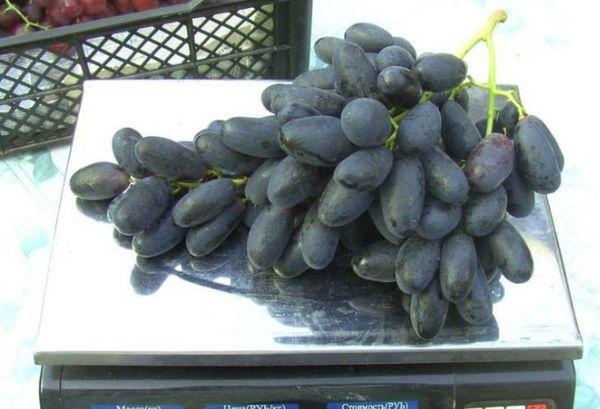
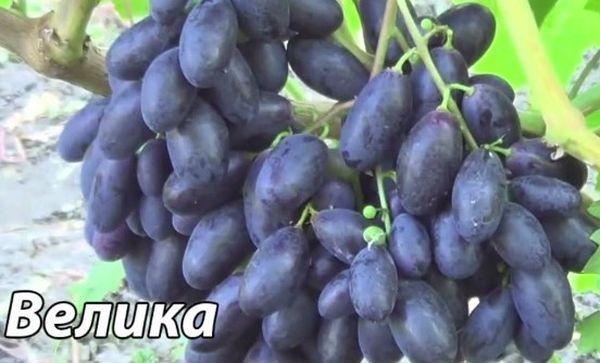
- The weight of a bunch ranges from 0.6 to 1 kg, with the record weight reaching up to 1.5 kg, which is possible if the cultivation techniques for the variety are followed.
- Large berries, up to 14 g, somewhat elongated and slightly pointed at the apex. Dark in color, ranging from red to purple, sometimes even black.
- The length of the bunch of the Velika variety is usually up to 20 cm, and the width is 10-15 cm.
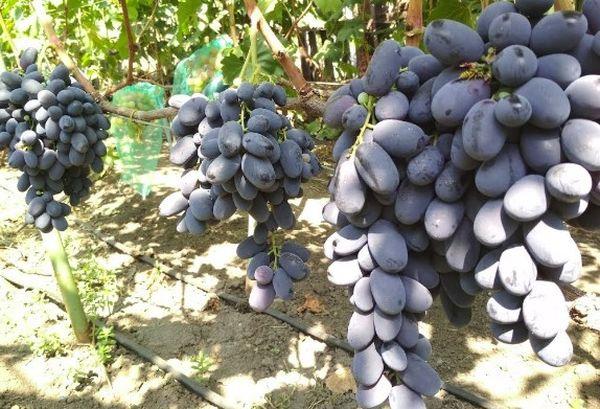
The cluster shape is conical, elongated, and medium-dense. Record-breaking weights are possible with proper cultivation techniques.
Productivity
The Velika variety, a very early-ripening variety, produces berries in its native Bulgaria by the end of August. In Russia, the timing depends on the latitude and other local conditions.
On average, the Velika variety ripens in 130 to 135 days. Its yield pleases both gardeners and commercial growers. Average values for this variety:
- up to 10 kg per bush;
- 350 centners per hectare.
Taste qualities
Some say the flavor is a bit reminiscent of prunes. Although the skin is thick, it's easy to eat. Beneath it is the crunchy flesh, which contains a significant amount of sugar. The following qualities characteristic of this variety are also revealed upon tasting:
- There are usually no seeds.
- The skin is firm but not tough. This doesn't affect the flavor and ensures the berry's stability.
- The taste is sweet and rich, allowing the Velika variety to stand out with its hints of ripe cherry.
- The flesh is slightly pink, crisp, but not watery.
Those who have tried these grapes are delighted with the taste, which complements the appearance.
Winter hardiness and drought resistance
In winter, the variety tolerates temperatures down to -20°C, but requires significant insulation. This quality is considered a drawback for Velika: its frost resistance is average. Even climates with winter temperatures as low as -10°C require plant protection. Its ability to bear fruit from replacement buds helps. Drought should not be allowed; daily watering of the bush is recommended.
Disease resistance
The grape variety's natural immunity doesn't fully protect it from diseases. Velika is particularly troubled by:
- anthracnose;
- oidium;
- Alternaria;
- mildew.
Another problem is phylloxera, an aphid that destroys roots.
Applications of berries
The Bulgarian table grape variety Velika is not intended for winemaking. However, it is quite good for eating fresh. The crisp flesh and fairly dense skin allow the bunches to be stored. This is a valuable quality for commercial use, as is its transportability. The fruits of this variety do not crack or turn into raisins in adverse weather conditions.

How to plant correctly
Those considering planting the Velika variety in their garden should keep climate conditions in mind. In temperate climates, the southern variety will require additional insulation. The plant's rapid growth is also important.
Recommendations for choosing deadlines
Velika grapes are planted from March to May or in the fall. Regardless of the time, it is important to follow agricultural practices. The variety has the best survival rate when planted early in the fall. Active growth will begin in the spring.
Site selection and preparation
The relocation site is prepared three months in advance. It is dug and fertilized. The hole or trench should be located on the south side of the garden or a southeast-facing plot. A slope is ideal for:
- It is necessary to retreat from 0.5 to 5 meters from buildings, because the variety is characterized by strong growth.
- The distance between bushes is 3 m.
- The soil should not be waterlogged or have excess groundwater. Therefore, elevated sites are preferred.
- Good ventilation and lighting of the area.
Excess moisture will lead to fungal diseases, and a lack of light will lead to loss of moisture in the fruit and a decrease in the sugar content of the variety.
How to select and prepare planting material
When planting in the spring, only plants that have begun their growing season should be used. The material must be of high quality, free from damage and signs of disease. The seedling should be placed in the soil as soon as possible after purchase. Before planting, it should be soaked in water for two days. Trim the roots to improve water absorption.
Planting diagram
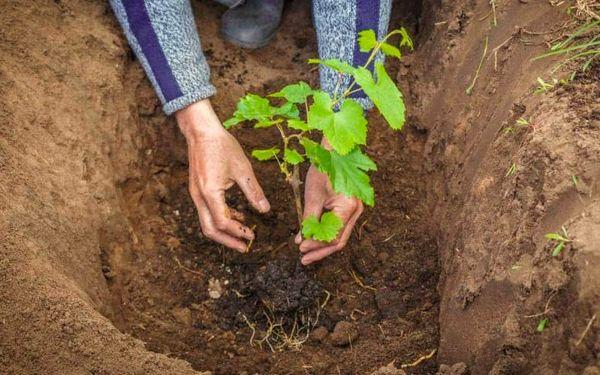
The seedlings of the Velika variety are placed in a hole or trench 90 cm deep:
- The top layer of soil is removed.
- Gravel is placed on the bottom, and if there is clay, it is mixed with sand.
- The fertility of the soil is increased by a mixture of manure, wood ash, and superphosphate mixed with the soil.
Finally, the root system is covered with fertile soil. After planting, the plant is watered.
Care instructions
Growing this variety involves a number of challenges related to its sensitivity to cold and disease. Other care steps are standard: cultivating the soil, removing weeds during the warm season, and fertilizing. Let's examine these factors in detail.
Watering
Soil watering should be done as needed. Young plants should be watered immediately after planting. Daily watering is recommended thereafter. This ensures the variety's yield and the quality of the fruit. However, caution is also necessary. Excess moisture can build up, which can be detrimental to the roots.
Top dressing
It is suggested that good care involves fertilizing twice a year. Superphosphate is added to the planting hole.
Mulching
This procedure helps retain moisture during hot periods. It is also performed in the fall in preparation for winter. Materials such as fallen leaves and sawdust are used.
Garter
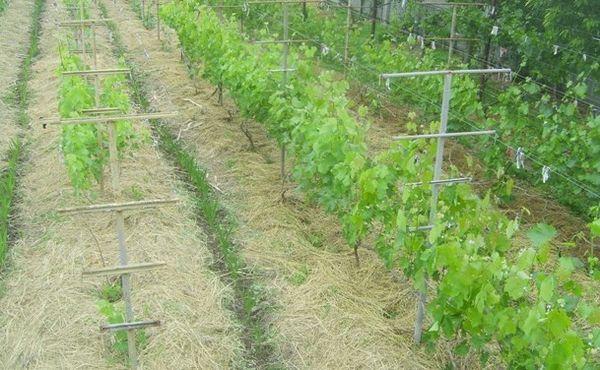
The Velika grape variety is especially successful when tied using a two-plane trellis. Its decorative qualities allow the plant to be formed into an arch, or used as a frame for an arbor.
High branches force the gardener to create supports up to 3 m high from several levels.
Disease prevention
During the warm season, this grape variety is treated with fungicides. Three sprays are required to combat fungi, as well as disinfect the soil beneath. The following products are used, depending on the season:
- In spring, Bordeaux mixture or copper oxychloride is used, as well as Horisom.
- Repeat treatment is performed when buds begin to form. Use Strobi. Do not spray a plant that has already bloomed. If the treatment is late, skip it.
- The third treatment is to grow the berries to pea size. Bordeaux mixture and other copper-containing fungicides are used.
The specified number of treatments may be increased if outbreaks of fungal infection are observed.
Please note! Poor disease resistance is the most significant drawback of the Velika grape variety. If the vine is not treated promptly, the harvest may be lost.
It is recommended to treat the variety before signs of damage appear.
Alternaria
Externally, the disease manifests itself as the formation of plaque and mold on the shoots. These gray and brown spots are a fungal infection, which can be controlled with fungicides.
Anthracnose
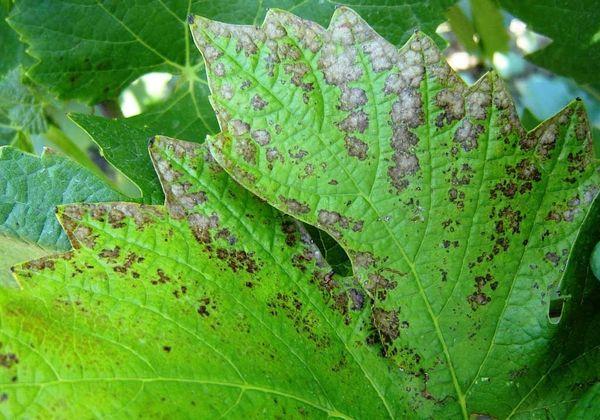
This disease is also caused by fungi. Dry, brown spots appear on grape leaves. Treatment is with fungicides.
Mildew
The spots that appear on the plant are multiple and yellowish in color.
Oidium
Blight and mold develop on grape shoots. This fungal disease is controlled with fungicides.
Gray rot
This disease is very difficult to treat. Treatment options include Fundazol, Euparen, and prophylaxis.
Protection from birds and pests
Velika is threatened by pests, the main one being phylloxera. This is a destructive aphid that destroys grapes from the roots. In subsequent stages, the variety's yield declines and the bush dies completely. Control methods include:
- destruction of affected bushes;
- burning of leaves on which phylloxera is observed in large quantities;
- planting in sandy soil;
- flooding with water for several days;
- drugs Actellic, Kinmiks, Fastak and Fozalon.
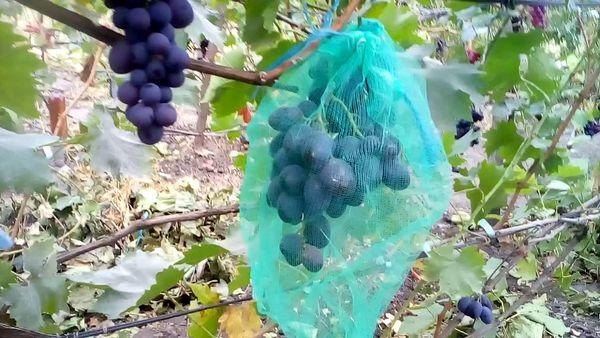
Another enemy of the Velika is wasps. Poisoned bait is used near grape bushes, and wild insect hives are destroyed. The birds cause significant damage to the crop, spoiling its quality. For protection, a net is necessary to prevent any birds from penetrating.
Preparing for winter
Growing the Velika variety in temperate climates requires additional frost protection. Covering materials such as slate, plywood, and other materials are used for this purpose.
Moreover, the presence of fungi or insects must be avoided. In southern regions, the vines of this variety are not covered for the winter. However, in colder regions, a warm "blanket" is created.
With the arrival of autumn, it's also necessary to treat the grapes with antifungal and anti-disease agents. This procedure is carried out after harvesting.
Pruning and shaping
An important part of plant care is shaping, which begins four months after planting, the first year after planting. This variety grows quickly. Branches are pruned, leaving only the strongest ones close to the ground.
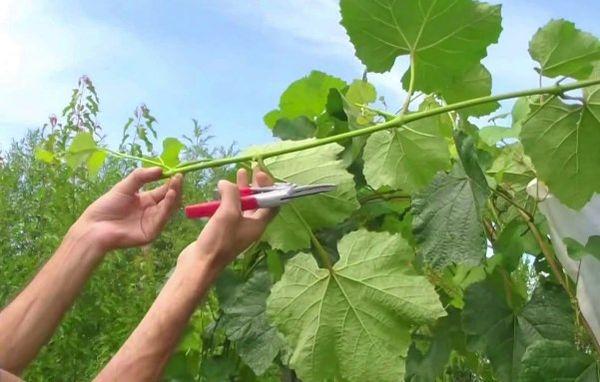
The procedure is repeated annually. Up to four ovaries are left on each shoot, which promotes fruit production and prevents overcrowding.
Methods of reproduction
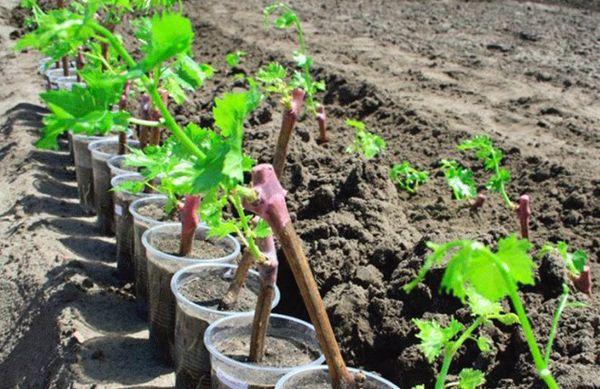
The Velika grape variety can be propagated in several ways. The easiest way is to purchase rooted seedlings. The cuttings are sold both in the spring and fall.
Another method is propagation by layering (cuttings). Cuttings are taken from neighbors or from an existing bush on your property. Velika can be obtained by grafting onto another vigorous variety. This is done during the sap flow period.
Let's take a closer look at the listed methods.
Grafting onto other varieties
- The most commonly used rootstocks are the Chasselas and SO4 varieties. Their beneficial effect is that they moderate the vigorous growth of the Velika. The procedure is carried out in the spring. A green scion is placed in a cleft at a height of 0.4 to 1.5 meters. The following steps are followed.
- Prepare a sharp knife and process it.
- They make a cut and split it, then insert a grape stalk.
- The place where the graft was made is pressed, smeared with pitch and tied with twine.
Grafting using woody cuttings
Lignified grape cuttings are tied to both the above-ground and underground parts of the trunk.
Cuttings
Cuttings can produce high-quality seedlings. However, this method requires healthy material, specifically, one free from phylloxera.
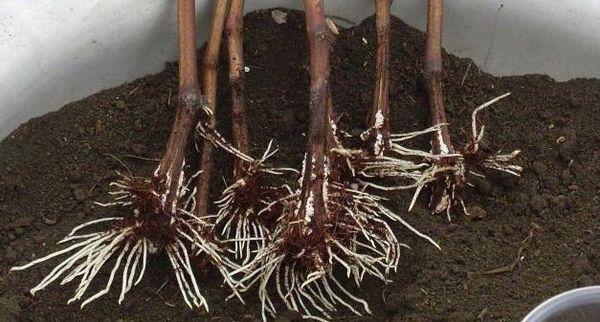
After three years, the plant begins to bear fruit.
Advantages and disadvantages of the variety
The advantages of the Velika variety include the following properties:
- Productivity.
- Ripening occurs from both fruiting and replacement buds. This is a unique characteristic of the variety.
- The flowers are bisexual, so there is no pea formation and additional pollination is not required.
- The berries do not crack and are of a significant size.
- Taste, smell.
- Safety and marketability of the variety.
- Early ripening.
A drawback is its poor disease resistance. This variety requires constant care and preventative measures against damage and death. Some people dislike its rapid growth and insufficient winter hardiness.
Harvesting and storage
The grape harvest takes place at the end of August. The harvest has a long shelf life, but moderate temperatures are essential for storage. This is important for trade.
Tips and advice from experienced gardeners
It is recommended to place it during the first year of life grapes in a greenhouseIf it's grown in a cold region, it should also be covered with hay and other standard materials.
A number of gardeners report a decrease in the sugar content of the variety and an increase in the acidity of the fruit if this condition is not met.
Related posts:
 How to grow grapes in the Moscow region in open ground without a greenhouse
 Description of 30 grape varieties for Siberia, planting and care for beginners
 Description of 30 varieties and types of Muscat grapes, planting, cultivation and care
 The ripening time of grape vines by variety, how to speed up the process, and what to treat the plant with
 Description of the Julian grape variety, planting and care instructions
 Beginner's Guide to Growing Grapes in Open Ground in Central Russia
 Description of the Krasotka grape variety, planting and care technology
 The best grape varieties for growing in the Urals, planting and care rules in summer