
- Why are irises transplanted to a new location?
- When is the best time to replant irises?
- Advantages and disadvantages of spring planting
- Pros and cons of fall planting
- Can the procedure be performed in summer?
- How to properly repot a plant
- Preparing the flower and soil
- Rhizome division
- Planting in the ground
- We take into account the nuances for different varieties
- Bulbous
- Siberian
- Bearded
- Post-procedure care
- Disease prevention during transplantation
- When will the transplanted flowers bloom?
Irises are repotted to rejuvenate the flower. This procedure is performed every 3-4 years. If not repotted, the iris will stop blooming after 5 years. Although the procedure is relatively straightforward, several important rules must be followed when repotting. Furthermore, it is recommended to repot during the most favorable season.
Why are irises transplanted to a new location?
As already mentioned, gardeners recommend replanting irises every 3-4 years. This is necessary because the plant's root system is weak. If left to grow in one spot for too long, the irises will first stop blooming and then die.
Repotting is necessary because, as the plant develops, a new root link emerges, which consumes a lot of nutrients. Therefore, after 3-5 years, irises die even from light frosts.
Some gardeners recommend repotting the plant every 1-2 years. However, this procedure isn't necessary so frequently. During the first three years, the plant's root system tolerates frost and other environmental stress well.
When is the best time to replant irises?
The timing of planting and replanting depends on the growing region. In the Moscow region, this procedure is recommended in the spring, as the plant's root system has time to establish itself in the new location before frost sets in. In southern regions, replanting is also done in the fall. However, these are general rules that apply to all plants. A different approach is used for irises. To ensure the plant is fully established in its new location, replanting is recommended:
- at the beginning of September (for Siberia);
- in mid-September (for the Moscow region);
- at the end of summer (for the Leningrad region);
- in October (for southern regions).
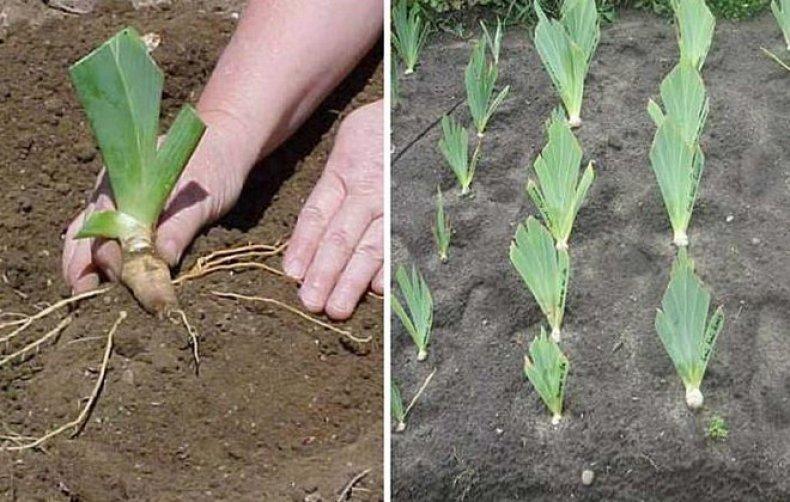
Irises can be repotted in spring and summer. However, autumn is considered the optimal time.
Advantages and disadvantages of spring planting
Most gardeners prefer to plant (replant) their plants in the spring because it allows the plant enough time to establish roots in its new location. However, relocating irises during this period is not recommended because:
- in spring, the above-ground part of the flower actively develops, as a result of which the root system is not able to support the plant;
- with the onset of warm weather, the number of pathogenic microorganisms and microbes increases sharply;
- In spring, gardeners mainly focus on fruit and vegetable crops, leaving little time for flowers;
- Before the onset of summer, frosts at night are not uncommon in middle and northern latitudes.

Due to the above circumstances, it is recommended to plant irises in May.
Pros and cons of fall planting
Experienced gardeners insist that it's best to repot irises in the fall. This procedure should be carried out in September. In October, as in November, night frosts (and less commonly, daytime frosts) are possible. It's also not recommended to plant irises in late September (if the procedure is carried out in mid- and northern latitudes). Otherwise, the plant won't have enough time to establish itself in its new location.
The main advantage of autumn repotting is that the above-ground portion of the plant does not develop during this period. This ensures that the roots receive sufficient nutrients for growth.
Can the procedure be performed in summer?
In early summer, irises' root systems are actively developing. Therefore, when choosing this time for repotting, it's recommended to perform the procedure in the second half of June. Such procedures should not be performed in July, as the heat will weaken the plant and prevent it from establishing itself in its new location. Gardeners recommend repotting in August. This month is considered the most favorable because the above-ground portion of the plant has ceased developing, and the first frosts are still more than a month and a half away.
How to properly repot a plant
Irises are sun-loving plants. It's recommended to repot them in sunny locations. It's also important to ensure adequate moisture. They should also be planted in well-ventilated areas, protected from strong gusts of wind.
Preparing the flower and soil
You can't plant a flower in:
- swampy soils;
- in places where groundwater is located close to the surface;
- heavy and acidic soil.
Loamy soil with a neutral pH is considered optimal. Two weeks before the planned replanting, the soil should be dug to a depth of 20 centimeters with a shovel. After this, a mixture of sand and peat should be added, and if the soil is acidic, lime should also be added.
A few days before planting, the soil should be fertilized with mineral fertilizer, which is also recommended for accelerating the development of irises. Weeds should also be removed from the area where the flowers will grow.
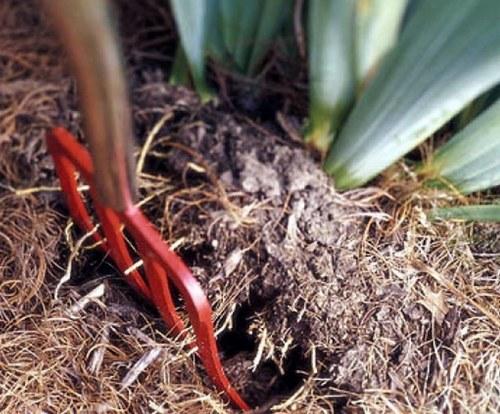
It's recommended to dig up irises using a pitchfork. This will preserve most of the roots. To help the plant establish itself in its new location, avoid applying fertilizer for 1.5 to 2 months. The dug-up bulb should then be rinsed. Damaged and dried roots should be removed.
After this, the leaves are trimmed back by two-thirds. Finally, the roots are disinfected with a weak solution of potassium permanganate or another similar solution.
Rhizome division
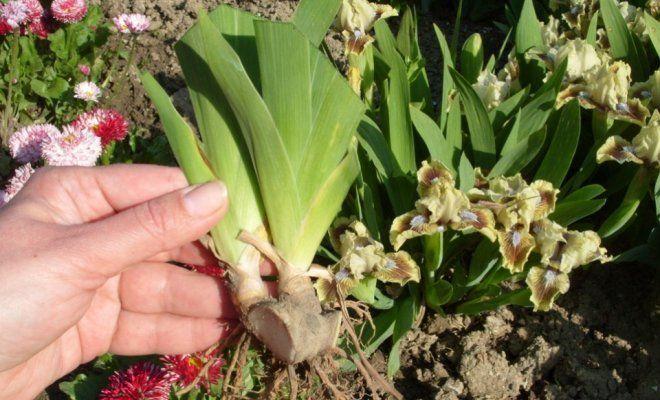
The dug-up rhizomes should be divided into several parts, removing old shoots. A sharp knife is used for this. The planting material is divided so that each part contains several buds, a fan of leaves, and a developed root up to 10 centimeters long. After this process, the iris is treated with ash or potassium permanganate.

Planting in the ground
Irises are transplanted according to the following algorithm:
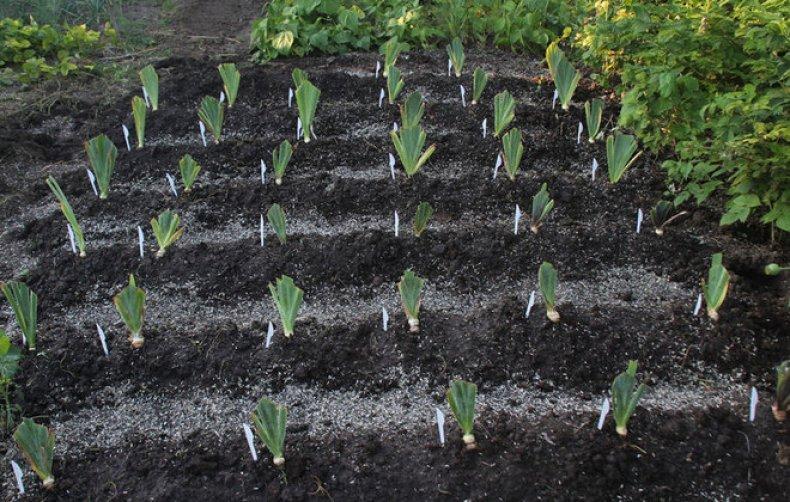
- A hole up to 10-12 centimeters deep is dug in the prepared soil, at the bottom of which a mound of earth 2-3 centimeters high is poured.
- The planting material is placed in the center of the hill, and the roots are distributed along the edges.
- The hole is filled with soil so that after watering the plant, the root collar remains above the soil surface.
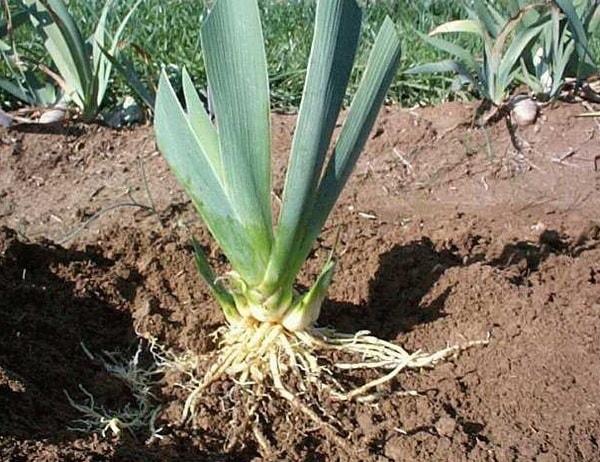
When replanting, you need to maintain a distance of 10-35 centimeters between the holes (the larger the flower, the further away the plant should be placed).
We take into account the nuances for different varieties
As noted above, when planting flowers, it's important to consider the variety. Some varieties prefer sunny spots, while others prefer shade. Therefore, before replanting irises, it's important to familiarize yourself with the characteristics of the specific flower.
Bulbous
Bulbous irises are repotted according to the described algorithm. This flower variety has the same growing zone requirements as other popular varieties.
Siberian
Siberian varieties are distinguished by their robust root systems, which require frequent watering. However, overwatering the soil encourages fungal diseases and can kill the iris. The robust root system ensures the flower's stability even in strong winds.
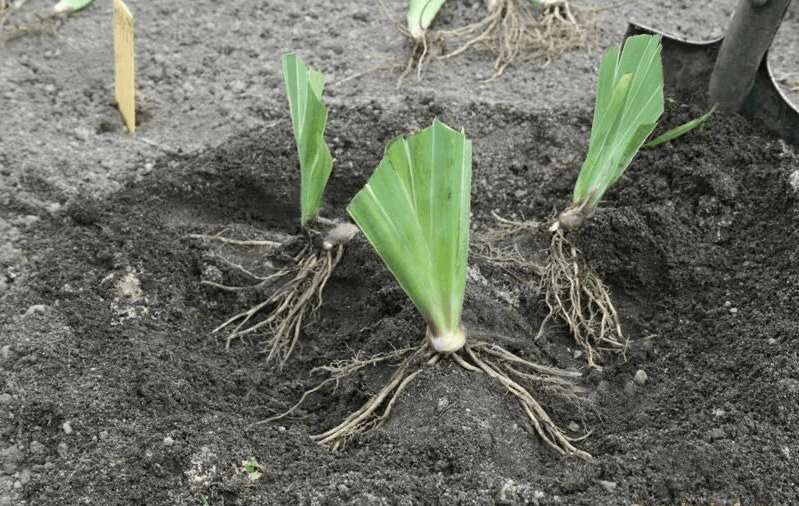
Siberian varieties prefer to grow in shaded areas near shrubs or trees. This type of plant requires repotting every 10 years. Due to the extensive roots of Siberian irises, they should be spaced 35 centimeters apart when planting. Additionally, to prevent the flower from dying in its new location, compost should be added to the prepared hole.
Bearded
Bearded iris varieties are propagated by dividing the bush into several parts. The leaves of these flowers are trimmed to two-thirds of their original length. When dividing bearded irises, it's important to remember to leave at least one year-old branch on each rhizome. This determines the plant's survival in its new location.
Post-procedure care
Replanted irises should be watered again after 3-4 days (assuming there has been no precipitation). To ensure the plant establishes successfully in its new location, the soil around the bush should be weeded several times before the onset of cold weather. This procedure is best done by hand, as the roots are located close to the soil surface.
Take a look Also


Even after planting in the fall, irises can survive the winter outdoors. However, a few days before the onset of cold weather, each bush should be mulched with spruce branches, peat, or fallen leaves. After the snow melts in the spring, the cover should be removed immediately. The first green shoots will appear within a few days. Regardless of the variety, irises should not be fertilized with manure. This will kill the plant. This is because the components contained in manure cause root and trunk burns.
If the above rules are followed, the irises' above-ground parts begin to actively grow with the arrival of spring. The first buds appear after 1.5 months. The root system then begins to develop rapidly in early to mid-July. During this period, new roots are formed, which will produce flowers the following year.
With the onset of autumn, iris leaves are trimmed back almost to the ground, and any damaged parts are removed. These damages hinder plant growth and can kill the flower. Pruning is recommended in October (or another month, 3-4 weeks before the first frost).
Disease prevention during transplantation
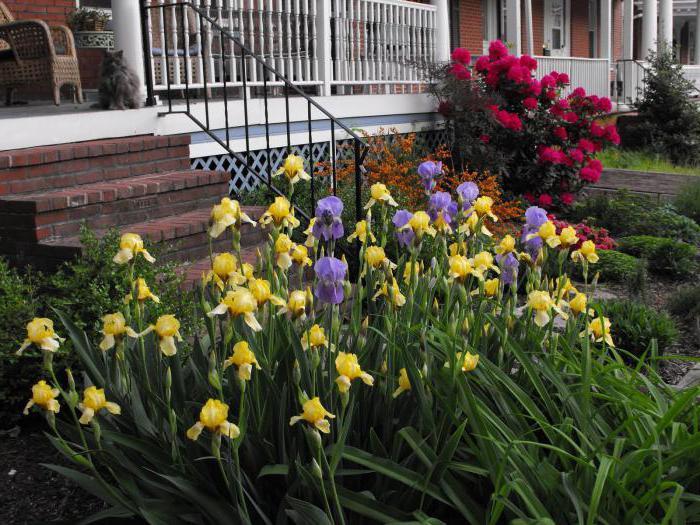
Disease prevention consists of treating the planting material with a weak solution of potassium permanganate, wood ash, or specialized products available at gardening stores. At the same time, it is recommended to remove weeds from the flower bed. Additionally, sprouts that appear in the spring should be treated with fungicides. This procedure should be completed 1.5 months before flowering.
When will the transplanted flowers bloom?
The first flowers appear on a transplanted iris after at least eight green leaves have formed on the stem. This occurs within 1.5 months.
Related posts:
 Description and characteristics of the best varieties and types of irises
 Planting and caring for irises in open ground, propagation and variety selection
 Description of the best varieties of reticulated irises (Denfordia), planting and care, propagation
 Why do irises have only leaves and don't bloom? What to do and how to eliminate the causes
 Description of Japanese iris varieties, planting and care in open ground
 Description of Siberian iris varieties, planting and care in open ground
 What flowers go well with irises in a flowerbed? What flowers are best to plant them with?
 Description of bearded iris, planting and care in open ground, and preparation for winter