
Replanting tulip bulbs is an important step in plant care, ensuring abundant blooms and the health of the plant next season. Since these flowers are among the first to grace gardeners with their buds, it's important to carry out the procedure correctly to speed up spring blooming. While replanting tulips can be done in the spring, experienced florists recommend doing it in the fall.
Why are tulips replanted?
Tulips, although considered perennials, require annual repotting. Only some varieties, such as Kaufmann tulips, are less demanding and can bloom and thrive in the same location for two or three years without issue.
Other varieties of primrose need to be moved to another area for a number of reasons:
- When left in one place for a long time, tulip varieties begin to degenerate—the buds become smaller and their characteristic features disappear.
- When replanting, remove diseased bulbs and separate the young bulbs to ensure normal plant development.
- At this point, fertilizers are added to improve the soil quality.
When do tulips need replanting?
Experienced gardeners identify several signs that indicate that tulips need to be replanted to a new location:
- Flowering may be sparse or even cease altogether.
- Flower petals and buds become deformed.
- Thickening of plantings and strong growth of tulips in one flowerbed, which leads to insufficient nutrition of the plants.
- The need to propagate a rare variety.
- Frequent diseases that affect flowers even with preventative treatments.

Optimal timing
Throughout the growing season, tulips can be replanted either in spring or fall. The latter option is more commonly used by gardeners due to its many advantages.

Before flowering
In spring, tulips are replanted once the snow melts and the soil warms up. This is typically mid-April, but this timeframe varies depending on the climate zone. This spring transplant has several significant advantages:
- Before work begins, the soil has time to warm up properly.
- Heat-loving varieties will not die, which can happen during autumn replanting.
However, spring work also has its drawbacks: many of the transplanted tulips will bloom only the following year.


After flowering
Transplanting in the fall has many more advantages:
- During the cold season, the plant bulbs have time to fully take root in a new location.
- After the flowering period ends, the planting material is filled with useful components.
- Autumn work does not affect the flowering period, and with the arrival of spring, the buds delight gardeners with their decorative appearance.
- The active growth phase begins in spring without adaptation to the new site.
Among the shortcomings of the work carried out in the fall, the possibility of the death of heat-loving varieties is noted.

Caution! Tulips cannot be replanted during the flowering period.
Rules for replanting plants to a new location
The process consists of several stages, and it is important to follow gardeners' recommendations so that after transplantation, plants quickly take root in their new location.
We dig up the bulbs
It's recommended to dig up tulip planting material in dry, sunny weather. If you dig up the bulbs during rain, they will rot. Stop watering the plants a week before the planned digging.
It's recommended to begin this work after two-thirds of the stem has turned yellow. After this point, the bulbs are stored indoors in ventilated boxes. If left in the ground until replanting in the fall, they won't establish themselves in their new location.




Drying
After the planting material has been removed from the soil, it is dried. For this purpose, use small wooden boxes with mesh at the bottom. The bulbs are laid out in 2-3 layers and placed outdoors under a canopy. It is important to keep the material away from direct sunlight and moisture during the drying process.
The drying process takes about a week, after which dry scales and remnants of old roots and stems are removed from the bulbs.
We process before planting
Treating tulip bulbs before planting helps protect them from fungal diseases and pests. Soak the bulbs in a dilute solution of potassium permanganate for 30 minutes. If the bulbs show signs of damage, trim them and soak them in a solution of potassium permanganate or a diluted fungicide. It is recommended to plant these bulbs separately from healthy ones.

Direct landing at another location
Before planting bulbs in a new location, it's necessary to prepare the site. Choose a spot for the flowerbed where bulbs haven't been grown for the past two years. Loosen the soil to a shallow depth and remove any weed roots. Next, dig holes, each about 3-4 cm deep and spaced 30 cm apart. Place a 3 cm layer of drainage material, such as small pebbles or washed river sand, at the bottom of each hole. Place the bulbs in place, press them lightly, and cover with the remaining fertile soil. Watering is not necessary when planting tulips in the fall. This should only be done if there has been no rain for a week.
Further care
Agrotechnical care for transplanted flowers consists of several stages:
- Applying mulch. Wood shavings or spruce needles are used for the mulch layer. This procedure helps insulate the bulbs during the winter.
- Irrigation. Transplanted tulips require additional watering only if natural precipitation is lacking. As soon as the first night frosts arrive, this procedure is stopped to avoid damaging the bulbs.
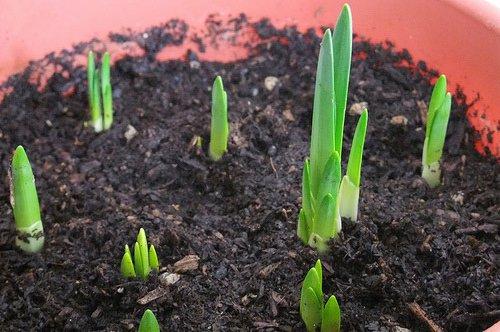
- As soon as the first shoots appear in spring, it's necessary to begin loosening the soil and weeding to prevent them from robbing the flowers of their nutrients. This work should be done after every rain or irrigation.
- During the germination period of tulips, it is necessary to add nitrogen-containing fertilizers to the soil that promote active vegetation.


Common mistakes of beginning gardeners
Inexperienced flower lovers often make mistakes when replanting tulips. The most common mistake is to replant during the flowering period. Even if replanting is urgently needed, it's still necessary to wait until the flowering period has ended, otherwise the plants won't survive the procedure and won't establish themselves in their new location.
Another mistake is not storing planting material at the recommended temperature. If temperatures exceed 30 degrees Celsius, flower buds will die, and the gardener will not experience abundant flowering in the spring. High humidity also negatively impacts the bulbs, leading to the development of mold and fungal diseases.
Related posts:
 When is the best time to plant tulips in open ground? Timeframes by region and rules.
 Description of the top 20 most beautiful tulip varieties and types, their planting and care
 When and how to plant tulips in the Urals in autumn and care for them outdoors
 Timing and methods for planting tulips with your own hands in baskets for bulbous plants
 How to plant tulips beautifully: diagram and ideas for landscape design
 Top 10 methods and rules for treating tulips in the fall before planting
 When is the best time to plant tulips in the Moscow region in autumn? Timing and care instructions.
 How to prepare and store tulip bulbs, possible difficulties