
- Pros and cons of this landing
- The best tulip varieties for planting in baskets
- Selecting a container and soil
- Preparing the bulb
- Optimal timing
- Schemes and methods
- Traditional
- Patterns
- Multi-level
- How to care for a plant
- Watering and nutrient application
- Preventive treatments
- Trimming
- Shelter during the winter period
- Analogues of baskets for bulbous plants
- Pots
- Bottles
- Grids
- Containers
- Boxes
Primroses, which adorn a garden in spring, have one significant drawback: after flowering, unsightly gaps form in the flowerbed. Bulbous plants shouldn't be dug out of the ground immediately; the tubers need to absorb nutrients. Planting spring tulips in bulb baskets solves this problem, as after flowering, simply remove the containers containing the primroses and replant the flowerbed with other plants.
Pros and cons of this landing
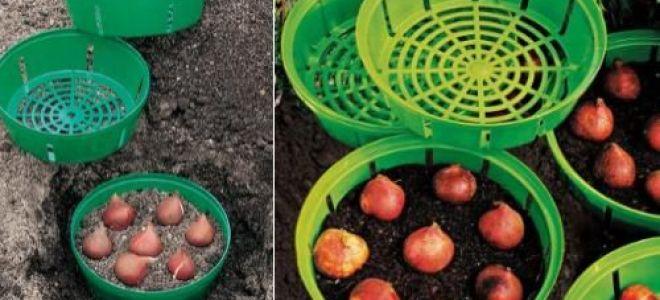
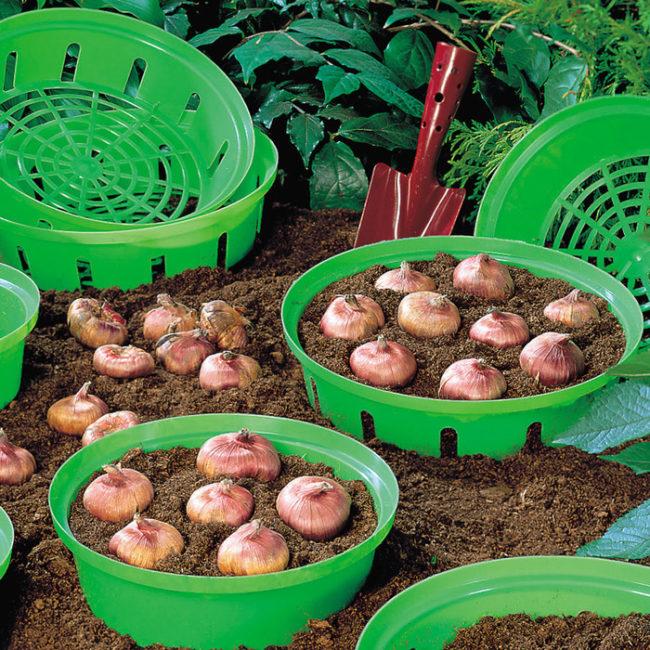
Baskets for planting bulbous flowers are plastic containers with a mesh bottom. The sides are cut out, sometimes also made of mesh. Typically, the diameter of these baskets does not exceed half a meter. These baskets are available at gardening stores. Growing tulips in baskets has both pros and cons.
Advantages:
- When digging up the bulbs after flowering, there is no need to remove them from the ground; the containers can be easily removed from the soil, and the tubers remain undamaged.
- When grown outdoors, tulip bulbs go deep into the soil, and to find them, you need to dig up the flowerbed, which is inconvenient if other flowers are planted nearby.
- Since tulips require slightly alkaline sandy loam soil for full development and decorative appearance, it is much easier to provide such a composition in a compact container than in an entire flowerbed.
- Rodents love tulip bulbs, and they won't be able to get to them in baskets.
This method has few disadvantages, but they still exist:
- As the bulbs grow, they become cramped, which negatively affects the size of the buds.
- A flower bed with baskets does not look as decorative as one with natural planting of flowers.
The best tulip varieties for planting in baskets
Before you begin planting, it's worth finding out which tulip varieties are best suited for this growing method.
As a rule, experienced gardeners prefer the following varieties:
- White Prince with snow-white cups of buds on long stems and strong peduncles.
- Sunny Prince with bright yellow petals of buds.
- Purple Prince with purple flowers.
- Monte Carlo, which belongs to the terry varieties and has a rich yellow tone.
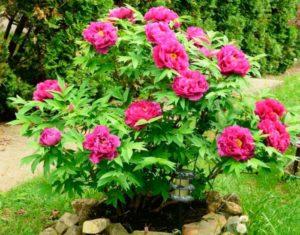
- Ice Cream, characterized by creamy pink shades and reminiscent of a peony flower when in bloom.
- Havran, which has a tall and strong stem, on which is a flower of a rich purple tone.
- Long Lady, with petals with yellow-pink tints.
When planting tulips, select varieties with the same flowering period.
Selecting a container and soil
When starting planting, first select suitable, sturdy containers and prepare soil with the recommended composition.

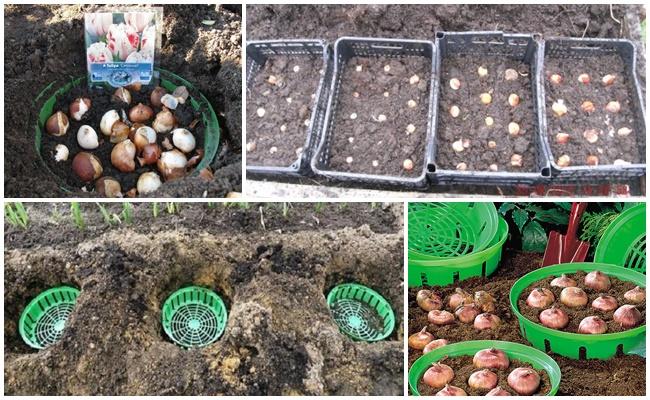
If you plan to plant several plants in a limited space, use a wide basket. Plastic containers with holes to prevent waterlogging are available at gardening stores. If suitable containers are unavailable, use a regular plastic container and poke small holes in the bottom with a soldering iron to allow water to drain.
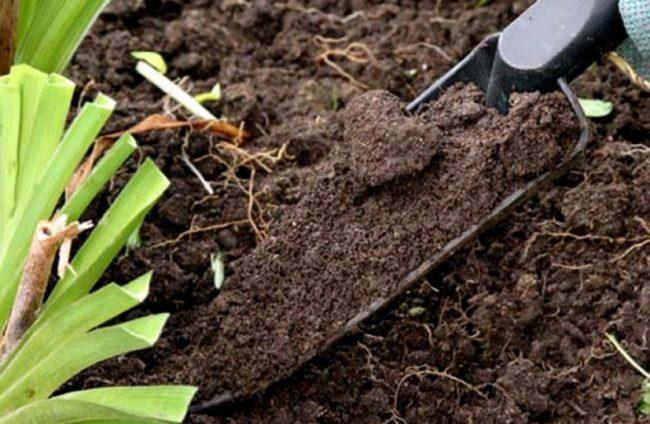
Tulips prefer loamy soil with a slightly alkaline reaction. If you have soil in your area where these primroses have already thrived, you can use it. Since the previous plants have already absorbed most of the nutrients from the soil, compost can be added as fertilizer. Suitable soil for growing tulips can also be purchased at a flower shop; it should be labeled "for bulbous flowers."
Preparing the bulb
Before starting work, the bulbs are sorted, discarding any with signs of disease or damage. In a compact container, infections and fungi develop quickly and damage the plants, so it's best to discard such bulbs.
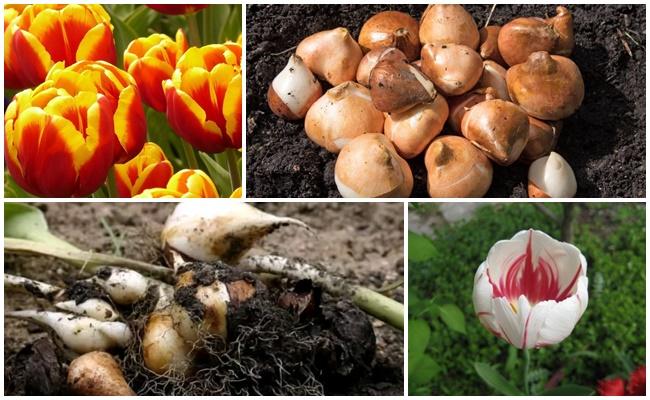
As a preventative measure, it is recommended to soak the tubers for 15 minutes in any fungicide solution, for example, Fitosporin, diluting it according to the instructions on the package.
Optimal timing
Experienced gardeners recommend planting tulips in the fall. This way, with the arrival of warm spring days, they will grow much faster than those planted after winter. Tulips can be planted throughout September and October, depending on the climate. The key is to allow at least a month before the first frost. Over the winter, the plants will root well and grow strong, and will delight you with abundant blooms in the spring.
Schemes and methods
There are several ways to plant tulips in baskets in your garden. Using a well-thought-out layout, you can create a striking landscape design in your dacha.
Traditional
The easiest way to plant plants on your site:
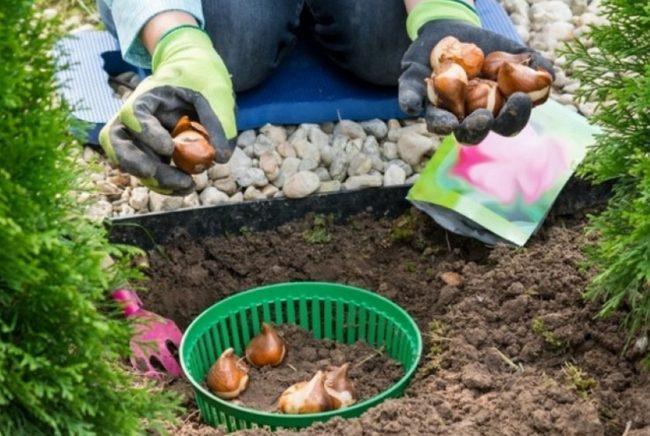
- Holes are made in the ground, corresponding in volume to the size of the basket.
- The container is lowered into the ground and a little river sand is poured onto its bottom.
- Place the bulbs on top and sprinkle with prepared soil.
- After the tulips sprout in the spring, provide them with proper care.
Patterns
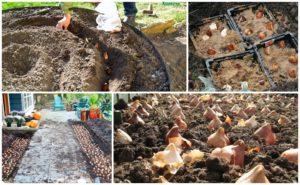
Before beginning the work of planting primroses in a pattern, it's necessary to mark the area. This is done using stakes and string. Once the markings are made, remove the lawn and plant the tulips as with the traditional method.
Multi-level
For this planting method, you need to purchase round containers.
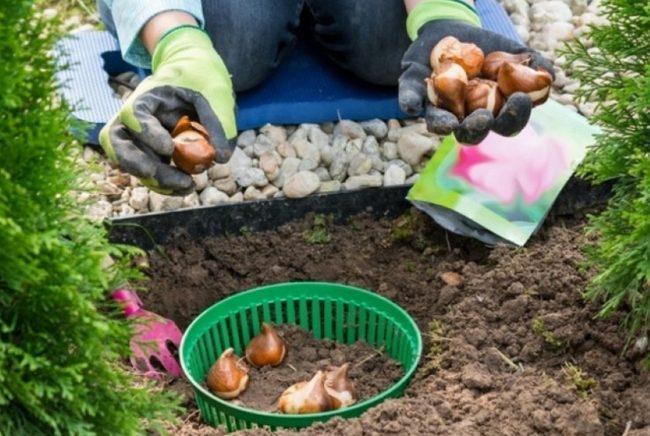
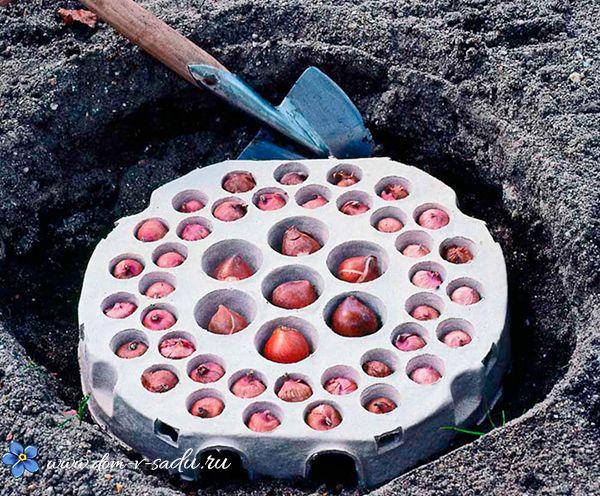
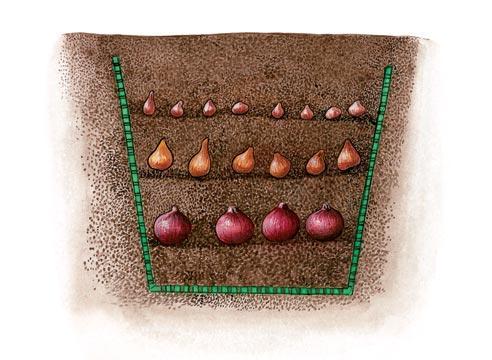
Algorithm of actions:
- Prepared soil is poured into the bottom of the basket, and the largest tubers are placed on top.
- There is a layer of soil on top again.
- Small specimens are laid out on it and covered with soil up to the very edge of the container.
- The baskets are placed in holes of a suitable size so that 5 cm of the container is visible above the ground level.
The advantage of this method is that when winter comes, tulips do not need to be dug up from the flowerbed; they overwinter well when planted in layers.
How to care for a plant
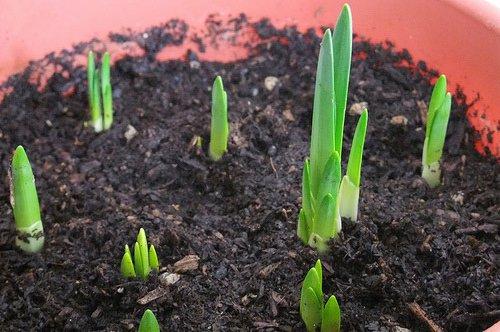
After the first shoots emerge from the ground in spring, the plants are provided with proper agricultural care.
Watering and nutrient application
Tulip beds need to be watered regularly, but avoid waterlogging. A dry soil crust also negatively impacts plant development. Watering should be done once a week, using 10 liters of water per square meter of plantings.
The first application of nutrients is done as soon as the tulips emerge from the soil. At this stage, the plants require fertilizers with a higher nitrogen content to ensure rapid growth and foliage growth. Nitroammophoska or crystalline fertilizer with added micronutrients are used.
Preventive treatments
To prevent diseases and pests from affecting tulips, preventative treatments are carried out. Before storing, bulbs are soaked in a fungicide or potassium permanganate. Other preventative measures include:
- Crop rotation.
- Preventing excess nitrogen in the soil.
- Treating the soil with fungicides before planting flowers.
- Preventing dense plantings.
- Regular weeding and destruction of infected specimens.
- Storing bulbs in cool, low-humidity areas.
Trimming
Tulip foliage and stems should not be trimmed immediately after flowering, as they contain nutrients needed for bulb storage. This procedure should be performed when two-thirds of the stem has turned yellow.
Shelter during the winter period
Tulip bulbs need to be insulated before the winter frosts. The type of covering depends on the growing region. In southern regions, a layer of dry leaves is sufficient, while in northern regions, additional covering with spruce branches or any natural material is required. With the arrival of the first warm days, the insulation is removed to prevent the bulbs from rotting.
Analogues of baskets for bulbous plants
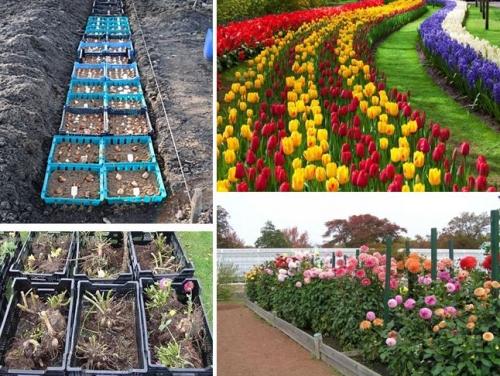
If the store doesn't have any baskets for planting tulips, use containers that are found in every home.
Pots
Holes are made in ordinary plastic pots for water drainage and they are used for planting tulip bulbs.
Bottles
You can also make flower containers yourself:
- Take a plastic bottle with a volume of 5 liters.
- Using a sharp knife, cut off one of the side parts.
- On the other one, rectangular holes are made.
- Holes are cut in a checkerboard pattern at the bottom of the bottle.
Grids
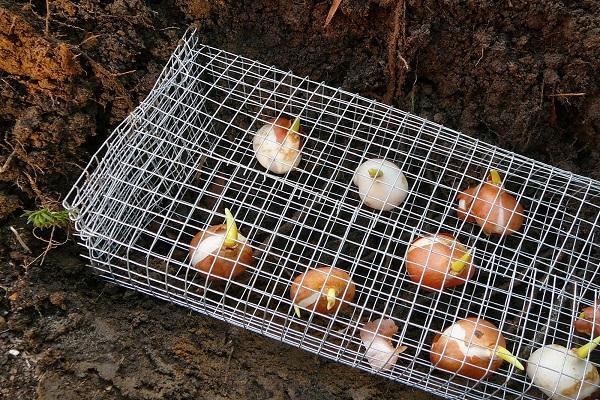
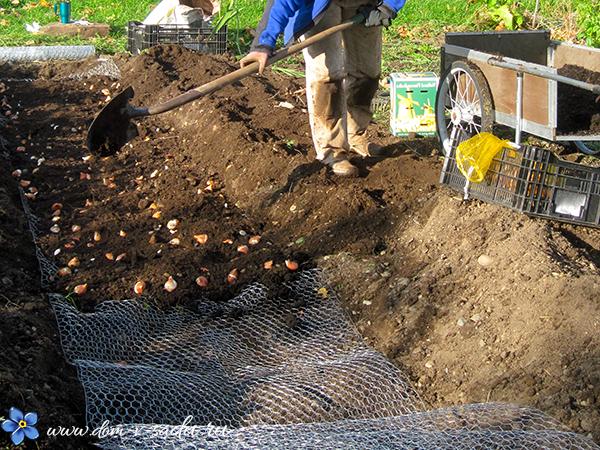
Nets are also used for planting tulip bulbs. They are laid along the sides of the hole, sand is added to the bottom, the bulbs are placed on top, and the prepared soil is covered. The disadvantage of this method is that rodents can damage the nets.
Containers
Containers with holes are an ideal replacement for baskets. They allow plants to receive adequate air and nutrients, and prevent water from stagnating after watering.
Boxes
Vegetable boxes are large, so they are often used for tiered tulip plantings. When choosing flower containers, consider the planting method and the size of the flowerbed.
Related posts:
 When is the best time to plant tulips in open ground? Timeframes by region and rules.
 Top 10 methods and rules for treating tulips in the fall before planting
 How to plant tulips beautifully: diagram and ideas for landscape design
 When and how to plant tulips in the Urals in autumn and care for them outdoors
 Description of the top 20 most beautiful tulip varieties and types, their planting and care
 Timing and rules for replanting tulips in the fall, further care
 How to prepare and store tulip bulbs, possible difficulties
 The best eggplant varieties for growing in a polycarbonate greenhouse: planting and care