
- Characteristics of Japanese gladiolus
- Application in landscape design
- Varieties of Montbretia
- Lucifer
- Star of the East
- Norwich Canary
- Emily McKenzie
- Paniculata crocosmia
- How to plant a flower in a garden
- Preparing the seedling and planting site
- Timing and rules for planting Chinese gladiolus
- Specifics of plant care
- Irrigation
- Fertilizing the bushes
- Loosening the soil
- Tying up
- How to prepare a flower for cold weather
- Rules for storing bulbs
- Difficulties in growing and care
Japanese gladioli are a perennial plant that graces garden beds and parks with their abundant and long-lasting blooms. The plant's popularity stems from its lush clumps of decorative foliage and the varied color palette of its paniculate inflorescences, allowing for the most unusual landscape design ideas to be realized.
Characteristics of Japanese gladiolus
Japanese gladiolus is a member of the Iridaceae family. It is characterized by a slender, branched stem up to 1-1.5 m tall and a two-tiered root system. This easy-to-grow bulbous plant boasts lush, long-lasting blooms, which begin in early summer and continue into late autumn. Its main distinguishing features are its delicate, graceful flowers in a variety of shades and leaves that grow up to 60 cm, forming dense clumps. Japanese gladiolus is also known by the following names: crocosmia, montbretia, and tritonia.
Application in landscape design
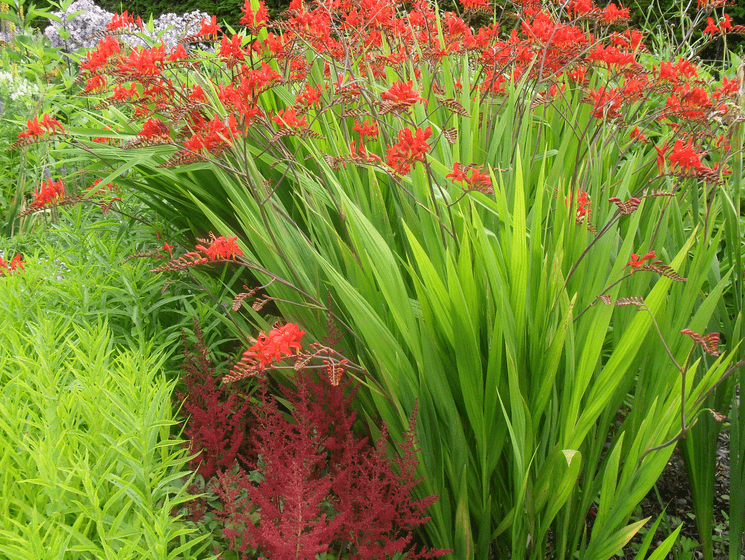
This beautiful plant can enhance any flowerbed, which is why designers prefer this flower when designing landscapes:
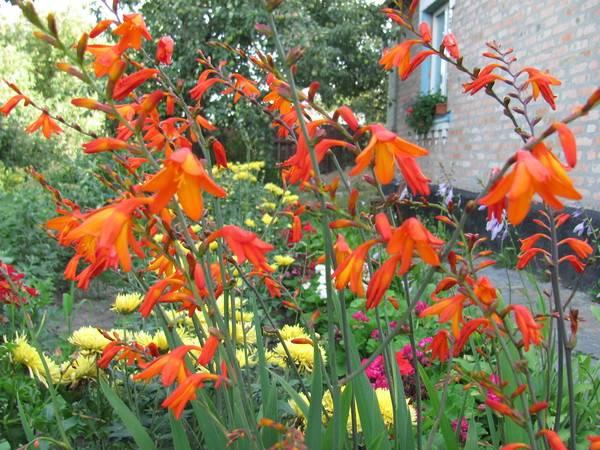
- Chinese gladiolus looks spectacular with such crops as dahlia, echinacea, and daylily.
- Good neighbors for montbretia are ornamental grasses and representatives of cereal crops.
- Flowering crocosmia is often placed against a background of low-growing plants, in the first rows of mixborders.
- Japanese gladiolus is also used as a groundcover plant in gardens.
- This bright perennial can be planted in groups in the middle of the lawn or along borders.
- Looks great with lushly blooming dahlias and bushy salvias.
Tip! This plant is recommended for cutting, as the inflorescences last for over 10 days in water. Dried flowers retain their color and shape for a long time, making them ideal for winter bouquets.
Varieties of Montbretia
Popular varieties of Japanese gladiolus that can often be found in flower beds include:
Lucifer
A vibrant plant that can reach a height of 1.5 m, this cultivar produces upright stems bearing red flowers that are eye-catching from July until late autumn.
Star of the East
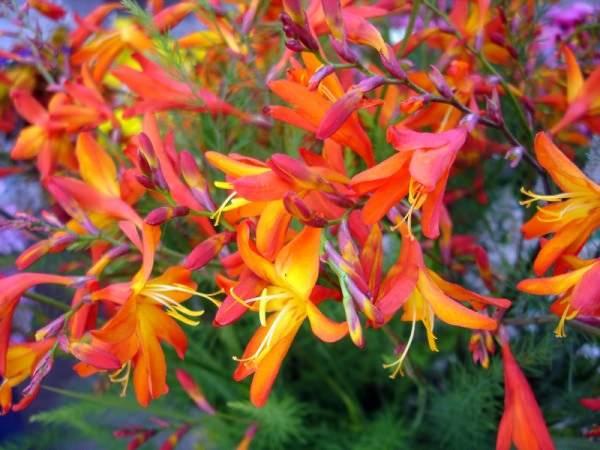
An ornamental variety, up to 1.0 m tall, distinguished by large, star-shaped flowers up to 10 cm in diameter, painted a vibrant orange-apricot color. The buds are strikingly orange. Flowering begins in late autumn.
Norwich Canary
A striking flower, reaching no more than 60 cm in height, it attracts attention with its beautiful yellow buds. The plant looks very decorative next to other contrasting garden plants.
Emily McKenzie
A graceful ornamental plant, 60 cm tall, it catches the eye with its brown-orange flowers, gathered in a symmetrical spike. The centers of the petals are adorned with red spots. The EmilyMcKenzie gladiolus blooms late.
Paniculata crocosmia
This species has earned its popularity due to its highly decorative qualities. The plant grows to a height of 1.2 m. Light green, lanceolate leaves up to 60 cm long adorn the plant. Paniculate inflorescences open from the branches of the slender but flexible stem. They form in July and delight the eye until the end of September. The petals are red, orange, or yellow. The buds open from the base outward.
How to plant a flower in a garden
To ensure abundant and long-lasting flowering of the Japanese gladiolus, you need to choose the right site, prepare the soil, know the timing and technology of planting, and create conditions close to the plant's natural habitat.
Preparing the seedling and planting site
When planting bulbs, it's important to soak them in a warm room for 2-3 days before planting. Two hours before planting, treat the bulbs with a dilute potassium permanganate solution to disinfect, encourage root formation, and stimulate growth.
The plant prefers loose, well-drained, humus-rich soil. It thrives in sunny, draft-free areas.
Important! When planting gladiolus in the shade it will stretch out and will not delight you with flowering.
In the fall, the flowerbed where the crop is to be planted must be prepared by digging and adding organic matter to the soil with the addition of slaked lime and superphosphate.
Timing and rules for planting Chinese gladiolus
There are two standard methods for planting montbretia: by seed or bulbs. Planting from seeds should be planned for February-March, sowing the seeds in pots in a sunny location. By May, the plant will have grown, and it can be transferred to the garden bed along with the root ball to ensure successful establishment. Gladioli grown from seed will delight you with their lush blooms in the second or third year after planting.
Planting with corms involves planting the material in mid-April, when the soil temperature reaches 8°C (46°F). It's important to maintain a distance of 10 to 12 cm between the corms and plant the corms 8 to 12 cm deep, depending on their size.

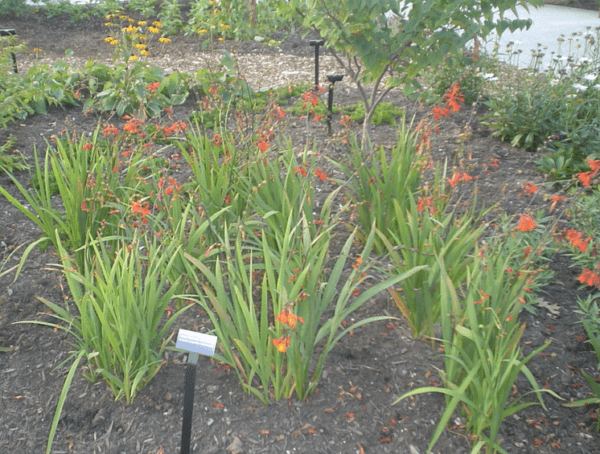 Tip! When planting multiple varieties of a crop in a plot, maintain a distance between plants to prevent cross-pollination and maintain the purity of the variety's lineage.
Specifics of plant care
Japanese gladiolus is an easy-to-care-for plant, so care is minimal. Standard techniques such as watering, loosening the soil, fertilizing, tying, and preparing for winter will allow you to decorate any corner of your garden with exquisite blooms.
Irrigation
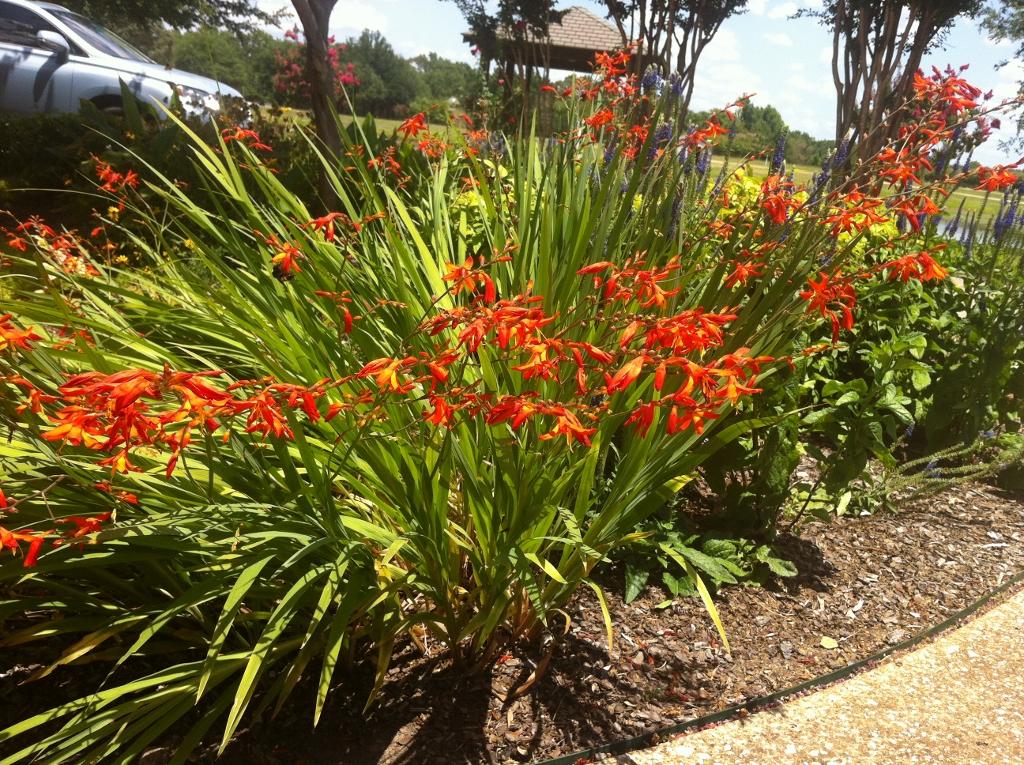
Water the plant 2-3 times a week. During hot weather, increase the amount of water, preventing the soil from drying out. If the summer is rainy, reduce or stop watering altogether. Overwatering and waterlogging can cause the bulbs to rot, and in dry soil, the plant loses its decorative appeal, as the buds will wilt and fall off.
Fertilizing the bushes
During the entire growing season, it is recommended to carry out several additional feedings:
- Before flowering, apply a mineral complex at a rate of 3 g per 1 liter of water. Apply nutrients at least twice.
- At the moment of bud formation, use potassium substances, 2 g per 1 liter of water.
- During flowering, water the plants with a mullein infusion (1:10). Fertilize twice a month.
Montbretia prefers fertile soil, so this stage of care should not be ignored.
Loosening the soil
After watering and rain, regularly loosen the soil around the bushes to prevent water from stagnating and allow air to reach the roots. This should be done carefully and shallowly to avoid damaging the bulbs.

Tying up
Some tall varieties require staking, as the stems bend and break under the weight of the flowers. To do this, install a support and tie the plants to it using soft rope. If you have numerous flowers, it's a good idea to construct a slatted structure. Install this structure in the spring, burying the flowers 8-10 cm into the soil.
To maintain the decorative effect, it is better to tie up the plants while the shoots are still short and positioned strictly vertically.
How to prepare a flower for cold weather
In southern regions, Japanese gladiolus can be left in the ground for the winter. Mulch the plant with fallen leaves, bark, straw, or sawdust. The mulch layer should be at least 20 cm thick and covered with plastic film. Remove the mulch once warm weather arrives in spring.
Rules for storing bulbs
In northern regions, bulbs must be dug out of the soil. This is important before frost, when the plant's foliage turns yellow. Then, cut the stem of the dug bulb 5 cm from its base. Afterward, dry the bulb in the shade or in a room with a temperature of 10 degrees Celsius.
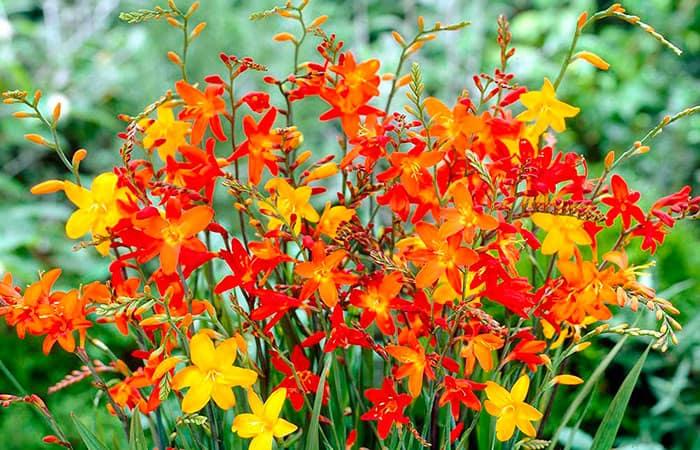
After drying, store the corms in boxes with sawdust and place them in a room with a temperature of 5°C (41°F). A basement or cellar can serve as a storage place. You can also store the corms in the refrigerator, placing them on the bottom shelf, wrapped in paper or cotton cloth.
Difficulties in growing and care
When growing Japanese gladiolus, there is a risk of problems, most of which are associated with fungal infections and harmful insects:
- Japanese gladiolus can be susceptible to fungal infections when grown in flooded soils. Repotting and treating with fungicides can help combat these.
- The crop can become a breeding ground for harmful insects such as thrips, spider mites, and wireworms, which damage the flower both during growth and storage. Broad-spectrum insecticides can help combat these pests.
- When grown, the stem often leans to the side and grows crooked, losing its decorative appeal. This can be caused by bulbs being planted too shallow, a calcium deficiency in the soil, or an excess of nitrogen.
- Lack of flowering may be due to poor lighting, lack or excess of moisture, and poor quality fertilizer.
- Drying of leaves can be caused by improper care, as well as pest infestations and an incorrectly chosen planting location.
Japanese gladiolus can become the centerpiece of any flowerbed. Tall and low-growing, with a diverse palette of colors, they make an incredibly attractive landscape plant. They are easy to care for, especially if you pay attention to planting material.
Related posts:
 Description of the fragrant gladiolus Acidanthera, planting and care in open ground
 Description of the Byzantine gladiolus, planting and care for the variety in open ground
 How to propagate and grow peas, cultivation technology, and care in open ground
 How to properly plant peas in a greenhouse and open ground
 Description and characteristics of wild and cultivated varieties of gladioli
 How to grow ginger in the open ground at your dacha, planting and care
 Description of varieties of sowing peas and cultivation, to which family they belong
 Planting and caring for gladioli in open ground, growing and the best varieties