
- The history of sakura
- Distinctive features of cherries
- Flowering time
- Features of application in landscape design
- Popular varieties
- Kanzan variety
- Kiku-Shidare variety
- Cherry Tai Haku
- Sakura Oshidori
- Sakura Payan
- Royal Beauty
- Fukuband
- Royal Burgundy
- Specifics of planting crops
- Basics of caring for ornamental cherry trees
- Watering
- Top dressing
- Trimming
- Disease prevention
- Preparing for winter
- Diseases: treatment and prevention
- Bacterial cancer
- Milky shine
- Fungal burn or moniliosis
- Hollow spot
- Late blight
The finely serrated cherry tree, known worldwide as the sakura, is widely used in urban landscaping. From mid-spring onward, the admiring glances of passersby are captured by the pink clouds floating over the avenues of Tokyo, Paris, Hamburg, and New York. There are 16 species and over 400 varieties of ornamental cherry. In Russia, the sakura's closest relative is the bird cherry.
The history of sakura
The sakura blossom entered European culture as a national symbol of Japan. Images of the plant can be found on clothing and household items. Cherry blossoms adorn the coats of arms of the military and police, and they are the most commonly depicted on traditional kimonos.
One of Japan's most vibrant traditions, "Hanami" (cherry blossom viewing), is recognized as an official holiday. The blossom season is officially opened by the imperial couple in Tokyo's central park.
Japanese Buddhists see the cherry blossom as a symbol of the frailty and transience of life, echoing the beautiful, sad legend of the cherry blossom: “By the command of the sun goddess, her grandson, the young god Ninigi-no-mikoto, the progenitor of emperors, descended from heaven, at the head of a host of deities-progenitors of ancient families.
The mountain god's daughters—the Maiden of Flower Blossom on Trees, Sakuya-bime, and the Maiden of Longevity on Rocks, Iwanaga-hime—came to him to become his wives. But Ninigi rejected the unattractive Maiden of Rocks and married only his younger sister, the beautiful Maiden of Flower Blossom.
The elder sister became angry and said to him: "If you had come to me, we would have had children who would have become as powerful and eternal as rocks, but you chose flowers. Children born to the Flowering One will be as fragile and short-lived as the flowers on the trees blooming in spring."
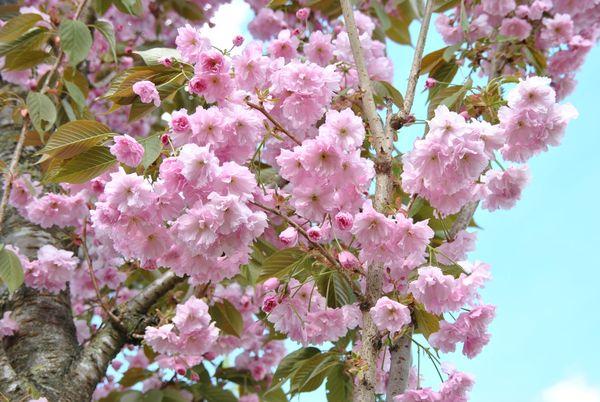
Since then, human life has become like cherry blossoms, just as beautiful, but fleeting.
Distinctive features of cherries
Sakura is a purely ornamental plant. Its fruit is tart and sour, with a large stone and thin flesh. Cherries are not suitable for consumption, although salted sakura petals are traditionally used in tea and rice cakes during the Hanami festival.
The Japanese learned to make wine from cherry blossoms.
Flowering time
Cherry blossom timing depends on the specific plant variety and the climate. In Japan, early varieties bloom by the end of February, with the main bloom period occurring from late March to the first half of April. The flowers last from one to three weeks.
Features of application in landscape design
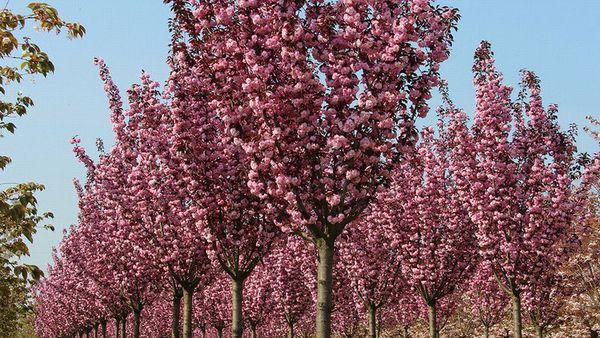
It's no coincidence that cherry blossom trees are planted in rows along the paths. Mature trees intertwine their crowns, creating arches of bloom. The trees look especially beautiful when they are finishing their blooms. Fallen cherry blossoms line the path, and pink blossoms alternate with new foliage on the branches.
Sakura can enhance any garden, either as a solitary plant or among a group of other perennials.
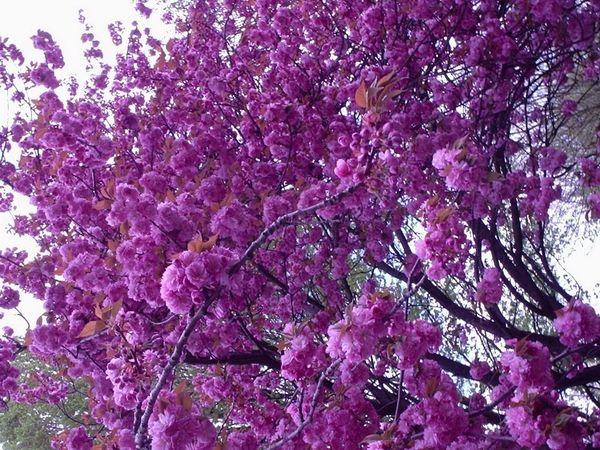
The cherry blossom period, regardless of the color of the variety (white, yellow, pink), is well played out with compact conifers in topiary.
The weeping form of the sakura creates a unique accent in a Japanese garden. The standard form of the Japanese cherry tree looks stunning next to a pond, against a simple border of arborvitaes or boxwood.
The bonsai technique allows one to obtain a dwarf form of sakura, which can then be planted in open ground.
Popular varieties
Thanks to the efforts of breeders, today gardeners' arsenal includes varieties of finely serrated cherry trees of various shapes, shades, colors, and leaves.
Japanese breeders distinguish the "yaedzakura" variety, or eight-layered sakura. This category includes varieties with double flowers, some of which rival the peony or chrysanthemum in petal count (Ichie, Fugenzo, Yaebenishidare, Kikuzakura).
One of the most popular terry varieties of the plant is Kanzan.
Kanzan variety
The mature plant reaches 12 m in height, with a broad crown extending 5–6 m around the trunk. The main (skeletal) branches extend upward, while the secondary branches have a drooping shape.
The bark of young plants has a bright, reddish-brown color; as they age, the shade becomes muted and the bark becomes covered with a network of small cracks.
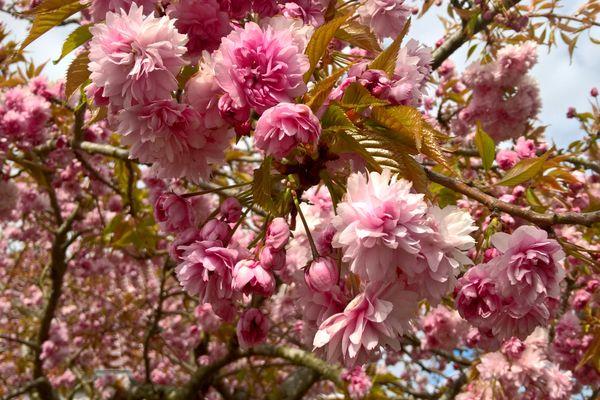
The leaves are very decorative, dense, glossy, and up to 12 cm long. Young sakura foliage has a bronze hue, but over time it acquires a rich green color, and as it ages, it turns bright orange.
Like all double-flowered varieties of finely serrated cherry, Kanzan blooms late. Flowering begins in the first half of May and lasts 10 to 14 days. The average flower diameter is 5-6 cm.
Purple buds open into densely double, fragrant, pink flowers. Sakura blooms in clusters of 3-5 blossoms. This variety is characterized by abundant flowering, beginning when the plant is two or three years old.
Kiku-Shidare variety
Sakura can be grown as a tree or a large shrub. It has a beautiful, rounded crown and drooping branches. Cherry trees grow quickly, adding up to 30 cm per year.
By the age of 10, it can reach a height of 1.2-1.5 m with a crown width of up to 1 m. An adult plant has a height of about 4 m with a diameter, and a crown width of more than 3 m.
In the first ten days of May, the Kiku-Shidare cherry tree is covered in fragrant, double, purple-pink flowers. They are slightly smaller than those of the Kanzan variety, reaching no more than 4 cm in diameter.
The variety begins to bloom profusely in the 3rd year after planting.
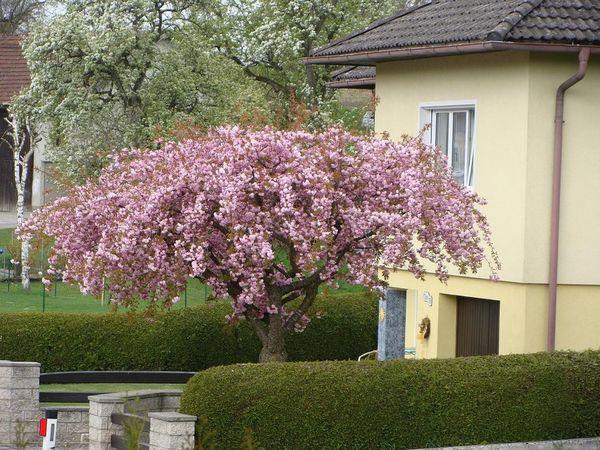
The foliage is bright green, turning bright yellow with an orange tint in the fall. This is an ideal variety for a small garden. It is drought- and frost-resistant (down to -28°C). 0 C), prefers well-fertilized soils.
Cherry Tai Haku
A favorite of European gardens, Tai Haku was brought from the Land of the Rising Sun in 1900. The British call it the "Magnificent White Cherry" for its enormous (up to 6 cm) flowers. When blooming, Tai Haku resembles an apple blossom, with pink buds gradually revealing snow-white, five-petaled flowers.
This medium-sized (4-7 m) tree has bright, decorative foliage: light red in young leaves, yellow-orange as they mature. The plant can be cultivated as a shrub.
Sakura Oshidori
A dense bush with a spreading crown, it grows up to 2.5 m tall. Flowering occurs in mid-spring. The flowers are densely double, large, and soft pink at the edges, darkening toward the center.
Sakura Payan
Another compact cherry variety, growing up to 2 meters tall as a tree or shrub. The flowers are dark pink, double, with a white center. The foliage is small, bright, and light green. By autumn, it turns reddish-yellow.
Royal Beauty
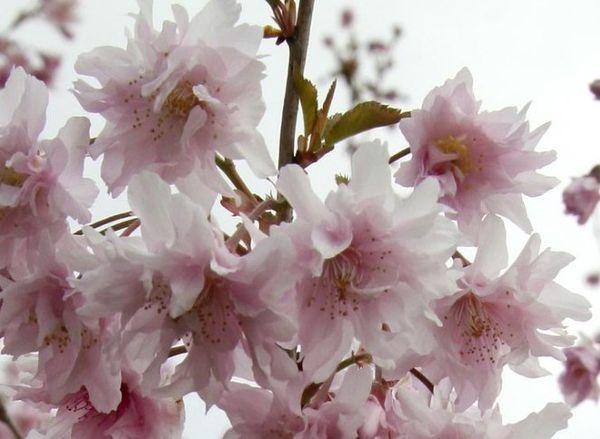
This low-growing plant, up to 2 meters tall, has a beautiful bushy shape. Its dense, branched crown, at its peak in bloom, resembles a purple-pink fountain.
The weeping branches are covered with vibrant purple-pink flowers. The double flowers, unlike other varieties, have long, drooping stalks.
Fukuband
The Fukuband cherry tree grows no taller than 2.5 m and has a compact, spherical crown. Its leaves are dark green, large, and glossy. It produces small (2-2.5 cm) pink flowers in a flat rosette. It is recommended for landscape planting in small gardens and looks good as a bonsai.
Royal Burgundy
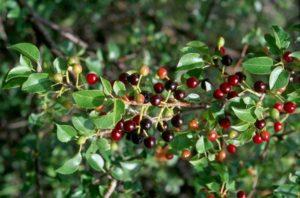
This vibrant, decorative variety reaches a mature height of 4-6 m, with a conical crown up to 3 m wide. It was named Burgundy for its unusually colored leaves. They are large, elongated oval-shaped, dark purple, and glossy.
Autumn foliage turns orange. Flowers are purple-pink, double (up to 6 cm), and clustered in inflorescences of 3-5 along the branches. Blooming is profuse, lasting 10-14 days from late April.
Specifics of planting crops
In temperate climates, varieties with high frost resistance should be purchased.
For abundant flowering and rapid growth, the plant requires certain conditions:
- good lighting: if there is not enough light, the cherry blossoms will stretch out too much and the branches will look deformed;
- the soil must have a neutral pH;
- the place should not be drafty or blown through from all sides;
- The soil should be loamy, but not too heavy. For proper root development, moisture and air permeability are essential;
- You cannot plant ornamental cherry trees in lowlands where there is a risk of the roots getting wet during rain or snow melting.
The ideal place for planting the plant is a gentle slope on the southwest side of the building.
Seedlings should be purchased from specialized stores or nurseries; they are grafted onto more resilient varieties adapted to local climatic conditions.
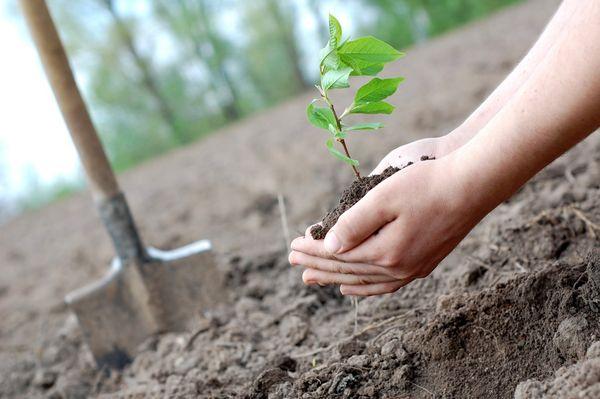
Requirements for seedlings:
- absence of dry, damaged parts on the roots, if the seedling is sold with an open root system (ORS) and branches;
- there should be no signs of rot or suspicious swelling on the roots;
- The optimal age for planting is 1 year, the recommended seedling height is 60-80 cm.
It's best to plant cherry trees in the spring, and they're usually purchased in the fall, after the foliage has died back. Before planting in its permanent location, the seedling can overwinter in a basement or trench.
For a small cherry tree sapling, digging a planting hole up to half a meter in diameter is sufficient. A drainage layer of at least 10 cm is placed at the bottom. A fertile layer of a mixture of equal parts compost and turf soil is placed on top, reaching two-thirds of the way up.
The seedling is placed in the center, with its roots spread out. To ensure the young tree grows straight and does not lean, a straight, sturdy support can be installed nearby.
Add the remaining soil over the roots, compact it, and water thoroughly. Do not bury the root collar (the grafting point of the cultivar onto the rootstock) of the cherry tree.
If the soil has settled after watering, add more and water again. This is to prevent air pockets from forming around the cherry tree's roots.
Basics of caring for ornamental cherry trees
The tree is most vulnerable during the first season after planting. Regular watering and inspection are necessary to detect diseases early.
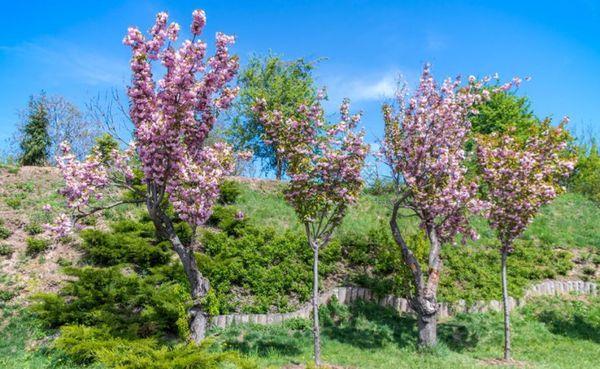
Watering
Mature sakura trees are unpretentious, but during dry periods, it's recommended to water the soil around the roots thoroughly once a week. For lush and abundant flowering, it's important to keep the soil around the tree from drying out while the cherry blossoms are forming.
Top dressing
The finely serrated cherry tree displays its decorative qualities best in rich, well-fertilized soils.
Sakura is fertilized with organic matter (compost, humus), which contains nitrogen and is necessary for growth, as well as mineral fertilizers containing phosphorus and potassium for flowering.
Fertilizer is applied to the soil around the tree trunk when watering. The water penetrates to the cherry tree's roots, helping the plant absorb nutrients more quickly.
Trimming
Cherry trees undergo sanitary pruning. This is done in the fall, after the leaves have fallen, or in early spring, before the buds emerge. Garden tools are disinfected before use.
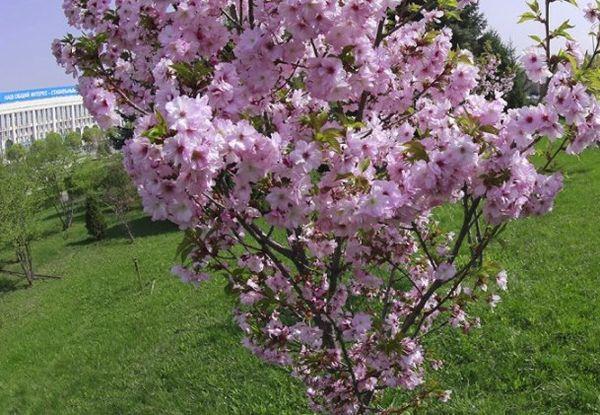 It's important to choose dry, warm weather to prevent the development of fungal diseases. Remove dead, damaged, and diseased branches.

After cutting off large branches, the cut areas must be treated with garden pitch.
Disease prevention
The main rule of prevention is regular inspection of the cherry tree. The plant is susceptible to fungal diseases, and infection must be stopped early.
The pathogens are fungal spores that overwinter in the soil, fallen leaves, and diseased tree tissue. If plant debris is not burned after sanitary pruning, the disease will attack cherry tree seedlings again in spring.
Preparing for winter
It's important to remember: nitrogen fertilizers are applied in the first half of summer, and subsequent fertilizing should be done only with potassium and phosphorus. Nitrogen stimulates the plant to expend energy on growing green mass rather than preparing for winter. Even mature cherry trees can freeze, and young plants may not emerge from winter at all.
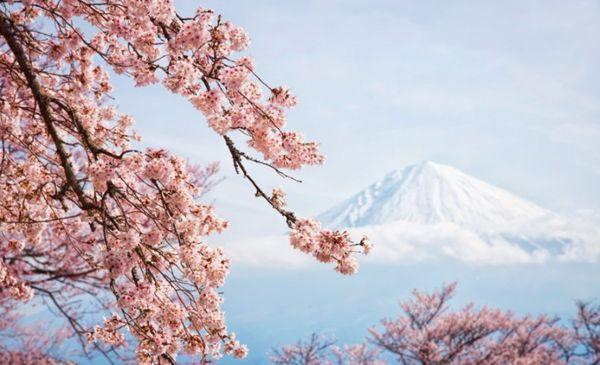
Before frost sets in, wrap the cherry tree trunk with a thick covering material, paying particular attention to the grafting site. High-density agrofibre is used for the base of branches and crowns of low-growing varieties. Covering materials allow the plant to "breathe" and allow essential moisture to pass through.
Diseases: treatment and prevention
Fungal diseases spread in damp, warm weather.
Spores can be brought to the cherry tree by wind, insects or birds.
Cherry blossom diseases can be treated with seasonal fungicide treatments. Regular inspection of the plant is important to prevent the spread of infection.
Bacterial cancer
The disease attacks the trunk and shoots of cherry trees through mechanical damage, spreading through the tree's blood vessels. Initial symptoms may not be apparent. In the late stages, growths—the disease's foci—appear on the roots (underground) and visible parts of the plant.
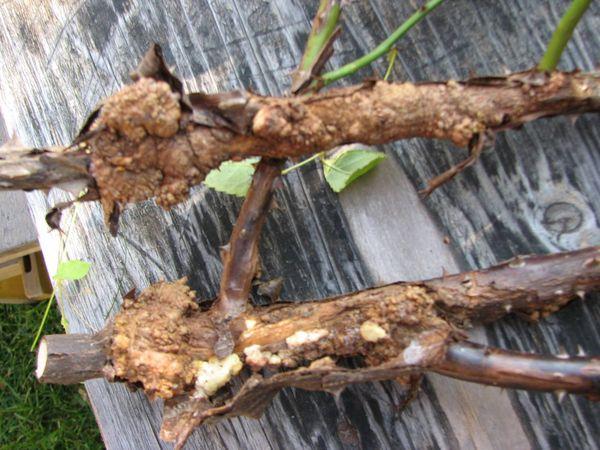
Characteristic symptoms:
- dark spots on the root collar and branches of cherry trees;
- the bark becomes covered with a resinous substance;
- the upper part of the branches dies off;
- leaves turn yellow and fall off out of season.
The causative agent of bacterial cancer is the pathogenic bacillus Agrobacterium.
Milky shine
The disease remains poorly understood, and the pathogen has not been identified. Symptoms are noticeable only during the active stage of infection. It is identified by a characteristic silvery sheen on the leaves and grayish-blue spots on the bark of the cherry tree. The cut of an affected plant is unusually dark in color.
Fungal burn or moniliosis
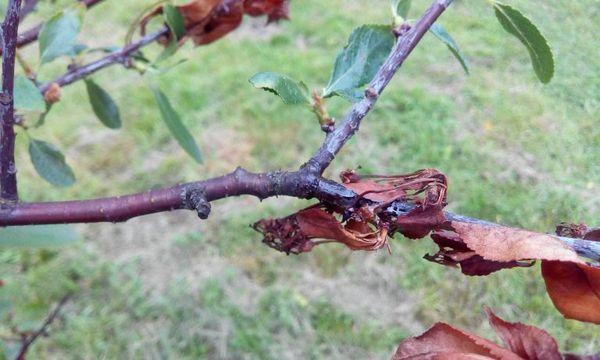
The infection enters the plant during the flowering period. The above-ground parts of the cherry tree are gradually affected through the blossoms. Cherry blossoms stop blooming, dry out, the foliage curls, and branches die. The diseased cherry tree appears as if it has been burned by chemicals.
Monilia blight is caused by the bacterium Monilia cinerea. A characteristic feature of the disease is its high recurrence rate.
Hollow spot
The disease is called Clasterosporium leaf spot, and is caused by the spore Clasterosporium carpophilum. Characteristic holes on the leaves appear from expanding brownish-red spots. If the disease has spread to large branches of the plant, treatment is not very effective.
Late blight
Phytophthora fungal spores attack all parts of the cherry tree. Longitudinal cracks form on the branches, and the foliage dies. Without timely treatment, the cherry tree dies.
With proper care, a healthy plant can not only delight the gardener with abundant flowering, but also cope with fungal infections at an early stage.
Related posts:
 Description and pollinators of the Vladimirskaya cherry variety, planting and care
 Description and cultivation of the best varieties of felt cherry, planting and care
 Description and varieties of Zhelezistaya cherry, planting and care
 Description and varieties of cherry variety Shpanka, planting and care
 Description of the 25 best cherry varieties for the Urals and Siberia, planting and care in open ground
 Description and characteristics of 17 dwarf cherry varieties, planting and care
 Description of the Zhukovskaya cherry variety, planting and care in open ground
 Description and characteristics of the miracle cherry hybrid, planting and care of the variety