
- The history of the Zhukovskaya cherry tree
- Growing area
- Advantages and disadvantages: table
- Description and characteristics of the culture
- Tree size and annual growth
- Pollinating varieties and flowering
- Fruiting and harvesting
- Useful properties and scope of application of berries
- What is needed to grow cherries?
- Planting technology
- Optimal timing
- In the spring
- In the fall
- Site selection and preparation
- We make a planting hole
- Planting a seedling
- We organize care for the variety
- Regularity of watering
- What to feed
- Loosening and caring for the tree trunk circle
- Pruning and crown shaping
- Shelter for the winter
- Cherry diseases and pests
- Struggle
- Prevention
- Gardeners' reviews of the variety
Crossbreeding cherries with sweet cherries has been around for a long time. This results in new fruit varieties with excellent flavor but very low yields. Hybrid tree varieties typically incorporate the best genes of the fruit crop, but the breeding process doesn't always produce the expected results. However, scientists continue to strive to create unique varieties, as exemplified by the Zhukovskaya cherry variety.
The history of the Zhukovskaya cherry tree
In the 18th century, an English scientist accidentally crossed a cherry and a sweet cherry, resulting in a new fruit variety. Then, in the late 19th century, the Russian scientist Michurin attempted to cross-breed fruit trees, producing the winter-hardy cherry variety "Krasa Severa" (Beauty of the North). In 1947, Michurin's research institute developed a unique, frost-resistant, and productive cherry variety, the Zhukovskaya variety. The cultivar's creators are credited to the renowned Soviet breeders Kharitonova and Zhukov, who subsequently developed numerous cherry tree varieties.
Growing area
This variety is recommended for cultivation in fertile and chernozem soils in temperate climates and southern latitudes. In northern regions, hybrid cherries often freeze and die. However, according to gardeners, with proper winter preparation, the plants survive harsh winters and bear fruit.
Advantages and disadvantages: table
Like any fruit crop, the Zhukovskaya cherry variety has not only advantages but also disadvantages.
| Advantages of the variety | Disadvantages of the variety |
| 1. Annual fruiting, abundant harvests. | 1. Trees do not have the ability to pollinate themselves. |
| 2. Large berries with excellent taste. | 2. Poor resistance to low temperatures. |
| 3. Ripe fruits do not fall from the trees. | 3. A large stone that occupies a significant part of the berry pulp. |
| 4. Natural immunity to fungal and viral infections. | |
| 5. Small size of the tree. | |
| 6. Simultaneous ripening of fruits. |
Important! The hybrid tree inherited most of its characteristics from the cherry, but the fruit's flavor is more reminiscent of that of the cherry.
Description and characteristics of the culture
The Zhukovskaya hybrid cherry possesses unique properties and characteristics inherent in this particular fruit variety.
Tree size and annual growth
Compact trees grow to a maximum height of 3 m, making this cherry variety suitable for small garden plots. The crown is spreading and rounded, with elongated, glossy leaves in dark green hues. Annual growth depends on proper care and agricultural practices. Under favorable growing conditions, annual growth ranges from 40 to 60 cm.

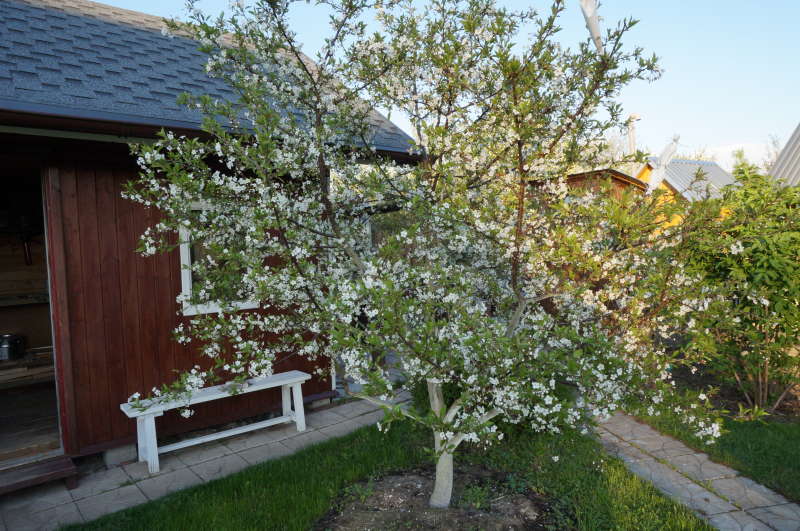 Important! The lifespan of a hybrid cherry variety is 18 to 20 years. The fruit tree maintains its high yield until it reaches 15 to 16 years of age.
Pollinating varieties and flowering
The Zhukovskaya cherry variety is unable to self-pollinate. To bear fruit, trees of this variety require the right pollinating neighbors. Excellent neighbors for the Zhukovskaya cherry include the Vladimirskaya, Lyubskaya, Shirpotreb Cherny, and Molodezhnaya varieties. Any cherry variety with similar flowering times will also serve as pollinators.
Flowering begins in the second half of May. Ovaries form on the main branches and year-old shoots.
Fruiting and harvesting
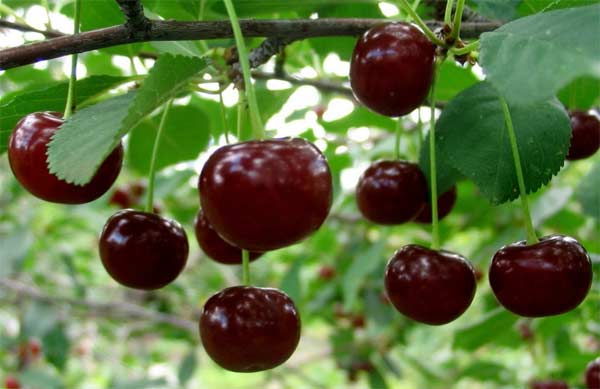
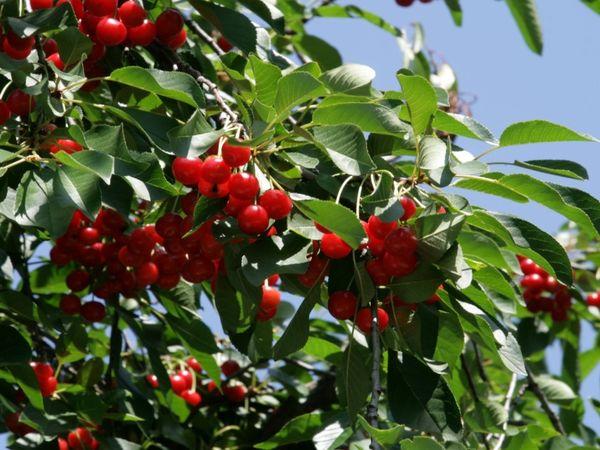
The garden crop begins bearing fruit in the fourth year of growth. The berries ripen primarily in the second half of July. A single cherry tree yields 12 to 30 kg of ripe berries. The fruits are large, weighing 4 to 7 g, dark burgundy in color, with juicy, sweet-tart flesh. The berries do not fall off after ripening, simplifying harvesting, storage, and transportation.
Useful properties and scope of application of berries
Zhukovskaya cherries contain a large number of vitamins and nutrients. This variety is considered versatile and is often used in the food industry. They are used to make juices, nectars, preserves, jams, and marmalades. The berries are also canned, frozen, and used in dairy production and confectionery.
Gardeners and vegetable growers use berries to make homemade wine and liqueurs.
What is needed to grow cherries?
This hybrid cherry variety tolerates drought well. Trees don't suffer from lack of moisture, but fruit yields decrease. Fruit trees are planted in fertile, loose soil enriched with vitamins and minerals.
Planting technology
Selecting a plot of land, observing the timing of planting seedlings, and preparing the soil are the main requirements for growing fruit trees.
Optimal timing
Depending on climatic conditions, planting seedlings in open ground is possible in spring or autumn.
In the spring
In regions with temperate and cold climates, planting is recommended in early April, before the growing season begins. The trees will establish themselves over the summer and easily survive winter dormancy. The site for spring planting is prepared in the fall.
In the fall
In southern regions with mild and warm winters, cherry trees are planted outdoors in the fall. The site for planting the seedlings is prepared in the spring.

Site selection and preparation
When selecting a site, special attention is paid to the proximity of groundwater, which should be at least 2 meters above the soil level. Otherwise, the tree is at risk of fungal diseases and root rot.
Hybrid cherry prefers sunny areas protected from winds and drafts.
If tree planting is planned for spring, the land is thoroughly tilled in the fall, and the soil is mixed with organic and mineral fertilizers. Lime is added to acidic soil, and sand and peat are added to clayey soil.

Important! Do not plant hybrid cherry trees of the Zhukovskaya variety in low-lying areas where meltwater accumulates or in marshy areas.
We make a planting hole
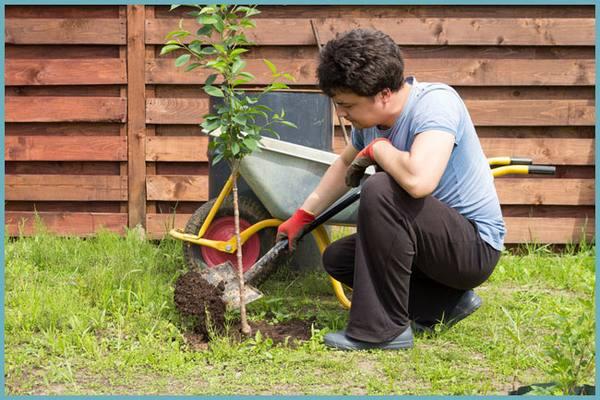
In the spring, before planting, the prepared area of land is carefully dug up.
- 2-3 weeks before planting seedlings in open ground, dig holes 60 to 70 cm deep and 80 to 100 cm in diameter.
- The distance between holes is at least 2.5 m, between rows 3 m.
- The soil from the holes is mixed with mineral fertilizers and humus.
- A drainage layer of small stones is poured into the holes and a support peg is inserted.
- Next, add nutritious soil into the hole and moisten it.
Note: Planting hybrid cherries is no different from planting other fruit trees, so even a novice gardener can handle the job.
Planting a seedling
It is recommended to purchase planting material from nurseries or garden centers. Inspect the rhizomes of the seedlings for damage, compaction, and moisture. The tree trunk should be straight and smooth, with branches, buds, or leaves.
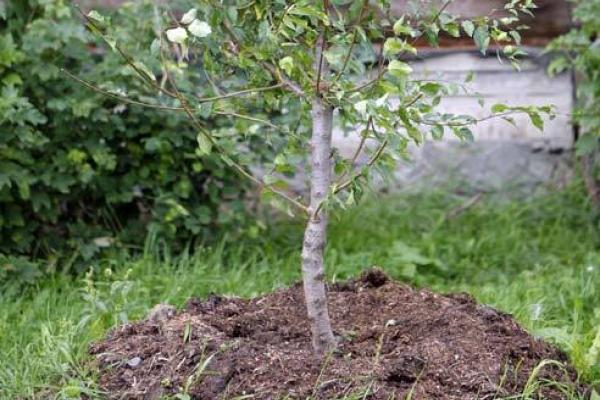
- Before planting in open ground, seedlings are left in water for 5-7 hours and then treated with antibacterial agents.
- A mound of nutritious soil is made in the hole, on which the seedling is placed.
- The rhizomes are carefully straightened and thoroughly covered with soil, leaving no voids.
- The soil is compacted and the soil around the seedlings is watered.
- The tree is tied to a support, and the soil around the trunk circle is mulched with sawdust.
Important! The soil around the tree will settle at first, so don't tie the sapling too tightly to the stake to avoid damaging it.
We organize care for the variety
The growth, development and fruiting of garden crops depend on properly carried out agricultural practices.
Regularity of watering
Adult trees are watered 4 times during the entire growing season.
- The first abundant watering is carried out when the tree is in bloom.
- Watering is required during the fruit formation period.
- The next watering is carried out at the beginning of autumn.
- The most abundant watering occurs before the plant's winter dormancy.
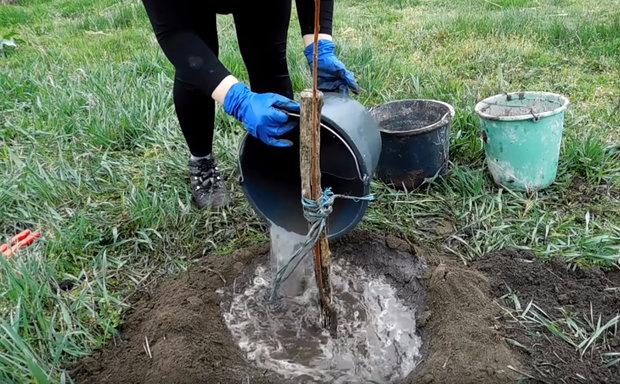
With each watering, 40 to 50 liters of moisture are poured under the tree; during the last watering before wintering, up to 70 liters.
Important! Young seedlings require more frequent watering during the first two years of growth than mature trees.
What to feed
Cherry trees begin to be fed and fertilized in their second year of growth. In spring and summer, the trees are fed with mineral fertilizers. In the fall, before winter dormancy, organic matter is added to the soil.
Loosening and caring for the tree trunk circle
Soil loosening is carried out after watering. This removes weeds and enriches the tree's roots with oxygen. Proper care of the tree's trunk area will help prevent the spread of pests, fungal infections, and viruses.
Pruning and crown shaping
After planting the seedlings in open ground, the tree crowns begin to be shaped. Each year, new tiers are formed on the main tree, leaving 3-5 of the strongest branches in each. The remaining shoots are pruned, and the cuts are treated with garden pitch. Mature trees undergo sanitary pruning in spring and fall. All damaged, broken, and frozen branches are trimmed, and the cuts are also treated with pitch.


Shelter for the winter
In southern regions, this garden crop easily survives mild winters. In temperate and northern latitudes, the hybrid Zhukovskaya variety requires additional insulation. The soil around the cherry tree is mulched with humus or manure. The mulch layer should be at least 15-20 cm thick. The plant trunk is treated with a lime solution and wrapped in special fiber or burlap. As soon as the first spring thaw arrives, the insulation is removed from the tree.
Cherry diseases and pests
Although the Zhukovskaya cherry tree has a strong immunity to some fungal infections, there are still many diseases and pests that can destroy the fruit crop.
Struggle
To combat viral and fungal infections, copper-based fungicides are used. To control pests, professional insecticides are used, which affect most of the unwanted guests.
 Important! Tree treatment solutions are prepared based on the age and size of the plant.
Prevention
Strict adherence to agricultural practices reduces the risk of diseases and pests. Also, preventative spraying of trees with special pesticides is carried out in the spring and fall.
Gardeners' reviews of the variety
Klara Vasilievna. Petrozavodsk.
Our Zhukovskaya cherry tree is over 15 years old. The tree is doing well and produces fruit every year. We planted the Vladimirskaya variety for pollination. Tree care is very simple; the only maintenance we do is spray the cherry tree for pests every spring. We water it twice throughout the summer. The yields are excellent, with large, sweet berries similar to cherries.
Ivanovich. Moscow region.
Our Zhukovskaya cherry tree is only six years old, but we've been harvesting for three years now. The berries are large, with large pits, juicy, and sweet and tart. My wife loves this cherry and makes jam and compotes from it every year.
Sergey. Kurgan.
A Zhukovsky cherry tree had already been planted on the property before I purchased it. No one had any idea how to care for it, so we left it to its own devices. The only thing I did was water it occasionally. But despite our best efforts to ignore the tree, it delighted us with a huge harvest of delicious, black berries in its very first year. Now we're thinking of planting more trees like it.
Related posts:
 Description of the 10 best black cherry varieties, planting and care in open ground
 Description and pollinators of the Vladimirskaya cherry variety, planting and care
 Description and characteristics of the Kharitonovskaya cherry variety, planting and care
 Description and characteristics of 17 dwarf cherry varieties, planting and care
 Description and characteristics of columnar cherry varieties, planting and care
 Description and varieties of cherry variety Shpanka, planting and care
 Planting and caring for cherries, feeding and growing rules
 Description and cultivation of the best varieties of felt cherry, planting and care