
- What are the characteristics of black-fruited varieties?
- Main differences from red-fruited
- Habitat
- The best varieties of black cherries
- Morel Bryansk
- Black Large
- Vladimirskaya
- Griot Rossoshansky
- Zhukovskaya
- Rossoshanskaya Black
- Anthracite
- Chocolate Girl
- In Memory of Voronchikhin
- Consumer goods Black
- How to plant on a plot
- Preparing seedlings
- Selecting a location and preparing a planting hole
- Technology of planting crops
- We organize care
- Watering
- Fertilization
- Formative and rejuvenating pruning
- Protection from diseases and pests
- Caring for the tree trunk circle
- Preparing for the winter period
Cherry trees have been known to mankind for over 1,000 years. The first mentions of the sweet and sour berries date back to the 11th century. Since then, numerous hybrid cherry varieties have been developed, incorporating the best characteristics of the fruit tree. Fruit tree varieties are divided into black-fruited, or morel, and red-fruited, or amorel. Black cherry cultivars have long since earned a strong niche among farmers and gardeners.
Ripe berries are eaten both raw and processed. Cherries are used to make aromatic compotes, juices, and nectars, as well as preserves and jellies, and are added to dairy products and desserts. They freeze well and can be stored frozen for a long time.
What are the characteristics of black-fruited varieties?
Black cherry varieties have the following characteristics:
- Trees of medium size, maximum height of an adult plant is 4 m.
- The crown is branched and spreading.
- The leaf blades are large, glossy, dark green in color, and serrated along the edges.
- On a mature tree the bark is grey, on young shoots it is dark green.
- High yields. With proper care and timely harvesting, a tree can yield up to 25 kg of ripe berries.
- During flowering, large flowers of white and pink shades bloom. Each inflorescence contains 2-4 flowers.
- Ripe berries are dark burgundy, almost black, with dark flesh and juice.
- The taste of the fruit is sweet and sour.
- The trees are resistant to severe frosts.
- Weak immunity to fungal and viral infections.
Important! Ripe berries often burst. Therefore, black cherries are harvested a few days before they reach full maturity.
Main differences from red-fruited
Unlike red cherry varieties, black fruit crops do not lose annual yield as the trees age.
Although red cherries are sweeter in taste, compotes and jams made from black berries are tastier and more aromatic.
Black fruits are larger and juicier, so they are more often used in the food industry.
The pulp of red berry varieties is light, and the juice is transparent, colorless.
Red cherry varieties are considered early ripening, while black fruits ripen towards the end of the summer period.
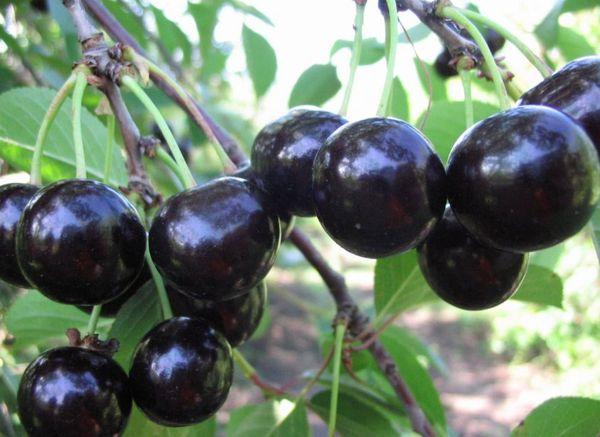
Habitat
Hybrid varieties of fruit crops differ from their originals in that they are more resilient to weather and climate conditions.
Varieties of black cherry are grown both in the hot climates of the southern regions and in the harsh climate zones of the Trans-Urals and Siberia.
The best varieties of black cherries
Black cherry varieties differ in tree size, fruit ripening time, and berry size.
Morel Bryansk
Although the cherry variety is called Morel Bryanskaya, the fruit crop was developed more than 200 years ago in the Netherlands.
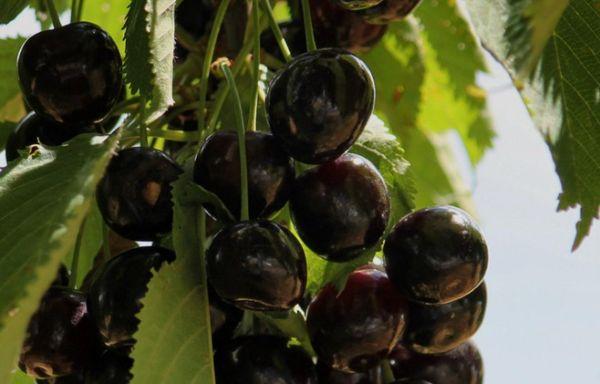
The trees are small, growing to a maximum height of 4 meters. The fruit is self-fertile, requiring no additional pollinators, and has excellent immunity to fungal and viral diseases. The fruits ripen late, producing large, juicy berries with a sweet and sour flavor.

Black Large
This frost-resistant hybrid fruit variety was developed in the 1990s by renowned breeder A. Ya. Voronchikhin. Almost 20 years ago, the Black Large cherry was added to the state register of fruit crops and recommended for cultivation in southern and temperate climates. This varietal is actively cultivated in the CIS countries.
A mature tree grows to 3-4 m. The crown is dense, spreading, and elongated. The first harvest occurs in the 3rd or 4th year of growth. To bear fruit, the tree requires pollinating neighbors with similar flowering times. The berries are juicy and large, weighing up to 8 g. Ripening occurs in early July.
This variety of fruit crop has weak immunity to diseases and pests.
Vladimirskaya
The history of the Vladimir cherry variety goes back centuries. It is believed that it was with this variety that cherry cultivation in Rus' began.
Depending on the climate zone and care, mature trees reach from 2.5 to 5 m. The crown is spreading, dense, and the leaves are sparse but large.
The harvest ripens in mid-July. The grapes are medium-sized, dark burgundy and black in color, juicy, and sweet and sour.
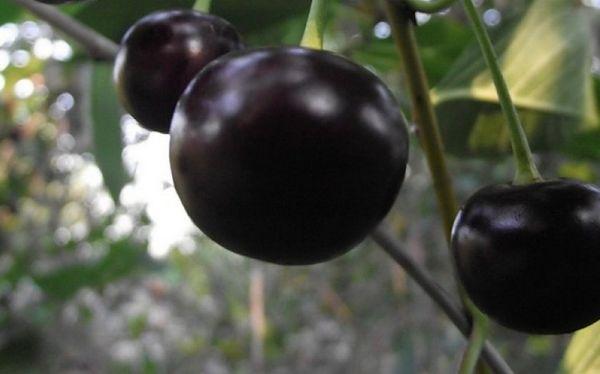
Trees easily tolerate sub-zero temperatures, but after severe and prolonged frosts, the yield drops.
Vladimir cherry trees don't bear fruit without pollinating neighbors. Therefore, cherry varieties with similar flowering times are planted nearby.
Griot Rossoshansky
Varietal variety Griot cherries Rossoshansky was developed by Russian breeders. Mature trees grow up to 6 meters, with an oval crown shape and multiple shoots and leaves.
The berries ripen in mid-summer. They are medium-sized, dark burgundy in color, and have juicy, sweet-and-sour flesh.
Zhukovskaya
The Zhukovskaya cherry is a bush variety. A fruit crop on its own.
pollinated, has high natural immunity to fungal and viral infections.
Fruiting begins 3-4 years after planting in open ground. A single mature tree can yield up to 25 kg of ripe berries. Frost resistance makes it suitable for growing cherries in northern latitudes.
The berries are large, from 4 to 7 g, dark burgundy in color, with a rich sweet and sour taste.
Rossoshanskaya Black
This self-fertile cherry variety was developed at the Rossoshansky nursery at the horticultural station. This fruit tree tolerates frost well but has weak immunity to many diseases.
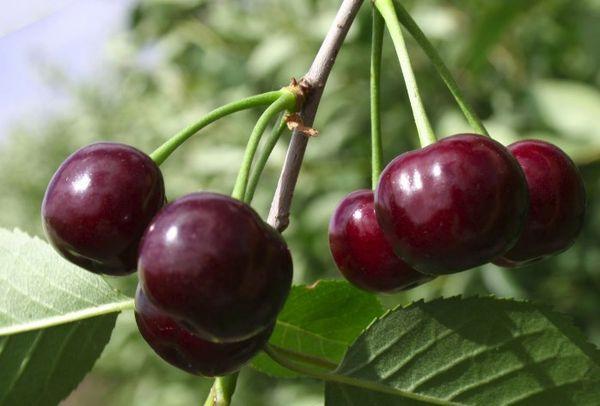
The berries ripen in late July. The fruits are medium to large in size, dark in color, with firm skin and a sweet and sour taste.
Anthracite
A new fruit variety, developed in the city of Oryol, has been available for cultivation since 2006. This small cherry tree grows to a maximum of 2 meters, making it much easier to care for and harvest ripe berries. The tree is partially self-pollinating, but to obtain a high-quality and abundant harvest, it requires cherry trees of other varieties.
The fruits are large, from 4 to 6 g, dark, almost black in color, with dense skin and juicy pulp with a sweet and sour taste.
Chocolate Girl
A variety of the Shokoladnitsa variety, developed at the end of the last century. Thanks to experienced scientists, the variety was created taking into account the best characteristics of the fruit crop.
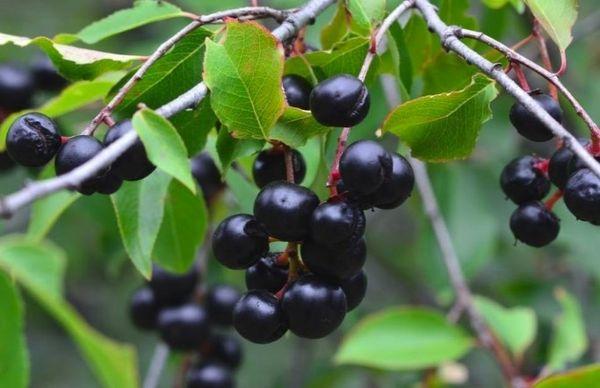
A mature tree will only grow to 2.5 m, which makes it easier cherry tree care and harvesting. The garden plant pollinates itself, but if there are other cherry varieties nearby, the crop's yield increases.

Fruiting begins in the third or fourth year of growth. The harvest ripens in the second half of summer, reaching up to 15 kg per tree.
The fruits are large to medium-sized with brown skin and sweet, dark flesh.
In Memory of Voronchikhin
A self-fertile variety of fruit crop was developed by Russian breeders at the beginning of this century.
The trees are tall, reaching 5 m. The fruits are large, from 5 to 7 g, dark purple and black shades, with sweet and sour, juicy pulp.
Fruiting depends on the climatic features of the region and weather conditions.
Consumer goods Black
This variety of cherry was developed by the world-famous scientist and breeder Michurin.
The trees are low-growing, with a spreading crown and are self-sterile. The fruits are medium-sized, juicy, and sweet.
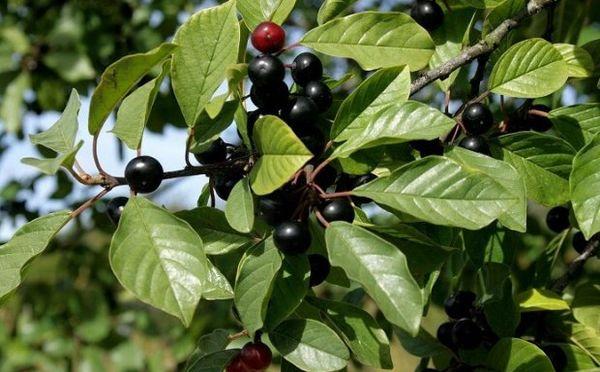
The fruit crop is susceptible to fungal and viral diseases. Yields are average and depend on weather conditions and care. Frost resistance is average, so in northern regions, trees are additionally insulated before winter.
How to plant on a plot
Choosing the right location for planting seedlings and adhering to the planting deadlines guarantees a harvest of tasty and juicy berries.
Cherry trees are planted in open ground depending on the climatic and weather conditions of the region.
In southern climates, planting is carried out in the fall. In northern regions, seedlings are planted in open ground in early spring. In temperate climates, trees can be planted in both spring and fall.
Preparing seedlings
When purchasing seedlings, carefully inspect the planting material. One- to two-year-old plants with well-developed rhizomes take root best. The trunk of the seedling should be straight, without visible damage, and have 2-3 skeletal branches. The root system should be well-moistened and free of growths, compactions, fungal growths, and rot.
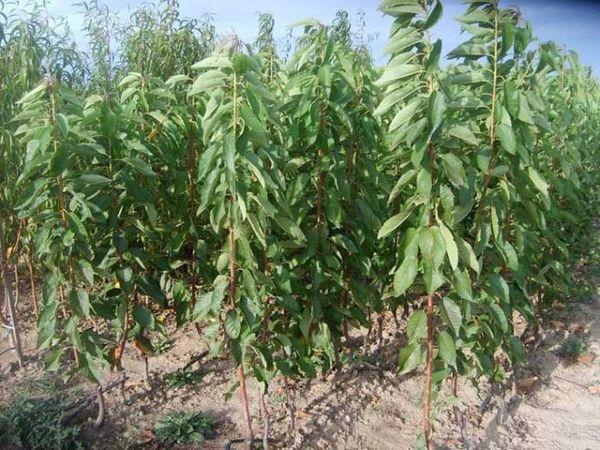
Before planting outdoors, seedlings are placed in a container of warm, settled water for 4-8 hours. The tree roots are treated with special antibacterial agents.
Important! If the seedlings' rhizomes are overdried, soak them in water for 15-20 hours.
Selecting a location and preparing a planting hole
The development and growth of the tree depends on the location chosen for planting seedlings.
Cherry trees thrive in well-lit, wind- and draft-free areas. A groundwater depth of at least 1.5-2 meters is recommended.
If tree planting is planned for spring, soil preparation begins in autumn.
Peat, sand, and humus are added to dense, heavy soil. Highly acidic soil is mixed with lime. The soil is thoroughly dug over, organic fertilizer is added, and the soil is left to mature until spring.
Technology of planting crops
The main work is carried out 2-3 weeks before planting seedlings in open ground.
- The soil is thoroughly loosened and holes are dug 50-60 cm deep and 60-80 cm wide. The distance between plantings is chosen based on the size of the mature trees, but not less than 2.5-3 meters.
- Small stones or crushed stone are placed at the bottom of the hole.
- The soil excavated from the hole is mixed with mineral fertilizers and ash.
- A support for the seedling is driven into the center of the hole and fertile soil is added.
- The seedling is placed in the center of the hole, the rhizomes are carefully distributed and covered with soil.
- Next, the soil is compacted and watered generously. The tree is secured to the support.
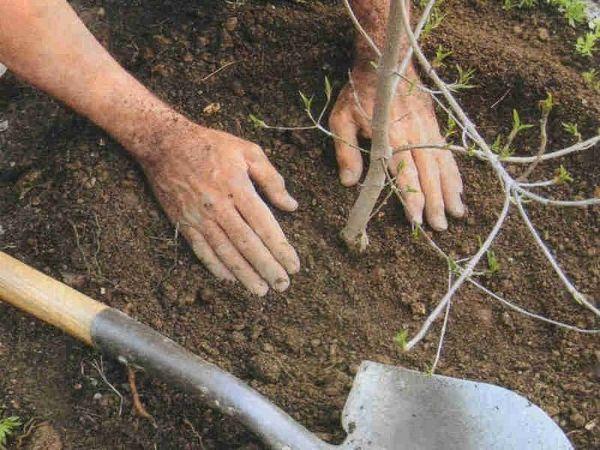 Important! After planting, mulch the area around the seedling's trunk with sawdust or dry grass.
We organize care
Basic care for fruit crops includes watering, fertilizing, pruning, and preventative treatment of trees against pests and diseases.
Watering
Cherry trees require a lot of water, but they also don't tolerate waterlogged soil. Watering is especially important for this fruit tree during flowering and fruit set. During this period, trees are watered once every 7-10 days.
As soon as the fruits begin to turn red and ripen, watering is reduced or stopped altogether.
Fertilization
Fertilizing cherry trees begins after they begin to bear fruit, in the 3rd or 4th year of growth.
In early spring, nitrogen-rich fertilizers are added to the soil. After flowering, organic fertilizers are added. In the fall, before the long rest period, mineral fertilizers are added.
Important! Fertilizer and dressing rates are calculated based on the age and size of the fruit tree.
Formative and rejuvenating pruning
Cherry trees grow and develop quickly. Numerous new shoots appear each year, expanding the crown and reducing the tree's fruit yield.
- On the main conductor, all branches located below the 40-50 cm mark are cut off.
- Next, tiers are formed annually, leaving 3-5 branches on each of them.
- Branches growing inside the formed crown are completely cut out.
In spring and autumn, sanitary pruning of trees is carried out, removing all broken, weak, frozen and damaged shoots.
Protection from diseases and pests
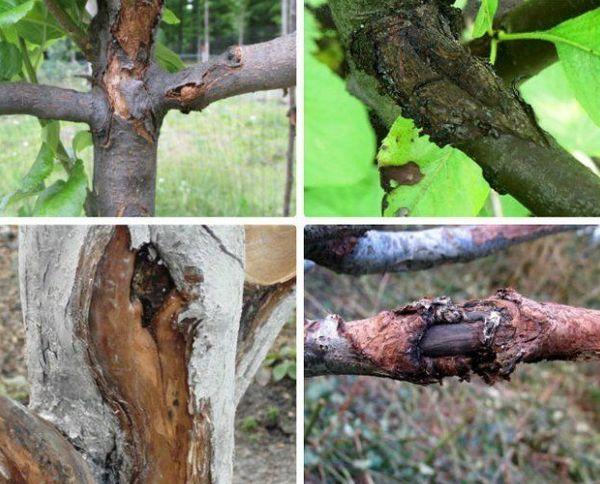
If cherry trees are attacked by pests, they are treated with professional insecticides. This type of treatment is also beneficial for preventative purposes in early spring, before the growing season, and in late fall.
Copper-based preparations are used to prevent and treat fungal and viral diseases.
Caring for the tree trunk circle
A tree's root system develops much faster than its above-ground portion. The area around the tree's trunk should be at least twice the size of the existing crown. The soil around the tree should always be well-aerated and moderately moist.
Loosening the soil around fruit trees is done 3-4 times throughout the season. In the fall, the area around the tree trunk is carefully dug over and mulched with sawdust and dry leaves.
Preparing for the winter period
In the fall, fruit trees are prepared for winter dormancy. They undergo sanitary pruning, and the cut areas are coated with garden pitch. The lower part of the trunk is treated with a lime or chalk solution. To prevent damage to the bark by rodents and small animals, the tree trunk is wrapped in netting or burlap.
In regions with cold and long winters, spruce branches or special material are placed on top of the mulch.
Related posts:
 Description and characteristics of 17 dwarf cherry varieties, planting and care
 Description and characteristics of the Kharitonovskaya cherry variety, planting and care
 Description of the Zhukovskaya cherry variety, planting and care in open ground
 Description and pollinators of the Vladimirskaya cherry variety, planting and care
 Description and characteristics of columnar cherry varieties, planting and care
 Description and characteristics of 14 varieties of the Bere pear variety, planting and care
 Description and varieties of cherry variety Shpanka, planting and care
 Description and cultivation of the best varieties of felt cherry, planting and care