
- Is it possible to grow an apple tree from seeds?
- Will a tree grown from seed bear fruit?
- What varieties are recommended for germination?
- How to get seeds
- Preparing seeds for germination
- Washing
- Soak
- Stratification
- Sowing and germination at home
- Timing and sowing pattern
- Sorting sprouts
- Germination: growing conditions for apple trees
- Recommendations for planting in the ground
- Preparing the hole and planting the seedling
- How to care for a sprout
- Is it necessary to vaccinate?
The apple tree is the most common fruit tree grown by gardeners. They most often purchase seedlings from a nursery, paying a considerable price for them. Few gardeners consider the possibility of growing trees from seeds, without the expense of seed. Below is information on how to grow an apple tree from seed, whether grafting is necessary, and whether such a tree will bear fruit.
Is it possible to grow an apple tree from seeds?
Experienced gardeners say it's entirely possible to grow apple trees from seeds. Breeders use seedlings as seedling material for developing new varieties. Rootstock from seedlings is hardy, winter-hardy, and long-lived. However, seed propagation is only possible if planting guidelines are followed.
Will a tree grown from seed bear fruit?
Apple seedlings grow healthy and strong, but they begin bearing fruit late. The first fruits can be tasted in 7-12 years. However, the trees can become too tall or, on the contrary, dwarf. To obtain high-quality plants in the garden, you can graft a cultivar onto the seedlings.
Please note: If apple trees are planted too close together in the garden, they will shade each other and will require constant pruning.
What varieties are recommended for germination?
When choosing varieties for germination, select ones that are adapted to the gardener's region. This will ensure the seed sprouts quickly and develops into a strong apple tree. The easiest varieties to grow are the wild apple, Chinese apple, and the following: Saffron Pepin, Striped Cinnamon, and Common Antonovka.
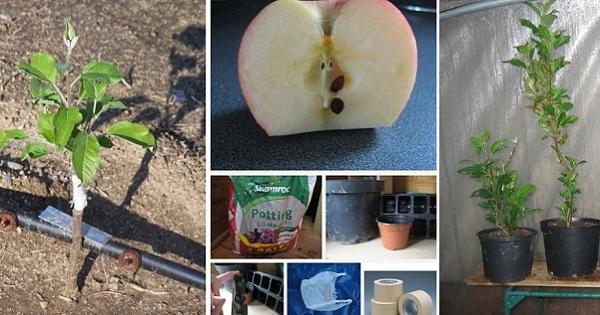
How to get seeds
Ripe, healthy fruits are selected for germination. If the fruit is underdeveloped or has a defect, the apple seed is likely of poor quality. The fruit is cut open, and the largest seeds are removed. One apple can yield about 10 seeds.
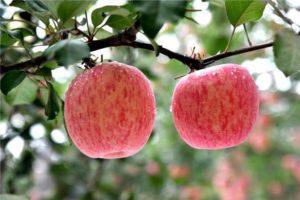
Preparing seeds for germination
Fresh apple seeds are selected for germination. The longer they are stored, the more difficult it will be for them to germinate. Before planting, the seeds need to be handled in several ways.
Washing
The seeds are coated with a substance that prevents them from sprouting. Therefore, they are thoroughly washed before planting. The seeds are small and slippery, so for ease of use, it's best to do this in a glass of water. Place them in a container, stir with a wooden stick, and then pour the water into cheesecloth.
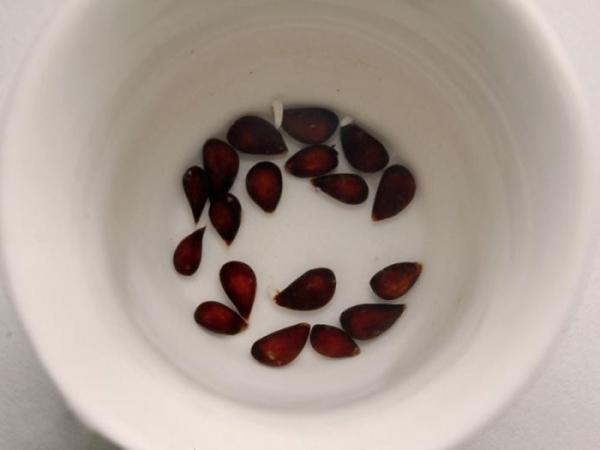
Soak
Growing will proceed faster if, after washing, the seeds are placed in a small bowl of water for three days. To prevent the seeds from blooming, change the water daily. For better germination and to boost the seeds' immunity, add Epin or another growth enhancer to the water on the last day.
Stratification
Keeping seeds at low temperatures is essential for better germination and subsequent seedling development. To achieve this, follow these steps:
- A mixture of sand and sawdust with the addition of activated carbon is poured into the box.
- The seeds are placed deep into it in such a way that they do not touch each other.
- The substrate is watered and the box is covered with film.
- The container is placed on the bottom shelf of the refrigerator for 2.5-3 months.
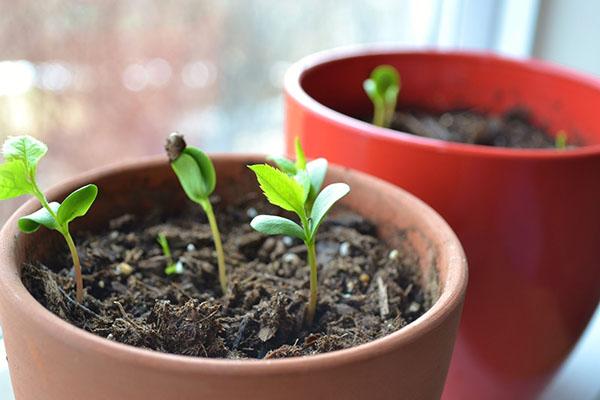
To ensure natural stratification, the seeds are planted directly into the soil after washing. In the spring, the hardened, swollen seeds sprout.
Sowing and germination at home
One of the conditions for the development of fruitful apple trees is planting seeds in fertile soil. To achieve this, the garden soil is fertilized with wood ash (200 grams), superphosphate (30 grams), and potassium sulfate (20 grams). These substances are calculated to fertilize 10 kilograms of soil.
Timing and sowing pattern
After stratification, begin planting the seeds. To plant them, follow these steps:
- drainage from small stones or expanded clay is placed at the bottom of the box;
- fertile soil is poured on top;
- the seeds are planted at a depth of 2 centimeters;
- the same distance is maintained between them in a row;
- the width between rows is 15-20 centimeters.
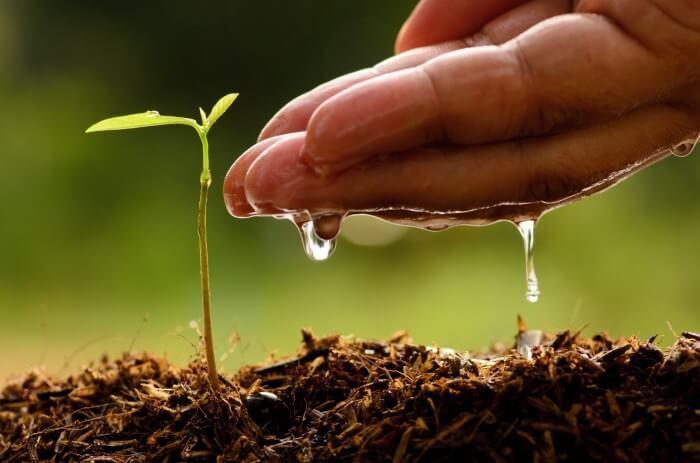
After the seeds have been planted, the substrate is carefully watered so that the seeds are not exposed.
Sorting sprouts
If the seeds are germinated correctly, they will germinate very quickly. When the seedlings develop two pairs of true leaves, they are inspected and sorted. Weak plants, which will not develop into full-fledged fruiting trees, are removed. After this procedure, each seedling should be spaced 7-8 centimeters apart.
Germination: growing conditions for apple trees
The seed boxes are placed in a warm, bright room. When the seedlings have grown a little, they are transplanted into individual pots. These shouldn't be large, as the above-ground portion of the plant won't develop until the root system has established itself. It will take at least four years for the apple tree to be ready for planting.
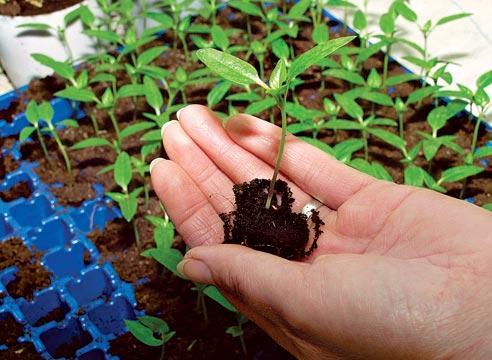
During this time, the seedlings are repotted 2-3 more times into a new container, which becomes increasingly larger with each transplant. Throughout these years, the seedlings require care: watering, loosening the soil, and fertilizing. The soil is moistened after the top 1-1.5 centimeters of soil have dried out. A mineral and vitamin complex is used as fertilizer.
Recommendations for planting in the ground
After four years, the seedling is ready for planting in open ground. Before planting, it needs to be hardened off.
The optimal time for planting is in spring, in May or June, or in autumn, in September or October.
A sunny location is selected, away from tall trees and shrubs.
Preparing the hole and planting the seedling
For spring planting, prepare the hole in the fall or at least two weeks before planting. To do this, dig it and fill it with the following substrate:
- fertile soil;
- humus;
- peat;
- sand;
- bone meal.
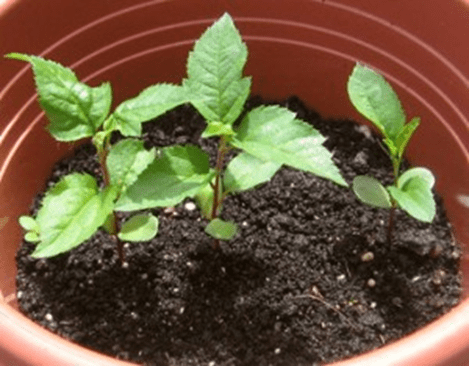
Within two weeks, the soil mixture will settle to the desired level, and the young apple tree can be planted. If planting several trees, maintain a distance of 5-6 meters between them. It's important to ensure that the root collar isn't buried deep.
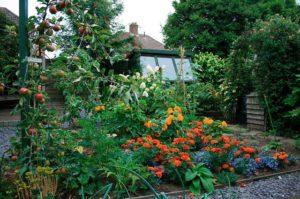
How to care for a sprout
The seedling is watered generously and mulched with peat or humus. The covering material will help retain moisture, especially necessary while the apple tree is establishing itself. However, mulch should not be spread too close to the trunk, as it can cause fungal diseases.
A small peg is driven into the hole and the plant is tied to it.
Experienced gardeners recommend pruning the apple tree's top immediately after planting to ensure better survival. If the tree was planted in fertile soil, there's no need to fertilize it during the first year.
Important! If mulch is placed too close to the trunk, the bark may rot, which can lead to the development of fungal diseases.
Is it necessary to vaccinate?
An apple tree sapling grown from seed can be used as a rootstock. It will grow winter-hardy and robust, making it suitable for grafting more tender apple varieties. If the sapling is to be used as a rootstock, the main root is removed 20 centimeters from the root collar. This procedure will promote branching of the lateral roots and also slow the growth of the tree. Grafting is performed in the spring.
Related posts:
 Is it possible to soak treated cucumber seeds before planting and how to do it correctly?
 Carrot care guidelines for outdoor cultivation to ensure a good harvest
 Is it possible to grow an apricot tree from a seed in your garden? How to plant and care for it?
 Why didn't the carrots sprout and what should I do? How to plant them so they sprout quickly?
 The best eggplant varieties for growing in a polycarbonate greenhouse: planting and care
 How to properly grow a peach tree from a seed at home, planting and care
 How to grow potatoes from seeds at home
 Is it possible to plant carrots in July or at the end of June? What are the best days and care instructions?