
- Powdery mildew - what kind of disease is it?
- Pathogens of the disease
- Disease development cycle
- Distribution area
- Reasons for the appearance on apple trees
- Signs of tree damage
- What is dangerous?
- Means for combating the disease
- Folk recipes
- Potassium permanganate
- Onion infusion
- Milk solution
- Chemicals
- Colloidal sulfur
- Fungicide "Topaz"
- Bordeaux mixture
- Apple tree processing technology
- Treatment of an adult tree
- Saving young seedlings
- Preventive measures
- How to fertilize an apple tree in the fall to prevent disease
- Seasonal processing
- Varieties resistant to powdery mildew
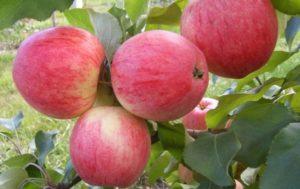
Growing orchard crops is fraught with difficulties arising from improper care, poor environmental conditions, and unfavorable climate. Powdery mildew, a fungal infection affecting apple trees, causes significant damage. It's important to recognize the symptoms of the disease early to save the crop.
Powdery mildew - what kind of disease is it?
Powdery mildew is a fungal disease that affects most garden, vegetable, and ornamental plants. Apple trees are also susceptible. The disease is also known as powdery mildew or powdery mildew.
Pathogens of the disease
Apple tree disease is caused by a parasite from a genus of pathogenic fungi. They colonize various parts of the apple tree, where white mycelial threads containing spores eventually appear. Over time, these threads acquire a yellowish tint and darken. The fungi feed on plant tissue. The fungus that attacks apple trees belongs to the genus Podosphaera.
Disease development cycle
The disease begins with the appearance of a whitish coating on the stems and leaves. This coating contains mycelial threads with chains of conidia. The mycelium attaches to the surface of plant tissue with specialized suckers. After the female cells are fertilized by the male cells, bodies containing spores are formed.
The cleistothecia, or fruiting bodies, split open, releasing spores. Once they land on the leaves, they infect the plants. This initiates the primary infection, which has an incubation period of 4-6 days.
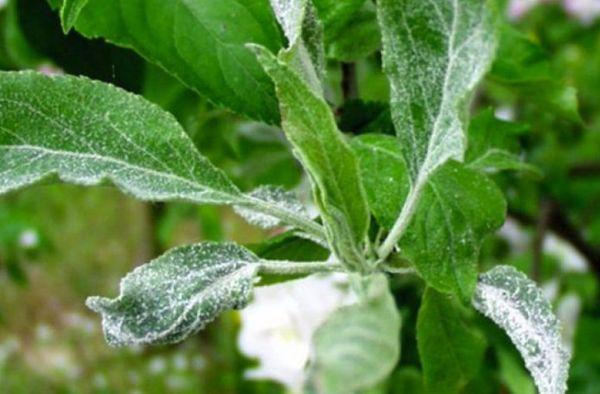
The mycelia overwinter in apple tree buds or, in milder winters, on the plant's shoots. In the spring, they germinate, infecting the buds. Conidia appear within them, which spread to the rest of the apple tree. Powdery mildew requires appropriate conditions for its development.
Distribution area
Apple trees are most often infected with powdery mildew in areas with warm winters. Crops in the Moscow region, Krasnodar Krai, and Stavropol Krai are particularly susceptible to this pathogen. If apple trees are grown in Siberia or the Urals, where temperatures drop below -24 degrees Celsius, powdery mildew does not cause any harm. After all, in such conditions the fungus may not survive the winter; it is weakened and is not capable of causing harm to the garden.
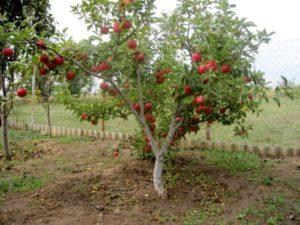
During the growing season, apple trees can become infected with powdery mildew in regions with both severe drought and high humidity.
Reasons for the appearance on apple trees
Conidia from infected plants are carried by wind and precipitation to healthy specimens. Trees that are particularly susceptible are those that:
- grow on dense soils with poor moisture and air permeability;
- do not receive enough sunlight;
- are grown in places where winters are warm.
The rapid onset of spring with heat and high humidity promotes the development of mycelium.
Signs of tree damage
You can determine if a fruit tree is infected with powdery mildew by:
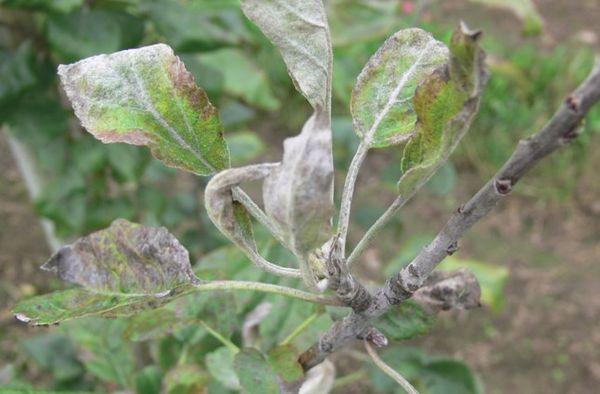
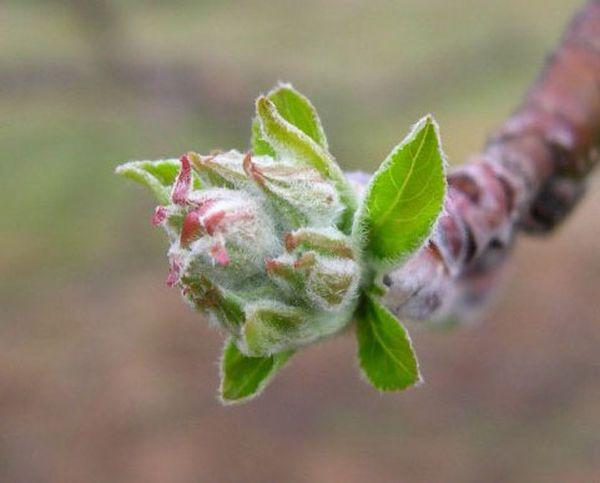
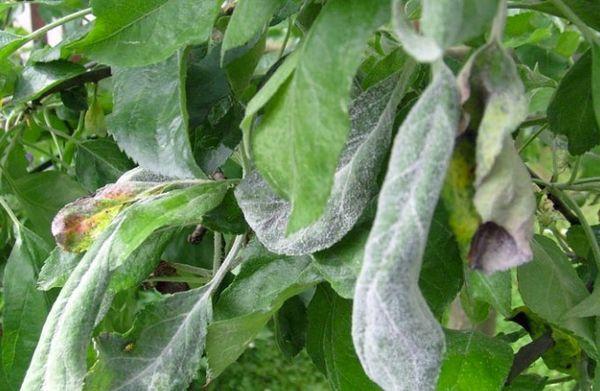
- white, slightly transparent coating during the period of foliage emergence;
- deformation, browning, wilting of buds;
- black dots on a silvery coating that turns brown over time.
Mycelium with conidia appears not only on leaves and shoots, but also on fruits. On apples, brown, dense, woody spots often appear.
Gardeners should be aware that the infection begins to destroy the tree when the plaque becomes silvery and dense. At this point, the fungus is difficult to control, as it has already penetrated the plant tissue.
What is dangerous?
Powdery mildew must be taken seriously. Don't think that simply wiping off the coating will remove the mycelium from the leaves and shoots forever, and the tree will recover. No, the damage has spread inside the plant. The haustoria remaining inside the leaf feed the mycelium, leading to the tree's decline and the lack of flowering and fruiting.
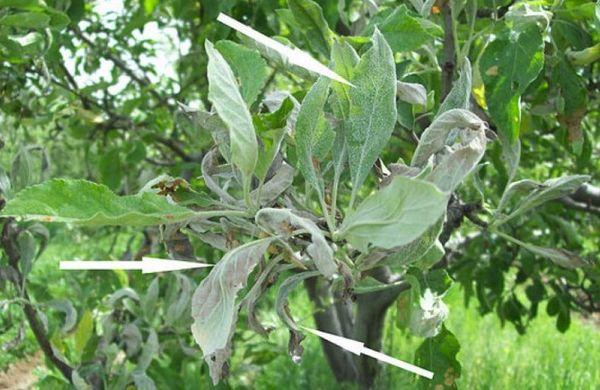
After some time, the mycelium's spread on the plant's surface will increase. The weakened apple tree will have a harder time surviving the winter.
Means for combating the disease
Only effective methods can protect an apple orchard from powdery mildew. As soon as signs of the disease are detected, treatments are carried out.
Folk recipes
Folk remedies can be used to combat powdery mildew when it first begins its parasitic activity. For spraying diseased plants, choose both disinfectant solutions and those that can eliminate the initial infection.
Potassium permanganate
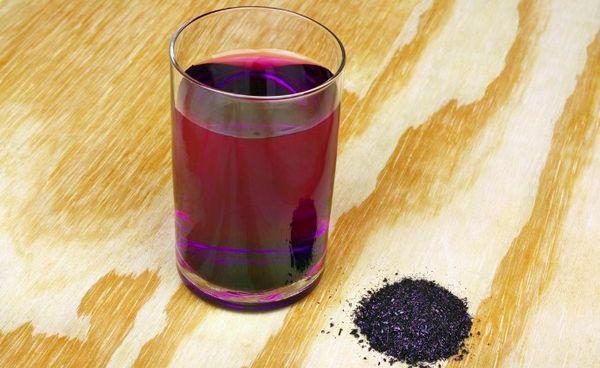
To prepare a spray solution for apple trees, dissolve 1-3 grams of potassium permanganate in 4 liters of room-temperature water. Pour the solution into a spray bottle and spray it on all parts of the tree. It's best to perform the procedure after rain, in clear, calm weather. Repeat the spraying twice more a week later.
Onion infusion
In the first 2-3 days after spotting a whitish coating on the leaves, you can combat the pathogen with an infusion of onion peels. Add 100 grams of peels to 5 liters of hot water. Let the solution steep for 24 hours. Only then apply the treatment.
Milk solution
A popular remedy against powdery mildew is milk. One liter of it is diluted in a bucket of water. Spray the apple tree every seven days to completely cure the disease.
Whey also kills fungus. It is also diluted with water in a ratio of 1:10. The procedure should be repeated three times, every four days.
Thanks to the whey protein pheroglobulin, powdery mildew pathogens die because they do not receive enough air.
Chemicals
If the disease reoccurs, folk remedies won't restore apple trees to health. This is where medications that effectively combat powdery mildew fungi and conidia come to the rescue.
Colloidal sulfur
Colloidal sulfur is the first choice against fungal infections on apple trees. Plants are treated with it when buds begin to form. Initially, a solution of 20 grams of sulfur per bucket of water is used. After 12-14 days, a weaker solution will be needed. This requires 10 grams of the solution. Spray again after 2-3 weeks. However, it's important to note that there should be 20 days left before apple harvest.
Fungicide "Topaz"
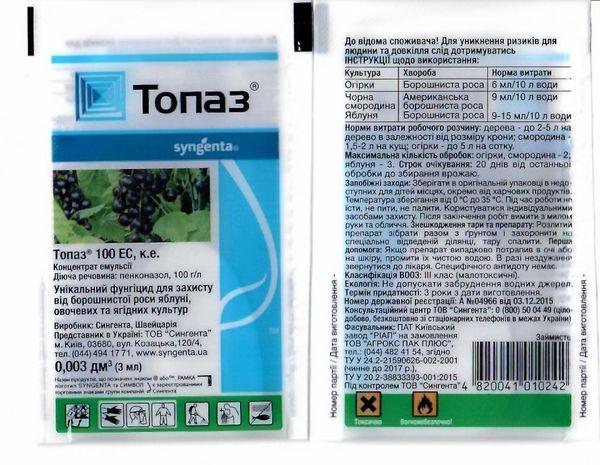
One effective treatment is suitable for both treating apple trees and preventing powdery mildew. The fungicide is based on penconazole. It kills the pathogen, penetrating deep into plant tissue. Three treatments are performed, separated by 8-10 days. Dilute the fungicide according to the instructions to ensure effective results.
Bordeaux mixture
Treating both mature and young trees with Bordeaux mixture will help protect apple trees from fungal pathogens. In the spring, use a 3% solution for spraying, and during the growing season, use a 1% solution. Only three applications will stop the development and spread of the disease.
Apple tree processing technology
Spraying apple trees should be done according to the rules. This should be done in a timely manner to ensure the plant remains healthy. The specific measures taken depend on the age of the apple tree.
Treatment of an adult tree
Treating a tall tree with a lush crown against powdery mildew is difficult. Spraying alone is difficult—you'll need an assistant and a powerful sprayer. When entire branches and leaves are infected, the damaged portion should be cut off or sawed off and burned. Be sure to coat the cut area with activated charcoal and garden pitch.
It is important to remove mulch around the tree in early spring.
Digging in the fall and spring will destroy conidia that overwinter in fallen leaves. Whitewashing the trunks is also done twice a year.
Saving young seedlings
To protect apple seedlings during planting, they should be treated with a pinkish solution of potassium permanganate. The soaking solution should not be too saturated, otherwise the trunk and roots may get burned.
If the tree takes root quickly, the fungus won't be able to damage it. Therefore, it's a good idea to soak the roots of young apple trees in a growth stimulant before planting them in the orchard.
Next spring, it is advisable to treat the seedlings with Bordeaux mixture.
Preventive measures
Preventing powdery mildew in the garden is possible only through preventative measures. These include choosing the right site for the garden and proper maintenance. Timely thinning of the crown and pruning of damaged branches are essential.
How to fertilize an apple tree in the fall to prevent disease
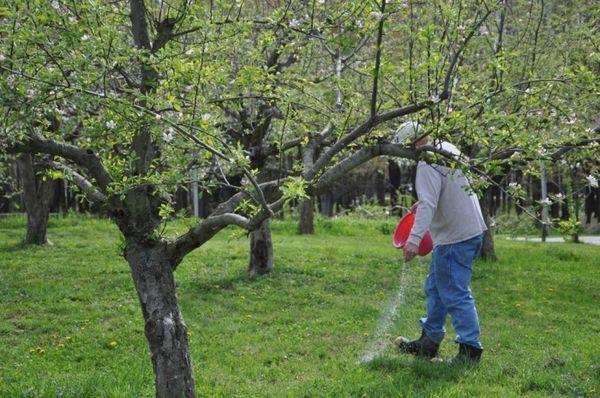
A tree weakened by winter is especially susceptible to disease. Fertilize the tree around the trunk in October with phosphorus-containing fertilizer. A 1% sodium phosphate solution provides good protection against powdery mildew.
Seasonal processing
Fruit trees are treated with phosphates after the apple harvest. Spraying should be done with a sprayer so that the solution is absorbed into the leaves and kills the powdery mildew fungus. Late-ripening trees shed their leaves early. They should be watered with a phosphate solution before winter. Thinning the crown will prevent the disease from spreading and infecting neighboring shoots. Before pruning, tools should be disinfected to avoid infection.
Varieties resistant to powdery mildew
In regions where the disease is widespread, crops resistant to the pathogen should be grown. Varieties with strong immunity to the disease include:
- Ranet champagne;
- Sary-Sinap;
- Golden summer;
- Marshmallow;
- Fortune;
- Calville snowy;
- Winter golden parmen.
On apple trees of these hybrids, the powdery mildew pathogen develops poorly.
Related posts:
 How to treat grapes for mildew, the best control measures and treatment rules
 Causes of powdery mildew on zucchini and methods of disease control
 Signs and treatment of apple tree cancer, varieties resistant to the disease
 Causes and treatment of powdery mildew on cucumbers, control measures using folk remedies
 Description of the Chudnoe apple variety, planting and caring for a dwarf tree
 Description and varieties of the Sinap apple tree, planting and care rules
 Description and characteristics of the columnar apple tree President, planting and care
 Sulfur control of powdery mildew on gooseberries using folk and chemical remedies