
- The benefits of growing apricots yourself
- Methods and technology of reproduction
- Cuttings and layering
- Green cuttings
- Lignified cuttings
- Air layering
- Root shoots
- Seed method
- What varieties are suitable?
- Selection and stratification of grains
- Preparing the soil and containers for planting
- Planting depth and rules
- Conditions for growing sprouts
- Propagation by grafting
- For the bark
- Into the cleft
- By bridge
- How to plant a seedling in open ground
- Preparatory work
- Required soil composition
- Pit
- Preparing cuttings
- Rooting
- How and what to fertilize before planting
- At what distance should I plant?
- Optimal time and technology of planting
- Tree care
Growing your favorite variety of apricot in your garden isn't always easy. The main challenge is finding the right seedling and a reliable supplier. For this reason, gardeners often wonder how to propagate apricots themselves. Several options have been developed and tested, each with its advantages and disadvantages.
The benefits of growing apricots yourself
Sometimes a neighbor will give you a surplus of delicious fruit, but they don't even remember the plant variety, or don't even know it, since it was inherited from the garden's previous owners. In this case, the only solution is to propagate the tree using the most suitable and reliable method. Growing a young seedling is free, and its characteristics will be known in advance.
Another advantage of growing apricots yourself is that the chances of running into unscrupulous sellers and purchasing low-quality planting material are reduced to zero. The gardener controls the entire process and has the opportunity to obtain the number of plants he needs, minimizing costs..
Methods and technology of reproduction
If you need to propagate your favorite apricot, you should familiarize yourself with all the common methods in advance and choose the most reliable and suitable one. After all, each has its pros and cons.
Cuttings and layering
Propagation by cuttings or grafting is the fastest and most reliable method, but also the most labor-intensive. The main challenge is to properly and timely prepare the material.

Green cuttings
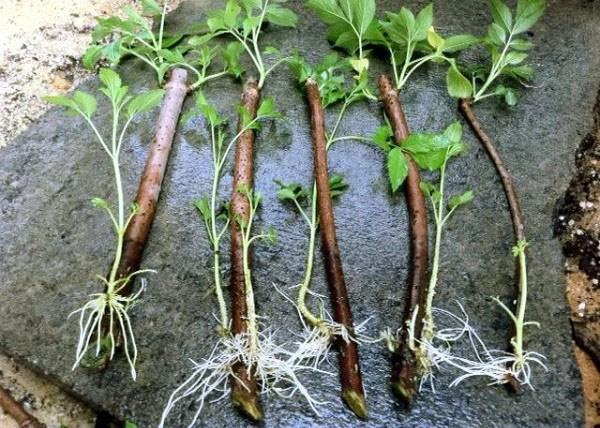
To propagate using green cuttings, separate a section of the shoot with leaves from the middle section. The cut branch should have at least three leaves. The cuttings are taken in the morning to ensure the shoot is as moist as possible. After this, soak the cuttings in a rooting stimulant solution (such as "Zircon" or "Kornevin") for 12 hours.
After this procedure, the cuttings are placed in a well-fertilized bed and a small greenhouse is created. This can be done without a greenhouse, but in this case, it's important to constantly monitor the soil moisture and prevent it from drying out. After a couple of weeks, callus begins to form, and within a month, the seedling will already have a root system.
Lignified cuttings
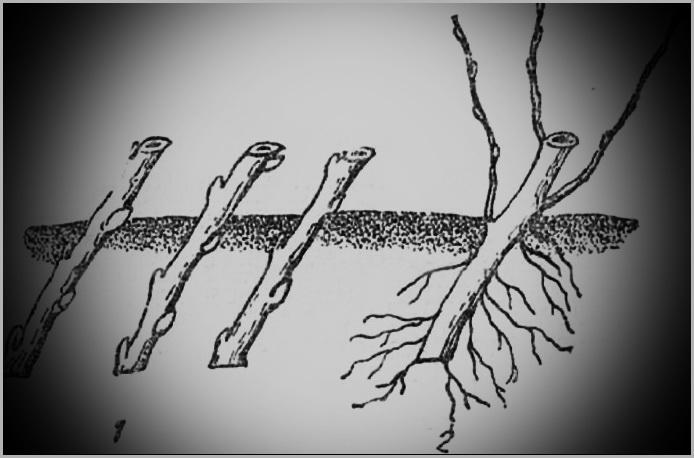
Cuttings are taken not only from green shoots but also from woody shoots. They are taken during the dormant period, after the leaves have fallen. The cuttings should be approximately 0.3 m long. They are stored in a cool, dark place until spring, then soaked in a rooting stimulator and planted in peat-fertilized soil.
Air layering
An equally effective method of propagating apricots than cuttings, although undeservedly forgotten by gardeners, is to select a one-year-old shoot. Make two circular cuts on it and remove the bark between them. Treat the shoot with a rooting stimulant and wrap it in a plastic bag, allowing enough space to accommodate soil. Once the shoot is mature, separate it from the mother branch and transplant it to its permanent location.
Root shoots
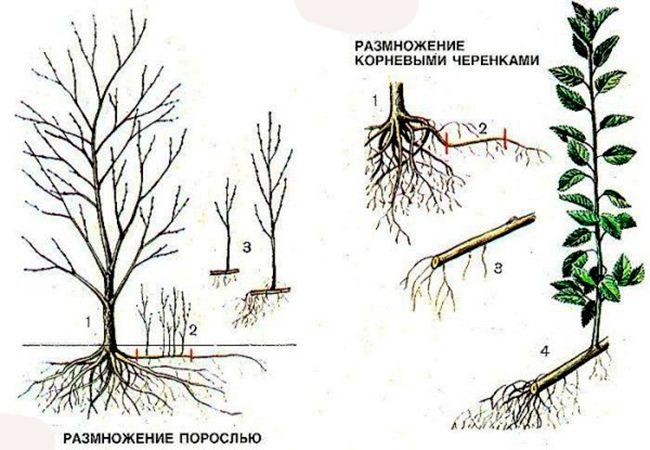
This propagation method is only effective if the apricot tree is self-rooted. In a grafted plant, the shoots form from the rootstock, and it is impossible to achieve the same characteristics in the seedling as the mother plant. It should be noted that shoots are formed only as a result of damage to the tree by frost, animals, or as a result of severe pruning. A healthy apricot tree doesn't produce suckers from its roots. When transplanting young trees, choose only those located as far away from the mother plant as possible. This will reduce the risk of damaging the root system.
Seed method
Propagation by seed is considered the most reliable, but also the most time-consuming. The resulting seedling is adapted to the local climate, although it sometimes does not inherit the characteristics of the mother plant.
What varieties are suitable?
Almost any apricot variety can be propagated from pits, but preference should be given to domestic varieties. Foreign varieties have difficulty adapting to climate conditions and often die in winter. Gardeners also note that when growing a tree from a seed, it is necessary to select simple varieties, rather than capricious elite varieties that will subsequently fail to produce a harvest.
Selection and stratification of grains
Only ripe apricot pits are selected for planting. The fruit should be large, disease-free, and juicy. It's preferable to grow several seedlings, as the crop has a difficult time establishing itself.
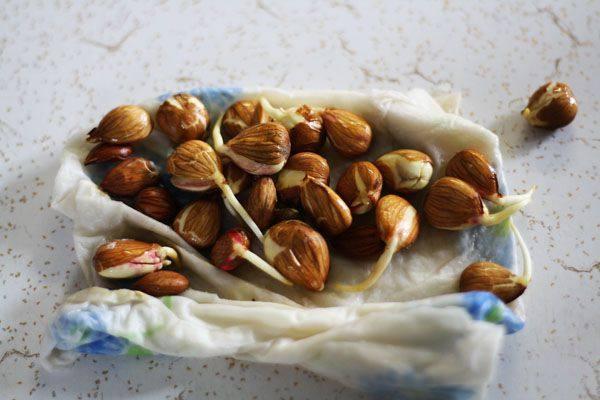
Before planting, the prepared seeds undergo stratification. To do this, they are soaked in cool water for a week. To keep the water warm, change it periodically.
Preparing the soil and containers for planting
For planting soil for apricot kernels, choose sawdust, sand, or damp moss. The volume of soil should be three times the volume of the seeds. Place the mixture in a container with drainage holes or a plastic bag and leave in a cool place for 2-2.5 months.
Planting depth and rules
The apricot pit should be planted no deeper than 10 cm. It is covered with humus, peat, or sand and placed in a room with an air temperature of about +10 °C.
Conditions for growing sprouts
To grow a seedling indoors, regularly check the soil moisture after planting the seed, water it if necessary, and loosen it lightly. After 65-70 days, a young apricot tree should emerge. Transplant the tree into a small flowerpot and place it in a warm, well-lit location.
Propagation by grafting
Another popular method of propagating apricots is grafting. This requires a young rootstock and the grafting material itself. There are several methods for this.
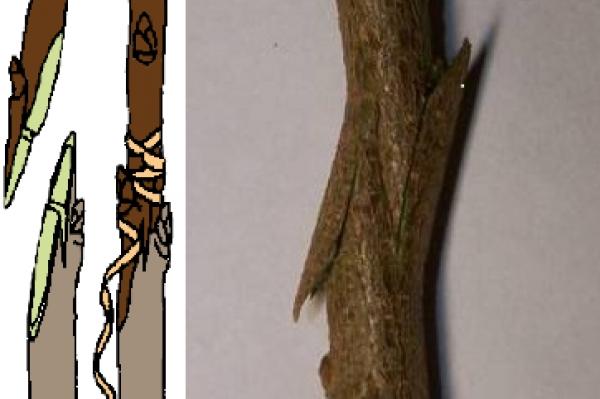
For the bark
This method is best used at the very beginning of the growing season. Pre-prepared branches with dormant buds are used. Grafting is permitted on mature apricot trees no older than 10 years.
You should cut off the skeletal branch and insert several cuttings under the bark so that they do not touch each other.
First, make a diagonal cut at the bottom of the scion, leaving three buds. The scions are secured with tape, and the graft site is treated with garden pitch.
Into the cleft
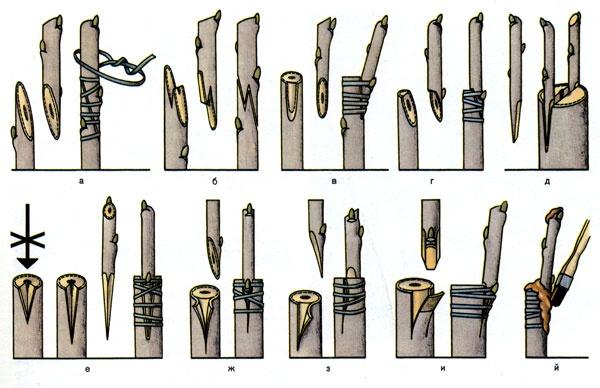
This technique is suitable for grafting both young and mature branches. The work is performed before the sap begins to flow, that is, immediately after the end of winter frosts. An important condition for cleft grafting of apricots: the rootstock must be thicker than the scion and in no case the other way around. The branch chosen as the rootstock is carefully cut to the desired height, then a 2-5 cm deep split is made with a knife. The scion is sharpened and inserted into the rootstock, aligning the cambium layers. The scion is trimmed, leaving only three buds. The graft is secured with tape and treated with garden pitch.
By bridge
This technique makes it possible to save a tree damaged by rodents. It is advisable to use this graft only if there is ring damage. Apricot cuttings can be bridged not only from cultivars but also from wild plants.
The work begins when the sap begins to flow. The bark is stripped back to the healthy area, and 3-cm-long T-shaped cuts are made at the bottom.
All buds are removed from the cuttings, after which 4-cm-long diagonal cuts are made at the ends. The apricot bark is slightly pulled back and the cuttings are inserted into it. The bridge is formed in the shape of an arch. The completed graft is secured with electrical tape and sealed with garden pitch.
How to plant a seedling in open ground
Correct planting of an apricot seedling in open ground is the key to its successful survival.
Preparatory work
First, you need to choose a location for the apricot tree. The plant is heat-loving and does not tolerate close groundwater. The site should be well-lit and protected from cold winds and drafts. The soil pH should be neutral or slightly alkaline. If necessary, apply appropriate soil preparations and fertilizers.

Required soil composition
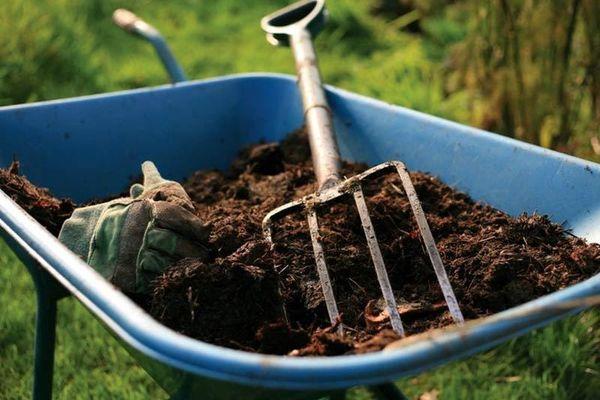
Before planting an apricot seedling, add humus, superphosphate, wood ash or potassium sulfate to the soil.
Pit
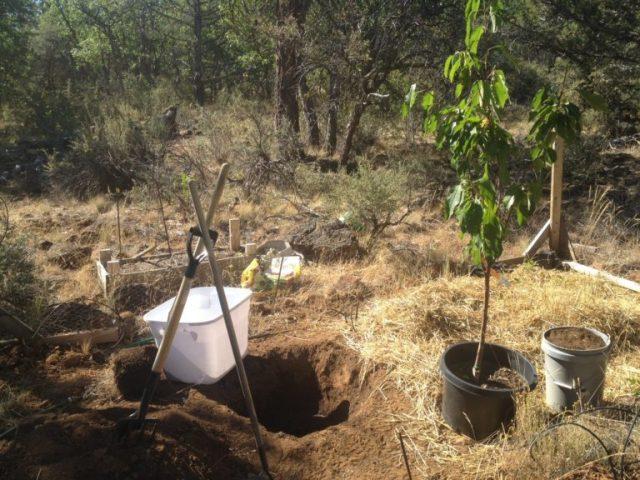
A planting hole for the seedling is dug measuring 0.8 x 0.8 x 0.8 m. A drainage layer of pebbles, small stones, or broken brick is placed at the bottom.
Preparing cuttings
For rooting, select a cutting with 2-3 buds, as one with just one may fail to take root. The top is pruned perpendicular to the main branch, and the bottom is pruned diagonally. Harvesting is done in mid- to late June.
Rooting
Place the freshly cut cutting in a rooting stimulant overnight. The room temperature should be no lower than 24°C. Ideally, use a small greenhouse for rooting.
How and what to fertilize before planting
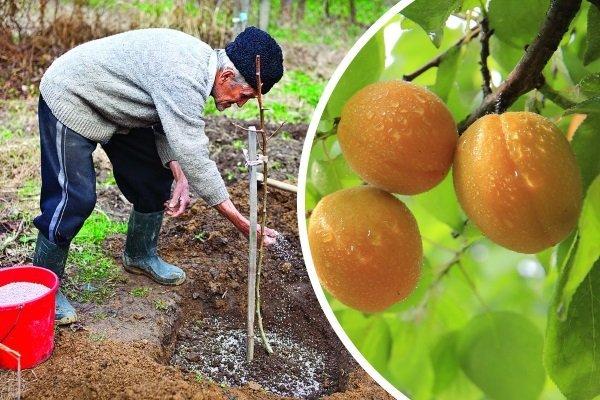
Apricots prefer well-drained soil with ample nutrients. Before planting, it's a good idea to add wood ash, compost, and superphosphate. You shouldn't get carried away with nitrogen fertilizers, as they can provoke premature growth of the seedling to the detriment of the development of the root system, as a result of which it may not survive the winter.
At what distance should I plant?
When rooting cuttings, space them closely, about 15 cm. When the seedling is ready for transplanting to its permanent location, choose a location that is at least 3-4 m from nearby trees and shrubs.
Optimal time and technology of planting
It's recommended to root cuttings immediately after harvesting, in the summer. They should be planted so that the base itself isn't submerged in sand. Sprinkle the top with a nutritious soil mixture and water. To prevent moisture evaporation, you can build a shelter or apply mulch.
Tree care
During the first weeks of life, water the unrooted apricot tree once a week. After each watering, loosen the soil to ensure air and moisture reach the roots. In subsequent years, organic and mineral fertilizers will be needed to ensure the tree develops normally and produces a fruitful harvest. If the summer is extremely hot and dry, it's a good idea to mulch the soil around the trunk to prevent water from evaporating too quickly.
Related posts:
 Is it possible to grow an apricot tree from a seed in your garden? How to plant and care for it?
 Description and characteristics of the Lel apricot, planting technology and care
 Description of the Melitopol apricot variety and cultivation technology
 Description and technology of growing the Tsarsky apricot variety
 How and whether it is possible to graft an apricot, the choice of rootstock, timing and methods of budding
 Description and cultivation of the Manchurian apricot variety
 Reasons why apricot trees may not bear fruit and what to do about it
 Description and subtleties of growing the Champion of the North apricot variety