
- Why do people prune trees?
- Pruning old trees
- What happens if you don't shape the crown?
- Pruning tools
- When pruning is performed
- In the spring
- Pruning in summer
- In the fall
- Winter pruning
- Methods of crown formation
- KGB system
- Australian bush
- Spanish bush
- Sparsely tiered
- Pruning scheme by year
- First
- Second
- Third
- Fourth
- Advice from experienced specialists
Trimming and cherry tree care Pruning is an important component of growing this crop. Pruning helps increase yields and maintain the tree's immunity and health. Proper crown formation will not only improve the appearance of the landscape but also promote the health of the cherry tree. The tree's compact branching will reduce space consumption and facilitate harvesting.
Why do people prune trees?
All garden trees require regular pruning. Each age group requires specific pruning times. This procedure has a beneficial effect on cherry tree development:
- increases ventilation inside the tree crown, which prevents the development of bacteria inside;
- allows you to remove all broken, dry and non-fruiting branches, thus increasing the yield;
- the tree has a certain shape and height, which makes harvesting easier;
- pruning gives rise to new fruiting shoots;
- increases the vital activity of the tree;
- helps to obtain the largest possible fruits.
Gardeners' opinions on pruning vary. Some believe that fruit and berry trees should not be pruned. However, scientists have proven that pruning has many positive effects on tree development.
Pruning trees increases the vitality of cherry trees.
Pruning old trees
By the 7th or 8th year of growth, cherry fruits begin to become smaller and fewer in number. This indicates the tree is aging. To prolong its life, it needs to be rejuvenated. To do this, prune the tree to a maximum of 1/3 for three consecutive years. If necessary, even large branches are removed to allow new ones to form. This can extend the tree's lifespan by five years. At the same time, the quality and quantity of berries gradually return to their previous levels.
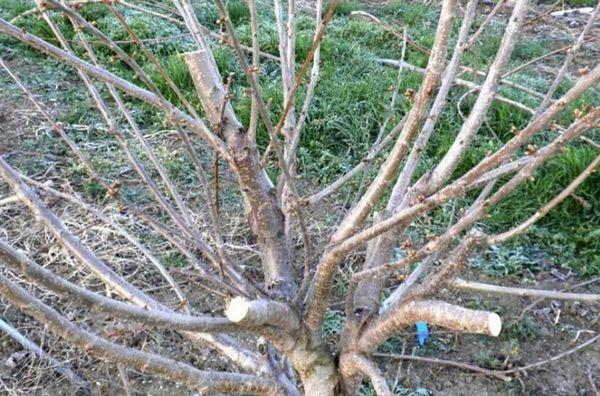
What happens if you don't shape the crown?
For the first five years, the tree will develop branches in a healthy state. They will be quite far apart. However, the accumulation of damaged, dry, and abnormally growing shoots on the skeletal branches leads to the gradual death of the cherry tree:
- Dense areas of wood block oxygen circulation, which creates a favorable environment for the growth of bacteria and fungi.
- The harvest quantity will gradually decrease, and the berries themselves will become smaller.
- A large number of non-fruit-bearing branches will form on the tree.
- Such a tree stops bearing fruit by the 5th-7th year of vegetation.
Pruning tools
If we are talking about a young seedling up to 3 years old, then for work you will need:
- pruning shears;
- garden gloves;
- garden saw for thick branches;
- rope for tying down interfering branches;
- a sharp knife for cleaning cuts;
- solution of potassium permanganate or garden varnish;
- garden shears for thin branches;
- protective glasses for eyes.
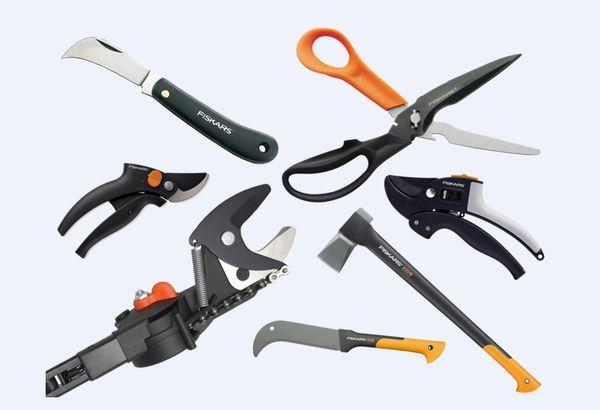
If the tree is tall and old, a ladder may be necessary to reach the top and perform any necessary manipulations. When working, be careful not to expose your eyes to branches. Wear gloves to protect against accidental cuts; they should be thick enough to protect your hands without restricting their movement.
For medium-height cherries, you can use a stool or stepladder to reach hard-to-reach areas.
When pruning is performed
The procedure is performed at different times of the year. The most optimal times are autumn and spring. For some situations, autumn and winter are suitable. To perform the procedure correctly, you need to know the intricacies of the wood, its variety, and the time of year.
In the spring
Spring pruning is suitable for seedlings. It's done to shape the crown. Choose warm days between mid-March and mid-April. The procedure is performed before the sap begins to flow and the buds begin to swell. For a young tree, spring pruning is optimal, as it will fully recover during the summer and produce new shoots.
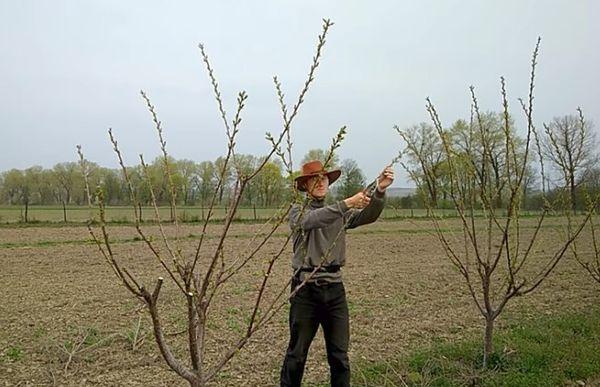 Important! This procedure is performed in spring only for the first three years; after that, sanitary thinning is done in the fall or summer.
Pruning in summer
Summer pruning helps correct misaligned branches. They are shortened and pinched before fruit set. This usually occurs in July. All young shoots that are growing incorrectly are pruned. The second stage of the procedure occurs in August. During the fruiting period, non-fruiting shoots are removed. This procedure increases the harvest weight and improves its quality.
In the fall
After fruiting has finished, the harvest is collected. When the leaves begin to fall, the tree undergoes sanitary thinning. All work should be completed by September; later thinning is characterized by poor healing of the cut areas. All damaged, dry, broken, diseased, and abnormally growing branches are removed.
Some gardeners perform this procedure using the pruning method. They prune all young shoots by one-third. This stimulates the development of new fruiting branches.
Winter pruning
Pruning can be done in winter. However, it serves a rejuvenating purpose. It is suitable for fruit-bearing trees older than 7-8 years. Pruning is done in February. Rejuvenation occurs over three seasons. Each time, one-third of the tree's branches are renewed. This procedure extends the life of the cherry tree by 5-6 years.
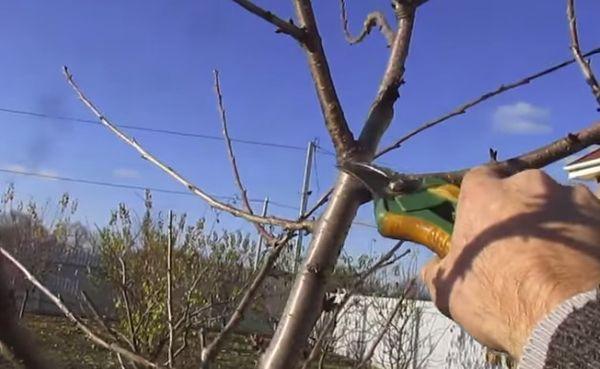
Large stumps on the tree trunk are covered with garden pitch or treated with a solution of potassium permanganate.
Methods of crown formation
Cherry tree crown shaping has its own unique patterns and methods. Each gardener chooses the most suitable and convenient option for themselves.
KGB system
This system helps shape dwarf cherry trees, reaching a height of no more than 2.5 meters. This method is widely used in Spain and the Americas. The procedure has its own nuances, and it's important to do it correctly. The top is pruned in the first year after planting, leaving three to four central branches. These branches are 30-50 cm long. All other shoots should be 10-15 cm shorter than the main branches.
Take a look Also

Australian bush
Shaping the crown of the Australian type is fairly simple. The result is a low-growing tree with all the qualities of the variety. To achieve this, the tree is pruned to 50 cm in the first year after planting. The cut is sealed with garden pitch, and new shoots are allowed to emerge. All new branches are pinched back, and clothespins are attached to the ends to ensure the correct branching direction. The shoots are monitored for proper growth, and by the fifth year of growth, the crown will form into a small bush.
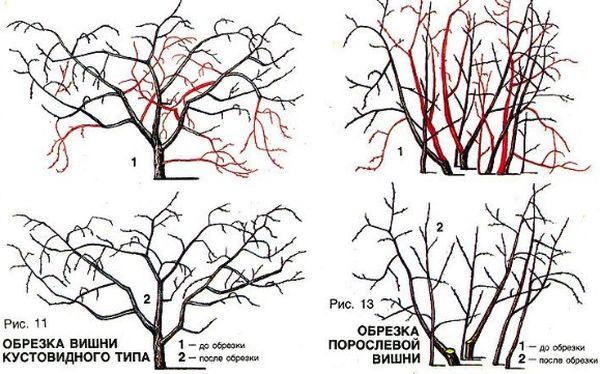
Important! When training an Australian bush, be aware of the reduced yield due to its compact size.
Spanish bush
Formative pruning is a Spanish method. It was first used in Spain to facilitate harvesting and reduce space requirements. The maximum height for this type of cherry tree is 2.5 meters. The crown is shaped starting in the first year after planting. Four to five main branches are selected, and all other shoots are pruned accordingly. This results in a compact, slightly rounded bush, allowing for effortless harvesting and saving space.
Sparsely tiered
The most common method for shaping a seedling's crown is a sparse tiered method. From the first year of planting, cherry trees begin to form tiers. Over the course of the four-year growing season, four tiers are formed. The higher the tier, the shorter it is. In the first year, a central shoot is selected, from which three to four more main branches are formed. The following year, a second tier is formed in the same manner, leaving a 15 cm gap between them. The branches of the second tier should be at least 10 cm shorter than those of the first.
Pruning scheme by year
Cherry trees are pruned during the first four years to form a proper crown. In subsequent years, the tree's health is monitored, and dry, brittle, and damaged areas are removed. Sanitary thinning is also performed.
First
A young, one-year-old seedling is planted in a permanent location. After rooting, the following procedure is performed.
- on the tree trunk, mark a distance of 50 cm from the ground and another 30 cm from above;
- a cut is made at this place;
- sealed with garden pitch.
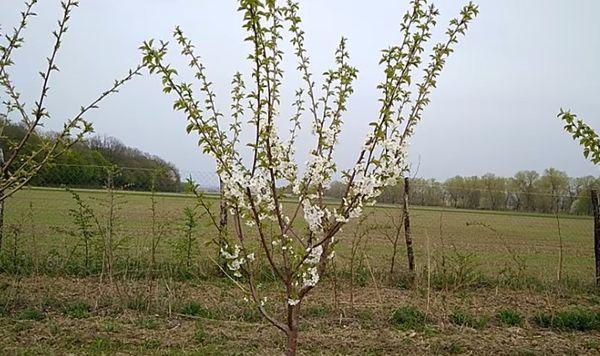
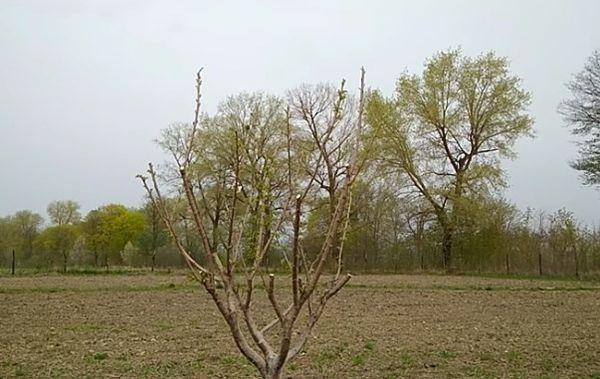
By late summer, 2-3 new shoots should appear on the stump. These will become the next formative branches. Over the course of a year, the plant's branches will increase in number and size, allowing you to select the strongest and most suitable ones for crown formation.
Leave a shoot with 6 buds.
Second
It's best to prune the plantings in early spring, before the sap begins to flow and the buds begin to open. Select four main branches, two on each side. They should be strong, healthy, and pointed in the desired direction. Leave the central shoot, select four central branches, and shorten them to 30 cm. The remaining branches are removed to the base. This forms the first tier.
Third
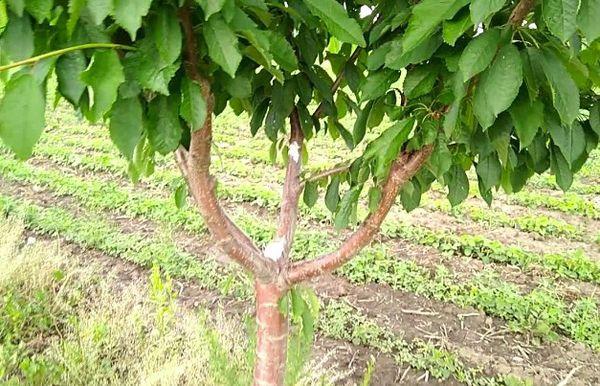
Rejuvenating pruning of existing shoots is necessary. If the tree is bearing fruit, this procedure is performed after harvest. Branches are inspected and damaged, broken, dry, and misaligned branches are removed. In the third year of growth, tiers continue to be formed:
- Select 3-4 new shoots from the top.
- They are shortened so that they are 15-20 cm shorter than the first tier.
- The 6 kidneys rule must be followed.
- The shoots that grow higher than the others are measured.
- All other branches of this tier are removed.
Fourth
In the fourth year, the third crown layer begins to form. By this time, the cherry tree has become a mature, fruit-bearing tree. The key is to prevent the tree from becoming too tall. To achieve this, shorten the central shoot by 20-30 cm. Inspect the branches of the third layer; if they are longer than those of the second layer, shorten them so that they are 10-15 cm shorter than those of the previous layer. Remove all old, dead, broken, or damaged branches.
Sanitary thinning of trees is done annually, regardless of age.
Advice from experienced specialists
To do everything right, you need to listen to the advice of more experienced gardeners. Many have been gardening for a long time, gaining invaluable experience. Helpful tips:
- Rejuvenating pruning is done when the tree reduces the quality and quantity of the harvest.
- You can rejuvenate the entire tree in 3-4 years.
- A vigorous tree can be pruned correctly and made compact.
- When rootstocking cherry varieties, strong and healthy branches are selected.
- Formative pruning is done in spring.
- Sanitary treatment of the crown is carried out after harvesting.
- It is better to thin out dense areas in the summer, as this will make it more obvious where the procedure is needed.
- Large stumps are covered with garden pitch or treated with potassium permanganate.
- The distance between trees on the site should be at least 3 m.
- Until the cherry tree reaches its 5th year of vegetation, it is better to keep the length of the branches no more than 50 cm.
- During the first three years, thin out flower buds to stimulate shoot growth and development. This will encourage the plant to devote more energy to its branches.
- Young seedlings should not be pruned in the fall, as they may not survive the winter.
- It is better to cut off an old branch than many new ones.
Related posts:
 Planting and caring for cherries, feeding and growing rules
 Description and cultivation of the Bryansk pink cherry variety, pollinators
 Causes and treatment of cherry diseases, methods of pest control
 Descriptions of the 20 best cherry varieties for the Moscow region, their planting and care
 Description and characteristics of the Veda cherry variety, planting and care scheme
 Description of the cherry variety Lyubimitsa Astakhova, planting and care
 The health benefits and harms of cherries, rules of consumption, and their effects on the body
 Description and characteristics of the Tyutchevka cherry variety, planting and care