
- History of selection
- Description and characteristics of the variety
- Height of a mature tree
- Flowering and ripening period
- Productivity
- Transportability
- Drought resistance
- Frost resistance
- Applications of berries
- Pollinators
- Vinca
- Early ripening
- Valery Chkalov
- Bigaro Burlat
- Advantages and disadvantages
- How to plant
- Recommended timeframes
- Choosing a location
- Preparing the planting hole
- How to select and prepare planting material
- Requirements for neighbors
- Planting diagram
- Care Features
- Watering mode
- Top dressing and fertilization
- Crown formation
- First year
- Second
- Third
- Fourth
- Fifth
- Whitewash
- Sanitary pruning
- Spraying
- Preparing for winter
- Weeding and loosening
- Diseases and pests
- Moniliosis
- Brown spot
- Aphid
- Fruit mite
- Reproduction of culture
- From seeds
- Cuttings
- Layering
- Harvesting and storage
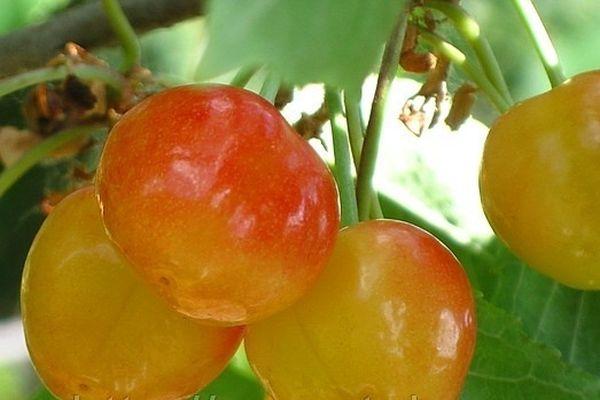
The Priusadebnaya Yellow cherry variety is a great gift from Russian breeders to gardeners, farmers, and vegetable growers. Thanks to its very early ripening, this variety opens the berry season every year. This hybrid cherry is characterized by its ability to self-pollinate and its tolerance to low temperatures, making it possible to grow berry trees even in the harsh conditions of northern regions.
History of selection
The cherry variety was developed and obtained in the late 90s of the last century by Russian biologists at the Michurin Research Institute.
The new hybrid variety was developed using the Zolotaya Loshitskaya cherry and the Leningradskaya Krasnaya fruit cultivar. After the first harvest, the seeds of the new hybrid variety were treated with neural particles, resulting in the variety acquiring unique properties and characteristics.
The Priusadebnaya yellow cherry quickly gained popularity among gardeners and farmers, and is now grown in various climatic zones of Russia and neighboring countries.
Description and characteristics of the variety
To grow a healthy, fruit-bearing cherry tree, you need to have complete information about its characteristics and properties.
Height of a mature tree
Cherry trees have always been known for their tall stature, and the Priusadebnaya Yellow is no exception. Without timely crown shaping and pruning, the tree can reach over 5 meters in height, significantly complicating maintenance and harvesting ripe berries.
Flowering and ripening period
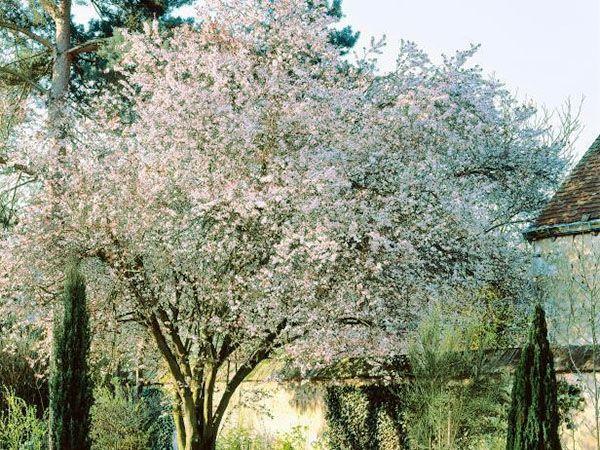
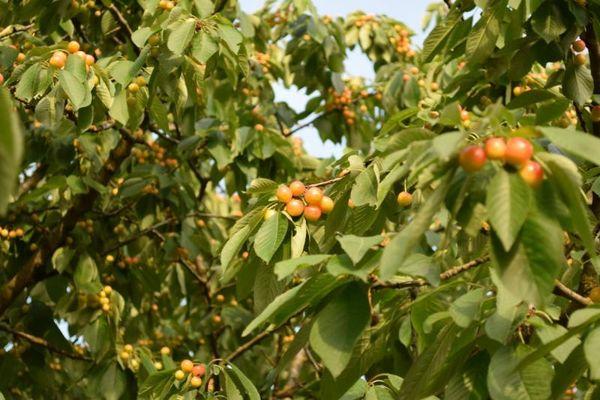
The berry crop enters its flowering phase in early May. Large white flowers appear on the bouquet branches.
The ripening of bright yellow cherries depends on the weather conditions in the region where the hybrid crop is grown. In southern regions, cherries are harvested in the first ten days of June. In temperate climates, the berries ripen towards the end of the month.
Important! The Priusadebnaya Yellow cherry variety begins bearing fruit in the sixth year of outdoor growth.
Productivity
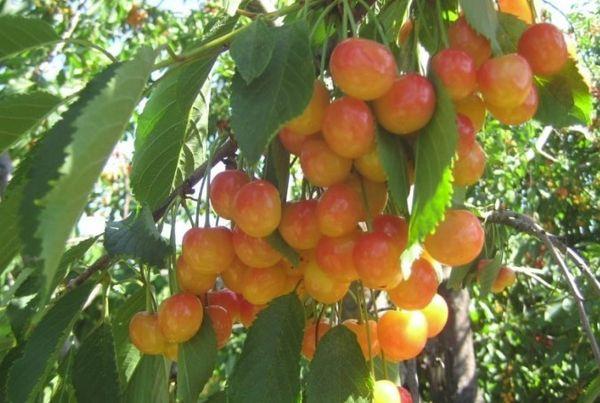
This fruit crop is known for its high yields. With proper care and favorable weather conditions, a single cherry tree can yield up to 30-35 kilograms of ripe, healthy berries.
Transportability
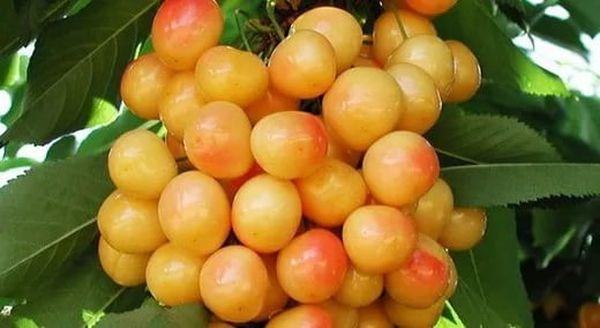
Juicy, sweet and sour cherries are covered with a thick skin, which allows the cherry harvest to be transported over long distances without damaging the fruit.
Drought resistance
In areas with hot, dry climates, fruit crops require additional irrigation measures.
Frost resistance
Resistance to low temperatures and spring frosts is one of the strongest attributes of the Priusadebnaya Yellow cherry tree. Trees easily survive temperatures down to -25°C (-25°F), and with proper care and winterization, the critical temperature can reach -30°C (-22°F) to -35°C (-32°F).
Applications of berries
Yellow cherries contain a higher content of beneficial acids and nutrients. The berries are recommended for fresh consumption. They can also be frozen, dried, or used to make jams and preserves.
Cherries are most often used to make juices, compotes, desserts, and baked goods. They are also used commercially in confectionery and dairy production, including making delicious and healthy yogurts.
Note: The Priusadebnaya yellow cherry variety is considered a dietary product that does not cause allergic reactions.
Pollinators
The hybrid form of the fruit tree, "Priusadebnaya Yellow," is capable of self-pollination. However, to ensure a high-quality and abundant harvest, it is recommended to plant cherry varieties with similar flowering and fruiting times nearby.

Vinca
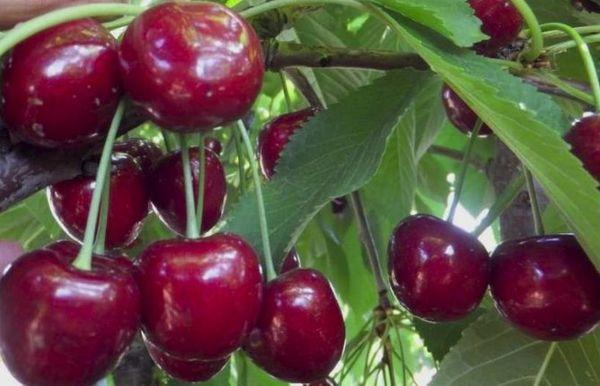
This variety, developed by Ukrainian breeders, is resistant to low temperatures and rarely affected by fungal diseases. The berries are dark red, weighing up to 7 grams, with juicy, sweet flesh. Ripening time is the second half of June.
Early ripening
The first berries of the Skorospelka cherry variety are harvested as early as late May. This variety tolerates winter temperature fluctuations well, making it suitable for growing in regions with a wide range of weather conditions.
Valery Chkalov
A productive, early-ripening cherry variety. The berries are large, weighing up to 8 grams, with juicy, sweet flesh. A single tree yields over 50 kilograms of ripe fruit.
Bigaro Burlat
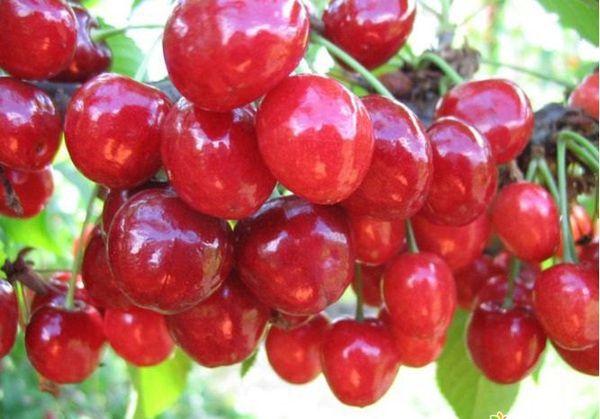
This high-yielding fruit variety was developed by French breeders but has successfully established itself in gardens across Russia and neighboring countries. The red berries have a sweet flavor and juicy flesh and ripen in mid-June. A single tree yields up to 100 kilograms of ripe fruit.
Advantages and disadvantages
Each hybrid fruit crop has many advantages, but one must not forget about the disadvantages that can become a hindrance when growing and caring for cherries.
Advantages:
- Annual fruiting and high yields.
- Early ripening of berries.
- High frost resistance threshold.
- Trees are rarely susceptible to fungal diseases.
- Ripe berries do not crack and do not fall from the bouquet branches.
- Excellent taste and beautiful presentation of berries.
Important! The advantages of this variety include the high content of beneficial acids and vitamins in ripe fruits.
Disadvantages include poor tolerance to high humidity and frequent attacks of cherry flies on the berries.
How to plant
The main conditions for growing healthy and fruitful cherries are observing planting dates and choosing the right plot of land.
Recommended timeframes
In southern and temperate latitudes, planting is recommended in the fall, 4-6 weeks before the first frost. In regions with early winters, cherries are transplanted outdoors in the spring.
Choosing a location
Cherry trees should be planted in level, sunny areas sheltered from northerly winds and strong drafts. Cherries do not thrive in lowlands or marshy soil, and the distance to groundwater should be at least 2.5-3 meters. Berry trees prefer light, loose, chernozem soil with neutral acidity and moisture levels.
Tip! If the soil in the area is predominantly acidic, mix the soil with a generous amount of lime or ash 6-8 months before planting.
Preparing the planting hole
4-6 weeks before the planned planting of seedlings, the land is tidied up and planting holes are dug:
- The soil is carefully dug up, removing all debris and weeds along the way.
- The area is loosened, the soil is mixed with humus, organic matter and a balanced mineral complex.
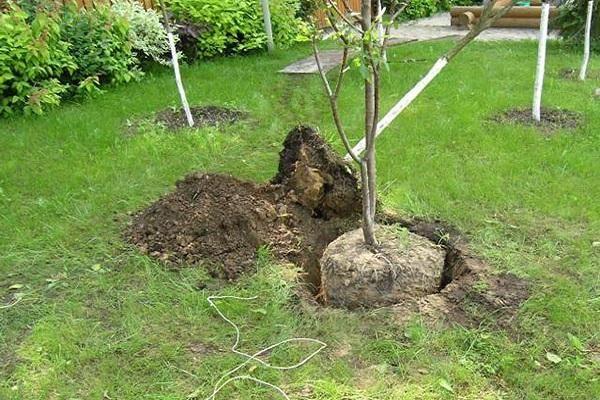
- On the prepared site, planting holes are dug, 60 to 80 centimeters deep and wide.
- The distance between plantings is left from 2 to 3 meters, between rows from 4 to 5 meters.
- A drainage layer of small stones and sand is placed at the bottom of the holes, fertile soil mixture is poured on top and the plant is watered generously.
A support peg is driven into each planting hole.
How to select and prepare planting material
It is recommended to purchase varietal hybrid cherry seedlings only from reputable nurseries.
Two- to three-year-old plants establish and root best. Seedlings are inspected for damage, rot, and fungal growth. Roots are well-moistened and free of broken or damaged shoots. Buds or green leaves are essential on the main stem.
Take a look Also
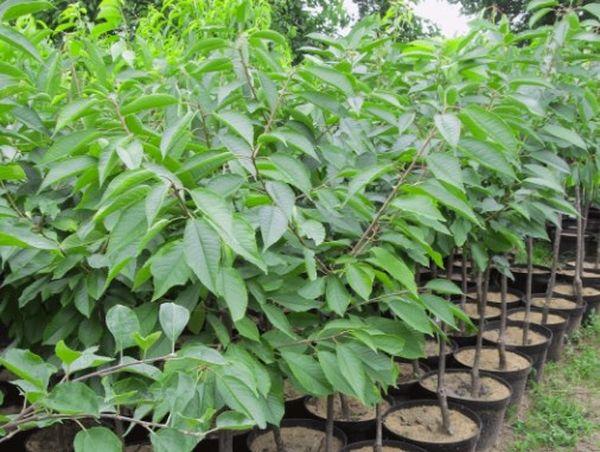
Before planting in open ground, seedlings are placed in warm, settled water for 6-8 hours, and then the roots are treated with a solution of manganese.
Requirements for neighbors
The growth, development, and fruiting of cherry trees depend on proper crop rotation. It is not recommended to plant apricots, apples, raspberries, currants, and pears near cherries. However, cherry and plum trees are excellent neighbors for this fruit crop.
It is recommended to plant honey herbs, mint, lemon balm, primroses, garlic or onions under the trees.
Note: Garlic and onions have antiseptic properties, cleansing the soil of fungi, viruses, and parasites, and many pests dislike the smell of mint.
Planting diagram
On the day of planting, the rhizomes of the seedlings are trimmed, leaving only the most developed and longest branches:
- The seedling is placed in the middle of the planting hole.
- The roots are evenly distributed in the hole and covered with fertile soil.
- The soil under the tree is compacted and thoroughly watered.
- The seedling is tied to a support.
After completing the planting activities, the tree trunk circle is mulched with humus or dry grass.
Care Features
The quality and quantity of the harvest depend on timely and proper care of the Priusadebnaya yellow cherry tree.
Watering mode
Fruit trees are watered 3-4 times throughout the growing season. The first heavy watering is done before flowering, with up to 15 buckets of water applied under each mature tree. The next watering occurs when fruit buds begin to form. The last watering is done in the fall, with up to 100-120 liters of water applied under the trees.
Important! In regions with arid climates, cherry trees require additional watering, and during prolonged periods of rainfall, watering should be avoided altogether.
Top dressing and fertilization
Like any fruit-bearing crop, cherries require additional feeding and fertilizers.
In early spring, organic matter is added to the soil. Before flowering and during fruit set, the trees are fed with a mineral complex containing phosphorus and potassium. As autumn approaches, the soil is mixed with humus, manure, and mineral complex fertilizers.
Crown formation
This fast-growing tree requires annual pruning to maintain its shape. This work is carried out in early spring, before the growing season begins.
First year
In the first year of growth, the top of the seedling is cut to the level of 6-7 buds on the conductor.
Second
In the second year of growth in open ground, the tree develops its first skeletal branches. To do this, 3-4 of the healthiest and strongest shoots are left on the trunk, and the rest are removed. The top of the trunk is increased by 4-5 buds.
Third
In the third year of growth in open ground, a second level of skeletal branches is formed, leaving 3-4 lateral shoots on each skeletal branch. All remaining branches and shoots are pruned.
Fourth
At the beginning of the fourth season, a third tier of skeletal branches is planted on the shoots. The branches should be directed upward, at a 45-degree angle to the main trunk.
Fifth
The fifth season is the last one, when the tree crown is formed and leveled.
Whitewash
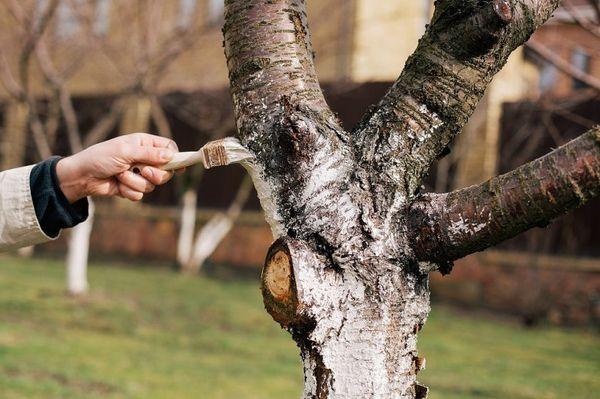
A lime or chalk solution is used to whitewash the trunk and skeletal branches. Whitewashing protects fruit trees from diseases, pests, frostbite, and sunburn.
Sanitary pruning
Sanitary pruning of trees is performed in spring and fall, removing deformed, broken, damaged, and abnormally growing branches and shoots. It is also recommended to remove any undergrowth that interferes with the tree's growth and development.
Spraying
Preventive spraying of cherries is carried out in the spring, before the buds open, and in late autumn, using chemical and biological pesticides.
Preparing for winter
Young seedlings require careful preparation for winter. A frame structure is built over the trees, covered with a special fiber, and topped with spruce branches.
Mature trees are watered generously, the trunk circle is mulched with a thick layer of humus and covered with spruce branches.
The trunk is wrapped in burlap and netting to protect against rodents and small animals.
In early spring, the coverings are removed from the plants.
Weeding and loosening
Weeds are the main carriers of harmful insects, fungal spores, and viruses. Therefore, weeding and loosening the soil around the tree trunks are carried out several times per season, combined with watering and fertilizing.
Diseases and pests
Unfavorable weather conditions and improper care of fruit crops often cause the development of diseases and provoke pest attacks.
Moniliosis
The fungal infection spreads rapidly and can quickly destroy not only the crop but also the tree itself. It manifests itself as blackening and drying of the above-ground portions of the plant. A putrefactive coating appears on the berries.
Balanced fungicides and copper-based biopreparations are used for prevention and treatment.
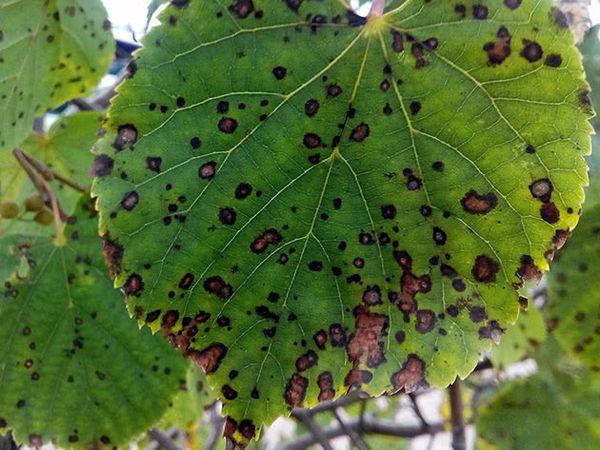
Brown spot
The disease manifests itself as brown spots on the leaves. The leaves dry out and fall off. Copper sulfate solution and fungicides are used for treatment and prevention.
Aphid
The pest appears with the onset of spring, feeds on the sap of young leaves, and then gets to the berry ovaries.
For treatment and prevention, insecticide-based preparations are used, as well as traditional methods of controlling aphids.
Fruit mite
The pest feeds on the juice of leaves and berries, which ultimately leads to necrosis and death of leaf blades and crops.
To combat the pest, chemical and biological control agents are used.
Reproduction of culture
To obtain young seedlings, it is customary to use vegetative methods of propagation of fruit crops.
From seeds
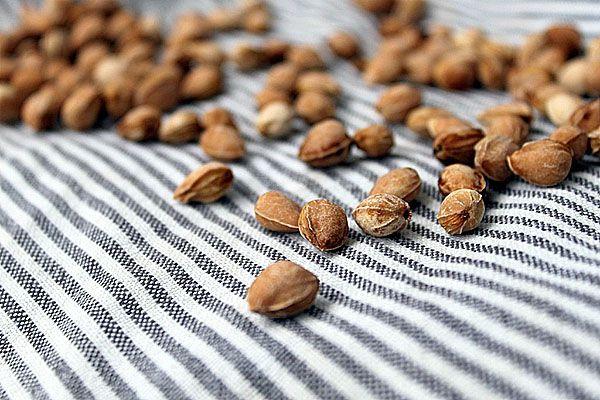
The Priusadebnaya yellow hybrid cherry was developed through years of research by biologists. Therefore, when propagated by seed, the fruit tree will not retain its varietal qualities and characteristics.
Cuttings
To obtain new cherry tree seedlings, a strong, healthy shoot is pruned from an adult plant in early summer and divided into equal sections containing buds or leaves. The cuttings are planted in containers with fertile soil. By autumn, the seedlings will have rooted and become strong, so they are transferred to separate planting holes.
Layering
For Air layering can be used to propagate cherries.To do this, select a strong shoot from a mature tree and make a double-sided, circular cut in the bark down the center. The cut is treated with a root growth stimulant and wrapped in plastic film with fertile soil, securely fastened with tape or duct tape. In autumn, the film is removed, and the rooted shoot is cut from the mother plant and planted in a separate hole.
Harvesting and storage
It's not recommended to leave ripe cherries on the vine for too long. Harvesting occurs as soon as they ripen. The cherries are picked with their stems intact, which allows them to remain firm and maintain their flavor and appearance for a long time.
Related posts:
 Planting and caring for cherries, feeding and growing rules
 Descriptions of the 20 best cherry varieties for the Moscow region, their planting and care
 Description and cultivation of the Bryansk pink cherry variety, pollinators
 The health benefits and harms of cherries, rules of consumption, and their effects on the body
 Description and characteristics of the Veda cherry variety, planting and care scheme
 Description and characteristics of the Bull's Heart cherry variety, planting and care
 Description and characteristics of the Valery Chkalov cherry variety, planting and care
 Description of the Ovstuzhenka cherry variety, planting and care instructions