
You can grow sweet, aromatic melons even in central Russia. The key is choosing the right variety. The early Cinderella melon is one option that gardeners have already come to appreciate.
General characteristics of the plant
The Zolushka melon variety is included in the State Register of Breeding Achievements of Russia and is recommended for early harvests in the southern regions of the country. However, private gardeners interested in the mere prospect of harvesting in uncharted areas have already learned to grow Zolushka melons in Siberia and the Moscow region. This early-ripening variety ripens even in short summers: only 70-80 days pass from sowing the seeds to harvesting the first fruits.

The plant is a climbing plant, with shoots up to 2 meters long. The leaves are large, slightly dissected, and a rich green hue. The variety is prone to forming lateral shoots. Experienced gardeners exploit this trait to produce a productive harvest: female flowers with ovaries form on the lateral shoots. Therefore, the Cinderella melon is trained in a special way.
The Cinderella variety easily tolerates temperature fluctuations. But melon is very sensitive to soil cooling: if the temperature drops significantly, the plant may become infected with root rot.
There are not too many melon pests in central Russia, but fungal ones pumpkin diseases (powdery mildew, downy mildew, and others) can seriously affect plants only during unfavorable seasons with abundant rainfall and cool weather. Because of these climate conditions, many try growing melons indoors.

The Cinderella variety is bee-pollinated, so when grown in greenhouses, it requires the presence of insects or artificial pollination of flowers. Without pollination, the plant will not produce fruit. With proper cultivation, one plant can produce 4-5 small, fragrant melons per season.
Consumer qualities of fruits
The average weight of a single fruit at biological maturity is 1-1.5 kg. A ripe melon is bright yellow, without a pattern. The surface is covered with a fine network of small cracks, smooth, and without ribbing. The pumpkins are round, almost spherical, about 20 cm in diameter.
Take a look Also

The fruit's rind is thin and firm. The Zolushka variety is not prone to cracking when ripe. The condition of the rind can be used to visually determine whether the melon is ready for picking: the color turns yellow, with no green tint at the base (stem), and the cracks become lighter in color.

Melons can be picked when slightly underripe, when the top (nose) of the fruit has not yet become soft. This fruit will withstand transportation well and can be stored for about 1-1.5 weeks in a pantry or at room temperature. During this time, the melon will ripen and acquire a tender texture.
The flesh of the Cinderella is soft, velvety, and very juicy. It is white when fully ripe; when slightly unripe, it has a greenish tint near the rind and is firmer than that of a ripe fruit.
The sugar content is low, reaching only 9-9.5%. The flavor is average, and reviews from sweet melon lovers describe the taste as too watery. However, the distinct melon aroma makes Cinderella a rather pleasant early dessert.
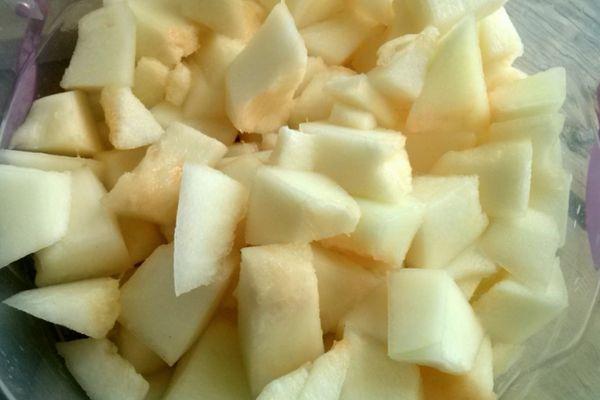
Fragrant, delicate slices of this fruit can be a beautiful addition to both everyday tables and festive table settings. Cinderella's pulp can be used to create a variety of exquisite desserts, incorporated into homemade ice cream or sorbet, or used in a fruit salad, where the aroma of homemade melon adds a unique touch among other fruits and berries.
If there's a surplus of melons, they can be preserved for the winter. The aromatic fruit is used to make preserves and jams. Slices of slightly unripe melons can be dried: this dessert is popular in Central Asia and the Caucasus. Modern home cooks can also freeze peeled and sliced melons. In winter, they can be used as a flavoring component in desserts. The last melons harvested at the end of the season can be stored unripe in a cool pantry or in straw, and eaten as they ripen.


Agricultural technology of the variety
When purchasing seeds from the store, it's advisable to purchase extra seed, as germination and suitability may be low. Select well-filled seeds for sowing. Soak them in a light pink solution of potassium permanganate for 30-40 minutes to kill pathogenic fungal spores. Place the prepared seeds in a damp cloth and place them in a very warm place for germination. At +30°C, seeds can germinate in as little as 24-36 hours.

During this time, prepare the soil and pots for sowing seedlings or form and fill the beds:
- When starting from seedlings, it's best to avoid peat pots and pellets: as the tender roots grow, they can't penetrate their dense walls. It's better to use plastic containers or make cups out of paper (office paper, newspaper). Prepare the soil from equal parts humus, sand, and fertile soil. Add a deoxidizer (chalk or eggshells) to the mixture at a rate of 1-2 tablespoons per 5 kg of the finished mixture.
- An open-ground plot can be created using the principle of warm cucumber beds. Place a layer of fresh manure on the bottom and sides of a wooden box, and in the center, add loose, fertile soil made from a mixture of acidifier, humus, sand, and soil taken from a place where cucurbits (squash, pattypan squash, cucumbers, etc.) have not previously grown. As the manure decomposes, it releases a large amount of heat. The greenhouse can be supplemented with arches of thick wire and covered with plastic during sudden cold snaps.
- The greenhouse site should be on the sunniest side. Prepare the soil the same way as for a warm bed, adding 1 bucket of compost, 1-2 buckets of sand, and 1-1.5 kg of dolomite flour or chalk per square meter. It's best not to plant melons in the greenhouse after cucumbers.


Sow 1-2 sprouted seeds per pot for seedlings. They will germinate in 3-5 days at soil temperatures of at least 18-20°C. The seeds should be planted 1-1.5 cm deep. Transplant to a permanent location when 3-4 leaves have formed, carefully removing the root ball from the pot. When transplanting, it is important not to damage the seedling's root system and to plant it only up to the cotyledons.
When sowing directly into the ground, place the seeds in holes 1.5-2 cm deep and cover with soil. For both seedling and direct sowing, the Cinderella melon planting pattern is 60 x 100 cm. As the side shoots grow, wait until they produce a flower with an ovary, then pinch off the top. The next side shoot is shaped in the same way. A total of 4-5 future melons can be left on the vine, and the main stem can be pinched off.
Related posts:
 How to grow melons outdoors, planting dates, watering, and care
 Golden recipes for preparing pickled melon for the winter and storing the prepared products
 Growing Kolkhoznitsa melon in open ground: benefits and how to choose
 Rules for growing and caring for melons in Siberia in open ground
 How to treat melons against pests and diseases, and can infected fruits be eaten?
 Why melons aren't setting fruit and what to do about it. Methods for hand pollination.
 Description and cultivation technology of the Ethiopian melon variety
 Why are my melon leaves turning yellow in open ground? How to treat and what to do.
This melon is very sweet, and the flesh is very juicy. I've been growing it for three years now, and the yield has never failed. I fertilize it exclusively with bioactivator.BioGrow" Works great.