
- Advantages and disadvantages of cuttings at home
- Recommendations for choosing deadlines
- How to properly prepare a cutting
- Rooting rules
- Preparation
- In the water
- In the ground
- How to care for after rooting
- Illumination
- Humidity
- Watering
- Top dressing
- Temperature
- How to transplant to a permanent location
- Tips and recommendations
Propagating pomegranates from prepared cuttings allows you to grow a plant indoors that will fill your room with a magical aroma during flowering. Furthermore, you can harvest a full crop of fruits from such a plant. This requires not only planting the pomegranate tree correctly but also providing it with proper care from the time it takes root.
Advantages and disadvantages of cuttings at home
Propagating a pomegranate tree from cuttings isn't all that difficult. This method has several advantages, including:
- the rooted cutting quickly begins to grow and in a couple of years turns into a small tree;
- when planting a cutting, the varietal qualities of the plant, the features of its agricultural technology and the necessary care are known in advance;
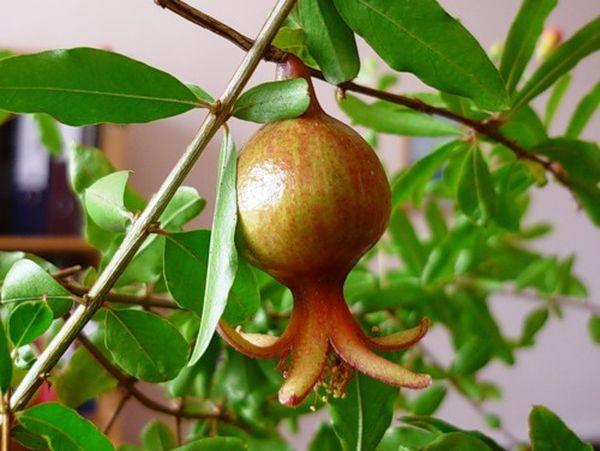
- A grown pomegranate tree will delight you not only with its flowering, but also with its fruiting.
One of the disadvantages of this method is that it can be difficult to obtain high-quality planting material.
Recommendations for choosing deadlines
Indoor pomegranate It also has a dormant period, which ends with the arrival of spring warmth and the awakening of all living things in nature. It is during this dormant period that cuttings should be taken to avoid harming the tree.
The prepared cuttings are placed in water with the addition of a rooting stimulator. In early May, the planting material is planted in the ground. This period is considered the most optimal for the cuttings to take root and begin to grow.
How to properly prepare a cutting
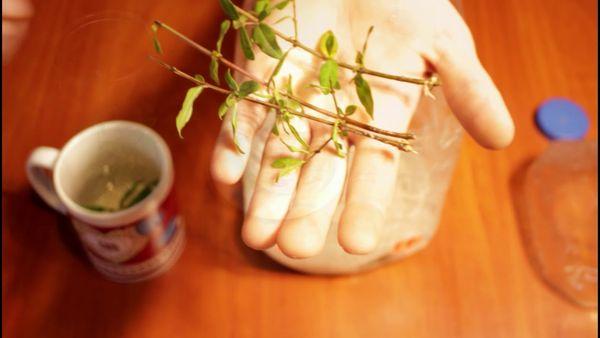
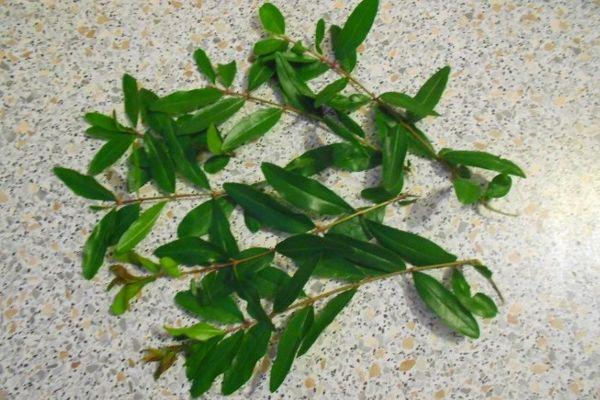
For rooting, cuttings are taken from healthy, one-year-old shoots. They should have approximately five buds and be 20-25 cm long. Cuttings from the tree's root system are also used. The lower part of the cuttings is cut below a bud, and the upper part is cut to 0.5 times the distance between the buds.
Rooting rules
To ensure that the cuttings take root successfully and begin to bear fruit quickly, it is necessary to follow simple rules for carrying out this procedure.
Preparation
Before rooting, it's recommended to treat the prepared cutting with a rooting stimulant. Sometimes, the lower edge is simply dipped in a mixture of activated charcoal and Kornevin. The remaining solution is then shaken off to prevent the cutting from dying. The cutting is then placed in a container of water to root. The cutting is then placed in a well-lit, warm location.
In the water
Rooting a pomegranate in water is easy, especially since you can monitor the viability of the cuttings and the development of their root system. If necessary, you can use additional fertilizers to help the plant grow and develop normally.
Within a week of placing the pomegranate stalk in water, its buds begin to swell. After seven days, the first roots begin to emerge. Over the next week, the plant's root system will develop and grow. A strong and healthy tree will develop numerous, powerful roots.
If you notice that the roots are weak and few in number, it's recommended to remove the cutting from the water and soak it in a Kornevin solution for 12 hours. Then, return it to the glass jar with clean water. Once a strong and well-developed root system has formed, transplant the pomegranate into the ground.
In the ground
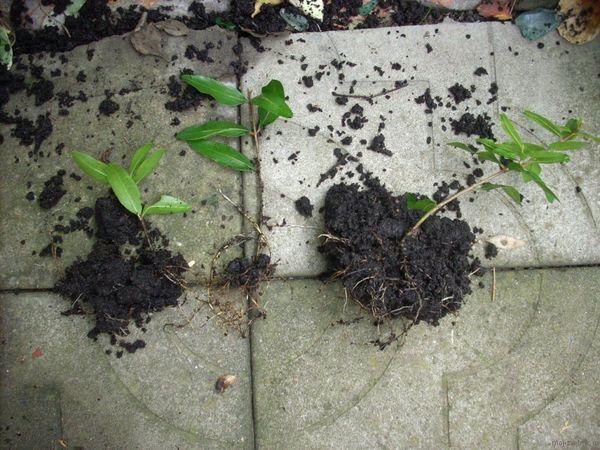
Once the cuttings planted in the soil have formed 3-4 shoots with leaves, they are transplanted into individual pots. All steps are performed with extreme care to avoid damaging the delicate roots. A drainage layer is placed at the bottom of a pot of the appropriate volume, then a nutritious soil mixture is added, and the seedling is placed in place.
Pots with young pomegranates are placed on a wide, sunny windowsill, preferably facing south. If the sun is very bright, the tree is slightly shaded to prevent the leaves from getting burned. The ideal option would be to place the plant in a well-lit place opposite the window.
How to care for after rooting
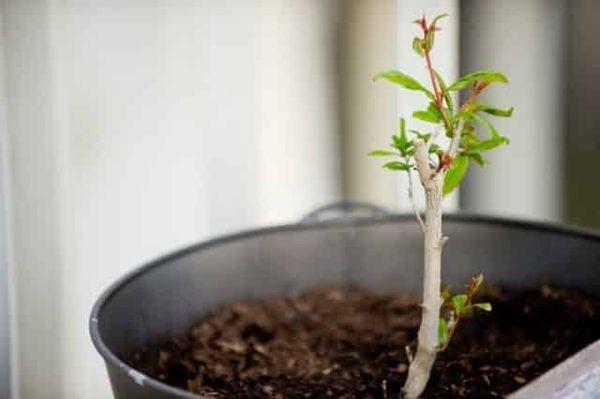
When growing a pomegranate, it is important not only to root and plant the cuttings correctly, but also to provide the plant with proper care.
Illumination
Pomegranates should be grown in the sunniest location possible. The plant does not tolerate low light and may drop its leaves. To protect against sunburn, use artificial shade.

Humidity
Pomegranates don't like excess soil moisture, which can cause root rot. Maintain average or slightly above-average humidity in the room.
In dry and hot weather, it's recommended to provide additional humidity by placing open containers of water or an automatic humidifier. The same should be done in winter when central heating is on. This can significantly dry out the air in the room, which negatively impacts the health of the pomegranate tree.
Watering
Pomegranates should only be watered with settled, room-temperature water from which any remaining chlorine has evaporated. Do not allow the soil to dry out. Water the plant using a tray.
If there's any water left after 30 minutes, it should be poured out. Excessive moisture can cause pomegranate roots to rot.
Top dressing
It's preferable to feed the pomegranate tree with a universal product that stimulates its growth and development—potassium humate. When the plant begins to bloom, it can be treated with "Buton," which will stimulate the formation of buds and ovaries. Once during the growing season, the tree is fed with a complex mineral preparation prepared according to the included instructions.
Temperature
When growing pomegranates, remember that the tree cannot tolerate temperatures below -10°C during the winter. If this is likely, the plant should be moved to another room or well insulated. When growing this exotic fruit indoors, it should be moved to a cool room with an air temperature of +10°C for the winter.
How to transplant to a permanent location
Pomegranate seedlings grown from cuttings are planted in a permanent location towards the end of summer. The site chosen for this purpose should meet the same requirements as the temporary location.
First, dig a planting hole 0.7 m deep and 0.6 m wide. When planting several trees, the distance between them should be about 2 m.
Take a look Also
A support stake is placed in the center of the hole, and a layer of drainage material is added to the bottom. Next, a nutritious soil mixture of fertile soil, humus, and sand is added in a mound. The pomegranate is carefully placed on top of the mound and covered with soil. The root collar should not be buried too deeply. The seedling is tied to the support stake, watered generously, and the soil mulched.
Tips and recommendations
To grow a pomegranate from cuttings at home, a ready-made commercial potting mix designed for growing citrus plants is typically used. However, if desired, you can prepare your own. To do this, you'll need a small amount of the following ingredients:
- fine river sand, washed free of clay;
- leaf humus;
- peat;
- turf soil.
Experienced gardeners say that under no circumstances should you use oak soil for growing pomegranate trees, as it is highly acidic.
During the first few years of its life, the tree needs to be repotted annually (if grown indoors). This is done in early spring. Each time, the pot's size should be increased.
It's worth noting that if the pot is too large, the pomegranate will grow roots first, and once they completely fill the pot, the above-ground portion will begin to grow. The mature tree is transplanted into a larger clay pot, where it will grow for several years.
Related posts:
 Planting and caring for indoor pomegranates at home for beginners
 How to grow pomegranate at home: care and pruning guidelines
 Caring for and growing pomegranate from seed at home
 The best eggplant varieties for growing in a polycarbonate greenhouse: planting and care
 Methods for planting and propagating cherries at home
 How to propagate grapes in summer using green cuttings at home
 How to propagate an apple tree using cuttings in summer and without grafting, rooting methods
 The best methods for growing grapes from seeds at home