
Treating grain fields with herbicides helps remove weeds, improving crop health and yields. Let's explore the action and purpose of the herbicide "Arbalet," its pros and cons, how to prepare and use the solution, what products "Arbalet" interacts with, and what alternatives it can be used with.
Composition, dosage form and purpose
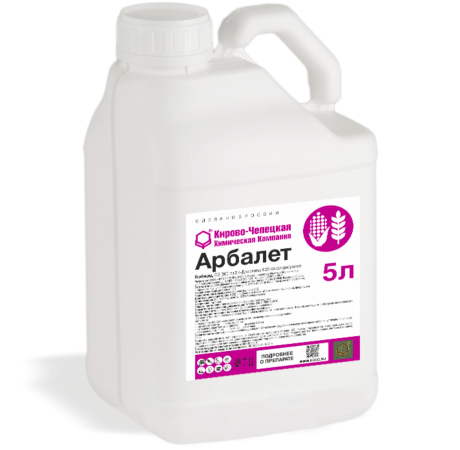
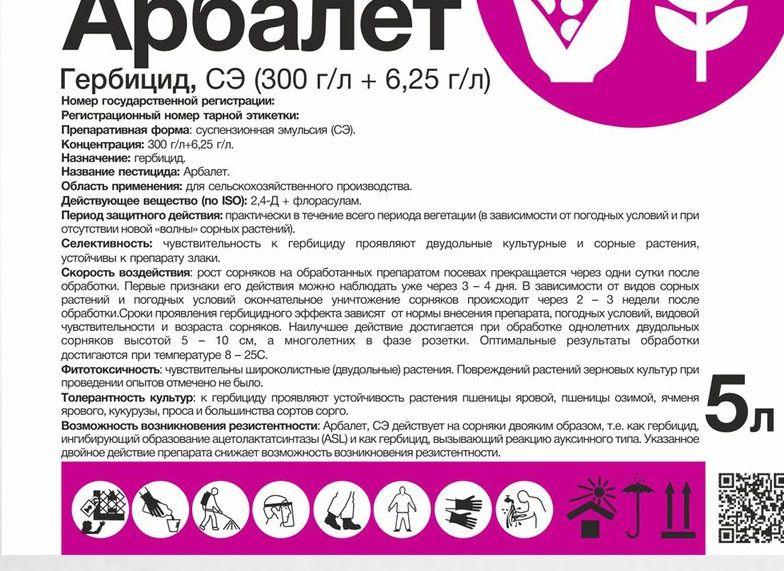
"Arbalet" is used on wheat, corn, barley, rye, millet, and sorghum. It controls annual and some perennial weeds. This post-emergence herbicide is effective. The manufacturer produces it as a suspension emulsion in 5-liter canisters. The active ingredients are 2,4-D (2-ethylhexyl ether) and florasulam. The formulations contain 300 g per liter and 6.25 g per liter.
"Crossbow" is classified as a selective herbicide by its mode of action and as a systemic pesticide by its method of penetration.
Mechanism of action
2,4-D acid is absorbed by leaves and roots, then redistributed and accumulates in the stems and roots of weeds. This disrupts metabolic processes and deforms plant organs. Florasulam inhibits the enzyme acetolactate synthetase.
Signs of herbicide suppression—leaf discoloration and curling—can be observed within 3-4 days. Complete plant death occurs within 2-3 weeks. The herbicide protects crops throughout the growing season; one application is sufficient. It does not induce resistance in weeds.
Pros and cons
Calculation of consumption
Wheat, rye, barley, and corn are treated against first-year weeds that may be resistant to 2,4-D and 2M-4X, as well as some perennial dicotyledonous species. The application rate for cereals is 0.4-0.6 l per hectare (0.6 l for later treatments), and for corn, 0.4-0.6 l per hectare and 0.5-0.6 l. The solution consumption rate is 200-300 l per hectare, with a waiting period of 56 and 60 days. Workers can return to work after 3 days.
Preparation of working solution
The "Arbalet" solution is prepared as follows: mix the required amount of suspension with water in a tank, making it 1/3 of the required volume. Then add the remaining water and mix again.
Terms of Use
Apply at temperatures between 15 and 25°C. Spray on a windless, cloudless day. There should be no rain on the day of application. Prepare a volume of herbicide solution sufficient for one working day's use.
Safety precautions
The herbicide is classified as a moderately hazardous product. Working with it requires the use of thick protective clothing, a respirator or gas mask, thick gloves, and plastic goggles. No bystanders should be allowed near the field being treated.
What to do in case of poisoning
If Arbalet solution comes into contact with skin or eyes, rinse immediately with water for at least 15 minutes. If the liquid is accidentally ingested, take activated charcoal at a dose of 1 g per 1 kg of body weight with water. Induce vomiting after 15 minutes. If symptoms persist, seek medical attention.
How toxic is it?
Hazard class 2 for humans (moderate hazard) and 3 for bees (low hazard). The herbicide should not be applied to fields near water bodies. Phytotoxicity has not been observed.

Possible compatibility
"Arbalet" is compatible with insecticides and fungicides used for treating grain crops. A preliminary test for physicochemical compatibility of the components is required.
In tank mixtures, do not mix pesticides in their pure form, without diluting them with liquid.
Storage rules and shelf life
"Arbalet" should be stored in warehouses designated for pesticides. These warehouses should be dry and dark. Do not store the herbicide near food, feed, or other commodities. "Arbalet" must be used before the expiration date. The date is indicated on the label, canister, or packaging. The manufacturer's recommended shelf life is 3 years. Store the product undiluted, in a tightly sealed, undamaged industrial packaging. After the expiration date, the product should be discarded. Do not store the diluted herbicide solution for more than 24 hours, as its effectiveness will decrease significantly.
Similar means
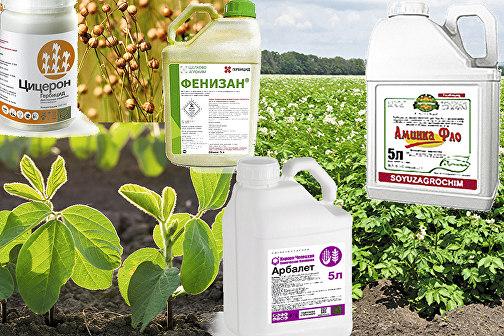
In terms of active ingredients, similar medications to Arbalet include Avrorex, Assoluta, Disulam, Zernomax, Camaro, Lambada, Octapon Super, Oktimet, Prishans, Svarog, Florax, Chistalan, Elant, Esteron, and others. They have similar compositions and effects and can be used as a substitute for the original medication if necessary.
The herbicide "Arbalet" is used on grain crops to protect them from weeds that inhibit them. It begins working immediately after application, suppressing weeds within the first day. It prevents new weed growth, and a single spray is often sufficient. Crop treatment can be performed by aerial spray. "Arbalet" has good compatibility with pesticides. It is nonphytotoxic, does not inhibit grain crops, and weeds do not develop resistance to the active ingredients. Allowing grain to grow freely allows for better crop development, increasing yields.
Related posts:
 Instructions for use and composition of the herbicide Esteron, dosage and analogues
 How to make a garden bed from scratch without grass and weeds: ideas and methods with and without weeding
 Composition and instructions for use of the herbicide Total, application rate and analogues
 Instructions for use and composition of the herbicide Caliber, consumption rate and analogues
 Instructions for use and composition of Glyphora for weed control, dosage, and analogues
 Instructions for use and composition of the herbicide Miura, application rates and analogues
 Carrot care guidelines for outdoor cultivation to ensure a good harvest
 Florax herbicide instructions, dosage, and analogues
Take a look Also
