
- Selection of the Yakovlevskaya pear
- Cultivation regions
- Advantages and disadvantages of fruit crops
- Varietal features and characteristics
- Dimensions and height of the tree
- Life expectancy
- Fruiting
- Flowering and pollinators
- Ripening time and harvest
- Tasting qualities and uses of fruits
- Transportability
- Resistance to drought and frost
- Immunity to diseases and insects
- Planting the Yakovlevskaya pear
- Deadlines
- Soil requirements
- Planting layout schemes
- Preparing the site and seedlings
- The technological process of tree planting
- Rules for caring for the variety
- Watering frequency
- Fertilization
- Trimming
- Whitewash
- Loosening and weeding the tree trunk circle
- Seasonal treatments
- Preparing for winter
- Methods of reproduction
- How to Increase Your Yield: Tips and Advice
- Gardeners' reviews of the variety
The Yakovlevskaya pear is a frost-hardy winter variety with good resistance to pests and diseases. Its fruits boast excellent flavor, gaining juiciness and sweetness over six months in specialized storage conditions. When grown indoors, the fruit retains its quality and marketable appearance until the New Year. Yakovlevskaya is grown commercially and in private gardens.
Selection of the Yakovlevskaya pear
The variety was developed in the early 2000s by a group of breeders led by S.P. Yakovlev at the I.V. Michurin All-Russian State Scientific University of Genetics and Breeding of Fruit Plants.
The donors for the development of the Yakovlevskaya variety were late pears Daughter of Dawn and Talgar Beauty.
Cultivation regions
The variety was created for cultivation in the Central Black Earth Region and fully complies with the stated characteristics when grown in the Tambov, Oryol, Tula, Kharkov, Belgorod, and Lipetsk regions.
It is successfully grown by gardeners in the Moscow region, Yaroslavl, and St. Petersburg.
Advantages and disadvantages of fruit crops
The Yakovlevskaya variety is characterized by the following qualities:
- strong immunity to diseases and pests;
- resistance to low temperatures;
- long-term storage of crops;
- large fruit sizes.
Disadvantage: Requires care and crown shaping. Failure to prune branches regularly will result in dense branches, reducing the quality and yield of the harvest.

Varietal features and characteristics
The Yakovlevskaya pear tree begins bearing fruit late, developing its root system and crown during its first five years. This variety produces consistent yields, with fruit weighing up to 210 g.
Dimensions and height of the tree
The variety is characterized by a tree with an average height of 5 m and a pyramidal crown.
The branches are upright, and the ability to form shoots is low, which leads to the formation of a sparse crown.
Life expectancy
Under favorable conditions, cultivated pear varieties live up to 90 years. After 45 years, the tree loses fruit yield and branch mass.
To maintain productivity, the crown is rejuvenated by pruning branches or the tree is uprooted.
Fruiting
The variety begins bearing fruit in the 6th year of vegetation, increases its yield for up to 20 years, and with good care, consistently produces the maximum number of large fruits for up to 40 years.
In private gardens, given good weather conditions and proper care, it is possible to harvest up to 50 kg of pears from a tree.
When growing fruit on an industrial scale, Yakovlevskaya's yield reaches 180 c/ha.


Flowering and pollinators
The Yakovlevskaya pear is self-fertile, pollinating with its own flowers. Growing trees that bloom at the same time in the garden increases the yield. Examples of such varieties include Saint-Germain, Saratovka, Pervomayskaya, and Nika.
Ripening time and harvest
A warm summer allows for harvesting in the first ten days of September. A rainy, cold summer slows the ripening of the fruit, and the mass harvest occurs in late September. In a warm, dry autumn (without nighttime temperature drops), the pears ripen on the trees, gaining sweetness and juiciness, until mid-October.
Tasting qualities and uses of fruits
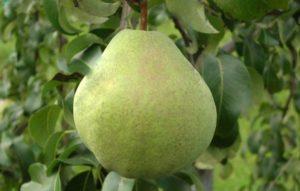
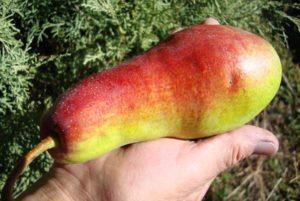
Ripe pears have tender, buttery, juicy flesh with a fine grain. Sugar and ascorbic acid content range from 11-10%, creating a balanced sweet and sour taste. The pear aroma features floral notes. Taste experts rate this variety 4.5 points on a 5-point scale.
Application of fruits:
- fresh consumption;
- obtaining dried fruits;
- winemaking;
- preparation of jam, marmalade, confiture, preserves, compote, juice, nectar.

Transportability
In special storage facilities, the variety does not lose its marketable appearance and retains its taste for up to 6 months.
Pears are transported in wooden or plastic containers with slits for air access, wrapping each fruit in parchment paper.
Resistance to drought and frost
The Yakovlevskaya variety is frost-resistant and can withstand temperatures of -38 With minimal damage and subsequent recovery, which is not typical for other varieties zoned for the Central Black Earth Region.
Pear trees are demanding when it comes to moisture. During hot and dry summers, the variety requires frequent and abundant watering; otherwise, it will reduce fruit size and yield.
Immunity to diseases and insects
The Yakovlevskaya pear has a strong, complex immunity to diseases and pests, which must be maintained and strengthened throughout the tree's growing season.

The variety is resistant to diseases and pests:
- scab;
- powdery mildew;
- fruit rot;
- cytosporosis;
- copperhead;
- leaf flea beetle;
- codling moth;
- flower beetle.
Planting the Yakovlevskaya pear
Selecting healthy seedlings and knowing and following agricultural practices are the key to stable harvests.
Pears are planted in an area protected from northern winds, on elevated ground or gentle slopes facing south.
Groundwater levels in the area should be no higher than 2.5 m from the soil surface.
Deadlines
Pear is a heat-loving crop, the best time for planting is early spring: late March, early April.
In the fall, trees are planted a month before the first frost to allow them to take root. Winters with little snow, unexpected frosts, and rodents are all factors that can contribute to the death of young seedlings.

Soil requirements
Pear trees thrive in fertile, nutrient-rich, warm, medium-textured soils that have been cultivated. Loamy, neutral soils are best.
Peat and humus are added to sandy soils, and river sand, peat, and organic fertilizer are added to clay soils.
Planting layout schemes
The pear is a large tree that loves the light, which requires following the recommended planting pattern: 5 x 4 m. If the light level is insufficient, the pear will produce a poor harvest, and the fruit will lose its flavor.
Preparing the site and seedlings
For spring tree planting, holes are dug in the fall, and for fall planting, two weeks before planting to allow the soil to settle. The holes are marked out to be 60 x 60 cm and 50 cm deep, with the top and bottom layers of soil stacked in opposite directions.
The roots of the seedlings are not cut, the branches are shortened after planting.

The technological process of tree planting
The procedure for planting a seedling:
- A stake is placed at the bottom of the hole below the level of the skeletal branches.
- Mix the top layer of soil with a bucket of humus, 200 g of superphosphate, 20 g of potassium sulfate and pour the mixture into a mound at the bottom of the hole.
- Place the seedling on a hill and straighten the roots on the sides.
- Cover with soil and compact tightly.
- Form a hole for watering using 5 buckets of water and water.
- The trunk is tied to a stake in a figure eight so that the seedling does not swing in the wind.
The root collar should remain at ground level after watering the soil, the graft should be above the soil on the eastern side.
Rules for caring for the variety
Caring for a pear tree consists of the following mandatory procedures:
- glaze;
- weeding;
- loosening, mulching, fertilizing the soil;
- branch pruning;
- preventive work.
Proper agricultural practices are the key to strong immunity and stable harvests.
Watering frequency
The pear is watered:
- before flowering, in case of little snow in winter and dry spring;
- 20 days after flowering;
- during fruit formation;
- at the beginning of September to increase the juiciness of the fruits and develop the root system;
- before winter to create a moisture reserve for spring, favorable wintering conditions, and protection from rodents.
Fertilization
The pear tree does not require feeding for 4 years after planting if the planting soil mixture is properly prepared.
Top dressing with nitrogen fertilizers (urea, ammonium nitrate) begins in the 3rd year of vegetation in early spring in the amount of 20 g/m2.
In the 5th year of tree development, before fruiting, in the fall, fertilize with a mixture of organic fertilizer with superphosphate 45 g/m2 and potassium sulfate 25 g/m2.
Trimming
Pruning pear branches helps shape the tree, improve growing conditions, increase yields, and enhance the taste of the fruit.
During the first 6 years of tree growth, a crown is formed with 5-6 skeletal branches, one order of branching, a large number of skeletal branches bearing a large number of flower buds.
The initial crown of a seedling is formed during planting:
- The central branch is left 25 cm above the skeletal branches.
- 3 skeletal branches at an angle of 450 cut at the same level.
- The branches are shortened by 1/3 of their length.

In the second year of vegetation, a single upward-growing branch is left on the skeletal branches. Upright-growing competitors are pruned, leaving horizontally growing branches, directed in different directions at a distance of 40 cm.
According to this principle, a loose crown is formed, with free access to sunlight and air.
Whitewash
To prevent and heal bark damaged by frost, whitewash is applied in mid-November.
Composition of the whitewash:
- water – 10 l;
- lime – 1 kg;
- mullein – 3 kg;
- clay – 4 kg;
- copper sulfate – 50 g;
- laundry soap – ½ pack;
- office glue – 50 g;
- Epin drug – 6 ml.
Coat trunks and large branches twice with an interval of 2 hours.
Loosening and weeding the tree trunk circle
Weeding is carried out regularly; Ground Bio eradicates weed growth on the site.
 Spring sowing of green manure around the tree trunk improves the structure and nourishes the soil, preventing weed growth. Loosening the soil to a depth of 5 cm is done in spring, fall, and during rainy summers to allow air to reach the root system.
Seasonal treatments
Seasonal preventative work against diseases and pests includes:
- collection and burning of leaves;
- loosening, mulching, digging the soil;
- pruning of diseased and old branches;
- whitewashing;
- treatment with protective agents.
The following preparations are used: copper sulfate, Bordeaux mixture, Topaz, Hom, Skor, Iskra, Antikleshch.
Preparing for winter
Pre-winter preparation of the pear tree trunk includes:
- whitewashing for burns and diseases, coating with a mixture of clay and manure for rodents;
- insulation with thermal insulation materials;
- mulching the soil with peat, humus, manure;
- lining the tree trunk circle with pine or spruce branches.

Methods of reproduction
Pears are propagated in orchards by grafting onto rootstock. The viability of the grafted pear variety depends on the biological properties of the rootstock.
Many amateur gardeners have mastered and successfully practice this method of propagation in their garden plots, grafting different varieties of pears and apples onto one tree.
How to Increase Your Yield: Tips and Advice
Preventive measures against diseases and pests, application of fertilizers and use of preparations help maintain and increase pear yields.
Stimulates root formation – Kornerost, Heteroauxin.
The bud accelerates the formation and ripening of fruits and preserves the ovaries in bad weather.
Gardeners' reviews of the variety
Mikheeva N., Tambov.
"The Yakovlevskaya pear is 15 years old, it tolerates winters well, I serve fresh, aromatic pears on the table for New Year's."
Svetlana K., Yaroslavl.
“The tree began to bear fruit in the 6th year; the pears weighed 100-150 g.”
Andrey Vovchenko, Yelets, Lipetsk region.
“I constantly collect a rich harvest, the pear tree doesn’t get sick.”
Related posts:
 Description and full characteristics of the Yakovlev Memory pear variety, planting and care
 Description and characteristics of the 45 best pear varieties, how to choose
 Description of the 23 best pear varieties for the middle zone, planting and care rules
 Description of the Abbot Vettel pear variety and the subtleties of growing it
 Description and characteristics of the Marble pear variety, pollinators and cultivation subtleties
 Description and full characteristics of the August Dew pear variety, planting and care
 Description and subtleties of growing the Efimova Elegant pear variety
 Description of the Moskvichka pear variety, agricultural technology, and the best pollinators