
- How does boric acid affect cabbage?
- What are the benefits of boric acid?
- Benefits of using boric acid
- Signs of boron deficiency in cabbage
- How to prepare a working solution
- Instructions for use: terms and conditions of use
- We process seeds before sowing
- Application to soil as fertilizer
- As a green leaf feed
- Cabbage seed plants are fed during the budding and ovary stages.
- Watering plants at the roots
- For pest control
- Safety precautions
Treatments such as seed treatment and boric acid spraying are crucial for cabbage, as they help eliminate the deficiency of this micronutrient, which significantly impacts plant growth and development. The effectiveness of this micronutrient depends on the correct dosage and timely application.
How does boric acid affect cabbage?
Boric acid, when applied at various stages of cabbage development, has the following effect on crop growth:
- enhances the growth and development of the root system;
- activates the emergence of new leaves from the apical bud;
- accelerates the formation of a head of cabbage with high density and weight;
- stimulates the accumulation of carbohydrates in the cabbage head;
- increases the crop's resistance to diseases such as clubroot and scab;
- Thanks to its rooted development, it increases the crop's resistance to damage by cruciferous flea beetles and slugs.
Treatment of cabbage seedlings with boric acid promotes more uniform and earlier flowering, pod formation, and the ripening of seeds with high sowing qualities.
What are the benefits of boric acid?
The benefits of boric acid as a micronutrient fertilizer for cabbage are as follows:
- Treated seedlings are smaller, more compact and take root faster in open ground.
- The root system of the seedlings develops very quickly, and the crop holds firmly in the soil.
- At the initial stage, seedlings can withstand sudden temperature changes.
- A fertilized cabbage plantation produces a harvest of large and dense heads of cabbage.
- The harvested cabbage stores well. When stored properly, the heads will not crack or rot.
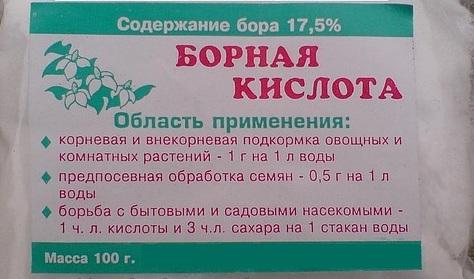
Plants treated with micronutrient fertilizers also have high resistance to various diseases and pests.
Benefits of using boric acid
The main advantages of using boric acid as a micronutrient fertilizer when growing cabbage are the following:
- Affordability and availability – this micronutrient fertilizer is inexpensive and can be purchased at any seed store or agricultural market.
- Ease of application – dissolved in hot water and mixed with cool water, boric acid is easily and conveniently applied in the form of several foliar applications using a standard backpack sprayer.
- High efficiency – a small amount of applied fertilizer increases crop yield by 15-20%, improves the taste and shelf life of the grown heads of cabbage.
- Compatibility with pest and disease control products – boric acid is compatible with all plant protection products and can be added to pesticide solutions, allowing for combined pest control treatments and foliar feeding.
- Safe for bees and other beneficial insects – classified as hazard class 4, this fertilizer is safe for pollinating insects, fish, and livestock.


However, it should be noted that the disadvantages of this micronutrient fertilizer include side effects such as twisting and deformation, profuse yellowing and falling of leaves, and marginal necrosis of the leaf blade when overdosed.
Signs of boron deficiency in cabbage
Boron deficiency in cabbage can be diagnosed by the following external signs:
- chlorosis – yellowing of the interveinal surface of the leaf blade;
- wilting and dying of the lower leaves in the rosette;
- depressed state and growth retardation;
- weak root system;
- the formation of a hollow and loose head of cabbage.
Another sign of boron deficiency is poor storage of the harvested crop, cracking and rotting of heads of cabbage.
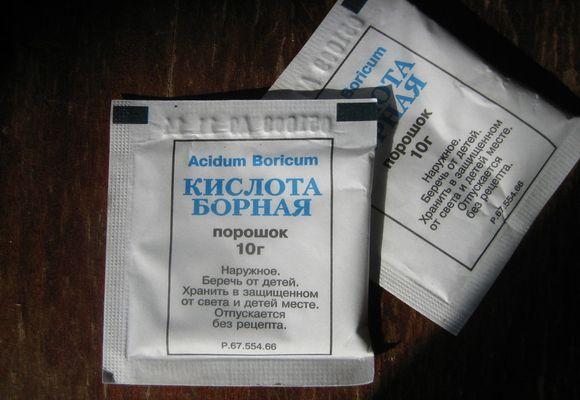
How to prepare a working solution
When grown in a garden plot, boric acid, sold as a finely crystalline powder, is applied diluted in water. A stock solution is first prepared and then diluted to the required concentration.
The process of preparing the mother liquor is as follows:
- Weigh 0.2 grams of boric acid.
- The weighed powder (sample) is placed in a small glass container with a volume of 1.5-2.0 liters.
- 1 liter of hot water at a temperature of 50-60 is poured into the container with the sample Using a small wooden stick, stir the fertilizer with water until it is completely dissolved and there is no sediment at the bottom.
- The resulting mother liquor is allowed to cool to room temperature.
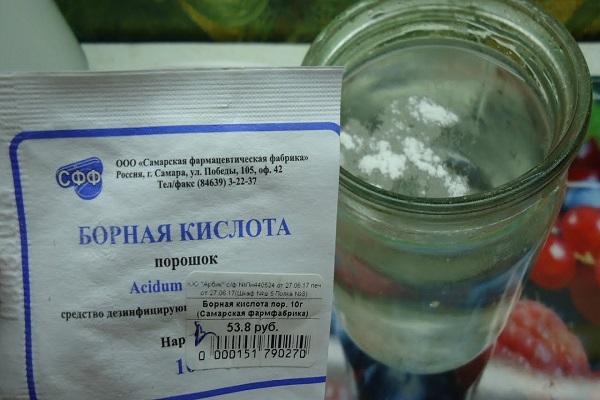
For top dressing, the stock solution is diluted with water in a 1:9 ratio: 9 liters of clean, settled rainwater is added to 1 liter of solution. The resulting solution is used for foliar feeding and watering plants at the roots.
Note: It is necessary to dilute boric acid with hot water, as the fertilizer is practically insoluble in cold water.
Instructions for use: terms and conditions of use
When growing cabbage, boric acid is used for soaking seeds and for foliar and root feeding.
We process seeds before sowing
Seed treatment before sowing in seedling boxes, cassettes or open ground under film is carried out as follows:
- 0.2 grams of fertilizer is dissolved in 1 liter of hot water.
- The solution is allowed to cool to room temperature.
- The calibrated seeds are poured into a small gauze bag and placed in the solution.
- After keeping the seeds in the solution for 12-14 hours, the bag with the seeds is removed from it, rinsed under running water, and dried on a newspaper for 5-10 minutes.
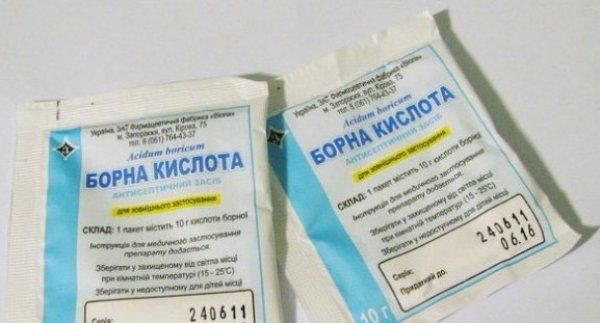
Along with boric acid, you can also add other micronutrient fertilizers to the soaking solution: potassium permanganate (1 gram), copper sulfate (0.5 grams), zinc sulfate (0.5 grams).
Application to soil as fertilizer
For a basic fertilizer application, dissolve 0.5 grams of boric acid in 1 liter of hot water, allow the solution to cool, and then add another 9 liters of cold water. Use a garden watering can to water the soil in the area where the seedlings will be planted. The application rate of the working solution is 1 liter per square meter.
As a green leaf feed
For normal development of cabbage throughout the growing season, it should be fed with boric acid 3 times:
- 10-12 days after planting seedlings in open ground;
- in the phase of increasing mass growth of rosette leaves;
- in the phase of increasing the volume and mass of the head of cabbage.

Cabbage seed plants are fed during the budding and ovary stages.
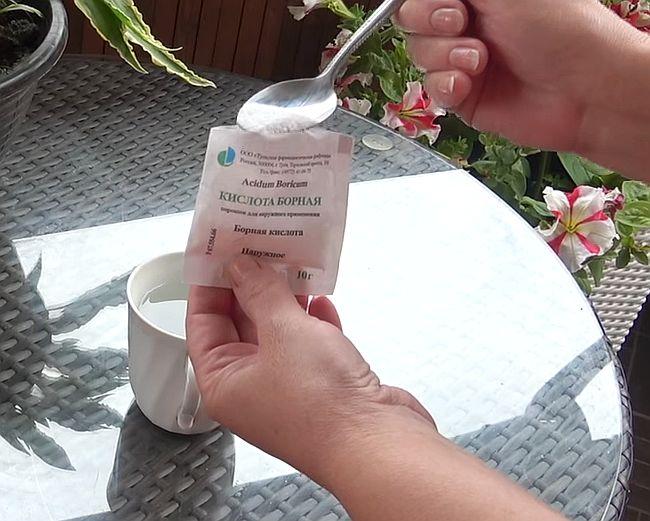
For foliar feeding, use a solution containing 0.2 grams of boric acid per 10 liters of water. It is applied using a backpack garden sprayer. The average fertilizer dose is 1 liter per square meter (approximately 200-250 grams per plant).
Watering plants at the roots
Unlike foliar feeding, a micronutrient solution (0.2 grams of boric acid per 10 liters of water) is carefully poured under each plant. The recommended application rate is 200-250 grams per head of cabbage. Root feeding begins when the leaves of the root rosette begin to actively grow. Since the seedlings are small at this stage, the boric acid solution is poured under each plant using a small container such as a glass jar or ladle. Avoid allowing large drops to fall on the leaf surface.
For pest control
Boric acid is used as an effective remedy against pests such as ants.

To combat them, the following boric acid-based products are used:
- Microfertilizer powder is scattered in a thin layer in places where insects accumulate.
- Dissolve 5 grams of boric acid in 100 grams of hot water, add 10-15 grams of honey and 40-45 grams of sugar. Pour the resulting syrup into a shallow container and place it near the cabbage patch, where ants often make their way.
Boric acid helps indirectly against other pests (flea beetles, cabbage white butterflies, slugs) – a healthy and strong plant that is not deficient in this micronutrient recovers very quickly from damage by these pests, and has less of a reduction in yield.
Safety precautions
When performing foliar feeding of cabbage, the following safety precautions should be observed:
- The fertilizer sprayer must be well adjusted, and leaks of the solution through the hoses and tank must be completely excluded.
- Treatment should be carried out in the morning or evening hours, in cloudy weather, wind no more than 5 meters per second, temperature no higher than +21 .
- When working, it is essential to wear a change of clothes, a headdress, and respiratory and eye protection equipment (respirator, glasses).
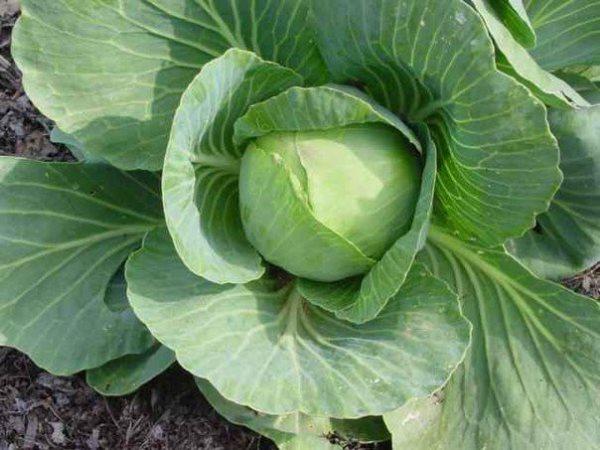
When fertilizing, apply the micronutrient solution so that a thin film of liquid forms on the leaves. Avoid dripping or excessively wet leaves, as high concentrations of the solution can cause chemical burns to the leaf blade.
Related posts:
 How to spray tomatoes with boric acid, cultivation and processing rules
 Using boric acid for spraying and treating peppers
 Boric acid application for plants, dilution and processing instructions
 Growing and caring for Chinese cabbage in open ground and greenhouses
 Planting, growing, and caring for cauliflower in open ground and greenhouses
 Why does cabbage grow tall in the garden and what can be done about it?
 Can cabbage be sprayed with valerian to control pests and what are the treatment guidelines?
 Description of the best cabbage varieties for 2025 for different regions