
The hybrid cabbage variety Rinda was developed by the Dutch company Monsanto and is suitable for commercial cultivation. Russian gardeners are interested in the consumer qualities of this hybrid, which appeared in Russia about 20 years ago. Since then, the Rinda variety has found its fans.
General characteristics of the plant
Back in 1993, the variety was recommended for commercial cultivation in the Central and Volga-Vyatka regions of the country. However, Rinda F1 cabbage has also proven itself in private gardens in the Urals and Siberia. Gardeners' reviews note the hybrid variety's high and consistent yield, regardless of weather conditions.
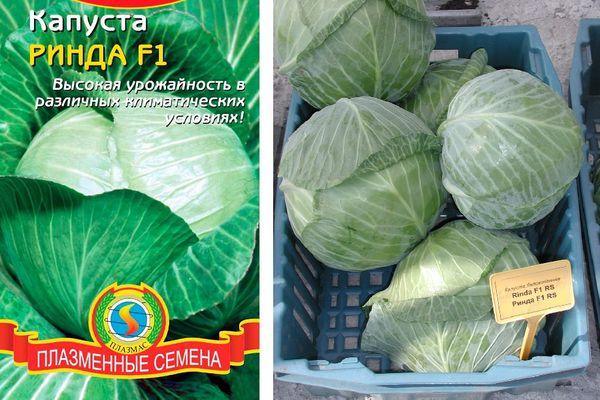
A mid-season plant, it takes about 120 days from sowing the seeds to harvesting the first heads of technical maturity. However, the characteristic of cabbage that vegetable growers give is particularly noteworthy: its ability to remain on the vine for a long time without sprouting or bolting.
The Rinda F1 cabbage variety grows compactly, with rosette leaves that lack long petioles and fit tightly around the growing head. This allows for reduced spacing between plants when planting, allowing for 1-2 more plants per square meter than with spreading varieties like Moskovskaya Pozdennya and others.
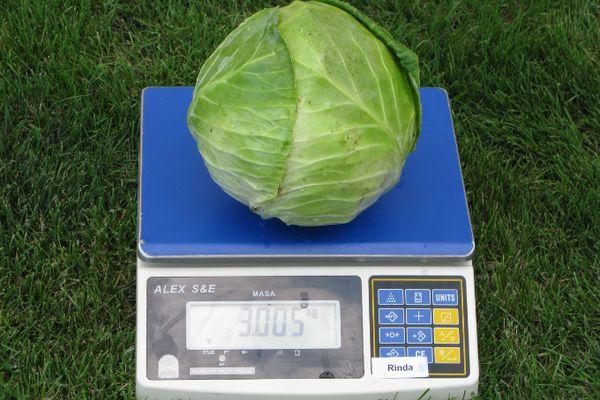
The vegetable's high yield ensures Rinde's continued popularity. The average head weight at technical maturity ranges from 4-5 kg, regardless of environmental conditions. Under favorable conditions, the record weight can reach 7-8 kg.
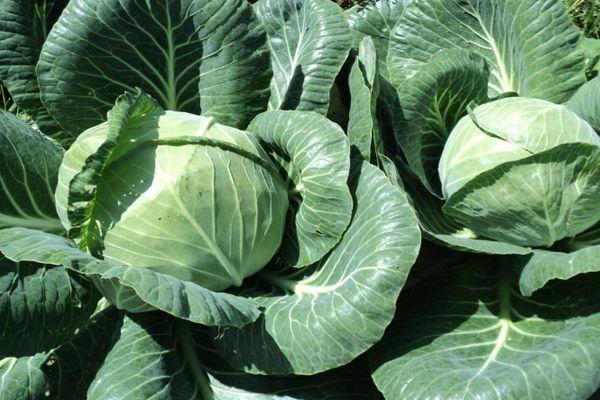
The plant isn't particularly demanding in terms of care. The main characteristics of white cabbage—its high water requirements and fertile soil—are also common to this variety, but a good grower can easily ensure both factors affecting yield. Another significant characteristic of the plant is its light requirements.
The Rinda variety is resistant to most cabbage diseases. It is virtually immune to downy mildew, and young seedlings, with proper care, are also resistant to blackleg. To prevent root diseases, it's important to properly prepare the soil for planting to prevent clubroot and similar infections from affecting the yield. These diseases thrive only in dense and overly acidic soil.
Consumer qualities of vegetables
The heads are medium-sized, round, and very dense, with no gaps between the inner leaves. The outer one or two layers of leaves may have greenish, curled edges. When cut, the head is creamy and uniform in color. The inner stalk is small.
The main advantage of this variety is the absence of thick, stiff petioles on the inner leaves. The central veins are thin (about 1.5 cm) at the base, but at 4-5 cm from the base, the vein becomes very thin and almost invisible.
The Rinda variety is distinguished by its increased resistance to cracking. Once technically ripe, heads of cabbage can be harvested without haste. Once harvested, fresh vegetables will keep for 2-3 months and are not suitable for winter storage.
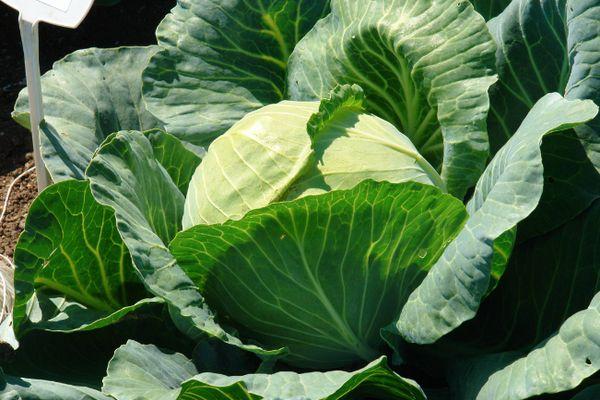
Vegetable growers' descriptions of the variety highlight the flavor profile of fresh cabbage: Rinda is characterized by high sugar content and a slightly sweet taste. This makes it particularly appealing in fresh vegetable salads and is important for pickling.
The cabbage hybrid Rinda is recommended for fresh consumption, preparation of hot dishes and winter preparations.
Light salads with tender leaves are also appropriate for the holiday table, just as delicious as dishes made with Chinese cabbage. This vegetable, rich in potassium, vitamins, and microelements (sulfur, boron, magnesium, etc.), is beneficial for children. The tender inner leaves make delicious cabbage rolls. Chinese cabbage can also be used in other hot dishes: added to borscht, stewed, or made into vegetable cutlets.
Rinda offers a wide range of winter preparations that are particularly successful. Its tender leaves are ideal for canned snacks and salads. Traditional pickling requires a certain amount of sugars in the cabbage, and Rinda cabbage has plenty of these. Its pickling qualities are comparable to those of tried-and-true Russian varieties, but it has the distinct advantage of not having tough veins.
Agricultural technology of the variety
For mid-season cabbage grown in central Russia, only seedlings are suitable. This method allows for an earlier harvest and allows the vegetables to reach full maturity, when they have the highest concentration of nutrients. Seeds for seedlings are sown approximately 30 days before planting.
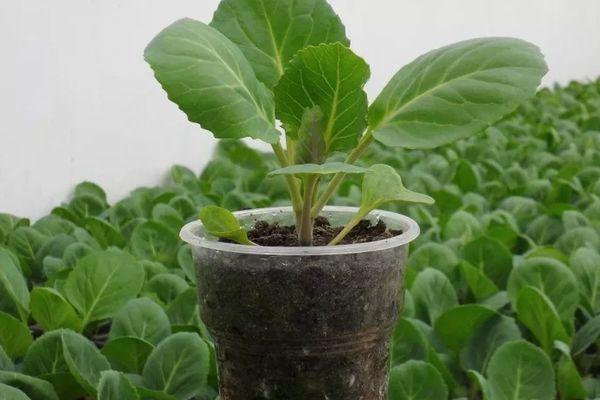
Sowing is carried out according to general rules:
- the soil is prepared from equal parts of humus, sand and garden soil, any calcareous substances are added (chalk, crushed eggshells, gypsum, dolomite flour, etc.) at the rate of 2-3 tablespoons for every 10 kg of soil;
- the prepared soil mixture is generously watered with a hot solution of potassium permanganate directly in the container, disinfecting and warming it up;
- you can sow the seeds after the soil has cooled to room temperature;
- scatter small seeds over the surface of the soil and cover with a layer of dry soil mixture no more than 0.5 cm thick;
- germinate under film or glass in a warm place.
At temperatures above 25°C, cabbage sprouts begin to appear within 2-3 days after sowing. However, Rinda seeds are often sold pre-treated for planting: they are coated with a colored film. This film may slightly delay germination, and seedlings will appear within 3-5 days. After the first sprouts emerge, the film should be removed.
To prevent the risk of blackleg, young plants are watered only with warm water with potassium permanganate (a light pink solution). The disease most often develops in poorly disinfected soil, when it's very cold (below 10°C) and overwatered.
When the seedlings develop 2-3 leaves, they should be transplanted into individual pots or a shared container, using a 5x5 cm pattern. After transplanting, the plants do not require any additional feeding. Young plants should be watered whenever the top 0.5 cm of soil dries out.
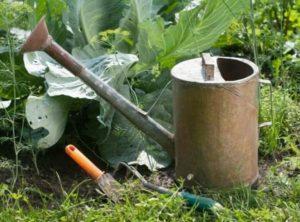
It is advisable to prepare the soil in the area for cabbage in the fall, adding the following per 1 m²:
- 1-1.5 buckets of humus;
- complex fertilizer with a high content of potassium and phosphorus (monopotassium phosphate, Agricola Vegeta, etc.) according to the instructions for the preparation;
- about 1.5 kg of lime (dolomite flour, slaked lime, gypsum or chalk).
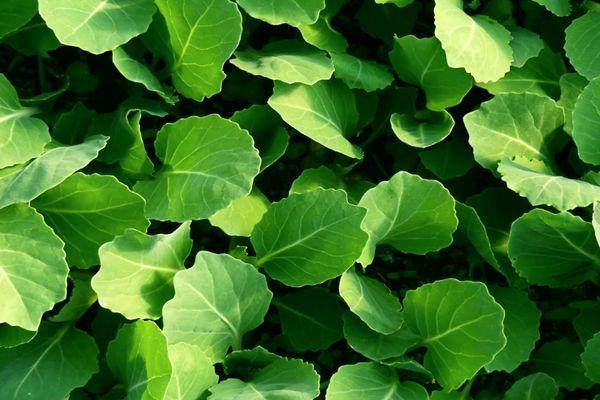
After applying fertilizer, dig the soil thoroughly. In dense, saline soils, add 2-3 buckets of sand or sawdust per 1 m² of cabbage.
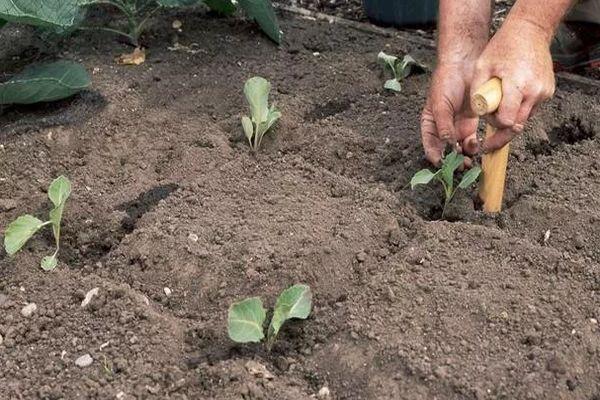
Plant the seedlings according to the 40x40 cm pattern. Care consists of daily watering if there is no natural rainfall. Fifteen days after planting, earth up the young plants to prevent the growing rosette from toppling them over. As the cabbage grows, the amount of water required increases, gradually reaching 10 liters per plant.
Upon reaching technical maturity and 1-2 weeks before harvesting, the heads should be slightly rotated around the vertical axis. This will tear off some of the roots, and the plant will stop growing and accumulate more sugar.
Related posts:
 Description of the best cabbage varieties for 2025 for different regions
 Why does cabbage grow tall in the garden and what can be done about it?
 Planting, growing, and caring for cauliflower in open ground and greenhouses
 Growing and caring for Chinese cabbage in open ground and greenhouses
 Why do cabbage leaves turn purple and what can be done to treat them?
 Why cabbage leaves wilt in the garden and what to do
 Description of cauliflower diseases and pests, methods of treatment and control
 Can cabbage be sprayed with valerian to control pests and what are the treatment guidelines?
The variety is excellent, I've been planting it for the second year, but this year the yield will be higher - this year I started feeding all the vegetables with plant growth bioactivators BioGrow, and the yield increased by at least a third!