
- Do potatoes need to be weeded?
- Description of potato weeding and timing
- Potato weeding tools
- Motor block and its attachments
- Cultivator
- Hand tools
- Trimmer and attachments
- General rules for weeding
- DIY Potato Weeding Tools
- Is it worth weeding potatoes during flowering?
- A method for growing potatoes without weeding
- Reviews
Potatoes are a vegetable crop that takes up a lot of gardener's time, taking up a large portion of the plot. With the increasing availability of various weed control chemicals on the market, the question of weeding without herbicides remains a pressing one. How to weed potatoes quickly and permanently without damaging the massive plants.
Do potatoes need to be weeded?
People are increasingly moving away from manual potato cultivation, which causes numerous health problems and is time-consuming. Planting, irrigation, and weeding are increasingly becoming mechanized.
Do potatoes need to be weeded? A few facts:
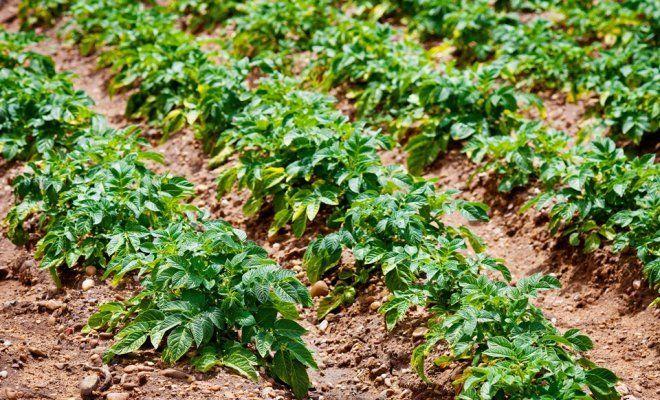
- Many people think they'll grow just because they've been planted. But despite the diversity of weeds, they're unable to thrive. During the early stages of growth and plant development, it's crucial to keep the garden clean; otherwise, harmful weeds will destroy the potatoes and prevent them from reaching their full potential.
- Another reason weeding is essential is because it draws nutrients from the soil. Rhizome-forming, creeping, and leafy grasses will absorb humus much faster than the crop can grow.
- Weeds provide a fertile breeding ground for certain insect pests, which lay their eggs in the fall and hatch in the spring, where they begin to actively feed on young potatoes.
- If the weeds grow quickly, they will form a “carpet” and the potatoes will not receive the full amount of light and air.
Typically, weeding is done several times per season, until the bushes become stronger and stand tall, and then they can suppress the weeds growing underneath them.
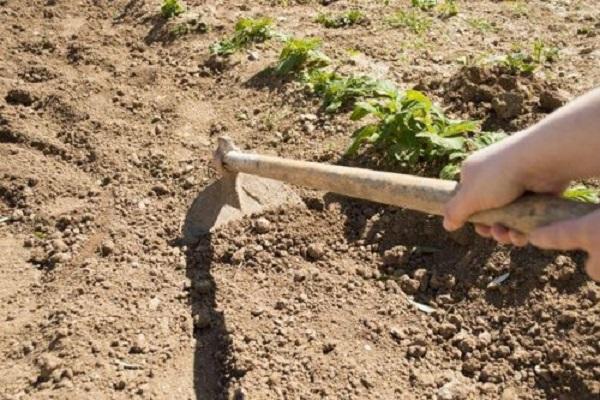
Description of potato weeding and timing
Weeding is the process of removing weeds from vegetable beds. The crop's yield depends on the quality and timeliness of this process. Weeding can be done manually, mechanically, or chemically.
For potato beds, it is important to start weeding a week after planting, because weeds grow much faster than the vegetables.
The first time weeds are removed is in late May or early June, depending on the potato planting time. Depending on the region, this typically occurs between May and June. Harrows, hoes, and other labor-saving tools can be used. This is easy to do since the potatoes are still deep in the soil.
Initially, weeds are removed as they appear, approximately once every two weeks. The second and subsequent weedings should be timed to coincide with the emergence of a new layer of weeds, before hilling.
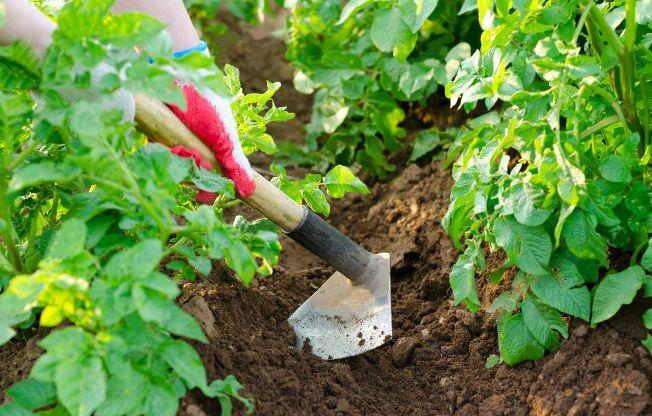
During hilling, which is in early July, they try to combat harmful vegetation as much as possible, since after this procedure it would be unreasonable to use hoes and various mechanisms, only in the inter-rows, if they are wide enough.
Potato weeding tools
Today there is a wide range of manual and mechanized devices for weeding potatoes.
Take a look Also
Motor block and its attachments
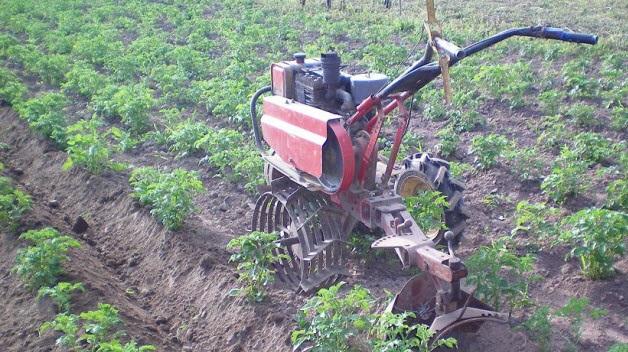
The walk-behind tractor and its modifications are designed specifically for soil cultivation, replacing manual labor with mechanical one. Wheels, attachments, handles, and gasoline—these are the components that make it work.
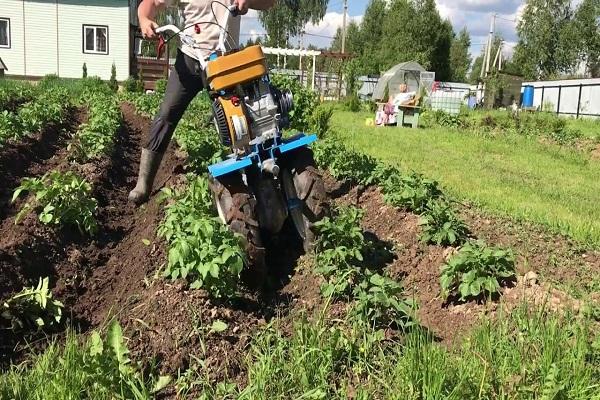
To remove weeds, attachments such as weeders, flat cutters, and paws are used:
- Rotary tillers are primarily used for weeding potatoes and incorporating fertilizer. Star-shaped blades are attached to the working shaft, set to the desired spacing equal to the row spacing, and then do the work.
- Arrow-shaped plows are also used by gardeners for weeding potatoes; they are equipped with V-shaped plows that cut weeds to a depth of up to 3 cm without raising dust or damaging the tubers.
- Rotary weeders are used with row spacings of 50-70 cm. This attachment can be used to weed a relatively small area of potatoes even with frequent plantings.
- Cone-shaped hedgehogs are capable of cutting weeds on the surface and in the soil that have not yet sprouted. The attachment also loosens the top layer of soil.
A walk-behind tractor with its attachments significantly speeds up the weeding process and reduces the time required. Even a woman with the necessary skills can use this device, although it is more difficult for her than a hoe or a mattock.
Cultivator
This device is similar to a walk-behind tractor, but slightly smaller, more compact, and easier to use. Electric, manual, and gasoline-powered cultivators are used for potato cultivation. They may have attachments that operate similarly to those found on a walk-behind tractor.
Most commonly used are knives positioned at a 45-degree angle relative to each other. These knives can be replaced with a pitchfork with teeth. To make the task easier, wheels are installed on the cultivator. Some gardeners install hedgehogs on the cultivator, which, in addition to weeding, also hill up the potato rows.
Hand tools
If the area occupied by potatoes is small, weeding can be done manually using flat-cutting tools, hoes, and various types of hoes. It would be difficult to weed a hundred square meters of arable land with a walk-behind tractor or cultivator.
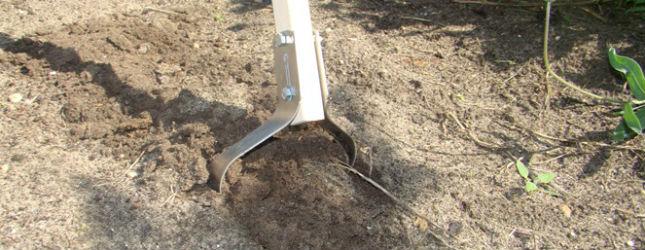
What devices exist today:
- weed weed "Swift";
- Fokin's flat cutter;
- weeder "Gardener";
- a hoe with a crescent-shaped blade.
These designs have a simple, easy-to-use system. For example, the "Sadovnik" can be used to loosen and weed narrow rows in beds with carrots, onions, and other vegetables. These flat-cutting hoes penetrate deep into the topsoil, cutting all types of weeds.
To make the device work, you need to hold it at arm's length, push it in slightly, and pull it towards you.
Another option, for example, the “Swift” weeder can be moved towards and away from you, alternating.
Trimmer and attachments
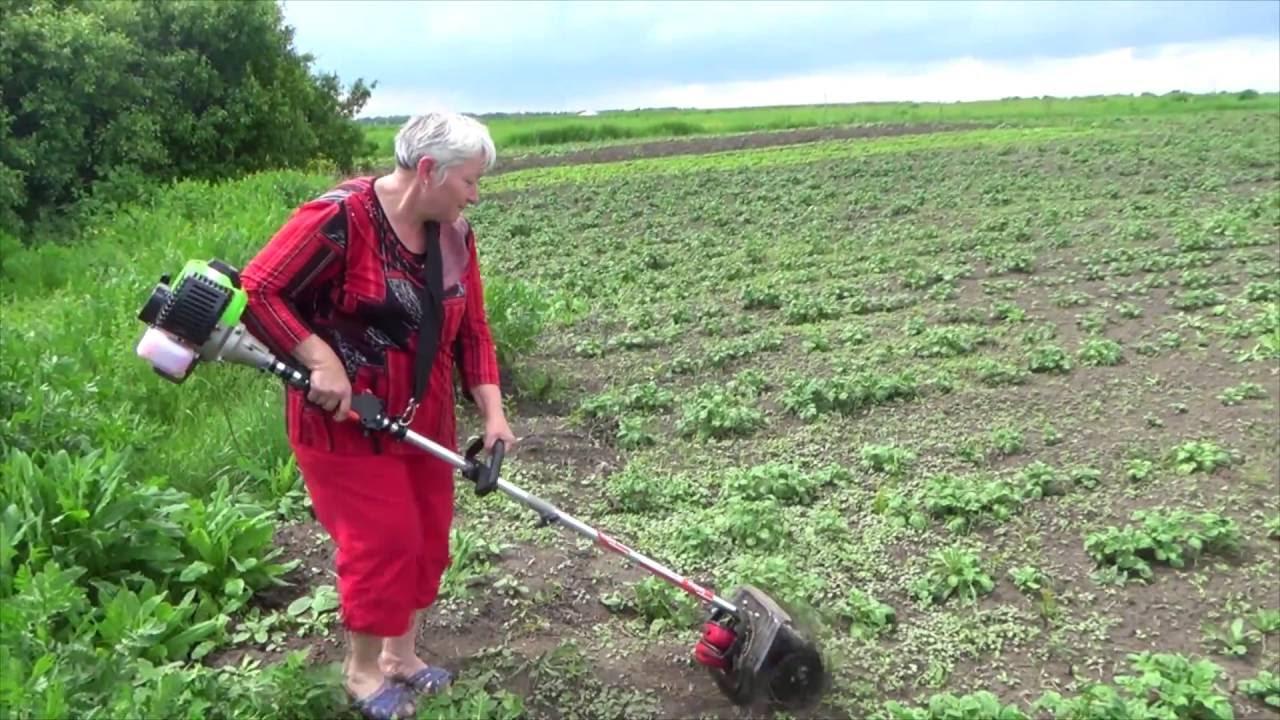
Weeding potatoes with a trimmer is now readily available. It significantly reduces the gardener's time and effort. Any trimmer can be used: electric or gas. However, the attachments need to be carefully selected.
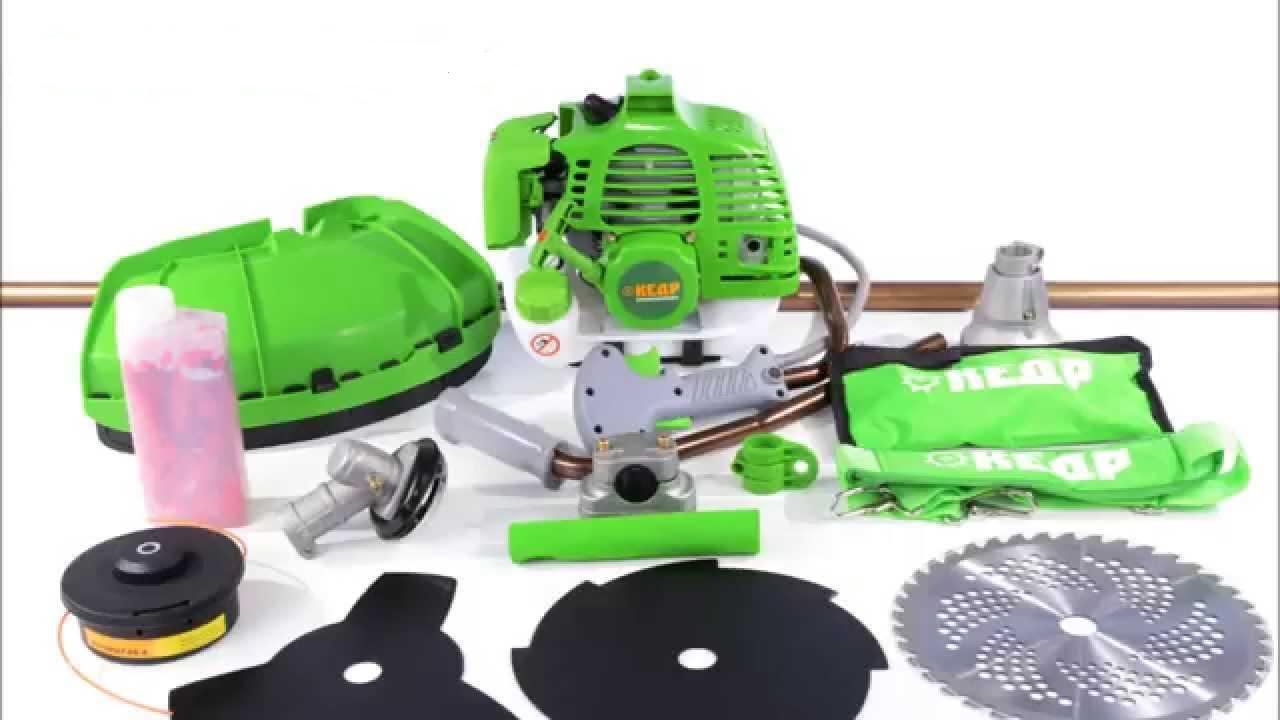
Here it is important to use it correctly:
- Wear protective goggles and rubber boots to avoid injury to soft tissues and eyes in the event of flying stones or earth particles.
- When strangers approach the machine, the trimmer switches off.
- It is not advisable to bury the working attachment into the soil to avoid damaging the brush cutter.
- Work for 15 minutes with breaks to prevent the engine from overheating.
- Wash knives with disinfectants every time.
Using a brush cutter or trimmer requires skill; otherwise, you could end up cutting down the weeds along with the potatoes. Round line and metal blades are used as attachments.
General rules for weeding
All the rules for weeding potato beds boil down to one simple method: quickly and easily eliminate weeds. Here's what to keep in mind when weeding your garden:
- It is important to carry out the first and subsequent weedings before the plants begin to touch each other, otherwise precious time will be wasted clearing the grass that has risen in several waves.
- Skipping early weeding is not recommended. It's easier and quicker, allowing you to move easily between the bushes without damaging them.
- Weeding should not be done randomly, but starting from a certain corner or strip, so as not to miss the potatoes.
- Weeding is best done in damp, cloudy weather. If weeding occurs in hot weather, wear a cap and light clothing to avoid sunstroke.
- As you weed, monitor the potatoes to identify any diseased plants. If you weed in the evening, after 4:00 PM, the likelihood of spotting diseases and pests on the potatoes decreases.
- When plowing land for potatoes, tractors with mounted plows are most often used. These plows don't plow the first couple of meters per hectare, but rather are used to turn the field into a new plot, so special attention is paid to this area.
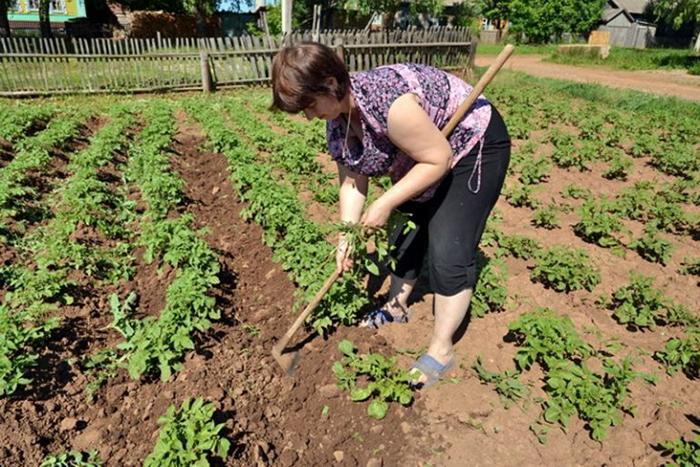
Gardeners combine weeding with hand-picking caterpillars, aphids, and Colorado potato beetles. If the beetles are few in number, this method is effective and eliminates the need for chemicals.
DIY Potato Weeding Tools
Even the most basic hoe isn't always worth the investment. The handle might not fit, or the cutting angle might be off. People always try to make the job easier by redesigning the device: welding additional cutters onto walk-behind tractor attachments, making new hoes. Homemade designs are often more effective than buying. So, what can you do yourself?
To make a hoe, like any other device, you will need metal, a welding machine, and welding skills.
Additionally, wooden handles and fasteners are needed. If you have a hand cultivator with a flat-cut frame in your arsenal that's outlived its usefulness, some spare parts can be salvaged from it or a new one can be made similar to it:
- Cut a long strip of thin, durable metal and bend it to create a square missing one edge. This creates a flat-cut frame.
- You need to purchase sprockets for such a flat cutter or design them yourself, if your skills and abilities allow.
- All parts should also be connected with metal rods, but so that the ripper blades are free to float, and the working frame can move slightly back and forth.
- Weld a small cylinder under the handle.
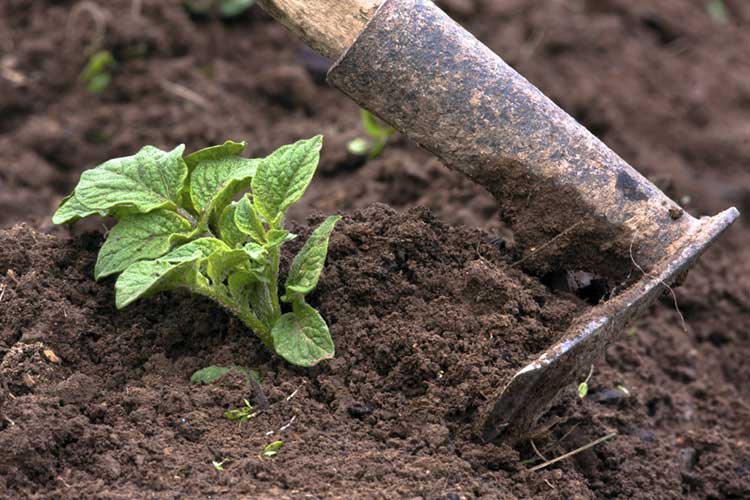
This hoe will serve as a cultivator and weed remover. You can weed the garden by moving it back and forth, making the work much easier.You can adjust the sharpening angle of the knives, which will reduce friction with the ground. This will reduce the strain on your hands. Each time before cleaning the potato beds, sharpen the knives, hoes, and flat cutters.
Is it worth weeding potatoes during flowering?
Potatoes should be weeded during flowering in the same way as before flowering. This has its advantages:
- additional loosening, which will provide air access to the roots;
- removing weeds that suck the juices out of the soil.
If there are very few weeds, this type of weeding can be omitted. When the grass is low, it won't cause much harm to the potatoes, even when they're blooming. After the flowers have fallen, the potatoes aren't at all susceptible to harmful shoots, as the bushes are large enough that the grass won't gain the same vigor as it would in a vacant lot.
A method for growing potatoes without weeding
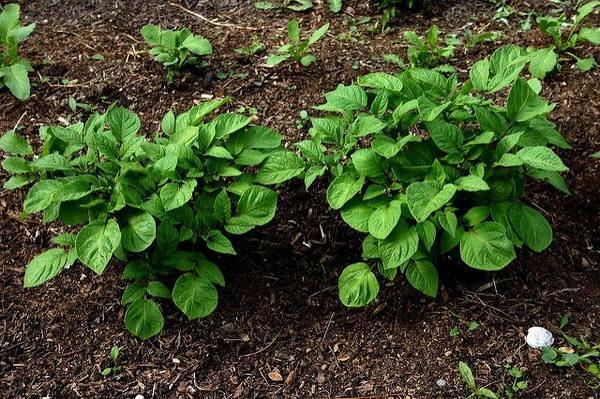
Some gardeners don't weed their potatoes at all. In the fall, after harvesting the next crop, the soil is dug or plowed to a decent depth to incorporate any remaining weeds and their seeds from the growing season. A layer of straw is laid on top. The height of the layer should be at least 5-10 cm.
In winter, the garden will be covered in snow, causing the straw to rot rapidly, along with any remaining weed seeds. In the spring, after the snow melts, the material will turn into mulch, preventing moisture from evaporating quickly and further inhibiting weed growth. This method will somewhat ease the workload during the mulching season.
If the garden is large, weeding is done with motorized equipment. This will significantly reduce the impact on health, but will require the investment of a cultivator or walk-behind tractor, although it will quickly pay for itself. For a 200-square-meter plot under the window, you can use a hoe or any flat-cutting tool, whether store-bought or homemade.
Reviews
Nadezhda Konstantinovna, 57, Perm: "I'm a family of two, but my children's families also grow potatoes, so we have to rent land outside the city to plant them. We work together, of course, as my husband and I have a hard time cultivating 15 acres. We have a cultivator at our dacha, but we only use it for weeding once a year, combining it with hilling. The rest of the time, we use regular hoes. Why is that? Because every time we use a weeding machine, we destroy earthworms along with the weeds, which is bad for the soil."
Tatyana, 38 hp, Priozernoe: "I use a Strizh weeder for weeding my garden beds and potatoes. My husband welded something that looks like stars to the front. The weeds are cut by the bottom of the weeder, and the discs threaded onto a thin tube perfectly loosen the soil. It's also easy to use, without applying pressure, just moving it away from you and back toward you."
Related posts:
 Why potatoes aren't growing well in the garden, and what to do to ensure a bountiful harvest
 Description and characteristics of the Rodrigo potato variety, cultivation and care
 Description of the best potato varieties of domestic and foreign selection
 Description and treatment of potato pests, control measures
 Description and treatment of potato diseases, methods of control using folk and chemical means
 Description and characteristics of the Krasavchik potato variety, planting and care
 Description and characteristics of the Zhukovsky potato variety, planting and care
 Description and characteristics of the Rocco potato variety, cultivation and care