
- Characteristics of the Rogneda potato
- History of the variety's development
- Appearance of the bush
- Productivity and taste of root crops
- Scope of application of fruits
- Main advantages and disadvantages
- Necessary conditions for the growth and fruiting of the Rogneda potato
- Optimal timing
- Preparing a plot for planting Rogneda potatoes
- Preparing planting material
- Diagram and step-by-step algorithm for planting seedlings
- Potato care rules
- Irrigation and fertilization of Rogneda potatoes
- Loosening and mulching the beds
- Hilling
- Diseases and pests: control and prevention
- Harvesting
- Reviews of the variety
Potatoes are one of the most popular vegetables, widely grown in Russian gardens. The fruits are used in cooking, medicinal purposes, and cosmetics. Thanks to the efforts of plant breeders, new, improved varieties of the vegetable crop are being developed. Based on the description and reviews of the Rogneda potato variety, it can be grown in virtually any soil, for industrial purposes or for personal consumption. It's important to familiarize yourself with all the nuances beforehand.
Characteristics of the Rogneda potato
The Rogneda potato is a mid-late table potato variety bred in Belarus. The plant adapts well to any soil. Ripening time is 95-110 days. The shelf life of the potatoes is 97%, provided storage guidelines are followed. This variety is best grown in the Northwest. It is highly resistant to diseases and beetles. Potatoes are rarely affected by canker, golden nematode, and rugose mosaic.
History of the variety's development
The Rogneda potato variety was developed by breeders from the Scientific and Practical Center for Potato, Fruit and Vegetable Growing of the National Academy of Sciences of Belarus using a symbiosis of the Charodey variety and the 1579-14 variety. Since 2011, the variety has been listed in the Russian state register. Today, the potato is grown throughout the CIS countries.
Appearance of the bush
The bushes grow large, tall, and semi-erect. The leaves are of the intermediate type, typical for potatoes. They are pubescent and wrinkled, with a slightly wavy margin. The leaves are medium-sized and light green. The corolla is also small and white.

Productivity and taste of root crops
Rogneda potatoes are renowned for their abundant yields, with approximately 300 centners per 100 square meters. With proper care, they yield 450 centners per hectare. Potato recipes abound; this table variety retains its nutritional qualities even after cooking.
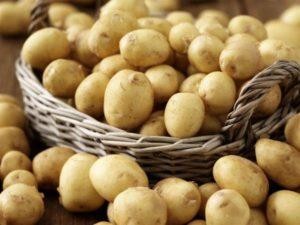
A root vegetable with a creamy, dense, smooth skin. The eyes are small and medium-deep. The tubers are oval-oblong in shape. The fruits contain 12.7-18.4% starch and are rich in carotene. The tubers weigh 80-120 grams, and there are 12-14 tubers per plant. Rogneda potatoes have a creamy, rich flavor.
Scope of application of fruits
Rogneda potatoes can be used in mashed potatoes, casseroles, salads, boiled, and fried. They are widely used in professional and amateur cooking.
To preserve as many nutrients as possible, it is best to boil potatoes in their skins.

Main advantages and disadvantages
The Rogneda potato variety has many positive aspects, but there are also some negative ones.
| Pros | Cons |
| A bountiful harvest | When storing, the air temperature must be low, otherwise the tubers will sprout quickly. |
| Excellent taste of fruits | If you don't follow the care rules, the fruits will grow small. |
| Versatility of application | |
| Resistance to damage, high shelf life | |
| Rapid growth, uniform emergence of seedlings |
Necessary conditions for the growth and fruiting of the Rogneda potato
Rogneda potatoes are planted in holes or furrows. If the soil is particularly moist, the plants are planted in raised row spacings. Because this variety is highly resistant to pests, frequent preventative treatments are not necessary. There are no special agricultural practices; the potatoes are grown in the same way as other varieties.

Optimal timing
Rogneda potatoes should be planted after May 15th, depending on the region's climate. When the soil warms to 16°C (62°F), planting is safe. Place the beds in a sunny, well-ventilated area away from trees.
Potatoes prefer light or medium soils; they grow poorly in heavy soils and rot. It's important to maintain crop rotation and replant the plants every three years.
If the area is small, cultivate the plot by planting green manure crops such as rye and mustard. It's not advisable to plant them in areas previously sown with tomatoes, sorghum, or sunflowers.
Preparing a plot for planting Rogneda potatoes
In the fall, prepare the area, adding organic matter, compost, and wood ash to the soil. In the spring, dig the beds again to the depth of a bayonet, adding compost or rotted manure at a rate of 5 kg per square meter. The soil surface is harrowed, furrows or ridges are cut, and saltpeter is sprinkled.

Preparing planting material
One month before planting, remove the seedlings from storage. They are selected in the fall, sorting through the best tubers with a complete surface. The sprouts are grown on the fruit, spraying the potatoes with a growth stimulant such as Epin. The sprouts should be 3 cm long and bluish, white, or purple in color.
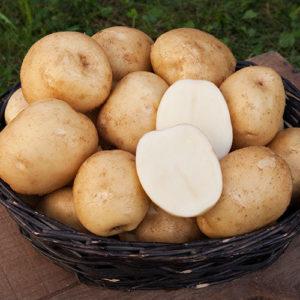
Diagram and step-by-step algorithm for planting seedlings
Rogneda potatoes are planted in single holes or furrows using the same planting pattern. The holes should be 16 cm deep, with a 50 cm spacing between rows and 35 cm between plants. Two tubers are placed in each hole, spaced 7 cm apart. Peat and ash are sprinkled on top in equal parts, then covered with soil.
Potato care rules
Rogneda potatoes are easy to care for: just provide them with regular watering, fertilizing, irrigation, and hilling. Then you'll achieve a decent harvest.

Irrigation and fertilization of Rogneda potatoes
During hot weather, potatoes should be watered once a week. Frequent watering allows the plants to develop fully. If the season is rainy, water once a month. Fertilizer is added in the spring, before budding. Use phosphate, potassium, and urea fertilizers. Nitrogen is added during flowering.
Loosening and mulching the beds
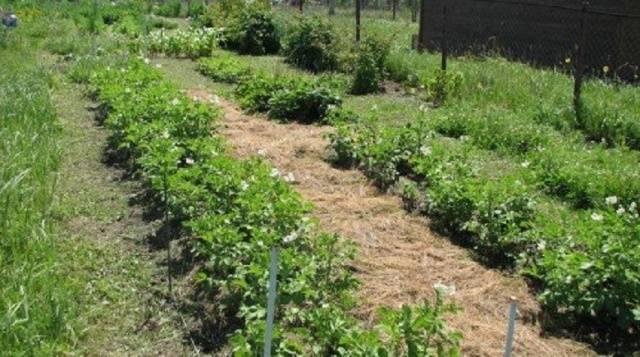
Weeding of Rogneda potatoes begins two weeks after planting the seedlings. The tops grow to 15 cm, and the soil is loosened to a depth of half a spade. This procedure helps remove weeds and improve soil aeration. The cut weeds are removed from the beds and burned. The plants are mulched with peat, hay, or straw. This helps retain heat and moisture in the soil and protects the plants from beetles and diseases.
Hilling
Experienced gardeners swear by the importance of hilling. This technique helps produce a bountiful harvest, promotes additional root growth, conserves moisture, limits weed growth, and increases air circulation.
Potatoes are hilled at least twice per season.
- The first procedure is when the sprouts reach a height of 15-20 cm, covering them with soil.
- The second mulching is done a week before flowering, without waiting for the tops to close.
When used for hilling up mown grass or humus, it serves as an additional source of nutrition..

Diseases and pests: control and prevention
The Rogneda potato variety is renowned for its resistance to nematodes, late blight, canker, and mosaic. It is occasionally susceptible to scab, blackleg, anthracnose, ditylenchosis, rot, and viruses C, M, and L. Among the pests, the Colorado potato beetle occasionally attacks. Infected plants are sprayed with Anti-Colorado and Prestige.
Two weeks before harvesting, you cannot use chemicals to treat beetles, but only folk methods.
Among these, sprinkling potatoes with a decoction of onion peels and hand picking are recommended. Wireworms are eliminated by tilling the soil and removing weeds. Insecticides protect bushes from mole crickets, moths, butterflies, and leafhoppers.


Harvesting
Rogneda potato harvesting should begin in mid-September. The plants are carefully dug up with a trowel to avoid damaging the rhizomes. The tubers are thrown onto the soil and left in the air for 2-3 hours until completely dry. Then, they are sorted and cleaned of soil.
Rotten or damaged tubers are discarded. If the defects are minor, these tubers are eaten first. Store the harvest in a cool, dark, well-ventilated area.
Typically, this is a basement or cellar. The air temperature should be between 2-4 degrees Celsius. The tubers are laid out in wooden boxes in a 0.5-meter layer, with newspapers or oilcloth placed underneath. Elderberries or fern leaves can be placed between each layer; this helps the potatoes stay fresh longer. The basement or cellar should be ventilated twice a week, and any rotten tubers should be discarded.
Reviews of the variety
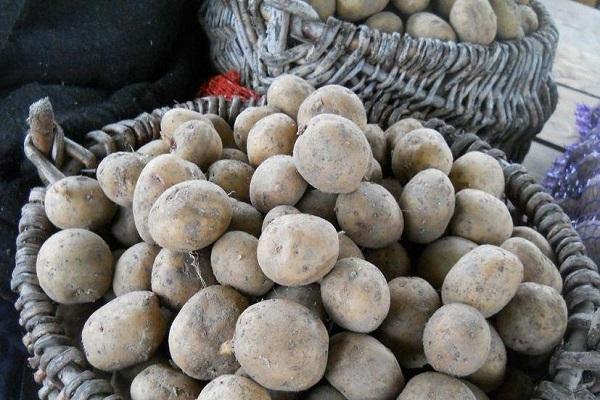
Gardeners have received positive feedback about the Rogneda potato. The variety is described as prolific and resistant to diseases and beetles.
Irina Aksyutina, 55 years old, Kyiv
Hello! The Rogneda potato variety is my favorite; the fruits are delicious and aromatic. I mash them, fry them, boil them, and make casseroles with them. I highly recommend growing them.
Lyubov Zavalskaya, 59 years old, Donetsk
Hello! I grow Rogneda potatoes in my garden for sale. Customers praise them, and the harvest sells out quickly. The variety is easy to care for, and the plants are almost disease-free. They have been attacked by Colorado potato beetles several times, but I used Anti-Colorado to treat them.
Oksana Dmitrienko, 70 years old, Energodar
Hello! I've been growing Rogneda potatoes for three years; they're my favorite. I learned about this variety from a neighbor at my dacha. I water the plants once a week and fertilize them with compost and humus twice a month before and after flowering.
Related posts:
 Description of the Rogneda pear variety, planting and care instructions
 Description and characteristics of the Rodrigo potato variety, cultivation and care
 Description of the best potato varieties of domestic and foreign selection
 Description and characteristics of the Gulliver potato variety, planting and care
 Description and characteristics of the Zhukovsky potato variety, planting and care
 Description and characteristics of the Krasavchik potato variety, planting and care
 Description and characteristics of the Arosa potato variety, planting and care
 Description and characteristics of the Bellarosa potato variety, planting and care