
- What's good about Timo potatoes?
- Description of the variety
- Plant characteristics
- Features of the root vegetable
- Conditions for the growth and fruiting of the crop
- Growing
- Preparing the site for planting
- Preparing planting material
- Step-by-step landing technology
- How to care
- Watering and fertilizing
- Hilling and weeding the beds
- Fertilizer
- Pests and diseases: control and prevention measures
- Harvesting
- Gardeners' reviews of Timo potatoes
The Timo potato variety is an early-ripening variety. It is very popular among gardeners in the northern region. Timo tolerates low temperatures well and is undemanding in terms of soil. It is grown commercially and for home consumption.
What's good about Timo potatoes?
Timo Hankkijan's potatoes have many advantages. These include:
- Early maturity, possibility to grow a double harvest.
- High taste qualities.
- Duration of storage of tubers.
- Resistance to some diseases.
- Unpretentiousness to soil composition.
- High yield.
This variety is very popular among gardeners in northern regions. It allows for the production of large potato crops.
Description of the variety
The description of this potato variety includes characteristics of the plant and root vegetable, as well as their appearance and distinctive features.
Plant characteristics
Timo forms low, light-green bushes. The leaves are large and spreading. During flowering, small blue or purple flowers appear. The trunks are strong and straight. The leaves have a wavy edge.
Features of the root vegetable
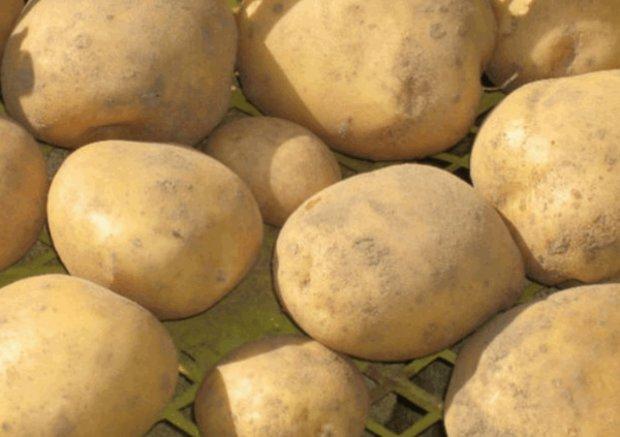
The tubers are medium-sized, weighing between 70 and 120 grams. The outer skin is light brown. When cut, the flesh is beige. The tubers have excellent flavor and a starch content of approximately 20%. They are suitable for making starch at home. They cook well when cooked.
Conditions for the growth and fruiting of the crop
To achieve a high yield, it's necessary to create optimal growing conditions. This includes:
- For planting potatoes, choose a sunny place without drafts.
- Any soil is suitable for Timo, but for maximum tuber formation, sandy soil is chosen.
- Potatoes are planted after growing: pumpkin, squash, corn, legumes and wheat crops.
- After emergence, preventative spraying is carried out against diseases and pests.
 Important! Growing potatoes after nightshade crops reduces yield.
Growing
Growing potatoes requires preliminary preparation of the site and seed material. A specific planting plan and algorithm are also followed.
Preparing the site for planting
The potato planting area begins to be prepared in the fall. It is dug over, all weeds, roots, and stones are removed, and organic fertilizer is added. In the spring, the digging is repeated and the soil is fertilized with mineral fertilizers.
Preparing planting material
Seeds can be purchased from reputable nurseries or used from last year's harvest. Two weeks before planting, the tubers are moved to a sunny and ventilated area. The optimal temperature for seed germination is 18°C.
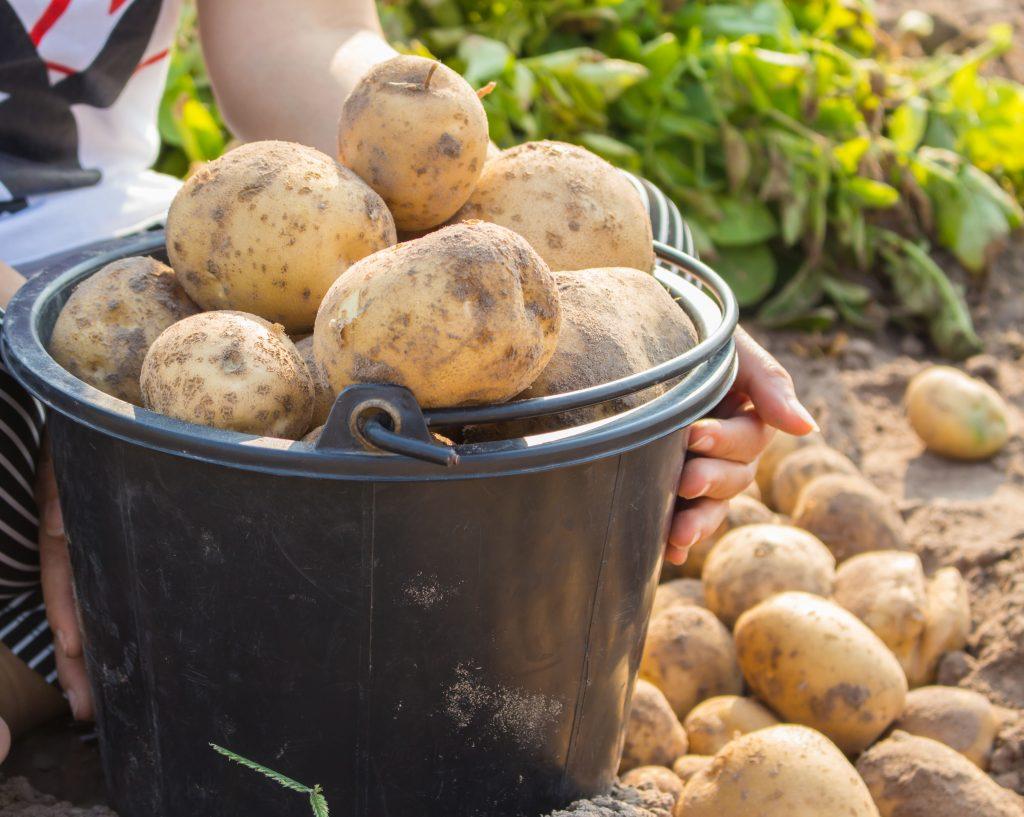
The tubers are spread out in an even layer on the surface. Every two days, they are moved to different sides and sprayed with water. All damaged or spoiled roots are removed. When the sprout reaches 2-3 cm in length, it is transplanted into the soil.
Step-by-step landing technology
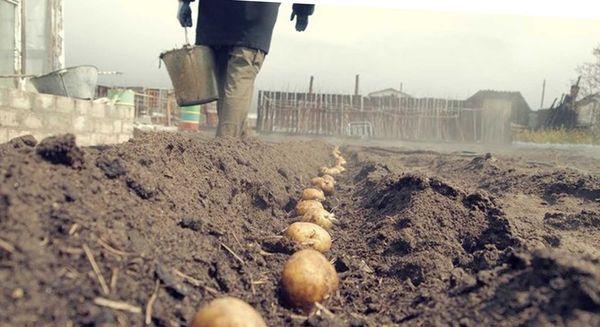
When planting seeds, adhere to a certain technology:
- On the prepared area, make depressions 10 cm deep.
- The distance between holes is 30–40 cm, and between rows 50 cm.
- 500 ml of warm water is poured into each hole.
- Before planting, tubers are kept in a solution of potassium permanganate for 30 minutes.
- Large fruits are placed in each hole one at a time, small ones 2-3.
- They bury it with soil.
- The beds are leveled with a rake.
How to care
To obtain a large potato harvest and ensure good plant development, it is necessary to provide care: water the crop in a timely manner, apply fertilizer, hill the bushes, weed, and prevent the development of diseases and pest attacks.
Watering and fertilizing
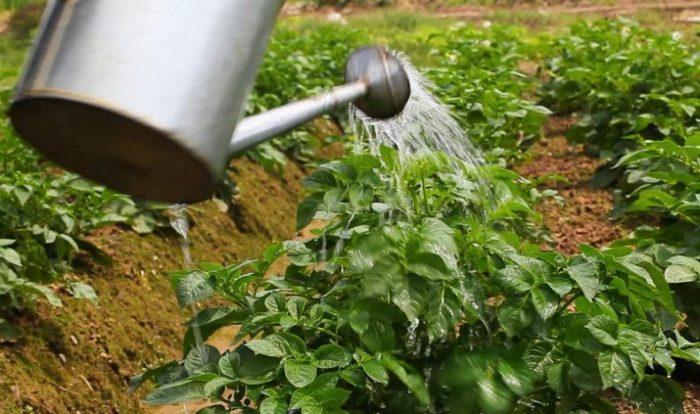
The crop is watered three times per season. Three liters of water are used per bush. The water should be settled or collected from a spring. The bushes are watered once after the first shoots appear. The second time is when the plants begin to bloom, and the third time after flowering has finished. Watering is stopped two weeks before harvest.
Important! Do not use tap water for irrigation, as it contains chlorine, which is harmful to shrubs.
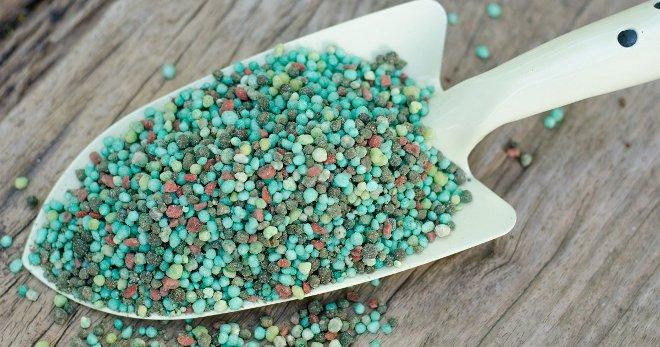
The first fertilizer application is made when planting the crop. The remaining fertilizers are applied during watering. The plant prefers mineral complexes containing nitrogen, potassium, phosphorus, and manganese.
Organic fertilizers are also used:
- manure;
- chicken manure;
- wood ash;
- herbal infusions;
- compost.
Fertilizers are applied using both root and foliar methods. For root application, dissolved or dry fertilizers are applied to the soil at the base of the plant and distributed between the rows. For foliar application, dissolved fertilizers are sprayed onto the leaves of the bushes.
Hilling and weeding the beds
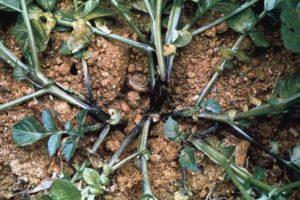
Hilling helps retain moisture at the plant's roots and also increases the number of tubers. Hilling is done three times per season. The first time is after the seedling reaches 20 cm in height. The bush is buried so that 3-4 pairs of leaves remain above the soil. The second time is two weeks after the first, and the third time is two weeks after the second.
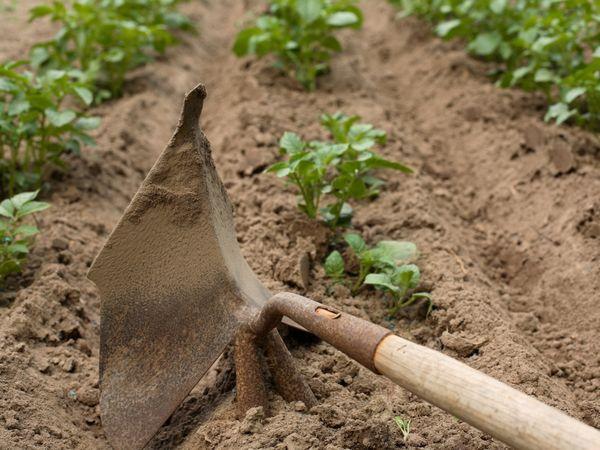
Weeds in potato beds consume minerals, depleting the soil. As soon as they appear, they must be removed. Weeding is carried out as needed. Herbicides are also used if necessary.
Fertilizer
Fertilize the crop with mineral and organic fertilizers. It is recommended to use formulations containing nitrogen, phosphorus, manganese, and potassium. Nitrogen improves the development of green mass, phosphorus promotes improved tuber formation, potassium accumulates in the tubers, and manganese improves the taste of the fruit. Fertilize every 2-3 weeks.
Pests and diseases: control and prevention measures
Timo potatoes are resistant to blackleg, potato rot, and potato cancer. However, they are most susceptible to late blight and nematode infestations.
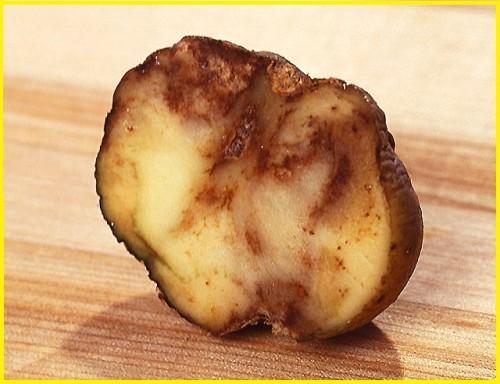
The most common potato diseases are:
- late blight;
- fusarium;
- Rhizoctonia;
- Alternaria;
- nematode.
All of these diseases, except nematodes, are caused by microscopic fungi. They begin to infect the lower leaves. The leaves dry out, turn yellow, and fall off. The plant stops growing.
In advanced stages, fungi attack the tubers, and part of the harvest is wasted.
Nematodes are small worms that feed on potato tubers. They are difficult to eradicate, so prevention is recommended. Chemical fungicides are used to combat the disease.
Pests that affect potatoes include:
- Colorado beetle;
- wireworm;
- green and black aphids;
- mole cricket.
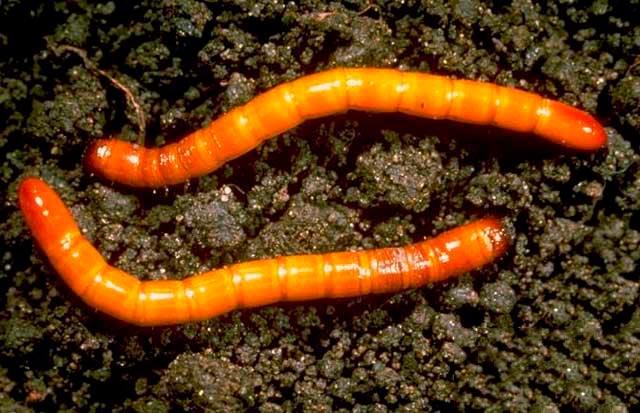
To control insects, bushes are treated with insecticides. Traps are set near the beds to catch mole crickets, and the insects are destroyed.
Important! When planting between mustard rows, Colorado potato beetles will not attack the bushes due to their distinctive odor.
To prevent diseases, follow several rules:
- Potato watering should be timely and limited. Overwatering increases the risk of disease.
- Hilling and mulching prevents the development of infections.
- Preventive treatments with insecticides and fungicides are carried out at the beginning of the growing season.
- Treatment with preparations is carried out in dry, windless weather.
- Fertilizing with mineral fertilizers attracts annelids, which fight nematodes.
Harvesting
The harvest begins when the tops are completely dry and the tubers separate easily. The roots are dug up with a shovel. They are then transferred to a cool cellar and spread out in an even layer. They are left to dry for 7 to 14 days. The potatoes are then packaged in cloth bags or breathable boxes and stored in a cool, dark place. Large, healthy tubers are selected for seed.
Gardeners' reviews of Timo potatoes
Vadim, 34 years old, Astrakhan
I really liked the Timo potato variety. You can grow two crops in one season. It ripens in 1.5 months. The potatoes have a sweet taste. I planted them in late May, and harvested them in mid-summer. I left some of the fruits for seed.
Dmitry, 56 years old, St. Petersburg
This year I planted the early-ripening Timo potato variety for the first time. It grows so fast you can't keep up with it. Our soil is heavy, so I thought the yield wouldn't be great. But I was wrong; we dug up 12-14 potatoes from each plant. I'll plant them again next year.
Alena, 43 years old, Tver
I've been growing Timo potatoes for three years in a row. I especially like their early maturity and the ability to produce a double harvest. When I first planted them, I thought the fruits wouldn't store well. They survived the winter just fine and retained their appearance.
Related posts:
 Why potatoes aren't growing well in the garden, and what to do to ensure a bountiful harvest
 Description and treatment of potato diseases, methods of control using folk and chemical means
 Description and treatment of potato pests, control measures
 Description and characteristics of the Sante potato variety, planting rules and care
 The best eggplant varieties for growing in a polycarbonate greenhouse: planting and care
 Types of fertilizers for foliar feeding of potatoes and application rules
 Description and characteristics of the Rodrigo potato variety, cultivation and care
 Description and characteristics of the Gala potato variety, planting and care instructions