
- Description and characteristics of the Eliane variety
- Pros and cons of strawberries
- The intricacies of growing garden strawberries
- Selecting and preparing a planting site
- Preparation of planting material
- Landing rules
- Landing time
- Further care of the variety
- Weed removal and watering rules
- Top dressing
- Loosening the soil
- Mulching
- Moustache removal
- Preparing for the winter period
- Treatment of strawberries from diseases and pests
- Methods of propagating garden strawberries
- Collection and storage of varieties
Breeders have developed many excellent strawberry varieties. But their combined characteristics don't always satisfy gardeners—some have poor taste, while others suffer from poor yield, fruit size, or shelf life. However, there are strawberries that are truly a joy to grow, such as the Eliane variety, which offers great potential for amateur gardeners.
Description and characteristics of the Eliane variety
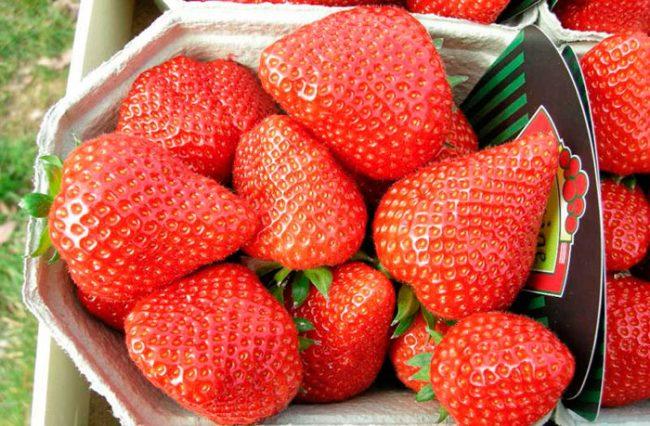
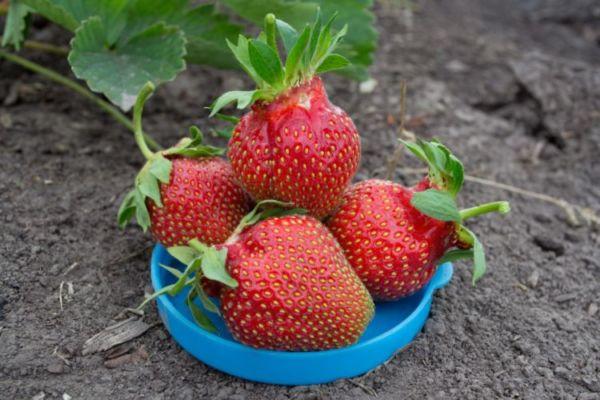
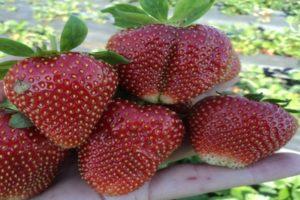
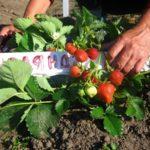
A mid-early variety bred in the Netherlands. It was developed in 1998 by Albert King and Herb Rybaki. The variety boasts vigorous growth, tall bushes, and large foliage. The fruits are uniform, even, wide, and bluntly conical, resembling a heart.
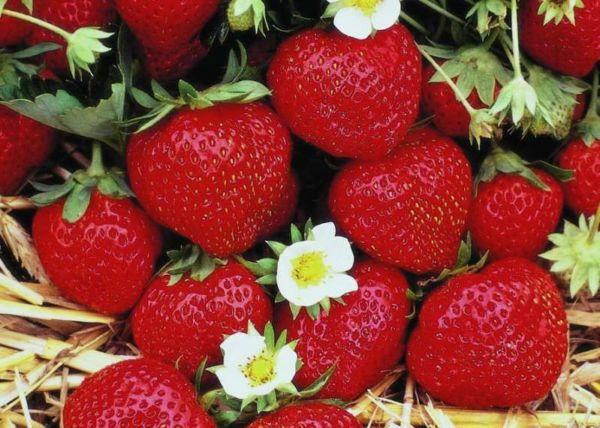
The berries are bright red, with a distinct glossy sheen. The flesh is firm but juicy. The fruits are sweet and tasty, with a distinct strawberry aroma. The skin is thin, but firm and elastic. The seeds are small, embedded in the flesh. The berries are large, averaging 25-30 grams, but can reach up to 50 grams. Eliane yields up to 2 kilograms per bush.
Pros and cons of strawberries
Like most strawberry varieties, Eliane has its own advantages and disadvantages. Gardeners need to be aware of these and take them into account.
Strengths:
- high resistance to strawberry diseases and pests;
- good adaptation to various growing conditions and soil types;
- retains its commercial qualities for several days after harvesting;
- good shelf life, transportability and frost resistance;
- high percentage of first-class berries in samples;
- Suitable for both amateur gardening and industrial-scale cultivation.
Weaknesses:
- berries of medium density;
- In conditions of extreme heat, bushes may fall out, productivity decreases, and the variety does not reproduce well at high temperatures;
- average yield indicators;
- Despite all its advantages, this variety is more suitable for amateur cultivation.
The intricacies of growing garden strawberries
To achieve high and consistent yields, it's essential to understand the specifics of strawberry cultivation. Only then will the variety reach its full potential.
Selecting and preparing a planting site
Strawberry beds should be in a sunny location. Planting in sheltered areas is desirable (but not required).
They choose areas without spring flooding, where groundwater does not come close to the soil level.
In the fall, weeds are removed and manure is applied (at a rate of up to 1 ton per 100 square meters, depending on soil fertility). Granular mineral fertilizers such as nitroammophoska are also applied at a rate of up to 50 grams per square meter. The area is then dug and watered.
Preparation of planting material
When using open-root seedlings, trim off almost all the leaves, leaving only one or a maximum of two per seedling. Any roots that are too long are trimmed back, leaving a length of 10-15 centimeters, depending on the size of the seedling. This is done to ensure that they remain straight and don't curl in the soil when planted.
For potted seedlings, trim off any roots protruding through the drainage holes. Two to three leaves are left per plant.
Landing rules
When planting bare-root seedlings, dig planting holes and fill the bottom with garden soil or planting medium. The seedling is placed on the soil, and the roots are spread out along the sides of the mound. Then, the strawberry plant is covered with planting medium so that the growing point (the heart) is level with the soil, no higher or lower.
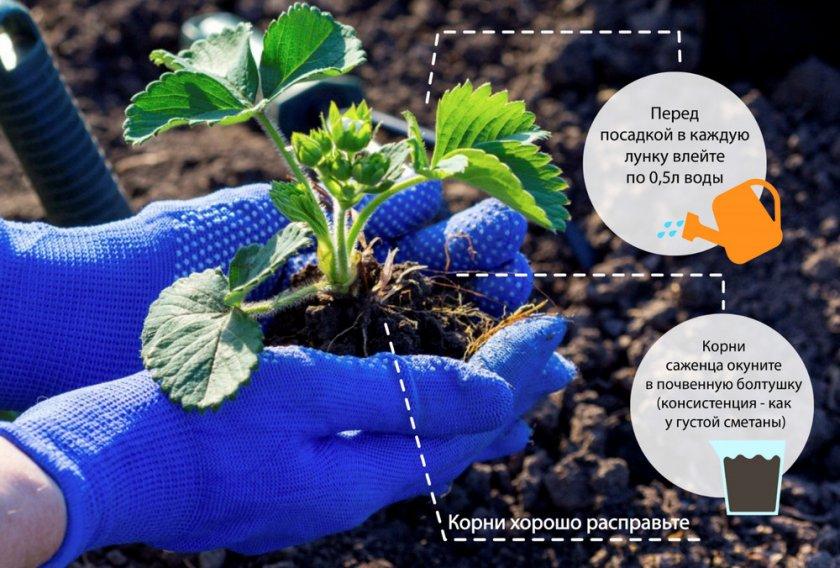
The soil is then compacted and watered generously. When planting seedlings in pots, they are placed at the bottom of the hole and simply covered with soil, followed by light compaction and watering.
Landing time
Potted seedlings are planted throughout the season. When planting bare-root seedlings, specific timing is essential. It's best to plant as early as possible in the fall and again in the spring, before the heat sets in. Late planting requires daily watering and shade.
Further care of the variety
The health of strawberry bushes and their yield depend not only on proper, timely planting. A number of necessary agricultural practices are required throughout the season.
Weed removal and watering rules
Weeds inhibit strawberry growth and rob the soil of nutrients, so regular weeding is essential. Ideally, weeding should be done every 10-14 days while the weeds are still small. Otherwise, weeding will be much more difficult—you'll have to pull them out by the roots, which can damage the strawberry plants and roots.
For high yields, regular, abundant watering is also necessary. The frequency depends on the soil type and growing region.
For example, in the south, watering is done every other day during the summer. For other regions, watering should be done based on the drying of the topsoil. The most efficient irrigation option is to install a drip irrigation system.
Top dressing
Strawberries, especially everbearing varieties, require regular, comprehensive feeding to achieve high yields, as well as good growth and immune support. At the beginning of the season (in spring), plants are treated with nitrogen-rich fertilizers. Both mineral and organic fertilizers are used.
During flowering and fruit ripening, strawberries are fed with phosphorus-potassium fertilizers, which influence the size, quality, and flavor of the fruit. Universal fertilizers, such as Plantafol 20.20.20, are applied continuously throughout the growing season.
Loosening the soil
To improve soil aeration and moisture permeability in the root zone and between strawberry rows, regular, shallow loosening is performed. This cultivation technique also helps control weeds and prevents crusting on the soil surface. In clayey, heavy soils, loosening is performed after each watering, but the frequency of loosening should be at least 4-5 times per month.
Mulching
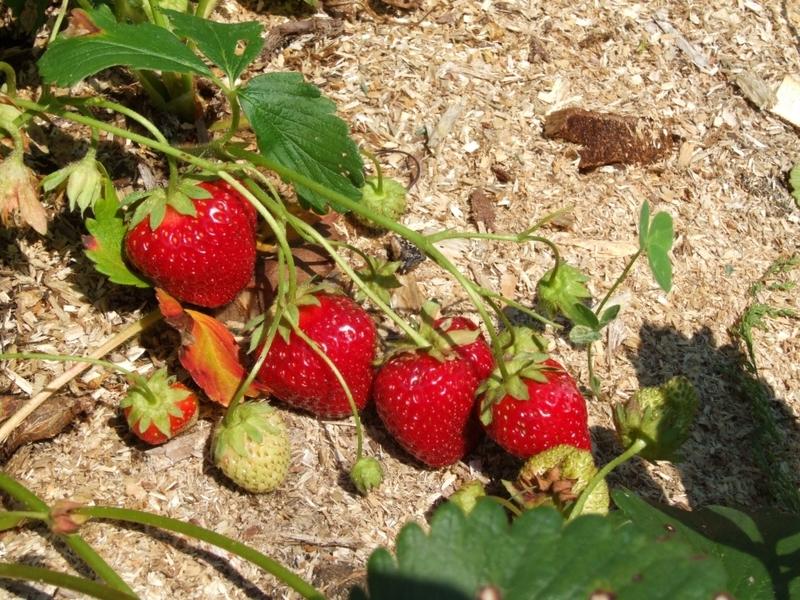
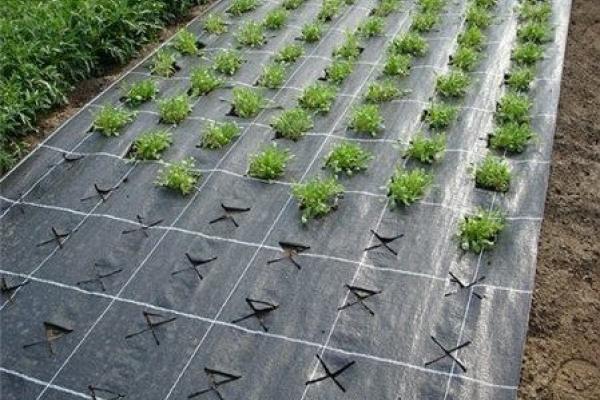
The most effective agricultural technique for growing strawberries is mulching the soil with organic matter, black, dense agrofibre, or other materials. Mulch inhibits weed growth, prevents premature evaporation of soil moisture, and prevents overheating of the plant's root zone. Organic mulch is especially beneficial—as it decomposes, it improves the soil structure and enriches it with nutrients. For it to be effective, it must be maintained at a layer at least 15-20 centimeters thick.
Moustache removal
Different varieties produce different numbers of runners. For example, Eliane is known for its excellent runner production. If you're not trying to propagate the variety, remove the runners by trimming them with scissors or a knife. They drain the plant of its energy and nutrients, preventing it from achieving its full potential. Regular runner removal is especially important on remontant varieties, which bear fruit multiple times a season. Mulched plantings make pruning much easier.
Preparing for the winter period
Winter preparation begins in late August or late September, depending on the growing region. This includes cleaning, pruning diseased leaves, fertilizing with a general-purpose fertilizer, treating with a systemic fungicide, and covering with agrofibre or other suitable material for the winter.
Treatment of strawberries from diseases and pests
To maintain a high agricultural background in strawberry beds, preventative treatments are necessary. This is especially important for varieties with low to moderate resistance to diseases and pests. In the spring, apply a root spray against soil pests (Aktara, Antikhrushch), and during the season, apply 2-3 sprays with fungicides (copper oxychloride, Switch, Alyette) and insecticides (Aktellik, Calypso).
Methods of propagating garden strawberries
Strawberries are propagated vegetatively—by rooting the rosettes that form at the ends of the runners and by dividing the plant. Only F1 hybrids are propagated with proprietary seeds; in varietal strawberries, the maternal traits are split. Growing by rooting rosettes is the most common and effective method.
Collection and storage of varieties
Eliane berries are harvested in May or June, depending on the growing region. After harvesting, they can be stored at room temperature for no more than 1-2 days. When stored with gradual cooling at 2°C (39°F), their shelf life is extended several times over.
Related posts:
 Description of the Florence strawberry variety, planting and care features
 How to grow strawberries at home
 Description and characteristics of the Vima Zanta strawberry variety, planting and care scheme
 Description of the everbearing strawberry variety Selva and cultivation technology
 The best varieties and cultivation of everbearing strawberries, fertilizing and propagation
 Description and characteristics of the Zenga Zengana strawberry variety, planting and care
 Description and how to plant the Garland strawberry variety
 Timing and rules for fertilizing strawberries, and the best fertilizer for a good harvest