
- History of the variety
- Growing area
- Suitable climatic conditions
- Characteristics and description of the Honey strawberry
- Description of bushes
- Flowering and fruiting
- Harvesting and use of the crop
- Shelf life and transportability
- Resistance to diseases and frost
- Planting and care
- The best predecessors and neighbors of culture
- Preparing the site and beds
- Selection of planting material
- Timing and technology of planting operations
- Watering and fertilizing
- Mulching the soil
- Diseases and pests: prevention and treatment
- Shelter for the winter
- Methods of reproduction
- Reviews of gardeners about the variety
Gardeners, farmers, and vegetable growers have long been familiar with the Honey strawberry variety. This variety has been successfully cultivated for many years, both commercially and in private plots.
This fruit crop has gained particular appeal and popularity due to its high yield, low maintenance, and early ripening time. Growing Honey strawberries requires no special skills or knowledge and is suitable for beginning amateur gardeners.
History of the variety
The history of the Honey strawberry variety's development began in the 1970s. Breeders in the American city of Honey set themselves the task of developing a fundamentally new fruit variety with improved and unique characteristics. The Holiday strawberry and the Vibrant variety were used for the cross.
As a result of long and productive work, scientists have developed an early-ripening garden berry variety with an unusual flavor. The new strawberry was named after the city where the research was conducted.
Growing area
In Russia, the new variety was officially added to the state register only in 2013, but by that time, the Honey strawberry had already gained popularity and was actively grown in various regions of the country.
The variety is recommended for cultivation in temperate climates and southern regions.
Also, garden strawberry Honey is cultivated in Ukraine and Belarus.
Suitable climatic conditions
When developing a new variety of fruit crop, breeders took into account characteristics such as drought resistance and frost resistance.
This is why the Honey garden strawberry easily tolerates frosts down to -20 degrees and feels great during periods of short-term drought.
Important! If left unwatered for a long time, the flavor of Honey strawberries will deteriorate.
Characteristics and description of the Honey strawberry
Garden strawberries of this variety are not everbearing. Timely harvesting of ripe berries is essential for high-quality fruiting.
Description of bushes
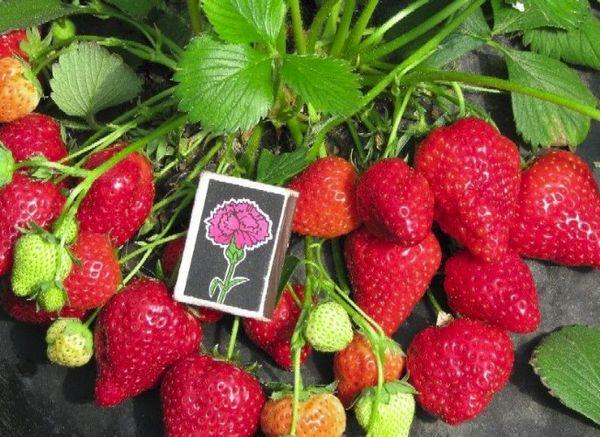
The plant's bushes are low, typically up to 30 cm, but vigorous and spreading, with numerous large, bright green leaf blades with serrated edges and barely noticeable hairs. After fruiting, the bushes actively grow multiple tendrils.
The plants have a well-developed root system.
Flowering and fruiting
Fruiting buds of the Honey strawberry are formed in the fall, so the garden crop blooms at the end of April.
The Honey strawberry variety is self-fertile. During flowering, short but strong flower stalks emerge from the bushes, opening into large white flowers. Each bush produces 5 to 9 flower stalks with multiple inflorescences, which produce berry ovaries. The active flowering period lasts 12-14 days.
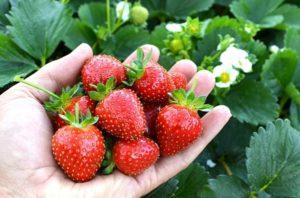
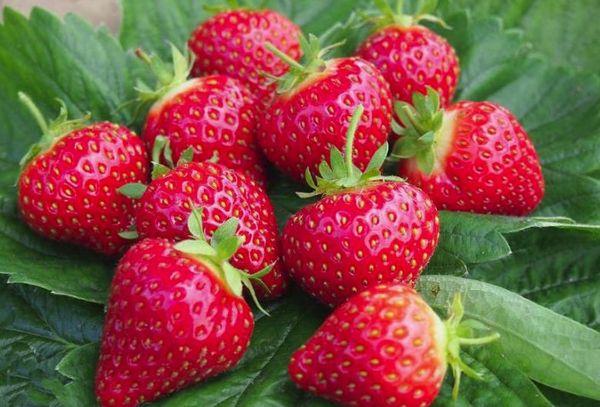
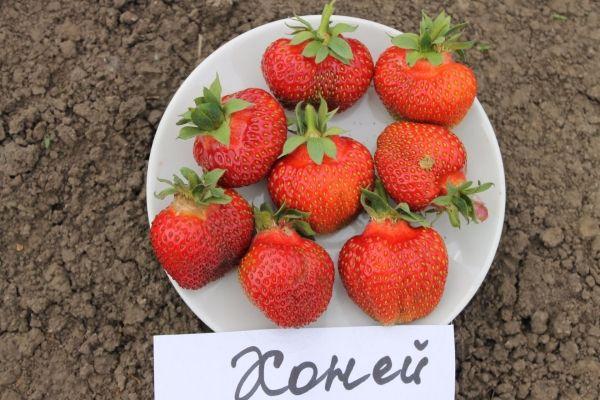
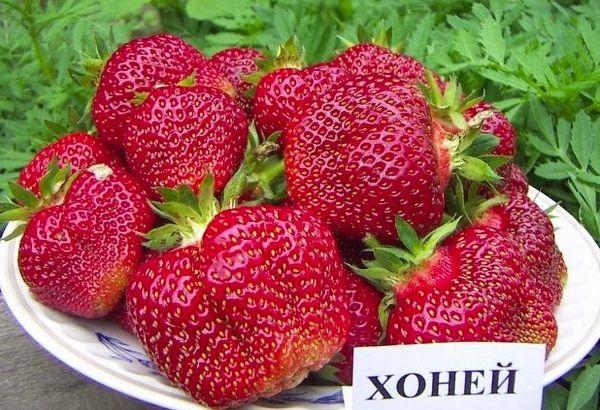
Towards the end of spring, the first ripe fruits appear on the bushes. The berries ripen large—up to 40 g—and are bright red with juicy flesh, a sweet-tart flavor, and a distinct strawberry aroma.
Note: Towards the end of the fruiting season, the berries become smaller, but the flavor improves.
Harvesting and use of the crop
In temperate climates, the berries ripen in mid-June. In southern regions, strawberries of this variety are harvested 10-12 days earlier.
One bush yields 500 to 700 grams of ripe fruit. On an industrial scale, up to 15 tons of produce can be harvested per hectare.
Honey garden strawberries are versatile and can be eaten fresh or processed.
Jam is made from garden strawberries, make homemade wine and liqueurs, dry, freeze and preserve.
 Important! After a long winter, the body needs vitamins and nutrients, which are found in abundance in strawberries.
Shelf life and transportability
The harvested crop of ripe berries retains its freshness and marketable appearance for 3-5 days, so the fruits tolerate long-distance transportation well.
Many farmers harvest their strawberries when they're technically ripe. This extends their shelf life, allowing them to ripen in the crates, but their flavor deteriorates.
Resistance to diseases and frost
The variety's natural immunity to fungal and viral infections of the above-ground portion of the bush makes it particularly valuable. The roots of this fruit tree are less resistant to diseases and pests.
Temperate winters pose no threat to strawberries. The hybrid variety easily survives temperatures down to -20°C (-4°F). In northern latitudes, the plant requires additional insulation during the winter.
Planting and care
To obtain a high-quality and abundant harvest, fruit crops require timely care and adherence to agricultural practices.
The best predecessors and neighbors of culture
The key to healthy berry bushes and a large harvest is crop rotation.
The best predecessors and neighbors for strawberries are bulbous and legume crops, greens, beets, carrots and lettuce.
To promote fruiting and protect against pests and diseases, calendula flowers or garlic are planted between berry bushes. These plants act as natural antiseptics, cleansing the soil of harmful bacteria and enriching it with beneficial nutrients.
It is not recommended to plant strawberries next to eggplants, potatoes, sunflowers and tomatoes.
Preparing the site and beds
For planting garden strawberries in open ground, choose level plots of land with good lighting and protection from drafts and north winds.
The soil for seedlings is prepared 2-3 weeks before planting.
- The area is thoroughly loosened, dug over and cleared of weeds.
- Organic and mineral fertilizers are added to the soil. Garden strawberries prefer loose, fertile soil.
- If the site has heavy, clayey soil, sand and humus should be added. Sandy soil is mixed with river sand and peat. Excessive soil acidity is reduced with lime or ash.
- If the groundwater level is high, high embankments are made on the beds.
Tip! To prevent the spread of fungi and pests, treat the soil with herbicides a few days before planting.
Selection of planting material
When choosing planting material, pay special attention to the plant's appearance. The seedling should be free of visible damage. The seedlings should have well-developed leaf blades, at least 3-4 in number. The rhizomes should tightly encircle the root ball in the container. It's best if the seedlings are sold in small cups, from which they can be easily removed and inspected. Before planting, treat the roots with a manganese solution and a growth stimulant.
Timing and technology of planting operations
Strawberries propagated by runners are best planted outdoors in early fall. This way, the first harvest of berries can be harvested the following season. Fall planting is also recommended for southern latitudes. The seedlings have time to establish themselves and take root before the first frost.
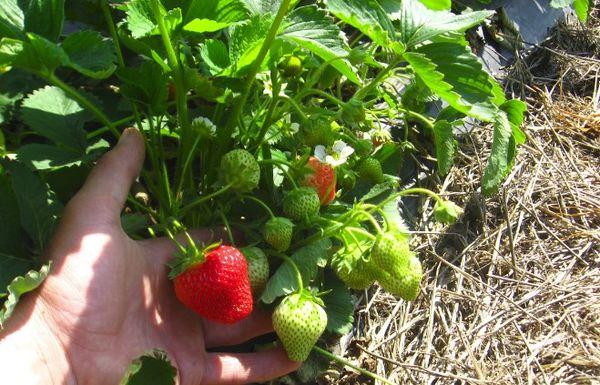
Seedlings purchased from a nursery or market are best planted in the spring. This work is carried out from mid-April to early May.
- On the prepared plot of land, holes are dug 25 to 30 cm deep.
- The distance between holes is left at least 40 cm, between rows 50 cm.
- Fertile soil is poured into the holes and moistened.
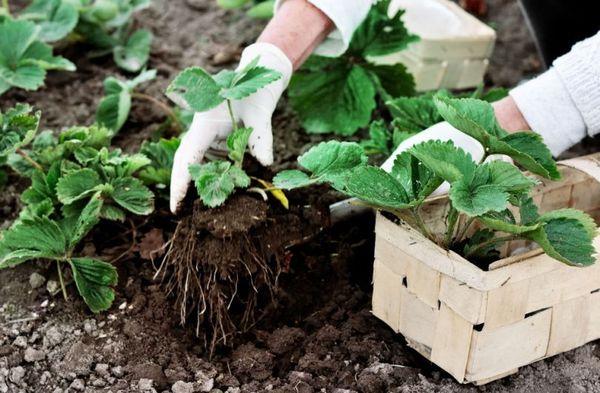
- The seedling is placed in the hole, evenly distributing the rhizome.
- The planted plant is covered with soil and watered.
Important! If planting fruit trees in the fall, mulch the soil under the seedlings with dry leaves, sawdust, or compost.
Watering and fertilizing
The Honey strawberry variety is equally susceptible to both very wet and dry soil. Therefore, watering this fruit crop must be approached with the utmost care.
Irrigation is especially important at the beginning of the growing season and during fruit set. Water strawberries as needed, as soon as the soil dries out. During drought, increase the frequency of irrigation.
Like any fruitful crop, Honey garden strawberry requires additional nutrients.
Strawberries are fed 3-4 times throughout the season, alternating organic fertilizers with mineral fertilizers.
Mulching the soil
The soil mulching procedure helps to get rid of weeds and stabilizes soil moisture.
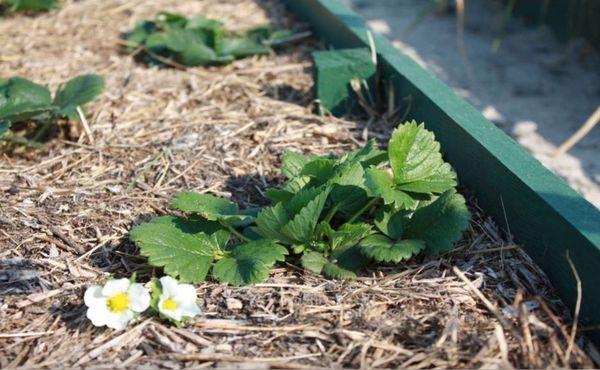
Note! Weeds are the primary carriers of fungi, viruses, and pests. Therefore, this procedure should be performed as frequently as possible.
Diseases and pests: prevention and treatment
The Honey hybrid strawberry variety differs from its peers in its excellent resistance to diseases and pests, but it is necessary to carry out annual preventative spraying of the bushes and soil with professional preparations or solutions.
Proper plant care and agricultural practices reduce the risk of disease and pest infestation.
Shelter for the winter
With the onset of autumn, fruit crops are prepared for winter dormancy.
- Yellowed, dry and damaged leaves are cut off from the bushes, and excess shoots are removed.
- Preventive spraying of plants and soil is carried out to prevent the spread of fungal and viral infections and pests.
- The beds are mulched with a thick layer of humus, dry leaves and spruce branches.
- When the first snow appears, large snowdrifts are made in the beds.
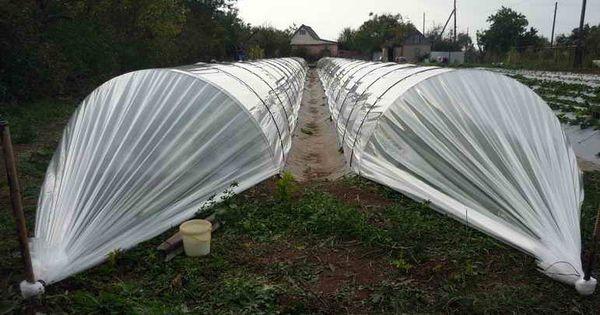
In northern regions, the beds are additionally covered with any rags or special material.
Methods of reproduction
The Honey strawberry variety is propagated vegetatively or by seeds.
The hybrid variety produces enough shoots for propagation. For propagation, select a sturdy bush, remove all flower stalks, and root the rosette in the soil. Once roots appear, separate the rosette from the mother plant and plant it in a separate bed.
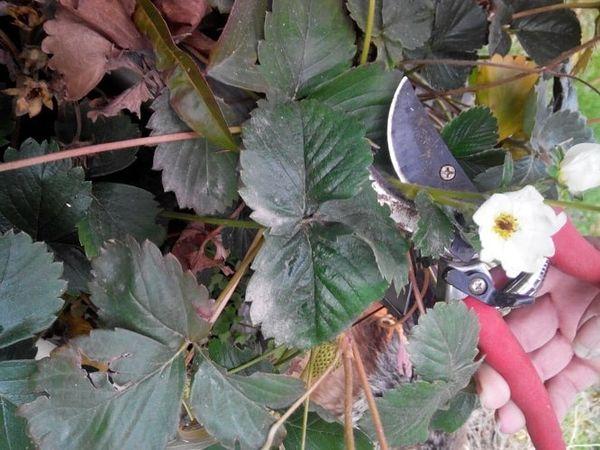
Dividing the bushes is done to rejuvenate the plants. To do this, select a mature, strong bush and dig it up. The roots are cleared of soil and divided into equal parts. Each new plant should have 2-3 leaves and formed rhizomes. The new strawberry bushes are planted in beds.
Propagating hybrid strawberries by seed is a time-consuming and labor-intensive process. Before planting, the seeds are placed in a container with fertile soil and stored in a cool place for 1.5-2 months.
After the time has elapsed, the container with the seeds is moved to a warm place and covered with plastic wrap. Once the first shoots appear, the plastic wrap is removed and the pots are moved into sunlight. When the first true leaves appear, the seedlings are transplanted into individual pots and planted outdoors in the spring.
Reviews of gardeners about the variety
Stepan Viktorovich, Tomsk
I've been growing Honey strawberries at my dacha for six years now. The bushes are compact but strong, supporting a huge number of berries. It's very easy to care for—watering and occasional fertilizing—and I've never encountered any diseases or pests. The variety produces excellent yields, with juicy and sweet berries that are perfect for jam and freezing.
Elena Petrovna, Nizhnegorsk
My neighbor at my dacha gave me some Honey strawberry runners. I planted them two years ago, they overwintered perfectly, and this summer we harvested our first crop of berries. We really liked the fruits; they're edible and also suitable for canning. I'll definitely be propagating this variety.
Evgeniy, 8 years old, Novosibirsk
I planted the Honey strawberry variety four years ago and haven't regretted it a single day. It requires minimal maintenance, grows quickly, and produces numerous tendrils. The berries are juicy, aromatic, and slightly wine-like, making them perfect for compotes and jams. My wife also dries them and freezes them for the winter.
Related posts:
 Description and characteristics of the Vima Zanta strawberry variety, planting and care scheme
 Description of the Florence strawberry variety, planting and care features
 Description and characteristics of the Korona strawberry variety, planting and care scheme
 Description of the everbearing strawberry variety Mara de Bois and growing rules
 Description of the everbearing strawberry variety Selva and cultivation technology
 Description of the Holiday strawberry variety, cultivation and propagation methods
 How to grow strawberries at home
 Description and how to plant the Garland strawberry variety