
- Why is pruning done?
- Strawberry whiskers
- Removing leaves after fruiting
- Pruning strawberries affected by disease or pests
- How long does it take to perform the procedure?
- In the spring
- In summer
- In the fall
- We follow the rules
- Caring for the plant after pruning
- Features of pruning remontant varieties
- Common mistakes and how to fix them
To ensure abundant fruit production, strawberries require care from early spring to late fall. Pruning is an important part of the process, and it's necessary for many reasons. Below, we'll discuss when to prune strawberries, why to prune them, how to care for the plant afterwards, as well as common gardening mistakes and how to correct them.
Why is pruning done?
Strawberries are perennial plants, so pruning serves several functions: it promotes rejuvenation of the bushes, increases yield, and protects them from damage due to diseases and pests.
Strawberry whiskers
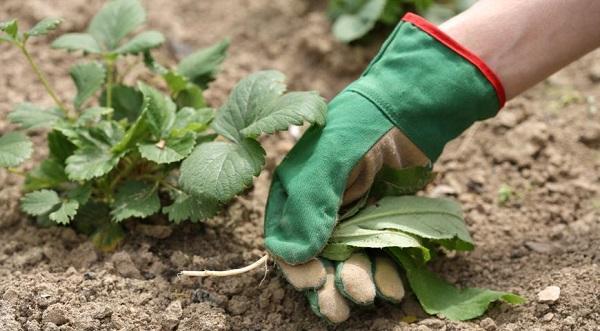
Almost all strawberry varieties produce runners, which can be used to propagate strawberries. Primary shoots, the largest and most viable ones, are usually left for this purpose. If the gardener doesn't intend to propagate the plant, the runners are removed, as they weaken the mother plant. This procedure is carried out carefully, taking care not to damage the main plant.
Removing leaves after fruiting
After the berries have been picked, strawberry bushes continue to be cared for. They are inspected, and yellowed and dry foliage, which can be a source of various diseases, is trimmed. Some gardeners completely prune all above-ground parts of their strawberry plants after fruiting, in July. By autumn, the plants recover and develop a healthy rosette, ready to successfully overwinter.
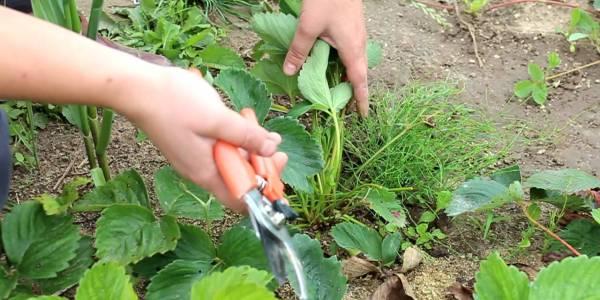
Pruning strawberries affected by disease or pests
Without proper care, strawberries are susceptible to diseases and pests. While you can spray them with chemicals, this will compromise the eco-friendliness of the product. Leaves should be trimmed at the first sign of trouble to prevent diseases and pests from spreading throughout the plantation. After harvesting, they are removed completely. To allow the bushes to recover, they are fed with mineral fertilizers over the winter.
Important! Affected leaf blades must be collected and burned.
How long does it take to perform the procedure?
Inspect and remove dead leaf blades of garden strawberries from early spring until late autumn.
In the spring
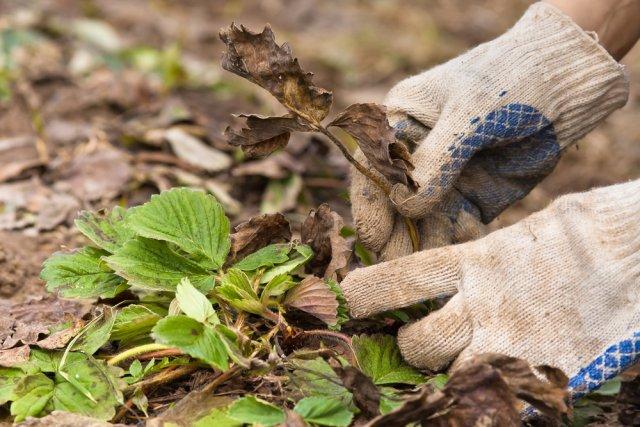
In spring, as soon as the snow melts and warm weather arrives, remove the mulch and inspect the bushes. Remove frost-damaged, dry, and diseased leaves. Pruning times vary by region, depending on weather conditions. Overwintering pests are carried away along with the leaf blades. Leaves should be trimmed carefully, as close to the root as possible, but be careful not to damage the young blades in the center of the rosette.
In summer
This is the most favorable time for the procedure. Prune strawberries in July or August, allowing the bushes to develop new leaves, set flower buds, and store nutrients before frost. Actively growing runners are also removed in summer. However, if old bushes need to be replanted, the first-order shoots are left and, after further growth, transplanted to a new location. Runners are also left if the strawberry plantation needs to be expanded.
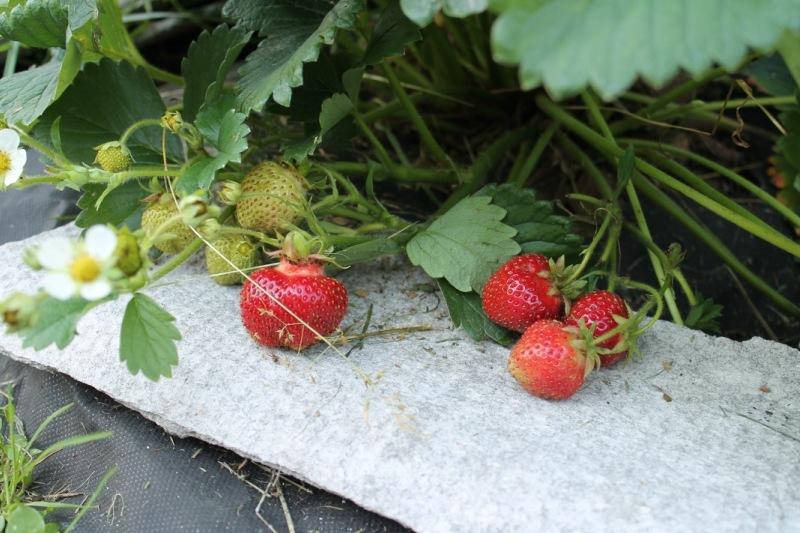
Second-order offshoots can also be left for propagation. They will be slightly smaller, but with proper care, they will produce a crop the following year. The remaining runners are dug up with a shovel and discarded or added to the compost heap. Pulling them out by hand is not recommended, as this can damage the root system of the mother plant.
In the fall
During this period, leaves are removed only when necessary, such as in case of disease or pest infestation. This procedure is performed as early as possible to allow the bushes to recover before the cold weather sets in. The core of the strawberry plant should not be touched during this process. After removing the leaves, the bushes are mulched with pine needles, sawdust, or peat. If a gardener removes plant debris solely to clean up the garden, it will cause more harm than good.
We follow the rules
To avoid damaging your strawberry beds, follow these rules when pruning the crop:
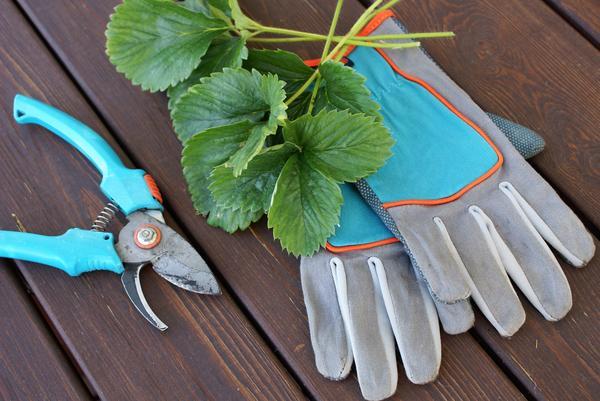
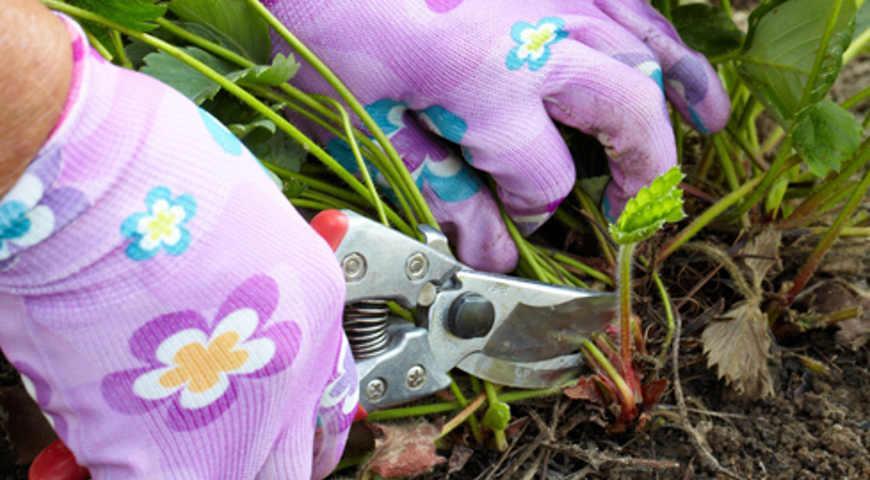
- The procedure is performed with a sharp knife or pruning shears.
- The runners are dug out with a shovel. If you pull them off by hand, the tension on the shoot can damage the mother plant. A bush that easily breaks away likely has a fungal root system.
- The leaf blades should be cut as close to the base of the bush as possible, but at the same time, care should be taken to ensure that the rosettes remain intact.
- The procedure is carried out in dry weather. If the bushes require moisture, water them only at the roots.
- Prune the healthier bushes first, gradually moving on to the more severely damaged plants. Tools are often disinfected in a solution of potassium permanganate or copper sulfate.
- When pruning diseased bushes, place newspaper next to them so that the fungal spores fall onto it and not onto the soil.
Properly performed pruning procedure causes minimal damage to strawberry bushes, allowing them to recover before the winter cold sets in.
Caring for the plant after pruning
After removing the leaves, care for the plants as follows:
- The soil between the rows is loosened. Simultaneously, weeds are removed, as they rob the plants of nutrients and can also carry diseases and pests.
- Plants are watered strictly at the roots.
- After pruning, the plants are weakened, so they need to be fed with complex mineral fertilizer.
- After harvesting, when grown both indoors and outdoors, the bushes can be sprayed with fungicides and insecticides.
Please note: Strawberries require mulching to help retain moisture in the spring and protect the bushes from frost in the winter.
Features of pruning remontant varieties
A special feature of everbearing strawberry varieties is that they bear fruit twice a year, and removing leaves after the first harvest can significantly weaken the bushes. However, if the leaf blades are damaged by diseases and pests, pruning is possible, and even necessary, otherwise the gardener could lose the entire strawberry plantation. At the same time, runners are removed, as they significantly reduce the second harvest.
After the last harvest, you should not delay pruning the affected leaves, otherwise the strawberries will not survive the winter well.
Common mistakes and how to fix them
Due to inexperience, gardeners perform the procedure incorrectly and end up with no harvest. After this, they conclude that pruning is unnecessary. This is incorrect, as a properly performed procedure increases the yield.
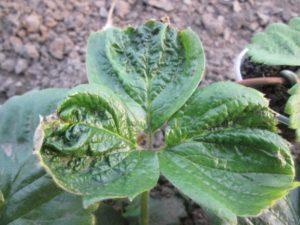
The most common mistakes when pruning strawberry leaves are the following:
- The procedure was performed at the wrong time. Late pruning delays the formation of flower buds, which reduces fruiting. The best time to perform the procedure is mid-July.
- Strawberries require no maintenance after pruning. The most important thing the bushes require after leaf removal is fertilization. To restore the bushes and promote new growth, garden strawberries are treated with complex mineral fertilizers.
- After the procedure, the bushes are watered from above. The cut ends, if exposed to moisture, can begin to rot. Therefore, strawberries are watered only from a hose, at the roots.
- A dull tool is used. Poorly sharpened pruning shears tear leaves from the base of the rosette rather than cut them. The injured plant takes a long time to recover. Sharpening the tool can correct the problem.
Properly pruned strawberries in spring will promote lighter growth on the bushes, resulting in an earlier harvest. Summer pruning will remove yellow and dry leaves, which can harbor diseases and pests, as well as runners, which can rob the plant of its energy for further development.
Related posts:
 Description of the Florence strawberry variety, planting and care features
 Signs of disease and pest attacks on strawberries, treatment methods
 How to grow strawberries at home
 Description and characteristics of the Vima Zanta strawberry variety, planting and care scheme
 The best varieties and cultivation of everbearing strawberries, fertilizing and propagation
 Description of the everbearing strawberry variety Mara de Bois and growing rules
 Description and how to plant the Garland strawberry variety
 Description of the everbearing strawberry variety Selva and cultivation technology