
- Selection and cultivation regions of the Maryshka strawberry
- Pros and cons of the variety
- Distinctive features and characteristics
- Size and appearance of the bush
- Flowering and fruiting
- Commercial and taste qualities of berries
- Susceptibility to diseases and pests
- Frost and drought resistance
- Agrotechnical recommendations for planting
- Deadlines
- Selecting a site and preparing beds for strawberries
- Preparing seedlings
- Stages of the planting process
- Further care
- Watering mode
- What fertilizer does the variety prefer?
- Weeding and loosening
- Mulching strawberries
- Treatment against diseases and pests
- Shelter during the winter period
- Methods of propagation of culture
- Reviews from gardeners and summer residents
The Maryshka strawberry variety is prized by farmers for its excellent taste and marketability. The plant is characterized by its low maintenance, low susceptibility to frost and disease, and large fruit size combined with a compact bush. The berries have a firm texture, rich flavor, and strawberry aroma. They are eaten raw and used in various desserts.
Selection and cultivation regions of the Maryshka strawberry
The variety was bred at the end of the 20th century in the Czech Republic and quickly gained popularity among gardeners in Russia and Eastern European countries.
The Maryshka strawberry quickly adapts to temperate climates. It is cultivated in the southern and central regions of Russia.
Pros and cons of the variety
Pros:
- large-fruited;
- early ripening of fruits;
- simultaneous ripening of berries, facilitating harvesting;
- unpretentiousness;
- drought resistance;
- disease resistance;
- suitability of berries for transportation without loss of commercial quality.
Disadvantages of the variety:
- average productivity;
- impossibility of growing in northern regions;
- non-repairability;
- difficulty in determining the moment of berry ripening.
Distinctive features and characteristics
Marishka has a number of characteristic qualities that distinguish this variety from other types of strawberries.
Size and appearance of the bush
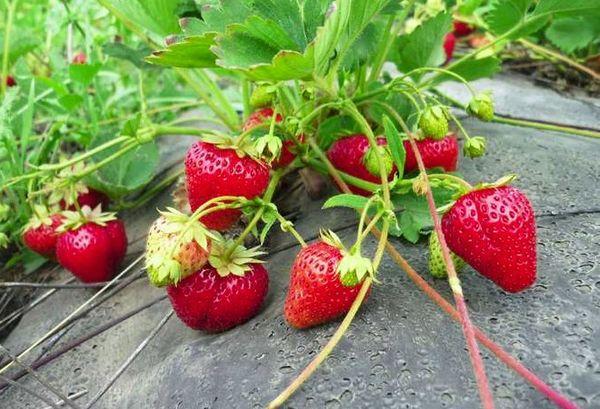
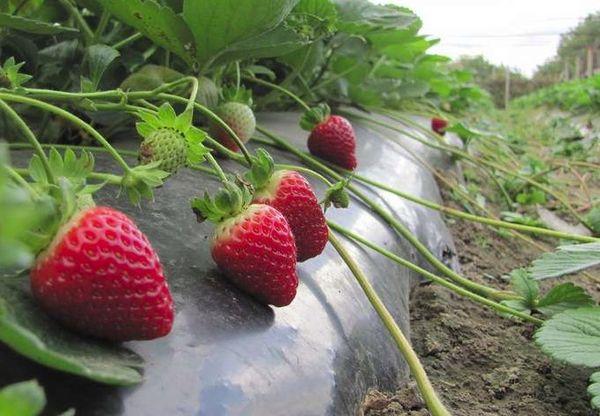
Maryshka strawberry bushes are vigorous and spreading, yet low and compact. They have a small number of leaves located close to the soil. The leaves are medium to large, rich green, glossy, slightly corrugated, and have sharp serrated edges.
Flowering and fruiting
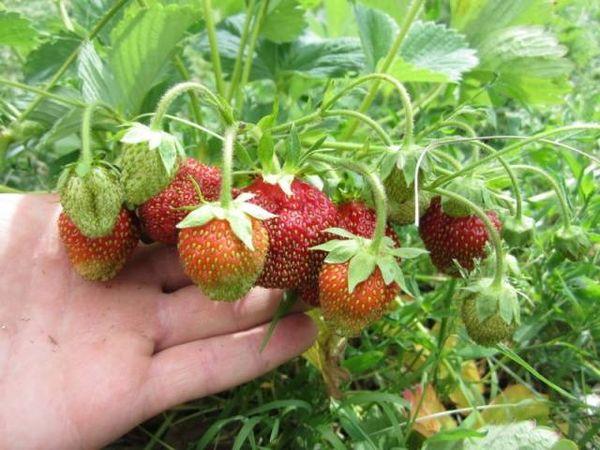
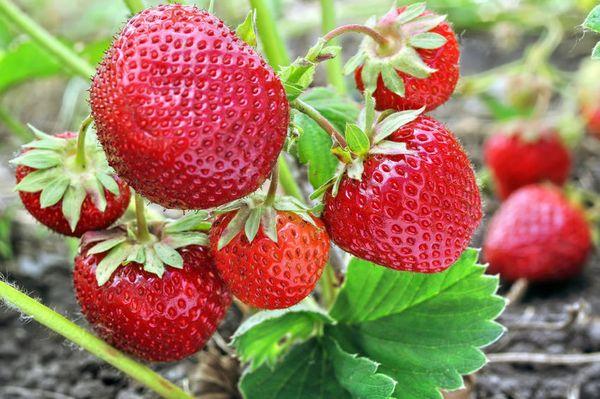
The inflorescences form in clusters, and the berries ripen in bunches. The flowers are large and bisexual. The peduncles are long and erect, supporting the fruit well, and are positioned above the foliage.
The Maryshka variety is mid-early. In central Russia, the first buds appear in the last ten days of April, and the berries appear in early summer. In the southern regions, the harvest begins earlier, beginning in mid-May.
A distinctive feature of this variety is the simultaneous ripening of fruits.
The entire harvest is collected within 1-2 weeks. Each plant produces no more than 10 berries, weighing a total of 0.5 kg.
Commercial and taste qualities of berries
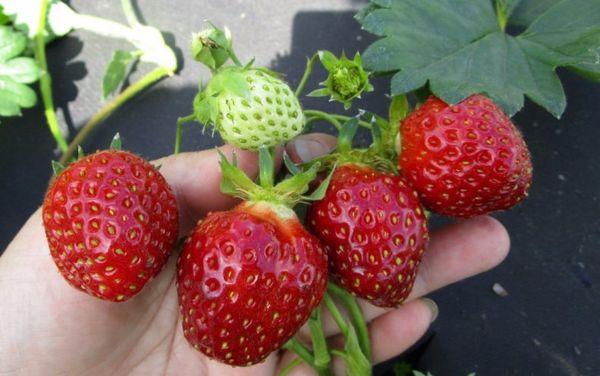
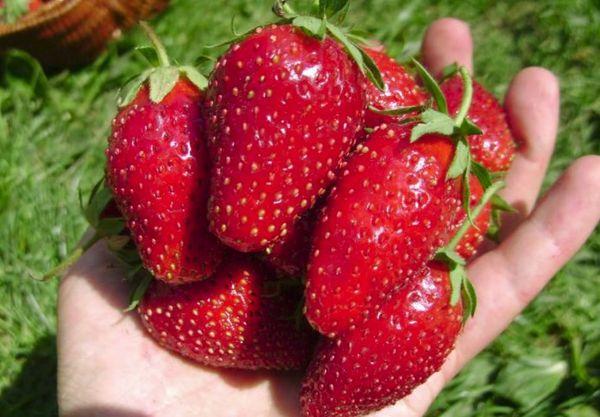
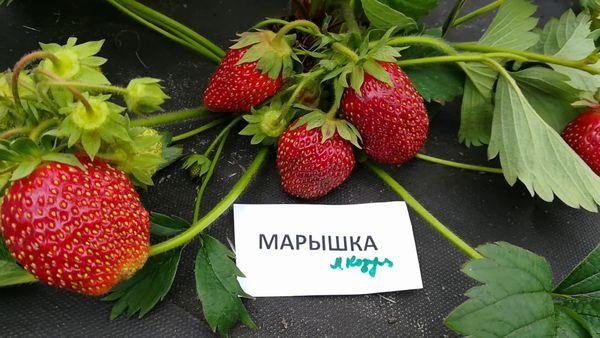
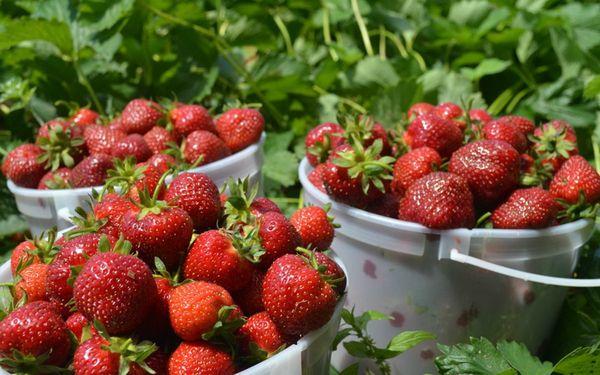
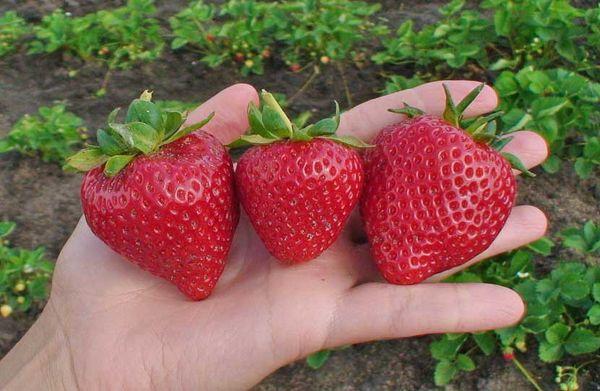
With proper care, the Maryshka variety consistently produces large fruits weighing 50-60 g. Ripe berries are a rich red color. Even ripe fruits become greenish toward the top.
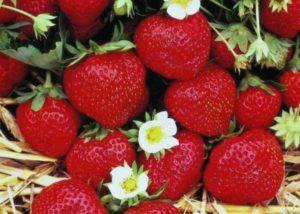
The berries come in a variety of shapes. The most common are oblong, cone-shaped, and flattened on the sides. Sometimes the fruits grow together.
When separated from the stalk, the sepals remain intact, ensuring the fruits retain their neat appearance. The skin and flesh of the berries are firm, and the surface is dry, making them suitable for transportation and long-term storage.
The berries of the Maryshka strawberry are juicy, with a rich, sweet, but not cloying, taste and a pleasant strawberry aroma.
Susceptibility to diseases and pests
If improperly cared for, the bushes are susceptible to fungus and red root rot. The Marishka strawberry is resistant to spider mites, but the plant often suffers from aphids, weevils, and whiteflies.
Frost and drought resistance
The Maryshka strawberry is frost-resistant, surviving temperatures down to -22 degrees Celsius. It tolerates snowless winters well, and freezing of the blossoms is virtually nonexistent during early flowering.
The variety is drought-resistant, does not wither even on the hottest days, and the fruits do not dry out in the sun.
Agrotechnical recommendations for planting
To achieve high yields, it is necessary to follow care and planting recommendations.
Deadlines
Strawberries are planted in spring or early autumn – the top 5-6 cm of soil should be warmed up.
In spring, plants are planted no earlier than the last week of April – beginning of May, and in autumn – no later than mid-September.
Selecting a site and preparing beds for strawberries
Strawberries thrive in a sunny, open location. Fruit grown in the shade will not be as sweet, and yields will be reduced.
Plants from the nightshade family should not be planted near strawberry beds. They often carry verticillium wilt and can infect strawberries with this disease.
Excessively wet soil is a cause of red root rot. If the area is flooded, provide drainage or fill.
The best soil types for Maryshka strawberries are loamy soils with a pH of 5.5-6. Saline and calcareous soils are not suitable.
Before planting, the soil is fertilized. When planting in the spring, use a mixture of organic and mineral fertilizers. The nutrient solution is added to the soil in the fall. For 1 square meter, apply 0.5 buckets of humus, 20 g of potassium chloride, and 60 g of superphosphate.
When planting strawberries in the fall, use only manure or humus; fertilizers are added in the spring.
Preparing seedlings
Before planting, seedlings are inspected; only strong plants with roots longer than 7 cm and a root collar diameter of at least 6 mm are selected.
Stages of the planting process
The Maryshka strawberry grows quickly; no more than 3 bushes are planted per 1 square meter.
Before planting, the roots of the seedlings are treated with a solution of 1 liter of water and 7 g of Agat-25K mixture or 15 g of potassium humate.
Landing methods:
- Bush planting. Dig holes 50 cm apart and plant 2-3 seedlings in them.
- Rows. Seedlings are planted individually in holes arranged in rows. The distance between adjacent holes is 20 cm, and between rows, 0.5 m.
- Nests. To create a nest, select seven seedlings, placing one in the center of the hole and the remaining six around it. The distance between seedlings in the nest is 5 cm, between nests in a row – 30 cm, between beds – 40 cm.
- Carpet. With this method, all the seedlings are arranged in a loose pattern. The Marishka strawberry grows quickly, so a carpet of plants soon forms in the bed.
The seedling holes are 20 cm deep. A small amount of complex fertilizer is added, the seedlings are placed, and 1 liter of water is added. After the liquid has been absorbed, the plant roots are covered with soil, the root collar should be at ground level, and the soil is compacted. Sawdust or hay is used for mulch.
Further care
To ensure that strawberries produce a bountiful harvest every year, they need to be properly cared for.
Watering mode
During the first week after planting, water the seedlings daily. The water consumption per square meter is 2-3 liters. Then, switch to watering once a week. During hot summer days, water the strawberries more frequently – every 2-3 days.
Before harvesting, no more than 1 liter of water is poured under the bush to prevent rot.
Watering is carried out with settled water at room temperature early in the morning or late in the evening.
What fertilizer does the variety prefer?
Fertilizer is applied in the second year after planting. Use one part bird droppings or cow manure diluted in four to five parts water, or nitrophoska – one tablespoon per 10 liters of water. Water the strawberries with this solution every 10 days in the spring until flowering begins. Once the flowers appear, stop fertilizing.
Fertilization resumes during fruit set. During fruit ripening, strawberries are not fertilized. Fertilization resumes after harvest. In mid-September, strawberries are fertilized with a mixture of 2 tablespoons of nitroammophoska, 1 cup of ash, 30 g of potassium sulfate, and 10 liters of water.
Weeding and loosening
It is necessary to regularly weed the beds after watering and loosen the soil around the bushes to ensure better aeration of the roots.
Mulching strawberries
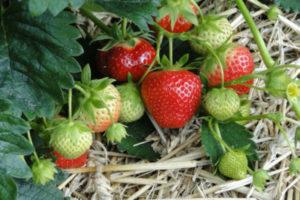
The soil around the bushes is covered with a thick layer of hay or sawdust after watering and loosening the soil. In late September or early October, mulch with peat.
Treatment against diseases and pests
To prevent fungal diseases, the rosettes of Maryshka strawberry seedlings are treated with a solution of 10 liters of water and 30 g of a mixture of copper sulfate and soda in a ratio of 1:6 before planting.
Red root rot attacks bushes when the soil is overwatered and there's a lack of ultraviolet light. To prevent the disease, seedlings are treated with a weak fungicide solution before planting. Infected plants are burned, and the area is disinfected with a potassium permanganate solution or boiling water.
To protect against insects, treat the Maryshka strawberry with Karbofos on a dry, windless day at an air temperature of no more than +15 degrees.
Shelter during the winter period
When cold weather sets in, the bushes are covered with plastic film, spruce branches, hay, straw, or agricultural fabric to protect the root system from frost. In early spring, the covering is removed from the beds to prevent damping off.
Methods of propagation of culture
The Maryshka strawberry has good self-propagation abilities and quickly covers the entire area prepared for it with daughter bushes.
Strawberries can be propagated by dividing the bush, or by propagating rosettes and runners. The latter method is the least traumatic for the plant, so it is used most often.
Reviews from gardeners and summer residents
Ivan, 40 years old, Lipetsk.
"I grow several varieties of strawberries so I can eat them all summer long. Marishka ripens first. The berries are large, sweet, and have a pleasant aroma. We don't candied this variety for the winter; we eat it fresh."
Olga, 38 years old, Tver.
"We all love strawberries; we eat them in the summer and preserve them for the winter. The maryshka doesn't bear fruit for long, but during that time I manage to feed the whole family."
Galina, 44 years old, Zhukovsky.
"I've been growing Maryshka for eight years now. I love this variety for its large fruits and ease of care. I cover the bushes with spruce branches for the winter."
Related posts:
 Description and characteristics of the Vima Zanta strawberry variety, planting and care scheme
 Description of the Florence strawberry variety, planting and care features
 Description of the everbearing strawberry variety Mara de Bois and growing rules
 Description of the everbearing strawberry variety Selva and cultivation technology
 How to grow strawberries at home
 Description of the Holiday strawberry variety, cultivation and propagation methods
 Step-by-step instructions for planting strawberries on black covering material and growing rules
 Description and characteristics of the Korona strawberry variety, planting and care scheme