
- Benefits of vertical strawberry planting
- Saving space
- Ease of care
- Are there any disadvantages?
- Limited soil volume
- Unsuitability for cold regions
- What varieties are suitable?
- Ostara
- Homemade delicacy
- Alba
- Queen Elizabeth
- DIY installation of structures
- Garden beds in pipes
- In plastic bottles
- In a barrel
- Strawberries in bags
- Tire pyramids
- Pyramids of planks
- Features and technology of planting and growing
- How to care for strawberries
- Watering, fertilizing
- Trimming
- Protection from frost, pests and diseases
- Possible errors and solutions
Building a small vertical strawberry bed is within the reach of any gardener. Vertical gardening has become a hot topic in recent years. It beautifies a garden plot and maximizes planting space. Many original designs have already been devised, but gardeners continue to invent new ones. They make beds from a variety of materials, including boards, tires, pipes, crates, and even drink bottles.
Benefits of vertical strawberry planting
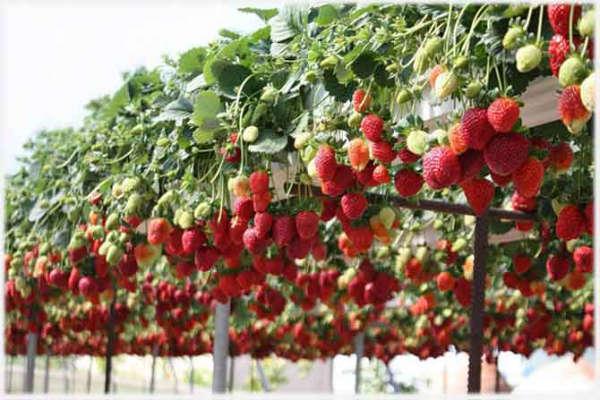
Vertical strawberry cultivation has long been used in commercial greenhouses. Many amateur gardeners have found a use for it in their plots, but before implementing such a system, it's important to weigh its pros and cons.
Saving space
Building a vertical bed makes sense when you have limited space at your dacha but want to grow strawberries. A tall, multi-tiered structure can yield 3-4 times more berries per square meter than a standard horizontal bed.
Ease of care
Caring for strawberries becomes a pleasant experience. The gardener doesn't have to bend over to trim runners or harvest the fruit. Strawberry bushes grown in vertical beds are less susceptible to disease and pests, so insecticides rarely need to be used.
The berries don't touch the ground, so they're always clean. They're whole because ants and other insects don't eat them. The benefits don't end there. Strawberries grown in vertical beds can be easily protected from rain and hail with plastic film, and in spring and fall, with non-woven frost protection.
Are there any disadvantages?
The technology does have its drawbacks, which must be taken into account when planning and constructing a vertical garden bed.
Limited soil volume
The soil volume is small, so it dries out quickly. By saving on soil, gardeners increase their water consumption. To prevent the soil from drying out in hot weather, watering is necessary frequently. Those who come to their dacha on weekends have to install a drip irrigation system. This requires additional funds.
Unsuitability for cold regions
In winter in Siberia and the central zone, strawberries on a vertical bed will freeze because the soil will freeze.
In cold regions, you need to think about how to insulate the structure or make it collapsible.
What varieties are suitable?
A vertical bed requires intensive cultivation, so it's best to choose varieties that produce 2-3 harvests per season. Everbearing strawberry varieties possess this ability.
Ostara
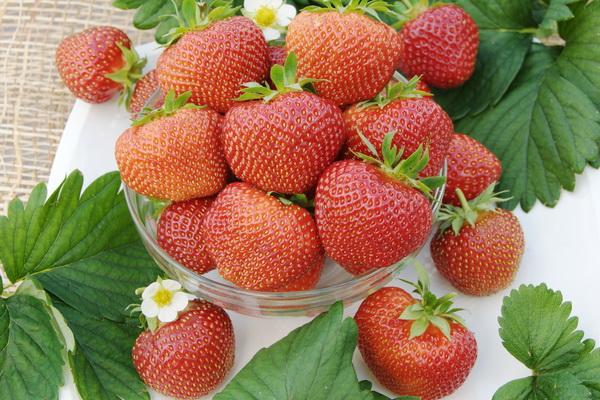
This remontant variety produces two harvests per season. The berries are glossy, conical, and have a sweet and sour flavor with a strawberry aroma. The low (25 cm) bushes are easy to care for, and few runners develop. With proper care, a single plant yields 1-1.2 kg of berries.
Homemade delicacy
Strawberries begin growing at temperatures of 5-7°C and continue to bear fruit until frost. The Domashniy Delikates hybrid bushes are compact and rounded during flowering and ripening, with long, upright flower stalks providing decorative appeal. This everbearing variety boasts comprehensive resistance to the main diseases of the crop. The berries are bright red, delicious, and round, 3-5 cm in diameter.
Alba
A large-fruited (30-50 g), early, non-everbearing variety. A single bush yields 300-700 g of berries with excellent marketability. The harvest ripens in May in southern regions and a month later in temperate latitudes.
Queen Elizabeth
The Queen Elizabeth bush bears fruit for one to two years, producing 3 to 5 runners per season. This is a remontant, large-fruited (30-100 g), early variety. If the rosettes are not removed, berries will form on them in July. In protected soil, the fruiting period lasts about 10 months, as Queen Elizabeth is a day-neutral variety.
DIY installation of structures
To build your first vertical strawberry bed, you can find materials at your dacha. You can use lumber, polypropylene pipes, and other building materials left over from building or renovating a house, shed, or greenhouse.
Garden beds in pipes
A vertical garden bed made of PVC pipes is placed next to the barbecue, pool, and along the central path leading to the house. The frame is made of beams. The pipes are of different diameters:
- for irrigation - 32 mm;
- for soil - 110 mm.
Holes are made in the top of the main pipe for the strawberries, and drainage holes are made in the bottom. Many small holes are drilled in the thin pipe, which is inserted into the larger diameter pipe using couplings and flexible hoses and connected to the water supply.
In plastic bottles
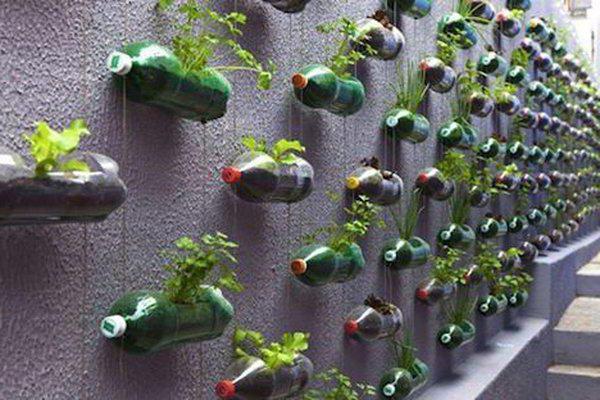
Large bottles, starting at 2 liters, are suitable. They can be used to make planters that can be hung on a fence, the wall of a shed, a gazebo, a terrace, or by constructing a special support from pipes, beams, or other building materials. Planters are made as follows:
- the bottle is cut in half;
- in the part with the lid, pour the substrate and plant strawberry seedlings;
- the bottom of the bottle is used as a stand, and a container with a plant is placed in it;
- holes are made in the lid to allow excess liquid to drain.

In a barrel
Take a metal or plastic barrel, usually an old one. It's easy to make holes in it, 5-8 cm in diameter. They should be staggered and spaced 30 cm apart. A layer of crushed stone is poured into the barrel, then the pipe is inserted. Before that, holes are drilled in it for irrigation. The container is filled to the top with fertile soil.
Strawberries in bags
To decorate a terrace or gazebo, bags are sewn from coarse canvas, filled with fertile soil, and then planted with strawberries. For growing large quantities of strawberries, thick, large-capacity polyethylene bags are purchased.
They are filled with nutritious soil. For planting strawberry seedlings, holes are made in the side walls at intervals of 20-25 cm. The bags are hung vertically or placed horizontally on a rack. A drip irrigation system is installed.
Tire pyramids
If car tires are of the same diameter, they are placed on top of each other. First, holes are cut in each pyramid for the strawberry plants, then soil is added. For watering, a plastic pipe is placed in the center of the pyramid. Before installation, holes are drilled along its entire length, and a plug is placed at the bottom to prevent water from spilling out.
If the car tires are of different diameters, then the pyramid has the shape of a cone, it is constructed differently:
- the sides of each one are cut off;
- Place the largest diameter tire on the leveled area and fill it with soil;
- lay down all subsequent tires, filling each one with soil;
- A perforated plastic pipe with a plug at the bottom is driven into the center of the pyramid.
Pyramids of planks
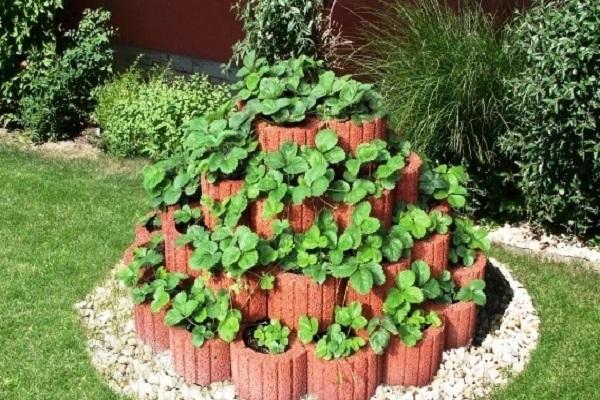
The pyramid base can be any shape: square, rectangle, or triangle. The number of tiers depends on the width and length of the bottom box, with each subsequent tier being 25-30 cm smaller than the previous one. The bed resembles a staircase, with strawberries growing on the steps.
Boards of the same thickness, for example, 25 mm, are cut to size, and then assembled into boxes. The installation site is prepared, leveled, and covered with a piece of geotextile. The largest box is installed and filled with soil mixture. The second and subsequent boxes are placed on top.
Features and technology of planting and growing
Strawberry seedlings are best planted in a slightly acidic substrate with a pH of 6.0-6.5. You can prepare it yourself by mixing:
- garden soil - 1 bucket;
- compost - ½ bucket;
- ash - 0.5 l;
- peat - 20% of the total volume.
When planting, add a drainage layer (pebbles, expanded clay, crushed stone) 8-10 cm thick to the container as the first layer. Plant the vines 20-25 cm apart, leaving the core (growing point) slightly exposed. Strawberries are planted according to weather conditions. If a greenhouse is available, transplant the seedlings to portable structures in April, and install them on the container frame (bags, containers, pipes) in late May or early June.
How to care for strawberries
Basic care for strawberries growing in a vertical bed has its own peculiarities, but the procedures themselves are standard: watering, fertilizing, trimming runners, and preventative treatments against pests and diseases.
Watering, fertilizing
The volume of substrate is limited, so strawberries have to be watered and fed frequently. Multi-tiered beds are equipped with a drip irrigation system, which includes a pump. This ensures water is supplied to the strawberries growing in the upper tier.
For the first few weeks, water the beds 1-2 times a day. Once the plants are established, water according to the weather, assessing the substrate moisture. Fertilize once a week (for 10 days). To promote foliar growth, fertilize with a urea solution:
- water - 10 l;
- fertilizer - 15 g.
During flowering and fruiting, switch to complex fertilizers for strawberries containing phosphorus and potassium.
Trimming
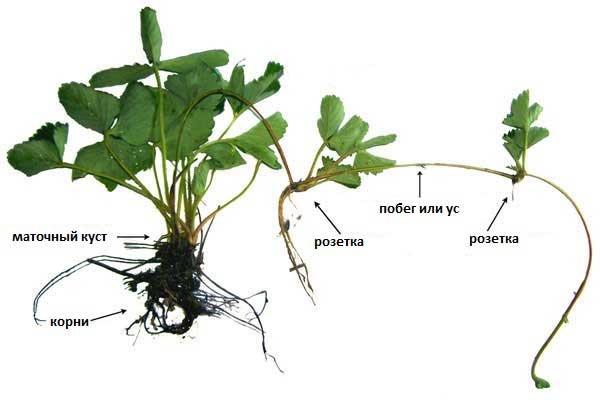
All runners are trimmed off unless the strawberry is intended for propagation. For varieties that bear fruit on first- or second-order rosettes, they are selectively left on.
Protection from frost, pests and diseases
In regions with cold winters, mobile vertical beds are constructed. In the fall, they are dismantled, and the strawberry containers are lowered into the cellar, trenches, or greenhouses, insulated with organic (straw mats) or commercially available covering materials. In areas with heavy snowfall (Irkutsk and Novosibirsk regions), the bed is placed on the ground; a thick snowdrift prevents the strawberries from freezing.
In the southern regions, the ridge is not dismantled; it is insulated for the winter with agrospan.
Possible errors and solutions
Experiments with growing strawberries in vertical beds often end in failure. The reasons are classic:
- poor quality soil (dense, not disinfected);
- unsuccessful variety;
- weak, diseased seedlings;
- insufficient volume of soil, at least 1.5 liters are needed for one bush;
- fertilization is absent or is carried out irregularly;
- frequent drying out of the soil;
- bad location (sunny, drafts, shade).
To begin, create a small vertical bed and place it in a convenient location with water nearby and out of direct midday sun. Choose healthy, everbearing seedlings. Care for them accordingly throughout the summer, watering and fertilizing regularly. Cover for the winter. Evaluate the harvest at the end of summer and the quality of the overwintering in the spring. Expand the vertical plantation in the new season if the experiment is successful.
Related posts:
 Description of the Florence strawberry variety, planting and care features
 How to grow strawberries at home
 Description and characteristics of the Vima Zanta strawberry variety, planting and care scheme
 Description of the everbearing strawberry variety Selva and cultivation technology
 The best varieties and cultivation of everbearing strawberries, fertilizing and propagation
 Description and characteristics of the Zenga Zengana strawberry variety, planting and care
 Description of the Holiday strawberry variety, cultivation and propagation methods
 Timing and rules for fertilizing strawberries, and the best fertilizer for a good harvest