
There are many ways to braid onions for storage. A rope is woven into the tops, tied into a knot at the end, and hung. Before braiding the tops, you need to know how to prepare the onion. If you follow the step-by-step instructions, the onion will be stored for a long time, retaining its beneficial properties and retaining its flavor and aroma. There are other benefits to this method of storing vegetables.
Optimal timing for weaving
The main advantage of storing onions in braids is that all the bulbs are freely ventilated.
Other advantages include:
- the ability to quickly select an onion of the required size;
- you can immediately see the head that has started to deteriorate;
- you can easily change the hanging location;
- hanging vegetables will not be accessible to pests and rodents;
- space saving;
- Vegetables retain their taste and aroma for a long time.
Harvesting of this spicy vegetable begins in late July. The maturity of the bulbs is determined mathematically, calculated according to the lunar calendar, or by observing the appearance of the tops and underground parts of the plant.
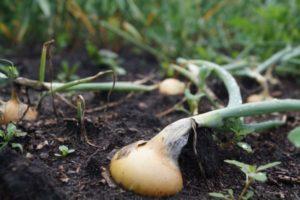
- By the time they are fully ripe, most of the feathers in the bed turn yellow, dry out and fall to the ground.
- The neck of the bulb becomes thinner and dries out.
- The head becomes dense, the top layer of scales rustles and is easily separated.
After harvesting, the onions begin drying. Drying can be done in beds, weather permitting, or in a well-ventilated room by tying the tops of several onions together. The onions should be tied with thick rope for drying. Drying continues for at least 12-14 days. Only then can the harvest be prepared for storage.
You should begin braiding the onion plants 3-4 days after digging. At this time, the tops will be limp and not completely dry. Trim the tops beforehand, leaving a length of 25-30 centimeters. There are several methods for braiding onion plants.
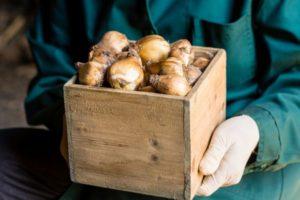
Preparing the bulbs
After digging, all the heads must be dried. Then you need to decide on a method. storing onionsThere are three main methods for storing onions: warm, cold, and a combination of both. Onions can be stored in glass containers, boxes, fabric bags, plastic containers, or simply in bulk.
If the vegetable is to be stored in boxes, baskets, or crates, the tops are trimmed off, leaving a 3-4 cm stump. When storing the spicy vegetable in braids, the tops are left at approximately 30 cm.
- Each bulb is dug up with a shovel and only then pulled out by hand.
- Carefully shake off any stuck-on dirt. Even minor damage can affect shelf life.
- It's important to dry the bulb along with the tops, as they contain many nutrients. Throughout the drying process, the bulb will continue to receive beneficial nutrients.
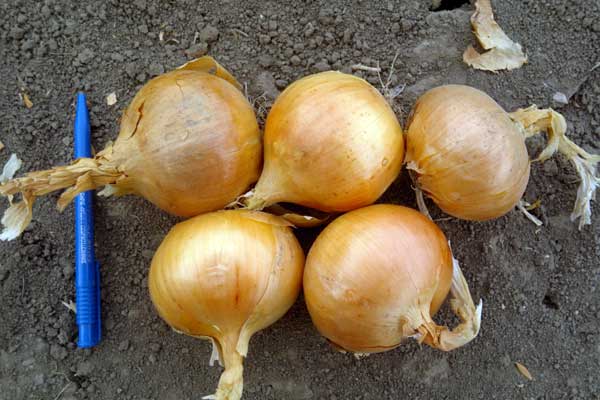
The indoor temperature for sweet and semi-sharp varieties should be between 0 and -1 degrees Celsius. Hot onions are recommended to be stored at -1 to -3 degrees Celsius. In an apartment, the temperature should be maintained between 18 and 22 degrees Celsius.
Popular onion braiding techniques
Among the many methods for drying onions, braiding them using rope is considered the most convenient. The onion dries more evenly and quickly, resulting in a longer shelf life. Braiding the tops can be done in various ways. If the harvest is small, rope can be omitted. In this case, a wreath-weaving technique is used.
Option 1
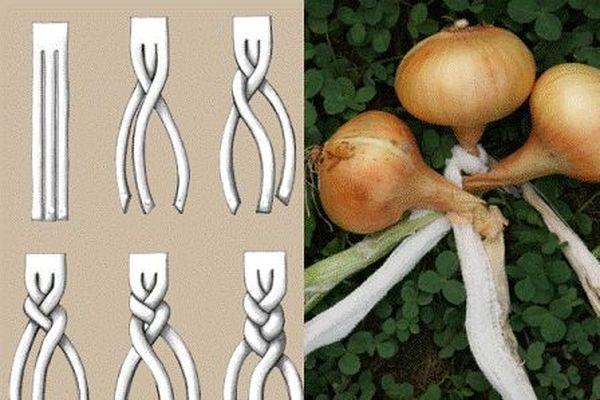
Since braiding feathers alone is difficult, twine, rope, cord, or any other strong rope can be used. You can braid the bow using the following pattern.
- From the entire harvest, select a dense head with thick, strong tops to serve as the base. A rope of the desired length is tied to the base of the tops, and its ends are aligned.
- Using the three resulting ponytails, begin to braid a braid. With each subsequent grab of the side ponytail, add new bulbs. Weave them as tightly as possible to the base of the head to prevent the bunch from falling apart.
Take a look Also
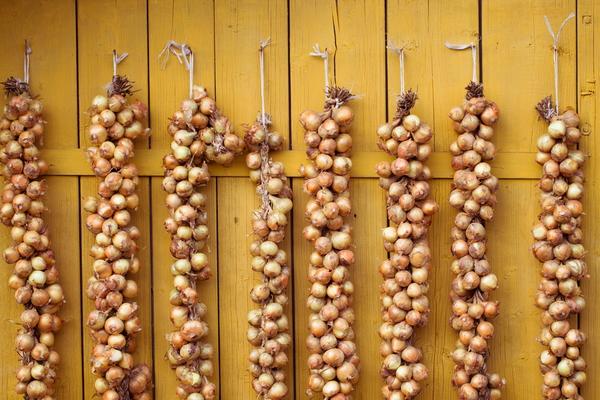
- Continue braiding the onion braid until the ends of the rope become short (18 centimeters).
- The ends of the rope are tied around the tops and a loop is made, from which the entire bunch is then hung.
The maximum length of such a braid should not exceed two meters.
Option 2
Another method of braiding a braid from onion feathers is also considered simple.
- The first bulb should be chosen with the longest and strongest tops.
- The rope is tied at the base of the bulb and aligned so that three tails of the same size are formed.
- Then take two onions and braid a pigtail between their tops.
- The pairs are woven into one common braid and secured with a knot.
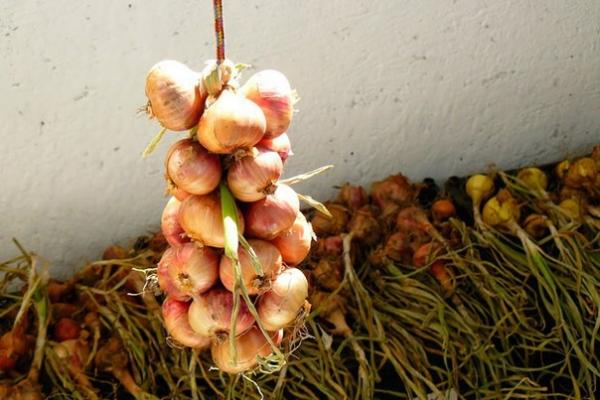
At the end of the weaving, a loop is made from the rope, with which the resulting bunch will be suspended for further storage.
This method is considered the simplest and best for drying and storing the harvest. Each bulb receives sufficient fresh air, reducing the risk of rot and disease.
Option 3
For the third method, take a rope and fold it in half. Tie the loose ends in a knot and hang them on a hook.
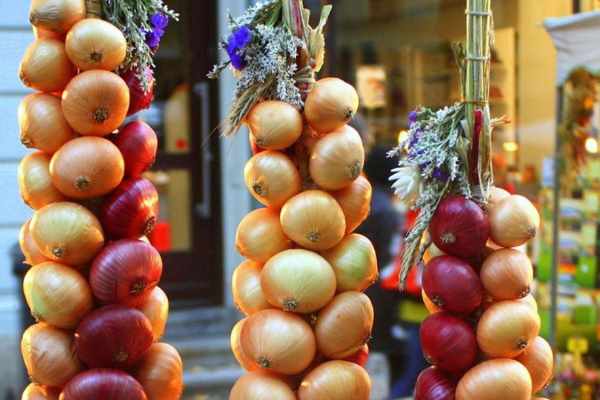
The turnips will be attached to the two resulting ropes later.
- A loop is made at the bottom of the rope, to which two bulbs with the longest and strongest tops are tied together.
- Next, another pair of heads is secured.
- The tops of the next head are wrapped first around the first rope, then around the second and brought forward.
- The tops of the next bulb, after being wrapped around the ropes, are brought out to the back.
- Continue working until the rope runs out. Leave a 10-centimeter loop at the top. Trim off any loose ends with scissors.
Only firm, undamaged heads are selected for storage in braids. The outer husk is removed, and the roots are cut off.
Take a look Also

Option 4
Onion braids are also woven according to the following pattern:
- The tops of three onions are tied together with a rope.
- Other bulbs with tops are woven in one after another.
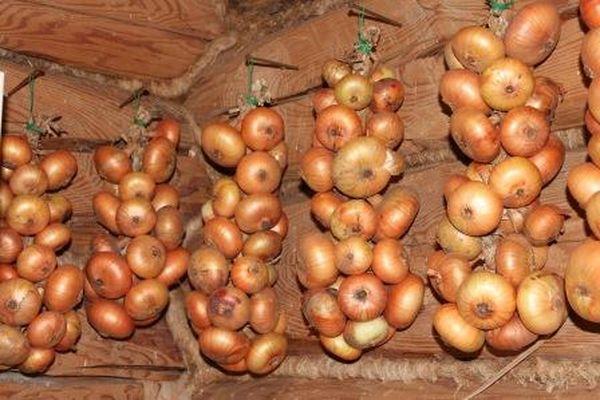
This simple method can be slightly modified. Fold the rope in half. Secure the bulb with a strong, long top at the point where the loop is formed. Then, begin tying the bulbs together on three sides. The tied bulbs can be used as a kitchen decoration if you weave different colored bulbs together and attach pepper sprigs between them.
Storage conditions for onion braids
For storing spicy vegetables, choose well-ventilated places. A cool cellar or basement is ideal. The air temperature should not fall below -3 degrees Celsius. Humidity should be 80-90%.
You can also hang onion braids indoors (in the kitchen, hallway, or pantry), but keep them away from heating appliances. They store best at temperatures no higher than 22 degrees Celsius, with a humidity level of 60-70%.
Related posts:
 Description of shallot varieties, cultivation and care, when to harvest
 When and how to plant tulips in the Urals in autumn and care for them outdoors
 How to tie up cucumbers in open ground: step-by-step instructions
 When is the best time to plant tulips in open ground? Timeframes by region and rules.
 When to dig up gladioli for the winter, timing and rules for storing bulbs
 Planting and caring for daffodils in open ground, the best time and growing rules
 When and when can daffodils be repotted? Step-by-step instructions and care.
 How to properly dry winter garlic after digging and where to store it at home
To braid it, you first need to collect it, I dare to recommend a plant growth bioactivator for a better harvest, this is BioGrow, the best thing I can recommend, you won’t regret your choice.