
- Irrigation rates
- Water consumption of crops
- Optimal level of natural precipitation
- Period of maximum sensitivity
- Daily consumption
- What are the risks of fluctuations?
- We carry out watering correctly
- Before sowing
- After landing
- Carrot seedlings
- In the phase of root crop formation
- Mature plants
- Temperature and amount of water
- The relationship between hilling and soil moisture
- How to combine watering with fertilizing
- If the soil is mulched
- Consequences of improper watering
To ensure proper root development and a bountiful harvest, carrots grown in open ground require consistent, but infrequent watering. Initially, when the seeds are planted, germinate, and the first shoots emerge, carrots especially require warmth and moderate watering. Rather than relying on rainfall, agro-industrial complexes successfully use drip irrigation and water-soluble fertilizers, tailored to the appropriate concentration of the aqueous solution and the needs of the carrots.
Irrigation rates
To ensure that carrots grow sweet, juicy, evenly shaped, and gain weight, it is important to follow watering guidelines.
- During sowing, germination and formation of root crops – 23-32 cubic meters per hectare.
- From the beginning of intensive ripening of carrots to technical maturity – 35-43 cubic meters.
- At the final stage – 22-27 cubic meters.
Water consumption of crops
Carrots respond to uniform and optimal watering throughout all stages of their development. This vegetable is most demanding of moisture during the period from seeding to plant formation, when carrot roots are just beginning to develop, and during the intensive development of roots and foliage. High, stable yields are impossible without well-thought-out irrigation.
The use of drip irrigation in agricultural enterprises, with a flow rate of 4000-5500 cubic meters per hectare, allows you to get 75-80 tons per hectare, in some cases - even 100.
Optimal level of natural precipitation
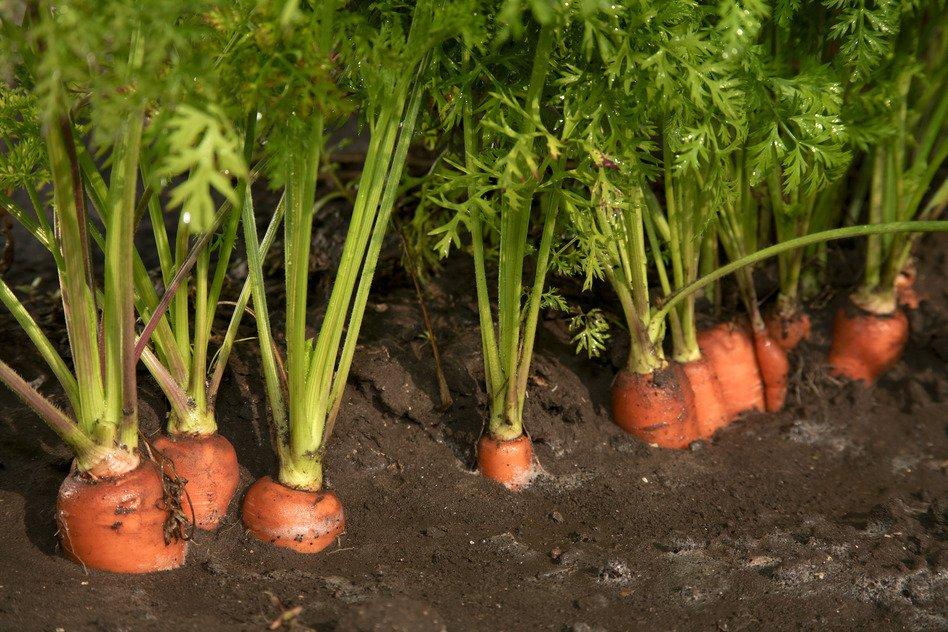
Favorable weather conditions during carrot seed germination aren't always present: sometimes it's dry and windy, sometimes it's excessively rainy. During dry weather, the soil must be moistened frequently, preventing it from drying out. The optimal soil moisture level for carrots is 75-80% of the minimum water-holding capacity (MWC). The optimal precipitation level, evenly distributed, is 400-500 millimeters.
Important! After watering and rain, be sure to loosen the soil and prevent a dense crust from forming to prevent the roots from suffocating.
Period of maximum sensitivity
Carrots require a high watering requirement from seed sowing until the root system and foliage develop. Slow seed germination is caused by the dense seed coat and essential oils, which prevent moisture and oxygen from penetrating the plant.
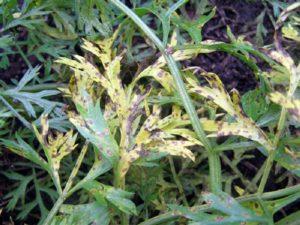
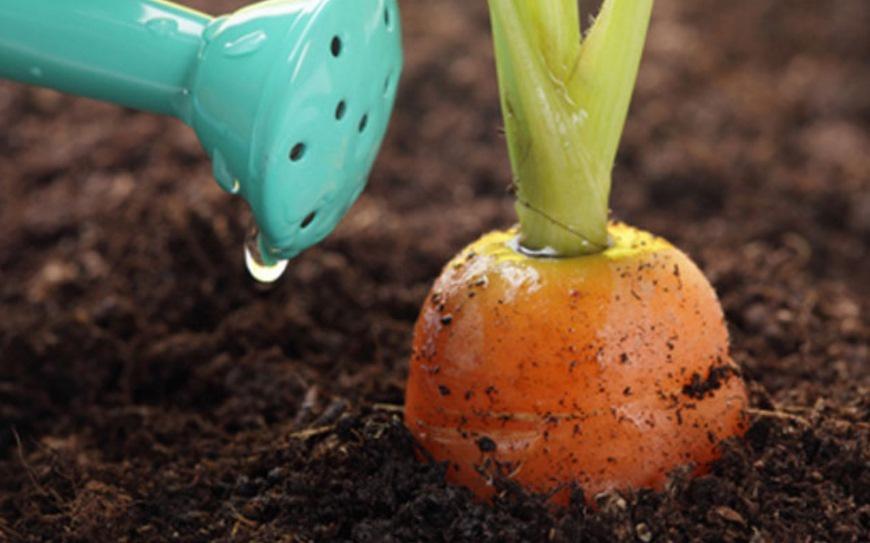
Insufficient watering during the period of vigorous root development will result in weakened plants, coarse, woody fruits with a neutral or even bitter taste. Excessive moisture will cause the fruits to grow crooked and develop lush foliage.
Daily consumption
Drip irrigation rate for carrots:
| Irrigation regime | Soil composition | |||
| Sandy loam | Light and medium loam | Heavy loam | ||
| Soil moisture threshold before irrigation, % HB | ||||
| Development phase | I | 75 | 80 | 85 |
| II | 75 | 70 | 75 | |
| Soil moisture depth in centimeters | ||||
| Development phase | I | 50-55 | 40-45 | 35-40 |
| II | 55-60 | 45-50 | 40-45 | |
| Irrigation rate in cubic meters per hectare | ||||
| Irrigation phase | I | 115-130 | 115-130 | 95-105 |
| II | 135-150 | 180-200 | 190-215 | |
The soil moisture depth depends on the planting pattern, the type of irrigation system, its capacity, and the time interval between irrigations. Maximum irrigation water consumption occurs in July and August. Irrigation is stopped 15-20 days before harvesting carrots intended for storage.
What are the risks of fluctuations?
Insufficient moisture during the period when carrots require the most water leads to weakened plants, stunted growth, cracked fruits, and ultimately, a deterioration in flavor. Excess moisture during the initial period leads to waterlogging, stagnation, rot, and other diseases, and ultimately, plant death or deformed fruits during their intensive development.
We carry out watering correctly
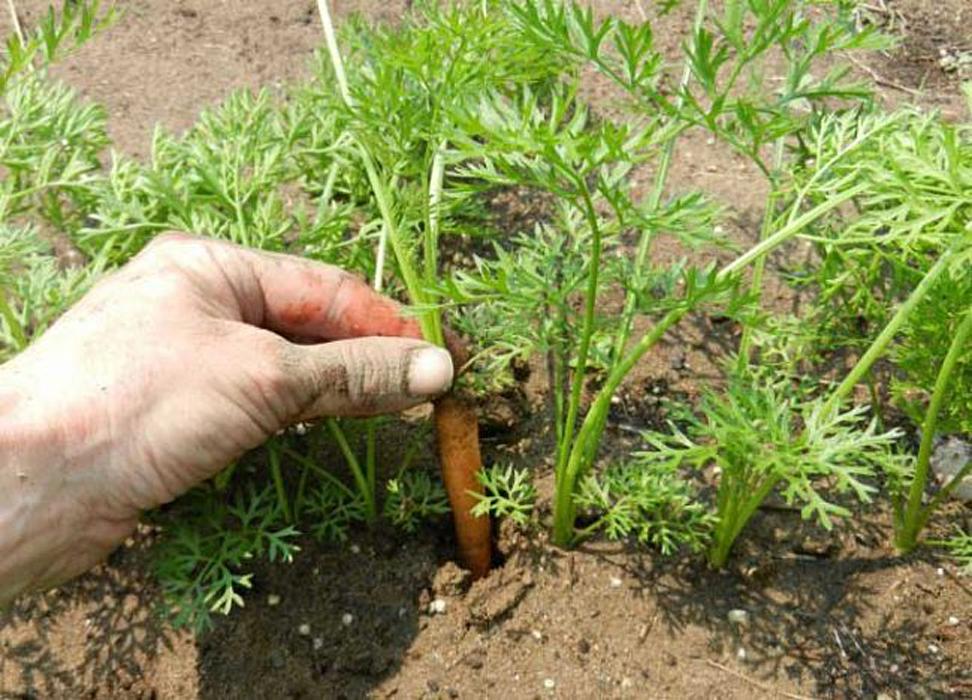
It is more rational to water the plantations in the evening.
Before sowing
It's important not to miss the optimal time for sowing carrot seeds, when the soil is saturated with natural moisture. The loosened and fertilized soil is thoroughly watered, and the pre-soaked seeds are embedded according to the pattern. Then, water the seeding area again. For better germination, it's best to cover the planting area with a covering material.
After landing
After planting, carefully monitor the soil moisture. Insufficient moisture will affect seed germination time. Overwatering is also undesirable. Frequent rainfall can cause a crust to form, preventing air from reaching the small roots, which can suffocate the plants.

With drip irrigation, this doesn't happen because a crust doesn't form on the surface, and the plant's root system thrives. Only the seedbed is treated, the spaces between the rows remain dry, and the soil structure is not disturbed.

Carrot seedlings
After the seedlings emerge, the covering material is removed. Irrigation is carried out strictly according to the watering and fertilizing schedule. Another advantage of drip irrigation is that the dissolved fertilizers, so essential for seedlings, are delivered directly to the roots, which is not the case with conventional chemical fertilizers.
In the phase of root crop formation
During fruit formation, the volume of water supplied to the roots increases. To ensure tasty, juicy produce, the frequency of watering is matched to rainfall. If rainfall is infrequent and the weather is hot, irrigation systems work more intensively. Drip irrigation prevents leaves from getting wet, and insecticides and fungicides are not washed off, preventing plant diseases.

Mature plants
During the final stage of development, when the roots have formed, the frequency and volume of irrigation are gradually reduced. At this time, the volume is reduced to 1.6 times the maximum. And 2-3 weeks before harvest, unless there is a severe drought, irrigation is stopped for carrot plantations intended for long-term storage.
Temperature and amount of water
Although carrots are considered a cold-hardy crop, the minimum temperature for seed germination is considered to be +4 to +6 degrees Celsius, and the optimum is +18 to +25 degrees Celsius. High temperatures and lack of moisture, as well as a drop in soil temperature to +10 degrees Celsius, slow carrot growth. The negative impact of these factors is significantly reduced by drip irrigation.
A big advantage of using an irrigation system is the leaching of salts near the drippers.
Salty soil collected at the edges doesn't significantly affect plant growth. Their roots draw nutrients from the leached zone. Using an irrigation system allows for irrigation without cold water—it's partially heated during spraying and has no harmful effects.
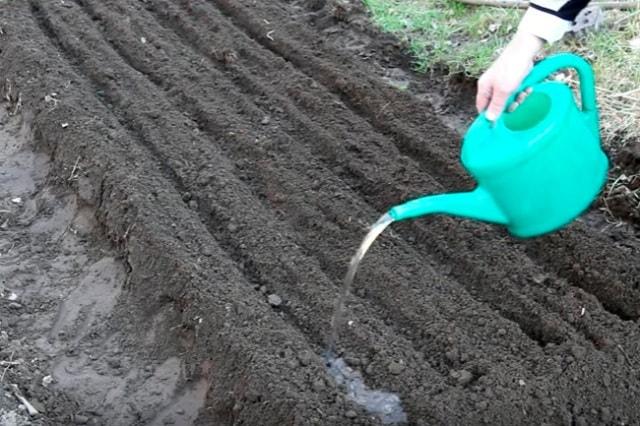
Watering carrots with salt water has long been a folk practice. This is justified when growing carrots for children or to ensure the product is completely natural. Salt solution is also used to treat carrots against pests and diseases. If the soil is heavy and infertile, watering with salt may even be necessary.
Using a saline solution results in rapid ripening of carrots and improved taste.
Sea salt and table salt are both suitable. However, to achieve different goals, it's important to know the proportions and apply them at the appropriate time. The following year, after applying the salt solution, apply a higher dose of organic fertilizer.
Take a look Also

The relationship between hilling and soil moisture
During periods of intensive growth, carrot tops begin to emerge above the soil surface. If not earthed up promptly, the carrot tops will turn green and become unfit for consumption. Hilling and loosening the soil is useful during periods of heavy rainfall to prevent compaction, as well as after weeding, thinning, and watering.

How to combine watering with fertilizing
The combined use of irrigation and fertigation systems (the proper use of water-soluble fertilizers) allows for high yields, a quick recoupment of costs, and a reduction in production costs by 1.5-2 times.
Fertilizers combined with irrigation were developed and used because they have significant advantages over traditional methods of applying fertilizers, which have a high concentration, cause burns, and harm plants.
Fertigation automatically regulates optimal fertilizer concentrations and ratios, allowing for more efficient use of expensive fertilizers, resulting in significant cost savings. Fertilizer application rates using this method are calculated in kilograms per hectare per day. A bountiful carrot harvest will not be long in coming. The market is constantly dictating new demands for product quality and appearance. The use of new technologies fully meets these requirements.

If the soil is mulched
Mulching carrot soil is beneficial during drought or prolonged periods of intense heat. Mulch retains precious moisture and prevents root deformities.
Consequences of improper watering
Irration, irrational, intermittent watering, and failure to properly apply the latest fertilizers negatively impacts the harvest. A significant portion of the crop is lost. Root crops develop unevenly, with cracks or branching, and disproportionately dense green foliage. This means wasted effort and money.
Related posts:
 How to control carrot flies with medications and folk remedies
 Is it possible to plant carrots in July or at the end of June? What are the best days and care instructions?
 What is the best way to feed carrots? Fertilizers and preparations, using folk remedies.
 How and when to thin carrots in open ground
 Timing and rules for planting carrots in winter, which variety is best to choose
 Carrot care guidelines for outdoor cultivation to ensure a good harvest
 Description of carrot pests and diseases and methods of control
 How to plant carrot seeds in open ground, timing and sowing methods