
- Types of sheet plate deformation
- They curl up into a boat shape
- Curl up
- Curl downwards
- The upper leaves are curling up
- Cotyledons
- The leaves curled into a pimple
- They dry up and fall off
- Possible causes of foliage deformation
- Uneven growth of the leaf blade
- Deficiency of essential elements in the soil
- Violation in crop care
- Diseases
- Leaf curl
- Blossom end rot
- Pest infestation
- Aphid
- Spider mite
- What to do
- Fertilizing the soil
- Phosphorus fertilization
- Wood ash
- We treat diseases
- Getting rid of pests and insects
- We organize proper care for peppers
- Preventive measures
Even an experienced gardener doesn't always know what to do when bell pepper leaves curl. There are many causes, and many symptoms are similar. It's important to inspect the plants, assess the growing conditions, and soil fertility to quickly resolve the problem.
Types of sheet plate deformation
The leaves of healthy bell peppers are tender, juicy, bright green, and shiny. Deformations occur due to adverse weather conditions, poor care, or insect infestations. Both sweet and hot peppers experience leaf curling.
They curl up into a boat shape
The leaves resemble a boat. Their edges curl upward, parallel to the midrib. This is caused by poor nutrition or a viral infection. The presence of the pathogen (tobacco mosaic virus) is indicated by the following symptoms:
- yellow border;
- spotted coloration.
Curl up
Upwardly curled leaves are a symptom of disease (phytoplasmosis) or potassium deficiency. If the nutrient is deficient, yellow leaves appear at the base of the bush, the plant lags in development, and buds are few or absent.

Symptoms of phytoplasmosis (stolbur) are different:
- First of all, young leaves at the top become deformed;
- later the lower tiers suffer, the leaves are bent upwards, dry out, and fall off;
- The fruits are small, gnarled, and turn red early.
Stolbur is caused by microorganisms spread by sap-sucking insects.
Curl downwards
There are three possible causes: sucking insects, lack of moisture, and a fungal disease (blossom end rot). Pests are identified by inspecting the bush. Lack of moisture is assessed by soil conditions. If there are no insects, treat the disease by watering regularly.

The upper leaves are curling up
Seedlings' upper leaves curl if the room is cool, they don't get enough sunlight, the soil lacks nutrients, and they aren't fertilized. In the garden and greenhouse, pepper leaves wrinkle in the heat. This is how plants reduce moisture evaporation.
Cotyledons
Don't worry if pepper cotyledons turn inside out and fall off. This is a natural process. The plant sheds them once it has grown enough true leaves to support photosynthesis.

The leaves curled into a pimple
Bumps can be seen on pepper seedlings. The problem isn't serious; it's related to the physiology of seedling development. Leaf cells don't have time to absorb the moisture entering the plant, causing swelling. Peppers need help:
- reduce watering or decrease its volume;
- transfer the seedlings to a warm room where the roots are warm;
- provide illumination;
- reduce the number of seedlings per unit area.
They dry up and fall off
Leaves fall for many reasons. Often, inexperienced gardeners water peppers with cold water. In cold soil, the roots stop absorbing nutrients, causing the leaves to dry out and fall off. In hot weather, such watering is especially harmful.

Possible causes of foliage deformation
There are several reasons why pepper leaves lose their usual shape and color. These include poor care, pests, and diseases.
Deformed leaves are a serious problem that can lead to complete crop loss and plant death.
Uneven growth of the leaf blade
Leaf blades become deformed when the lateral veins develop more slowly than the central vein. Uneven leaf development is temporary and can occur during sudden cold snaps, which disrupt the peppers' normal nutrition. Foliar feeding quickly resolves the problem.

Deficiency of essential elements in the soil
Peppers require various nutrients for normal development. A deficiency in the soil affects the condition of the above-ground portion of the plant.
| Element | Signs of deficiency |
| Magnesium | Pale leaves, pale pink in the vein area, curled edges |
| Potassium | The edge is dry, the plate is shaped like a boat |
| Nitrogen | The leaves are thin, twisted, with yellow spots |
| Phosphorus | Red-violet hue |
| Calcium | The leaf blades are twisted and covered with grey-yellow spots. |
Violation in crop care
Irregular watering, lack of fertilizer, insufficient light, and cold soil negatively impact the absorption of nutrients from the soil. This is reflected in the condition of the leaves.
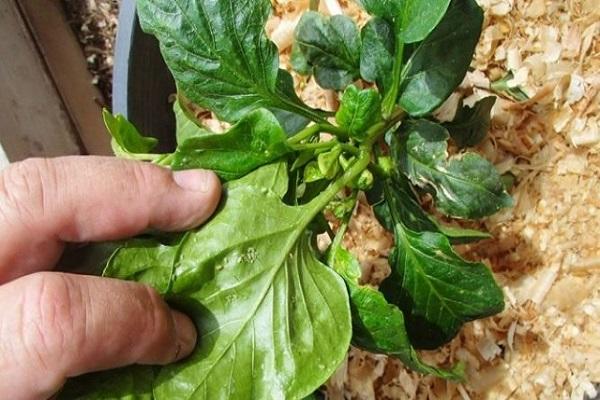
Overwatering can cause the leaves to droop, as if the plant hasn't been watered in a long time. Pepper plants also look miserable if they're overwatered when the air and soil temperatures are low. In hot weather, if there's a lack of moisture, the leaves turn pale and change shape.
Diseases
Bushes showing signs of phytoplasmosis are destroyed. Other plants are protected from the disease through preventative measures:
- destroy disease carriers (aphids, thrips, mites);
- In autumn, plant debris is removed, the soil and greenhouse structures are disinfected;
- In summer, weeds are removed.

Leaf curl
The disease is caused by the cucumber mosaic virus (CMV). It is transmitted by aphids. There are many virus strains, so the symptoms vary:
- the leaves curl without losing color, the bush dries up;
- during the formation of buds, the leaves turn brown and dry out;
- deformed leaves turn yellow, there are no flowers or ovaries;
- The ovaries fall off, the internodes are short, the leaves are dry and deformed, the fruits are small, the bushes do not grow.
Blossom end rot
On diseased bushes, the leaves curl, and diseased fruit can be found. They can be identified by dark, sunken spots. Such fruit spoils quickly, rotting right on the bushes.

Possible causes of blossom end rot:
- rare watering;
- excess nitrogen;
- calcium deficiency.
Pest infestation
No garden is immune to pest infestations. They can appear in pepper beds even if all preventative measures are taken.
Aphid
A small (0.3-0.5 mm), green, colorless, or dark gray insect that feeds on sap. It reproduces incredibly quickly. A single female produces up to 10 generations of aphids. It lays eggs on the underside of leaf blades. The egg, larval, and adult stages last only 10-15 days. Damage caused by aphids:
- by sucking out the juice, it weakens the peppers;
- secretes honeydew (a sweet sticky mass) in which pathogenic microorganisms multiply.
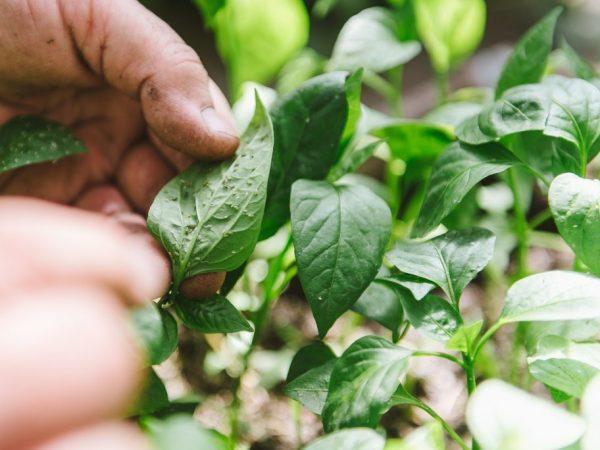
On bushes infested with aphids, the leaves are curled, and fallen flowers and ovaries can be seen on the ground. Ants on peppers are the first sign of a pest.
Spider mite
Adults of the pest suck sap. They settle on the undersides of leaves. The leaves become deformed, their edges curling inward. Spider mite larvae can parasitize pepper roots. You can identify a spider mite by the whitish structure inside the curled leaf blade. This is a web. The insect causes damage to:
- disrupts the process of photosynthesis;
- damaged leaves fall off;
- the plant is lagging behind in development.

What to do
Curled pepper leaves are a warning sign. An immediate assessment is necessary. The cause must be identified and addressed promptly.
Fertilizing the soil
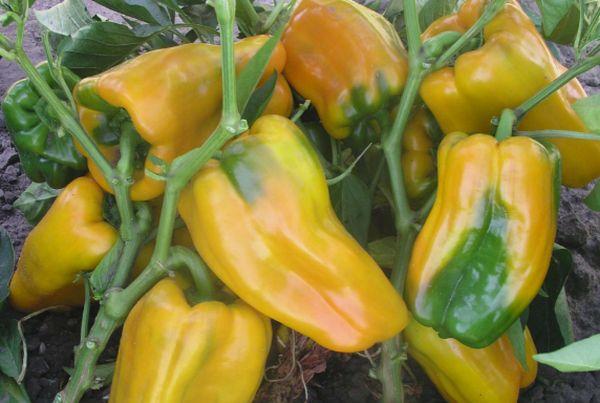
Soil fertility is restored annually to prevent nutrient deficiencies in the summer. Experienced gardeners believe that fertilizers applied in the fall are most effective. Urea and ammonium nitrate are an exception. These are used only in the spring. When applied in the fall, the nitrogen is washed away by meltwater.
Phosphorus fertilization
Superphosphate has a high concentration of available phosphorus (up to 19.5%). To feed peppers, prepare a solution:
- water - 10 l;
- superphosphate - 1 tbsp. l.;
- potassium sulfate - 1 tbsp. l.
You can feed peppers with this solution twice: before flowering and after the first ovaries appear.
Wood ash
Potassium deficiency can be corrected with ash, with 2-3 tablespoons applied to the root zone of each bush. Foliar feeding with an ash infusion is also effective:
- water - 10 l;
- ash - 1.5 tbsp.

Let the ash steep for 5-7 days. Strain the infusion before use. Spray the sweet pepper plants in the morning. The ash infusion is used to treat deficiency symptoms and to control sucking insects (aphids, spider mites, thrips).
We treat diseases
To prevent and treat blossom-end rot, peppers are sprayed with lime milk or a 0.3% solution of calcium chloride. The bed is regularly watered, mulched, and the soil is not allowed to dry out.
Bushes infected with CMV are destroyed. The following year, peppers are grown in a different location, using CMV-resistant varieties and hybrids. The plants are treated for aphids, and weeds are eliminated.
Getting rid of pests and insects
To kill aphids, you won't need chemicals if you treat your bushes immediately. If deformed tops appear, immediately spray with an onion peel infusion:
- husk - 1 tbsp.;
- boiling water - 1 l.
The folk remedy is infused for 24 hours and strained. Every single bush, both healthy and diseased, is sprayed. The surface of the leaves is washed with onion water. This treatment is repeated every other day, morning or evening. The soil beneath the bushes is dusted with ash, hot pepper, or dry mustard.

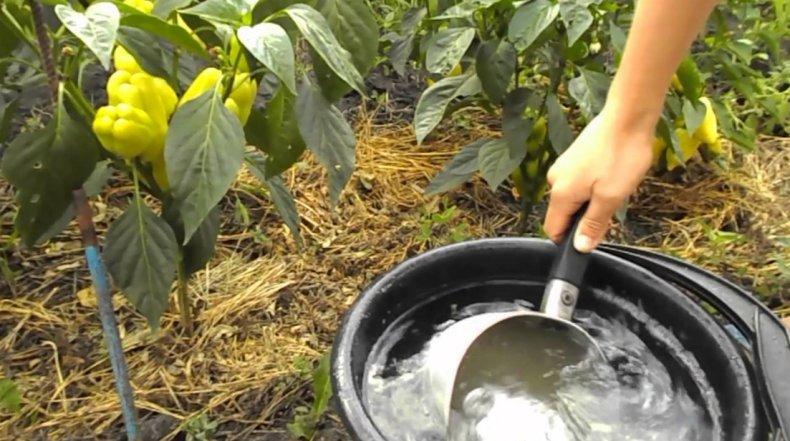
Aphids and spider mites can be controlled with soapy water. Use 72% laundry soap. Grate a bar of it and dissolve the shavings in lukewarm water. Wash all the above-ground parts of young plants with the soapy solution, and spray mature plants with it.
In severe cases, chemical treatments are used. Insecticides are used to kill insects:
- "Aktara";
- "BI-58";
- Intavir.
To destroy spider mite larvae parasitizing the root system, the bed is watered with a solution of manganese.

We organize proper care for peppers
Peppers in a greenhouse require regular feeding. Gardeners are required to apply three additional fertilizers.
| Item No. | Period | Recipe |
| 1 | 2 weeks after transplantation | For 10 liters of water 25 g of superphosphate, 15 g of urea |
| 2 | Abundant flowering | For 10 liters of water: 25 g of superphosphate, 20 g of potassium sulfate, 25 g of urea |
| 3 | Active fruiting (technical maturity) | For 10 liters of water 15 g of superphosphate, 30 g of potassium sulfate |
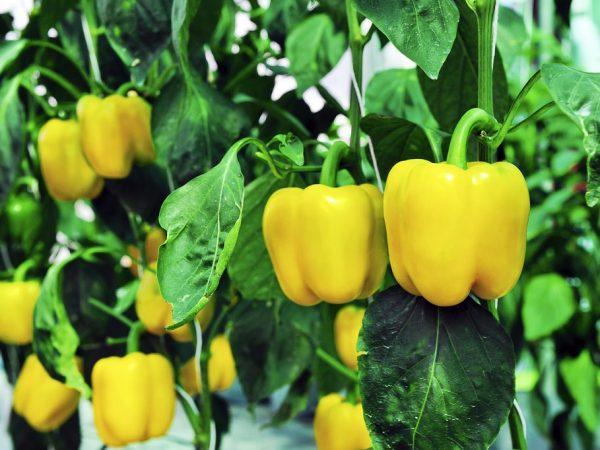
Throughout the season, provide the plants with regular watering, a comfortable temperature (23-25 °C), air humidity of 70%, no drafts, ventilation, and good lighting.
Preventive measures
Preventative measures begin in the fall with soil preparation. Choose a spot where onions, peas, and spinach were grown in the summer. These are good precursors for sweet peppers. Remove any remaining roots, weed stems, and vegetable matter from the future bed. Till the soil deeply, and apply phosphorus-potassium fertilizers. In the greenhouse, remove the top 5-7 cm of soil, add fresh soil, and wash the structural elements. In the summer, create comfortable growing conditions for the peppers:
- water the roots with warm water;
- the greenhouse is ventilated, and the optimal level of humidity and temperature is maintained;
- the soil is loosened after watering and mulched with dry grass or straw;
- don't forget about feeding.
Proper pepper care doesn't take much time. It saves time and money, as you don't need to buy insecticides, deal with pest control, or treat for diseases.
Related posts:
 Why are pepper leaves turning white? What to do and how to feed them in a greenhouse and in the ground.
 Why do pepper leaves turn purple and what can be done to treat it?
 What to do if your pepper's leaves turn yellow, watering and fertilizing rules, and disease control
 Planting, growing, and caring for bell peppers in open ground
 Causes of pepper diseases in greenhouses, their description and treatment
 Sweet pepper pests and how to control them, what to do and how to treat them
 Causes and treatment of eggplant pests and diseases, how to combat them at home
 Planting, growing, and caring for peppers in open ground in the Moscow region: the best varieties