
- History of origin
- Pros and cons of the Mirabelle variety
- Botanical information
- Description of the tree's appearance
- Pollinators and fruiting times
- Tasting qualities and use of fruits
- How to plant a plum tree?
- Choosing a location
- Preparing the soil and planting hole
- Planting dates and process
- What to plant next to it?
- Specifics of caring for the variety
- Watering and fertilizing
- Pruning and crown shaping
- Diseases and pests of the variety
- Loosening and mulching
- Preparing for winter
- Methods of reproduction
- Gardeners' reviews
Numerous plum varieties bred abroad are grown in our latitudes. Among the popular varieties, distinguished by their high yield, the Mirabelle plum deserves special mention. It combines characteristics of plum and cherry plum, and several varieties have been developed suitable for growing in different climatic regions. This variety is characterized by excellent tasting qualities and nutritional value.
History of origin
The yellow plum's original range included Asia Minor. Gradually, the variety spread throughout Europe and Africa. Today, it is especially beloved by the Germans and the French.
In Lorraine, France, where this fruit is most widely planted, an annual festival is even held. After the harvest, which can reach 15,000 tons, the French hold a contest to crown Miss Mirabelle, baking a large plum-filled pie. The Mirabelle grape is one of the symbols of the Lorraine region.
Pros and cons of the Mirabelle variety
The popularity of the Mirabelle plum among gardeners is due to the following factors:
- high yield (up to 25 kg per tree);
- winter hardiness (ability to withstand temperature drops to -30 °C);
- disease resistance;
- universal use of fruits;
- portability of transportation.
Among the disadvantages it is necessary to note:
- the need for pollination;
- relatively short period of life.
Botanical information
The Mirabelle plum is highly prized by farmers in Southern and Western Europe, Ukraine, and central Russia. It belongs to the group of columnar fruit crops and includes two types: yellow and Nancy (forked).
Many varieties of Mirabelle have been developed. The most common are:
- Yellow plum;
- Big;
- Nancy;
- Bona;
- September.
Description of the tree's appearance
Mirabella columnarum is a medium-sized tree with a voluminous, rounded or ovoid crown, reaching a height of 3 m. The bark on the trunk is gray, covered with small fissures. The root system is taproot.
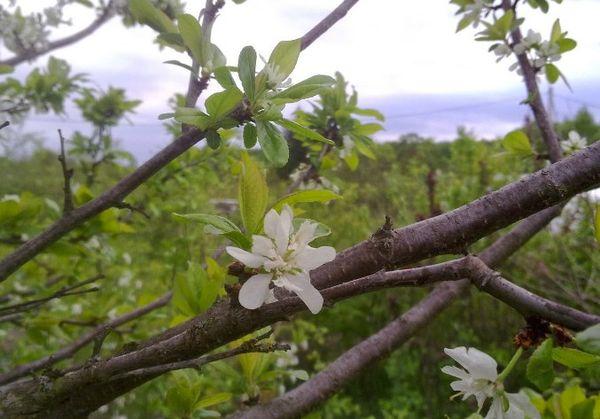
The leaf blade is oval, pointed at the tip, and rich green. The petiole is brownish-green, up to 2 cm long. White flowers, 2 cm in diameter, are clustered in threes. Flowering occurs in mid-May.
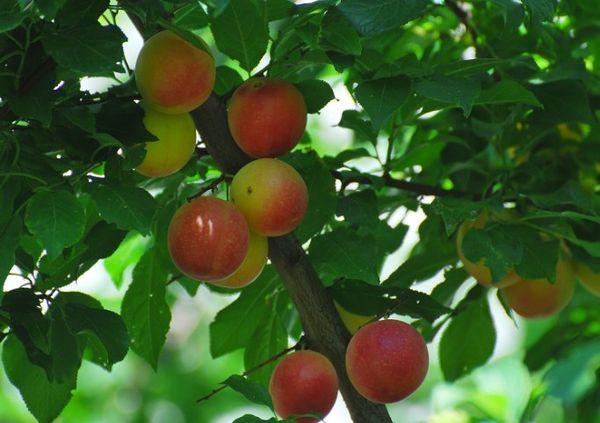
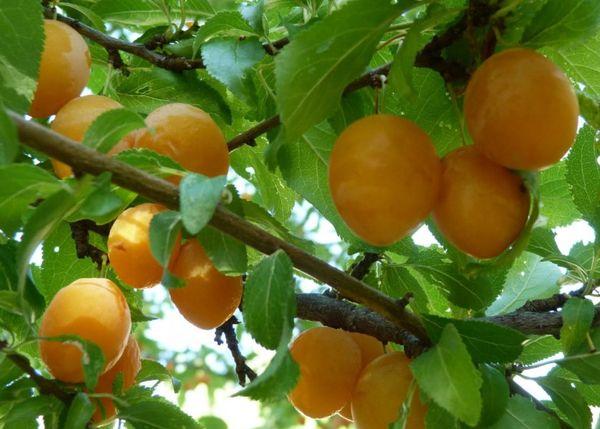
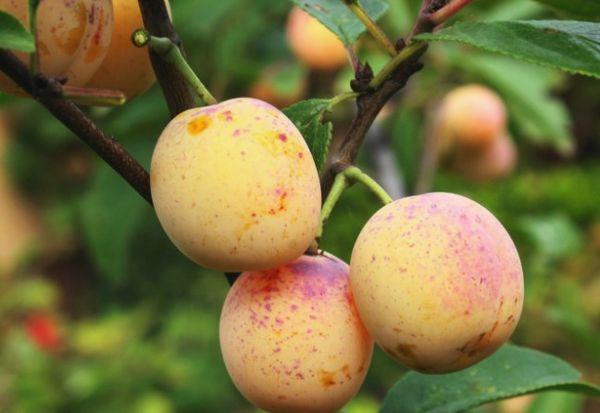
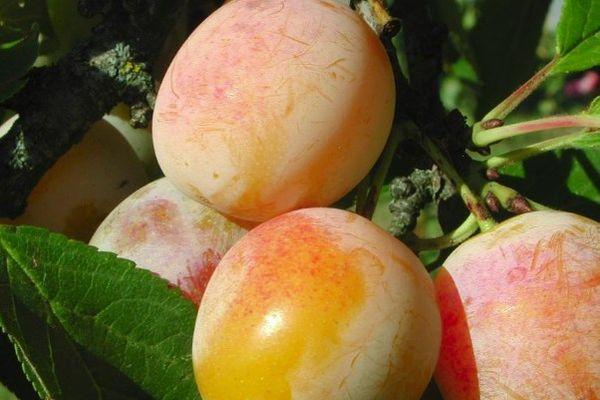
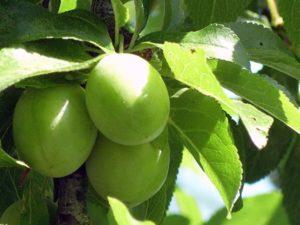
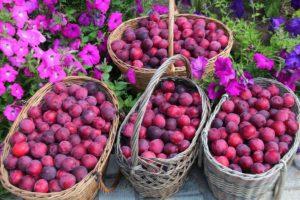
The fruit is round or oval, reaching 3 cm in diameter and weighing approximately 60 g. The skin is firm, warm yellow (possibly with a slight pink tint). The stone is small and separates easily from the flesh.
Pollinators and fruiting times
The Mirabelle variety is early-bearing. Fruiting should begin in the fourth year of development. Fruiting lasts for 20 years. Yields are 15-25 kg per tree. The tree lives up to 30 years.
Pollinating varieties should be grown nearby. The best options are Bona, Bolshaya, and Nancy. You can also attract pollinating insects to the plot.
Tasting qualities and use of fruits
Mirabelle plums are low in calories: 100 grams contain 40 kcal. However, their nutritional value is high. 100 grams of the product contains:
- proteins – 1 g;
- carbohydrates – 8.5 g;
- fats – 0.2 g.
Plum pulp is a rich source of fiber and organic acids. Vitamins include ascorbic acid (C), beta-carotene, tocopherol (E), and B vitamins. Minerals include calcium, potassium, iron, phosphorus, and magnesium.
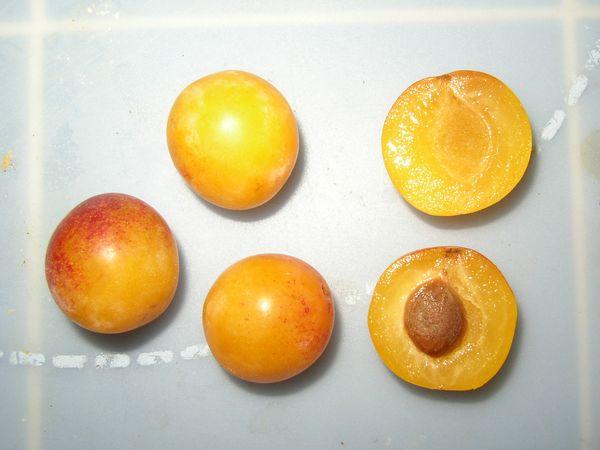
The Mirabelle plum has a soft, sweet flavor with a slight tartness. It's a versatile variety, suitable for both fresh consumption and cooking. It also transports well.
How to plant a plum tree?
There are no difficulties in planting the Mirabelle plum. The main thing is to follow proper agricultural practices.
Choosing a location
Mirabelle plums grow in any type of non-acidic soil. To test the soil's acidity, you can use vinegar. Drop a small amount onto a lump of soil and observe the reaction. If you notice bubbling, the soil is neutral; if there's no reaction, it's acidic.
An important detail is the depth of the groundwater table. It should not be deeper than 1.5 meters.
The chosen location should be well-lit and protected from winds. A southern or western facing garden is ideal. The distance from neighboring garden trees should be at least 3 meters.
Preparing the soil and planting hole
The selected area should be dug up to a shovel's length. If the soil is acidic and another area cannot be selected, deoxidization is carried out using ash or dolomite flour (800 g per 1 m2).
Next, prepare a planting hole measuring 70 x 70 cm and up to 60 cm deep. The removed topsoil is set aside; it's nutritious and will be used during planting. The bottom of the hole is covered with fertilizer. If planting in the fall, 3 kg of organic matter (peat, humus) is sufficient; if planting in the spring, add a mineral complex (80 g of potassium fertilizer, 100 g of superphosphate).
Planting dates and process
Mirabelle plum is planted both in spring, after the frosts have passed, and in autumn, before the arrival of persistent cold weather.
Step-by-step description of the process:
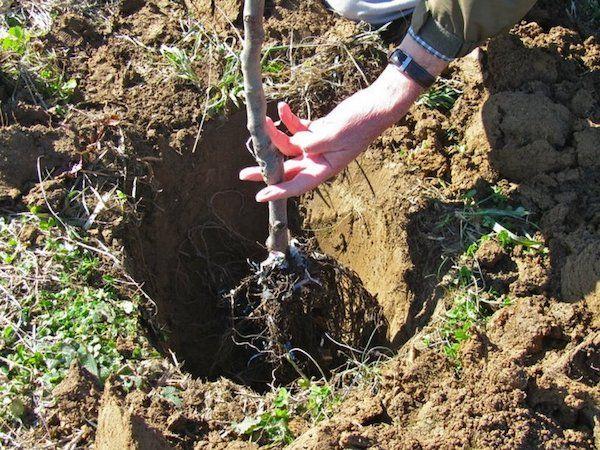
- The seedling is lowered into the prepared planting hole so that the root collar is level with the soil surface. If the plant is planted too deep, the bark will rot, impairing sap flow.
- The hole is filled with fertile soil. The seedling is gently shaken to eliminate any air pockets between the roots. The soil is lightly compacted.
- Water (2 buckets per seedling).
- The soil around the trunk is mulched. Peat is used as mulch.
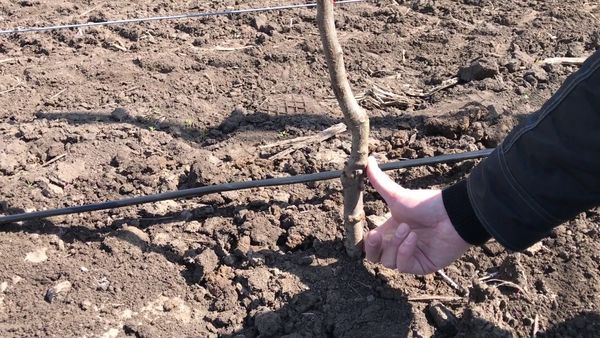
If planting in the fall, the seedling is buried at an angle. This ensures the young plant is completely covered in snow during the winter months, protecting it from frost.
What to plant next to it?
To attract pollinating insects, tulips and other spring flowers are planted in the area.
The best neighbors for a columnar plum are other plums, apple trees, and cherry plums; among shrubs, currants, raspberries, and gooseberries are ideal. The Mirabelle's crown provides some shade, so spring garden flowers can grow easily around the tree.
Bad neighbors include pear, sea buckthorn, cherry, and sweet cherry. Of non-garden trees, avoid hazel, birch, poplar, and conifers.
Specifics of caring for the variety
Young trees should be looked after especially carefully.
To keep the Mirabelle plum healthy, it requires regular fertilizing, watering, sanitary pruning, and loosening of the soil.
Watering and fertilizing
Mirabelle plums enjoy generous watering, but don't water them too often. Moistening the soil once every two weeks is sufficient. A young tree receives 30 liters of water at a time.
For mature trees, watering once every three weeks is sufficient, or every four if the weather is rainy. Use 50 liters of water per plant. Let the prepared water sit for two days.
Fertilizing the Mirabelle plum begins in the third season after planting. Fertilization schedule:
- beginning of May – mix 60 g of urea and sodium humate, dissolve in 10 liters of water, for one tree use 30 liters of solution;
- end of June – 90 g of Nitrophoska is dissolved in a 10-liter bucket of water, 30 liters of the preparation are taken per tree;
- End of September – mix 100 g of potassium fertilizer and 90 g of superphosphate, dissolve in 10 liters of water, use 30 liters for one tree.
Pruning and crown shaping
Crown formation begins the following season after planting. To create a standard tree, all branches are pruned at a height of 50 cm above the soil surface, leaving no stumps. The main shoot is shortened by 20 cm. The crown should consist of two or three strong shoots, shortened by 20 cm; the rest is pruned. In the third and fourth seasons, the main and secondary shoots are pruned by 20 cm.
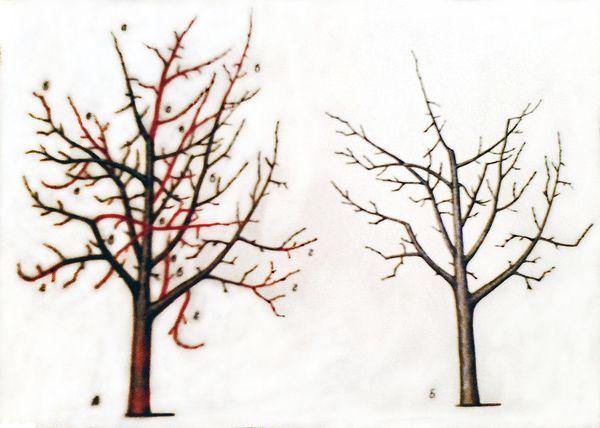
Sanitary pruning of the Mirabelle plum is performed annually. Damaged, dried, and diseased branches are removed.
Diseases and pests of the variety
The Mirabelle variety has a fairly strong immune system. However, it weakens if the tree suffers from nutritional deficiencies or winter frost.
Plums can be attacked by the following pests:
- Plum codling moth. To control the moth, dig up the soil and wrap the trunks in burlap.
- Plum sawfly. Control the insect by digging the soil and treating the shoots with insecticides.
- Aphids. Insecticides such as Karbofos and Nitrofen are used for control.
- Rose leaf roller. If the moths are few in number, they are collected and destroyed during the breeding season. If the infestation is severe, Nitrofen is used in the spring.
Loosening and mulching
Loosening and mulching are done every time after watering. This helps aerate the soil, retain moisture, and prevent weeds. Sawdust is used as mulch. Spread it around the plum tree trunk at a distance of 20 cm to prevent root rot.
Preparing for winter
Young Mirabelle seedlings don't tolerate frost well. If winters are snowy, a slate fence should be installed around the plant, and snowdrifts should be periodically formed. If there's little snow, the seedlings should be covered with spruce branches or sawdust.
Methods of reproduction
To save on planting material, you can propagate the Mirabelle plum. This isn't difficult. This columnar plum propagates:
- cuttings (using the standard method for all fruit trees);
- root shoots (only own-rooted trees; in grafted trees, the shoots do not retain the varietal characteristics of the mother plant);
- layering.
Columnar Mirabelle plums are not produced from seeds.
Gardeners' reviews
Growing columnar plums is currently trendy. Gardeners have positive reviews of the Mirabelle variety, noting:
- tasty, aromatic pulp, which becomes even sweeter if the fruits are left for several days;
- minor shedding of ripe fruits;
- compactness of the tree;
- undemanding to the growing site;
- abundance of harvest;
- easy fruit picking due to the special crown shape.
The Mirabelle variety is a good option for those who want to plant a plum tree in a small area to get a rich harvest every year.
Related posts:
 Description and characteristics of the Yakhontovaya plum variety, pollinators
 Description of the Renklod plum varieties and cultivation technology
 Description and varieties of plum variety Ternovka, planting and care technology
 Description and characteristics of the 30 best yellow plum varieties, planting and care
 Description of the beneficial and harmful properties of plums for human health, contraindications
 Description and distinctive features of the best varieties of Ussuri plum
 Description of the Volga Beauty plum variety, planting and care
 Description and characteristics of the Stanley plum variety, planting and care