
- Timing of planting operations
- Depending on the variety
- From the growing region
- According to the lunar calendar
- Step-by-step algorithm for planting plum trees
- Selection and culling of planting material
- The optimal place for culture
- Favorable and unfavorable neighbors
- Distance and layout on the site
- How deep should I plant?
- Required soil composition
- What to put in the planting hole for fertilizer
- Tree planting technology
- Basic plant care activities
- Watering and fertilizing
- Caring for the tree trunk circle
- Pruning and crown shaping
- Do I need to cover it for the winter?
- Diseases and pests
- What to consider depending on the season
- Spring care
- Summer
- Autumn
- Plum propagation
- Root suckers
- With bones
- Green and root cuttings
- By vaccination
The rules for growing and caring for plums are quite simple. This is an easy-to-grow crop that doesn't require much attention and will always delight you with its juicy and healthy fruits. Each region has its own regionalized varieties that maximize yield.
Timing of planting operations
Plum planting times vary depending on the variety and growing region. Many gardeners follow the dates indicated by the lunar calendar.
Depending on the variety
Plum varieties are divided into early, mid-season, and late-season varieties. Each variety has its own ripening time and favorable period for transplanting outdoors. Early plums ripen in 70-90 days, mid-season plums in 90-100 days, and late plums in 100-120 days. The first two plum subspecies can be planted in spring and fall; they establish quickly and begin bearing fruit 2-4 years after planting. Late varieties are best planted in early spring to allow them time to establish themselves before winter. They begin bearing fruit in the 6th or 7th year of growth.
From the growing region
In the south, plums can be planted at any time. Winters in this region are mild, and young trees can easily withstand light frosts. Planting can be done in spring or summer, or in autumn, but not before early October.
In central and northern Russia, it's recommended to plant plums in the spring. If this isn't possible, the young tree is covered with soil for the winter and insulated. At the beginning of the following season, it is moved to a new location.
According to the lunar calendar
Many gardeners prefer to work according to dates marked on the lunar calendar. The numbers and values change each year. In 2025, plum planting is recommended:
- April: 1-3, 8-12;
- May: 1-3, 7-10;
- June: 4-7, 14-17, 20-23;
- July: 5-9, 12-13;
- August: 2-6, 16-17;
- September: 5-6, 8-9, 21-25, 29;
- October: 2-5, 10-11, 15-16, 22-26.
Step-by-step algorithm for planting plum trees
To grow a plum tree, transplanting a seedling into open ground must be done according to a specific procedure. Selecting a suitable location and proper planting practices play a crucial role in the subsequent development of the plant. The quality of the fruit and its yield depend on these factors.
Selection and culling of planting material
Planting material is purchased from nurseries. To ensure a good harvest, it's important to choose varieties appropriate for the growing region. Young plums should exhibit the following characteristics:
- one-year age, at this time the plum takes root better;
- absence of rot on the roots;
- smooth and healthy bark;
- straight, undamaged central shoot;
- absence of signs of disease: spots, abrasions, growths;
- The seedling should not have any scratches, breaks or other mechanical damage.
The optimal place for culture
Plum prefers a sunny, flood-free location. Loamy and sandy loam soils are considered optimal. The tree grows well in other soil types, but it must be well-ventilated and drain properly.
The ideal soil pH is neutral or alkaline. If the soil is acidic, add slaked lime and ash at a rate of 0.8 kg of dry matter per 1 m² of soil.
Plum trees produce better fruit and thrive in highly fertile areas. To achieve this, fertilize the area where the tree grows before planting.
Take a look Also
Favorable and unfavorable neighbors
Avoid planting plums near cherries, peaches, nectarines, walnuts, and sweet cherries. These crops share the same diseases, which can spread to young trees. It's best to plant several plum trees close together. By growing simultaneously, they will produce higher yields, as they act as pollinators for each other.
Important! If you plant a plum tree with its closest relatives, it will be more susceptible to diseases.
Distance and layout on the site
The distance between trees should be at least 3 meters. This space is sufficient for each plant to receive the required amount of sunlight. Also, adjacent trees should not have their branches intertwined. Avoid planting plum trees next to cherry trees.
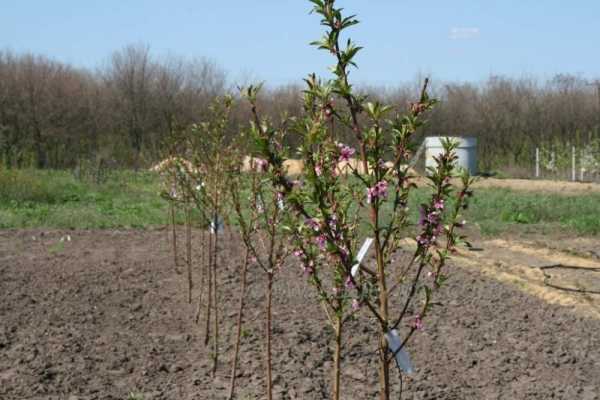
When growing large quantities of plums in a plot, planting holes are prepared 3 meters apart. Leave at least 2.5 meters between rows.
How deep should I plant?
The plum tree should be planted at a depth of 50 cm. The roots are buried 30-40 cm deep. The excavated soil from the hole is mixed with fertilizer, and half is returned to the ground. This procedure is performed to improve the flow of nutrients to the plum tree.
Required soil composition
The plant prefers sandy or sandy loam soils. It grows in any type of soil, but it needs to be well-drained and allow for proper aeration. To achieve this, a drainage material is placed at the bottom of the hole. Peat is most often used for this purpose. Peat significantly increases soil acidity, so wood ash is added along with it, which not only balances the acidity but also acts as a fertilizer for the plant.
What to put in the planting hole for fertilizer
The excavated soil from the planting hole is mixed with mineral fertilizers to increase soil fertility. The following components are added:
- superphosphate;
- potassium nitrate;
- humus or compost;
- wood ash;
- peat.
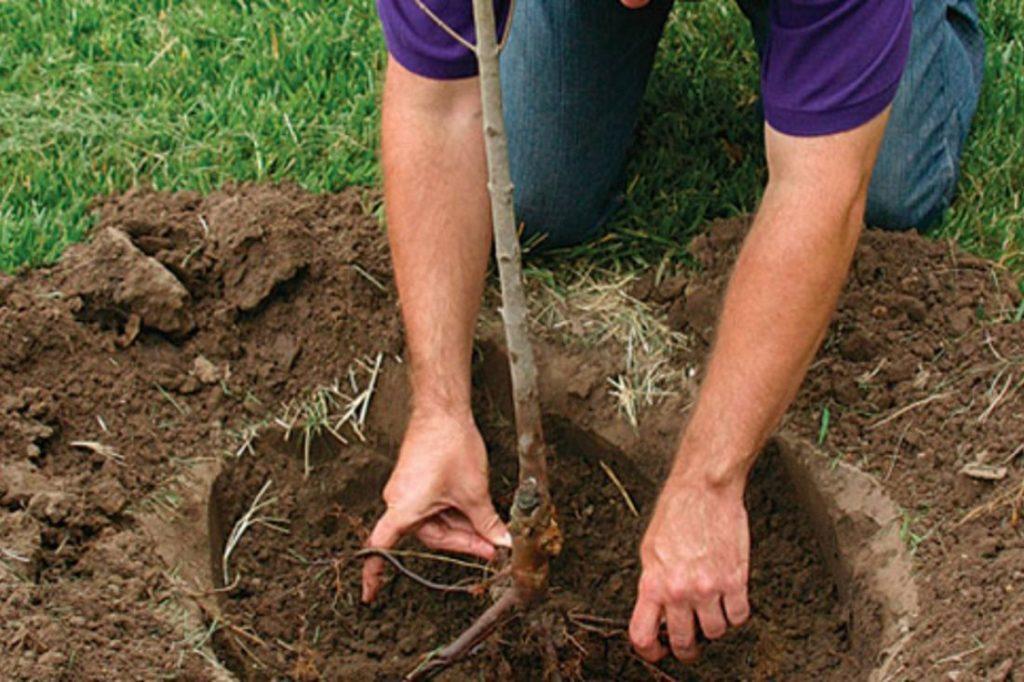
Tree planting technology
Plum seedlings are transplanted into the ground, following a specific technology:
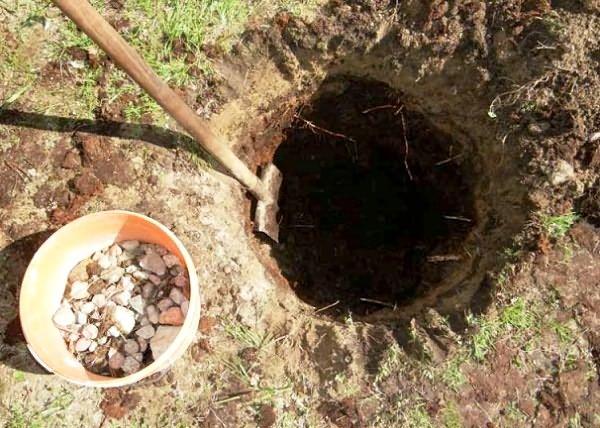
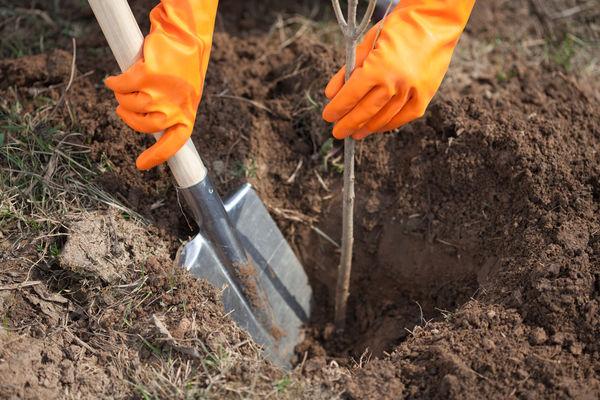
- Dig a hole 60-70 cm deep and 70 cm in diameter.
- The excavated soil is mixed with fertilizers.
- The hole is half filled with the mixture.
- Leave for 2 weeks.
- A wooden stake 1.5 m long is driven in.
- The roots of the seedling are straightened and lowered into the hole.
- The wood is sprinkled layer by layer, compacting each layer.
- A depression of 8-10 cm is left around the tree.
- Water with 4-6 buckets of water.
- Cover the tree trunk circle with mulch.
- The plum tree is tied to a wooden stake to prevent it from being damaged in adverse weather conditions.
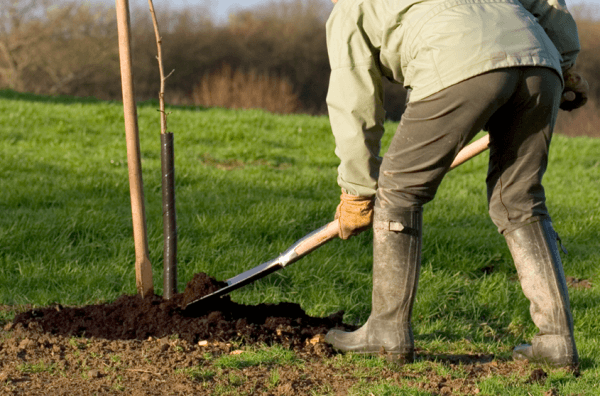
A plum tree with a closed root system can be planted together with a pot that decomposes in the ground.
Basic plant care activities
Plum is an easy-to-care-for plant, but following simple rules will increase its yield. To ensure the tree thrives, it needs to be watered regularly, pruned for maintenance and shape, protected for the winter, and sprayed against insects and fungal infections.
Watering and fertilizing
During the growing season, water the tree's trunk area 3-5 times. Weather conditions and precipitation are always taken into account. For up to five years of growth, 4-6 buckets of water are used per plum tree. After that, increase the amount by 2 buckets. During fruiting, water with 10 buckets of water. The soil around the tree's trunk should be moistened to a depth of 40 cm.
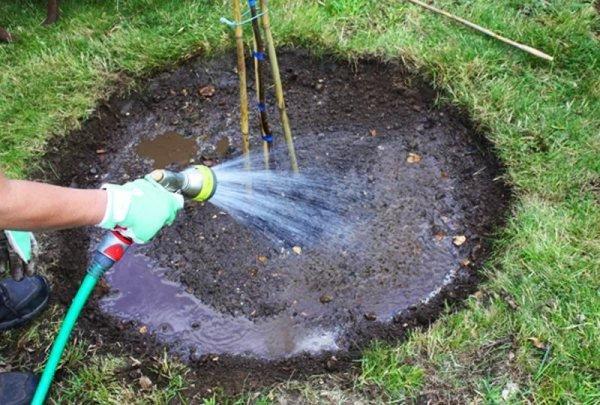 Important! Be sure to water the tree before wintering and after harvesting. This increases the plant's frost resistance.
The following organic fertilizers are used:
- manure;
- compost;
- humus;
- chicken droppings.
It is applied once every 3-4 years. The mixture is placed in the plum tree's trunk circle. This allows it to be absorbed more quickly through the roots and nourish the plant. Foliar feeding is also done. A solution is prepared from:
- potassium nitrate;
- phosphorite;
- copper sulfate;
- nitrogen fertilizer;
- urea.

Spray the plum tree leaves with the solution. Adding copper sulfate helps control pests that live in and under the roots of the tree. In spring fertilization, limit the amount of nitrogen and increase the amount of phosphorus and potassium. Fertilize the plum tree 2-3 times per season. Spraying is performed at the following stages:
- before the onset of bud formation;
- during flowering;
- during the period of fruit setting.
Applying fertilizer too frequently will kill the plant.
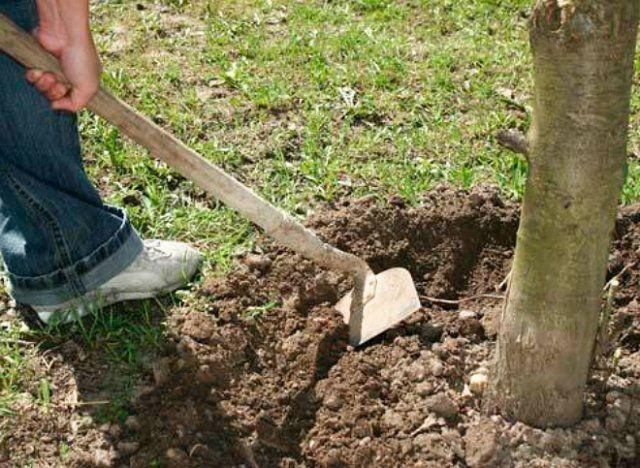
Caring for the tree trunk circle
The trunk circle is the tree's weak point. If left untreated, the plum tree will slowly die. This is where the tree's nutrition originates. To ensure the plant thrives, certain procedures must be followed:
- Loosen the soil 2-3 times per season;
- water through a circle;
- remove weeds and root shoots;
- lay down mulch for the winter period.
Pruning and crown shaping
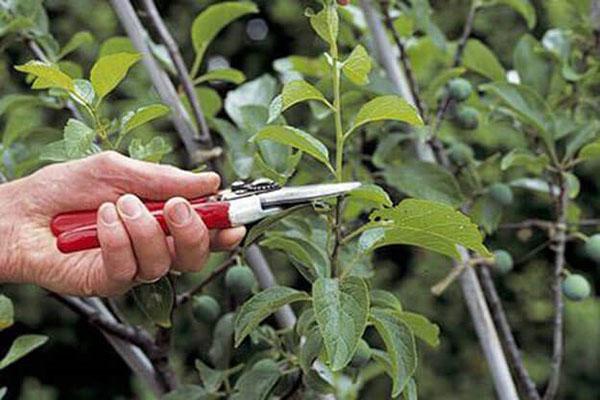
Crown shaping and sanitary pruning of plum trees should be performed every season. This increases the number of annual shoots on which fruit develops. Achieving the desired crown helps facilitate harvesting. Crown shaping is done over the first five years. The first pruning is performed one year after planting. The best time is early spring, before the sap begins to flow. Layered branching is suitable for plum trees.
In the first year, the main branch is left, and all other shoots located above are completely removed. Those located below are shortened by a third.
In the second year, the procedure is repeated. In the third year, the main branch is shortened by a third. The lateral, skeletal shoots are shortened until they are half the length of the central branch. After the tree reaches 2.5 meters in height, monitor for the growth of abnormal branches and remove them if necessary. In the fall, sanitary pruning is performed annually, removing dead, damaged, and diseased branches. Overcrowded areas are also thinned out.
 Important! Failure to shape the tree's crown will reduce its yield.
Do I need to cover it for the winter?
Frost protection for plum trees depends on the variety. Frost-hardy varieties tolerate severe frosts well. Frost resistance only becomes apparent in the third year of growth. Before this time, it is recommended to prepare the young tree for winter. To do this, mulch the area around the trunk. The following can be used:
- straw;
- chopped grass;
- compost;
- wood sawdust.
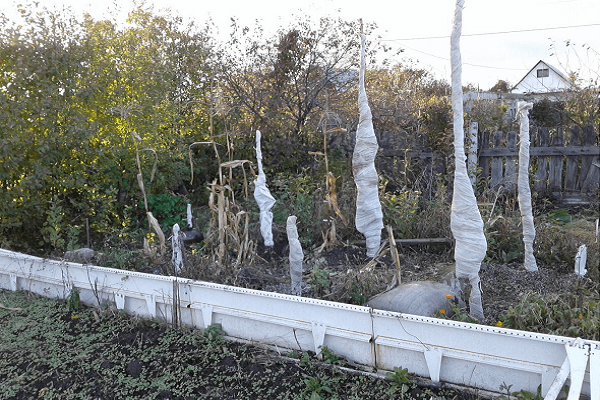
The top of the plum tree is also wrapped in a breathable material and secured with rope. This is done during the first year of growth.
Diseases and pests
The most common plum diseases are:
- Clasterosporium leaf spot is a microscopic fungus that attacks plant leaves, branches, fruits, flowers, and buds. Dark spots form, gradually developing into holes.
- Powdery mildew begins on the underside of the leaf. White spots appear, and the foliage curls and dries out. The disease spreads rapidly. In advanced stages, the tree dies.
- Moniliosis is a fungal disease that attacks flowers, fruits, and buds. Plums are most often infected in the spring, especially during rainy weather. Gray growths form on parts of the plant.
- Gummosis occurs due to excessive pruning, burns, and excessive nitrogen application to the soil. A hole forms in the trunk, from which resin oozes. The damaged branch dies completely.
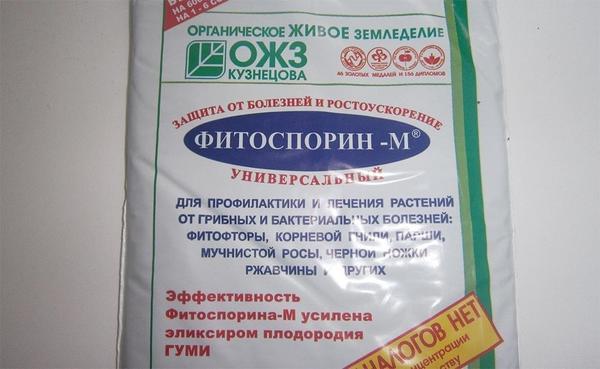
Fungicidal treatments are used to combat fungal diseases. All damaged leaves and fruit are removed from the tree beforehand. Spraying is done several times per season, as the protection from the treatment lasts about 20 days. Precautions must be taken during treatment. For gummosis, the damaged branch is cut off and the stump is sealed with garden pitch.
Plum trees are often attacked by insects that feed on the sap of the fruit, burrow under the bark, and lay their eggs. They eat the plums from the inside, causing the berries to fall off and become unusable. These insects include:
- apple scale insect;
- black aphid;
- codling moth;
- shoot moth;
- cherry sawfly.
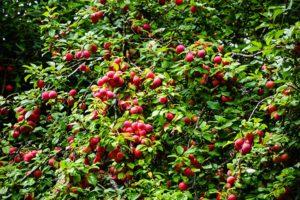
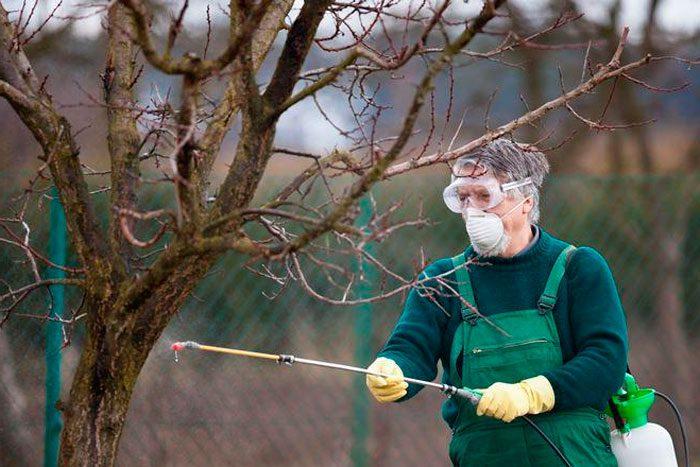
To control pests, spray the plum tree with an insecticide solution. Follow the precautions and dosage indicated on the label. The tree should be treated 2-3 times per season.
Important! All chemical treatments must be stopped 20 days before harvest.

What to consider depending on the season
Each season has its own unique care requirements. It's important to know how to properly care for your crops during different growing seasons.
Spring care
In early spring, perform formative pruning and water the tree with 3-6 buckets of water. Nitrogen and phosphorus fertilizers are applied. The soil around the trunk is dug over. In the spring, before flowering, the plum tree is treated with insecticides and fungicides for prevention.
Summer
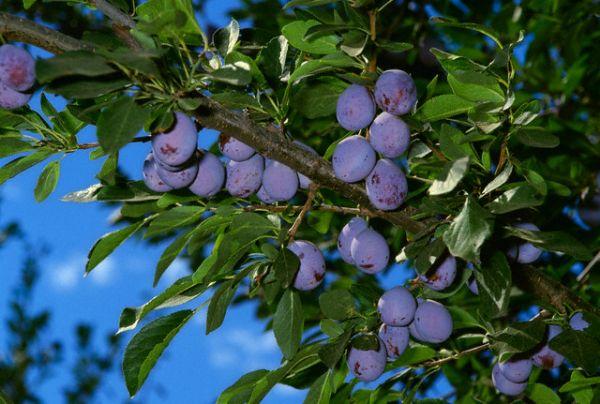
In summer, the plant needs to be watered frequently to improve fruit ripening. In July, during the fruiting period, fertilize and increase the watering amount. Plums ripen in August or September. Watering is stopped completely two weeks before harvest.
Autumn
After harvesting, perform sanitary pruning. Be sure to water the plum tree generously before winter, then fertilize with organic matter and mulch the area around the trunk.
Plum propagation
There are several ways to propagate the crop. Each has its own characteristics and rules. These include:
- root suckers;
- with bones;
- green and root cuttings;
- vaccination.
Root suckers
The simplest method: remove a sucker from the tree's trunk and replant it next to the mother plum. The following year, the seedlings are moved to a new location. The cut area is treated with garden pitch.
With bones
This method has its own peculiarities. The largest and firmest fruits are selected. They are left until fully ripe. The pulp is separated. They are soaked in water for two days, changing the liquid twice a day. The pits are dried for two days, then the seeds are extracted. A trench is dug in the area, and the pits are planted in the trench.
Important! Planting from seeds can be done at any time of year. Planting in winter will help discard weak seedlings.
Green and root cuttings
For this method, select varieties prone to producing large amounts of basal suckers. In early summer, select cuttings 30-40 cm long. Then, soak them in a rooting solution for 24 hours. The cuttings are transplanted into soil and covered with a plastic dome, creating a mini-greenhouse. After rooting, the seedlings are grown for two years before being transplanted to their permanent location. Root cuttings, which require regular pruning, are also suitable for this procedure.
By vaccination
The procedure is performed using the budding method. A strong cutting, 20-30 cm long, is selected. A 1.5 cm notch is made on it, just below and above the bud. The bark is then lifted in the area of the bud itself. A 1.5 cm notch is made on the parent tree, being careful not to damage the trunk or bark. The cutting is then attached to the tree and secured with plastic wrap. After two weeks, the branch should fall off with gentle finger pressure.
Related posts:
 Description and characteristics of the Yakhontovaya plum variety, pollinators
 Description of the Renklod plum varieties and cultivation technology
 Description and characteristics of the 30 best yellow plum varieties, planting and care
 Description and characteristics of the 27 best plum varieties for the Urals, planting and care
 Description of the Volga Beauty plum variety, planting and care
 Description and varieties of plum variety Ternovka, planting and care technology
 Description and distinctive features of the best varieties of Ussuri plum
 Causes and symptoms of 30 plum diseases, treatment and pest control