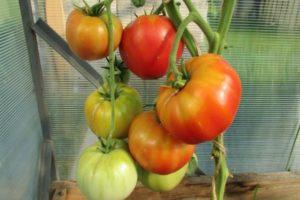
The exotic tomato "Royal Beauty" is also known as "Queen's Beauty." Regardless of the original name's translation, gardeners praise it not only for its flavor but also for its decorative fruits.
Features of the variety
The bushes are indeterminate and tall. The vine-like stems require staking and shaping into 1-2 branches. This helps to produce larger and more numerous ovaries. Reviews indicate that when lateral shoots become too large, the tomato plant virtually ceases fruiting.
This mid-season variety produces the first ripe tomatoes 120 days after sowing. In central Russia, these tomatoes are best grown indoors, where they will produce the maximum yield. In the garden, Royal Beauty tomatoes produce fruit quite successfully, but gardeners note that some fruits will have to be harvested unripe or even at the technical stage.
The variety's description describes it as resistant to late blight. According to gardeners, when grown outdoors, the variety is relatively resistant only in dry weather. Heavy, cold rains in the second half of summer create favorable conditions for the fungus, and Royal Beauty suffers from late blight no less than other tomatoes. Fungicides can be used for prevention and control.
The Tsarsky variety is quite resistant to tobacco mosaic and Alternaria diseases, provided proper agronomic practices are followed. Another advantage of this tomato is its stable yield. The Royal Beauty will not stop setting fruit despite sudden weather changes or extreme heat. When growing in a greenhouse, you will still have to monitor the room temperature: when the air warms up to +35…+40°C, the plant pollen becomes sterile, and fruits will not be able to form.
Gardeners' reviews note the variety's good to average yield. Approximately 10 kg of beautiful tomatoes can be harvested from 1 m².
Description of fruits
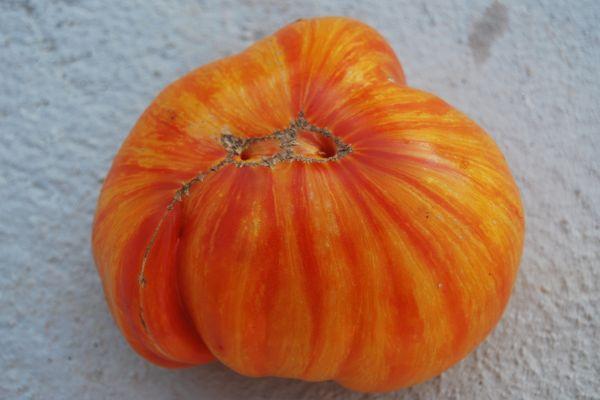
The plant produces several clusters with 4-6 fruits each. The average weight of a single tomato is 150-170 g, but a cluster can contain both large (up to 200 g) and very small (up to 100 g) fruits. The tomatoes are flat-round in shape, without pronounced ribbing near the stem.
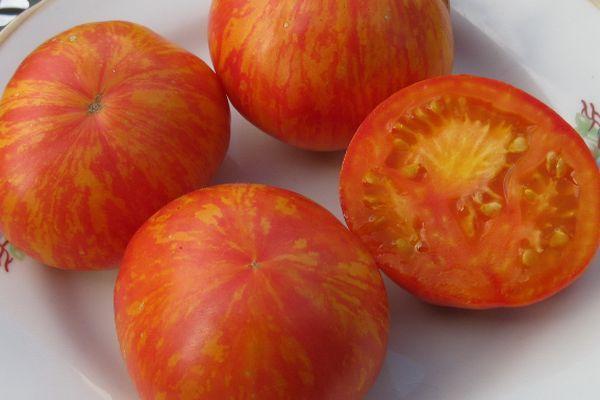
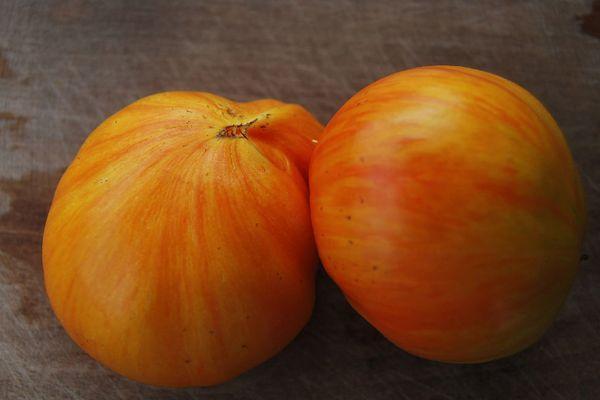
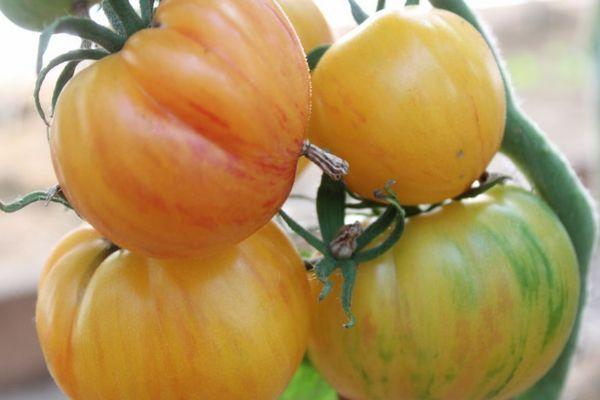
The description of the color of ripe tomatoes is noteworthy. Royal Beauty is considered a bicolor variety, meaning it combines two colors. Each tomato is orange with thin red stripes. At the technical maturity, the stripes have light and dark shades of green.
The tomato skin is strong, and the fruit is not prone to cracking. However, this toughness doesn't make the skin tough or unpleasant to eat. The fruits store and transport well, maintaining their marketable appearance for a long time even when fully ripe.
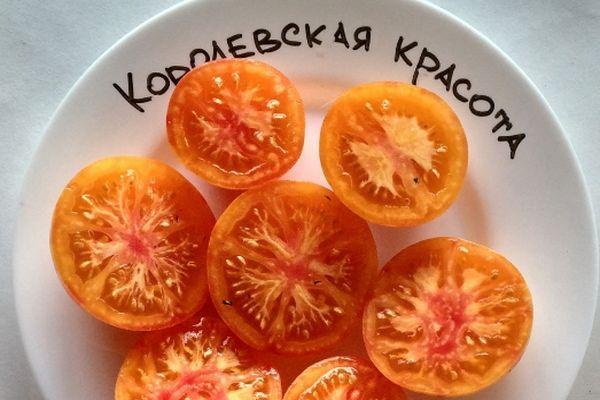
The flesh is juicy and tender, without being overly firm. The texture is reminiscent of beef tomatoes: the fruit is densely fleshed, and the seed chambers are small. The cross-section of the tomato is no less beautiful than its skin, with the flesh combining shades of orange and red, creating unique patterns. The flavor profile is described as medium: the tomato has a classic sweet and sour taste and aroma.
Decorative tomatoes can be used for a variety of purposes. They're used for serving buffets as slices and portioned appetizers, and they also adorn salads and sandwiches. While unusual tomatoes aren't often used for everyday purposes, the Royal Beauty can easily be incorporated into borscht dressings, tomato sauces, or vegetable caviar.
These attractive tomatoes are indispensable for winter preserves. They retain their color and don't burst when cooked. Housewives enjoy including these "Royal Beauty" tomatoes in vegetable platters. For juices and sauces, it's better to choose other tomato varieties with bright but more ordinary colors.
Agricultural technology of the variety
Sow seeds for seedlings 70-90 days before planting them in their permanent location. For central Russia, sowing time is approximately mid-March. Before sowing, soak the seeds in a solution of Fitosporin or potassium permanganate for 30-40 minutes to kill fungal and bacterial spores.

The substrate is prepared from equal parts humus, fertile soil, and fine sand, adding 1 tablespoon of lime for every 5 kg of the mixture. Dolomite flour, ground chalk, and gypsum plaster are also suitable. To disinfect the soil, pour it into the container where the seeds will germinate and water it generously with a hot, dark solution of potassium permanganate. Sow after the soil has cooled to room temperature.

Spread the seeds over the soil surface and cover with a thin layer of dry sand or soil. The seed layer should be no more than 0.5 cm thick. To retain moisture, cover the container with glass or plastic and place it in a warm place (25°C). Seedlings will emerge in 4-5 days, after which the plastic is removed.
When the seedlings reach 2-3 true leaves, they are pricked out. At this point, the young plants are transplanted and planted deep into the soil up to the cotyledons. The seedlings are watered and placed in a well-lit area. Care consists of timely watering.
Before planting in their permanent location, add 1 bucket of humus, 500-600 g of wood ash, and 1-1.5 kg of chalk or dolomite flour per 1 m² to the soil under the tomatoes. Dig the soil and prepare holes for the seedlings, spaced 40-50 cm apart. Descriptions of the variety often note the seedlings' tendency to stretch out. It's best to plant them in furrows, laying the stems horizontally, leaving only the top of the bush with 4-5 leaves.
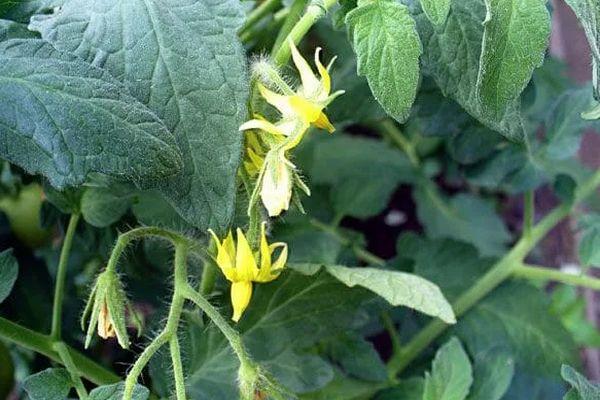
Before the first flower cluster appears, remove all side shoots from the stem. A second side shoot should be left above the inflorescence if the bush is being trained into two stems. When training into a single stem, do not leave side shoots.
When the bushes begin to bloom, apply a fertilizer with an ash solution (500 g per 10 liters of water). Repeat the application after two weeks.
Related posts:
 The best eggplant varieties for growing in a polycarbonate greenhouse: planting and care
 Methods for planting and propagating cherries at home
 The best grape varieties for growing in the Urals, planting and care rules in summer
 Is it possible to soak treated cucumber seeds before planting and how to do it correctly?
 Description and rules for growing Solaris grapes
 Causes and treatment of eggplant pests and diseases, how to combat them at home
 Growing and caring for hazelnuts in open ground, rules for planting hazelnuts
 The health benefits and harms of cherries, rules of consumption, and their effects on the body