
Growing tomatoes in buckets will be much easier and more convenient. Buckets can be used simply as containers in a greenhouse or outdoors, but there are also more unusual methods invented by resourceful gardeners. Like any method, growing tomatoes in buckets has its advantages and disadvantages.
Tomatoes in buckets: good and bad
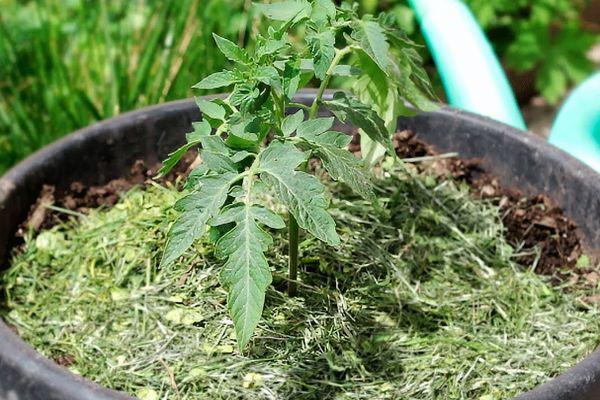
If a vegetable grower does not have a garden plot, he can grow tomatoes on the balconyIn this case, a leaky bucket can easily be used as a large pot. A standard 10-liter container is sufficient for growing medium- and tall-growing varieties. Excess water will drain through the holes in the bottom of the improvised container, leaving the gardener to simply tend to the plants.
Growing tomatoes in buckets has its advantages:
- Irrigation water and nutrient solutions will reach only the tomato plant. The liquid will not spread, but will flow directly to the plant's roots.
- Removing weeds in an area limited by the diameter of a bucket is easier than weeding and loosening a garden bed.
- If necessary, the tomato plant can be moved to a more convenient location, and outdoor containers can even be placed under a canopy in case of prolonged rains.
- In a cold summer, the soil in a bucket warms up better, tomatoes grow faster, the fruits fill out better and ripen sooner than in a garden bed.
- Compact bushes can be brought into a greenhouse at the end of the season if you want to prolong their fruiting.
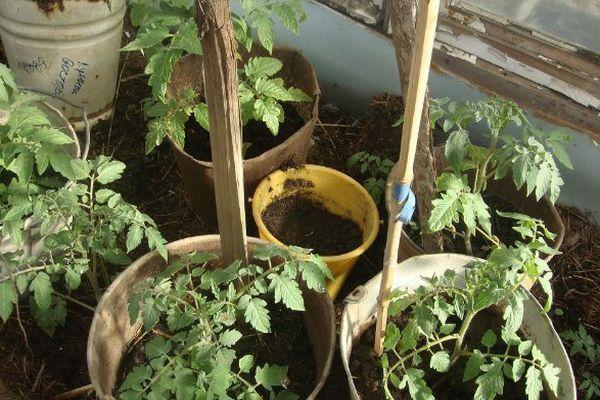
But along with these advantages, it's important to consider a significant, yet subtle, drawback. Because the soil heats better in a small bucket, it can overheat in extremely hot weather.
Most tomato varieties tolerate higher soil temperatures well, but moisture evaporates more quickly from containers. This occurs because the plant aspirates moisture, and some of it evaporates from the soil surface in the bucket. Tomatoes in buckets require more frequent and regular watering than those grown in raised beds.
How to use buckets to grow tomatoes?
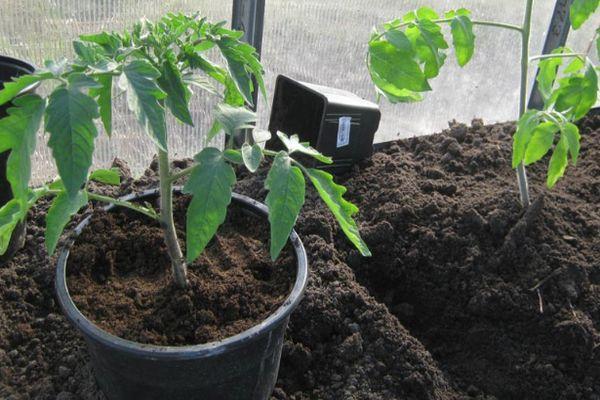
The method described above for planting tomatoes in a bucket, as in a regular container, is the simplest. However, gardeners also use more complex techniques. Experienced gardeners know that hilling tomatoes helps them develop a strong root system. The result is larger fruits, earlier ripening, and a greater number of tomatoes per plant.

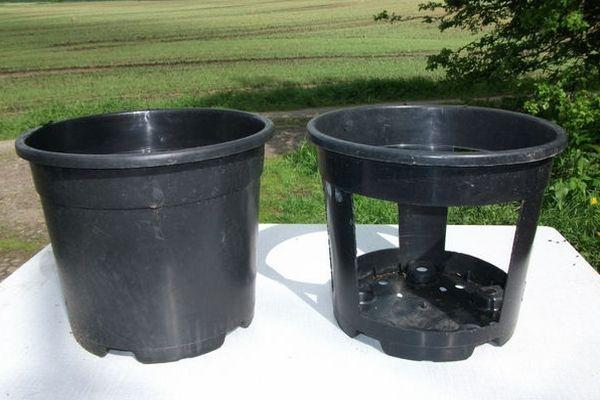
But for densely packed plantings in open ground and greenhouses, hilling is practically impossible, as it can damage neighboring plants. Resourceful homeowners have learned to grow tomatoes in containers or buckets in greenhouses. After planting tomatoes in a densely packed pattern, wait until they reach a height of 15-20 cm. Before staking, place a bottomless container on each plant.
If the plants are taller than the bucket, you can fill it to the brim with soil. If the container is tall, add enough soil to leave 2-3 pairs of leaves above the surface. When watering these tomatoes, some of the water goes to the roots of the plant, while the rest moistens the soil inside the bucket.
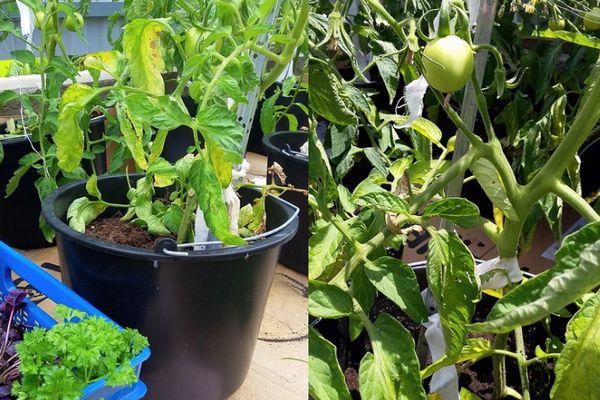
In a warm and humid microclimate, additional roots quickly grow, and the plant receives more nutrition and moisture. As tomatoes planted this way grow, you can add more soil until the bucket is full. This method is suitable for greenhouse tomatoes, but can also be used in open gardens.
In addition to the advantages listed above, this method of hilling differs from traditional hilling in that the soil doesn't crumble or wash away over time, and the beds look neater. Both metal and plastic containers (like those from paints, mayonnaise, etc.) are suitable for this method.
Growing in buckets upside down
European gardeners invented an unusual method for growing tomatoes. In Russia, this method is used in a simplified form, but it's quite effective. Experienced vegetable growers report that this method yields better yields than traditional cultivation and saves space in small gardens. Hanging containers can be placed in areas unsuitable for vegetable planting, and with a creative approach, you can even decorate your plot with tomatoes grown in buckets.
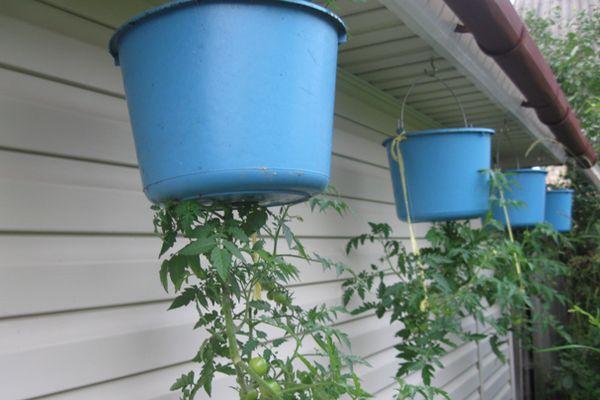
To plant using the original method you will need:
- a bucket with a capacity of at least 10 liters;
- a piece of foam rubber or capillary mat;
- a piece of cardboard;
- a container of suitable diameter for water.
Make a hole in the bottom of the bucket, approximately 5 cm in diameter. Place the container on a raised platform so that there's some space underneath. When planting seedlings using this method, turn the seedling upside down and push it through the hole. The roots should be inside the bucket, and the stem should be underneath, under the perforated bottom of the container.
Take a look Also

The hole in the bottom of the container should be sealed with a cardboard washer. Cut a hole in the center of the piece of material slightly larger than the thickness of the seedling stem, make a side slit from the edge of the washer to the middle, and place it on the stem of the plant. Fill with soil, carefully distributing it around the stem and roots. At least 10-15 cm of soil should be left above the root system.
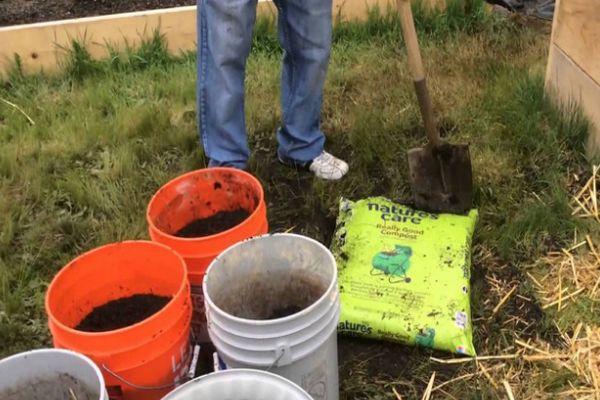
Lay a capillary mat over the soil and place a container with a small hole on top. As water is poured into the container, it will gradually soak through the mat and into the soil. The seedlings won't need to be watered; you just need to keep an eye on the water level in the container. A cardboard washer will prevent soil from spilling out during planting, but will become soggy in humid conditions and won't interfere with stem growth.
Russian gardeners often don't need drip irrigation for their tomatoes: rainfall in some regions is too abundant, and tomatoes get enough natural moisture. Therefore, instead of a watering reservoir, Russian vegetable growers plant another tomato plant (preferably compact varieties) or small ornamental plants on top. This makes the plants more attractive, and moisture evaporates more slowly from the soil surface.
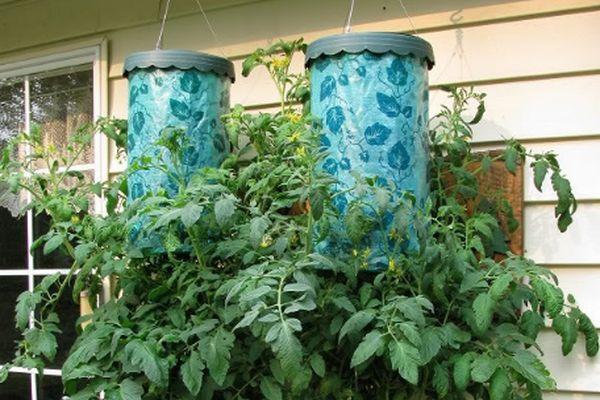
The final stage for any planting method tomatoes upside down in buckets means hanging them:
- To support the containers, you can use single metal poles driven into the ground, taking into account the total load on them. Such a support can hold 4-5 buckets of tomatoes, hanging them on welded hooks. These supports can be installed in any location inconvenient for gardening or used for landscaping.
- By digging in two posts and connecting them with a horizontal beam, you can hang containers to form a gate, an arch, or a living wall of plants. The posts can also be installed in a circle, creating a comfortable gazebo inside.
- You can hang containers on a wall or fence. This will decorate unsightly surfaces and free up space in the garden.
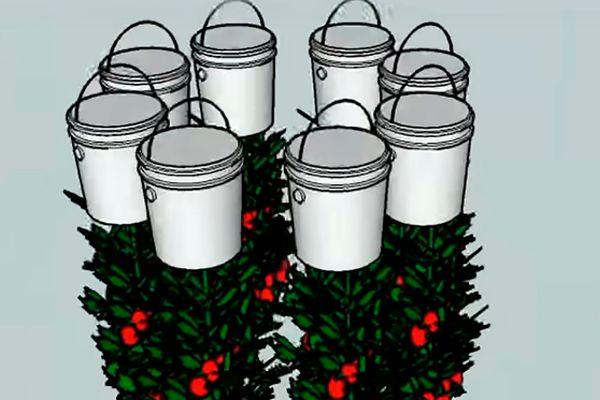
When planted upside down, tomatoes won't need staking. Their fruits won't touch the soil, even on the lower trusses, and the leaves won't be splashed with soil particles during rain.
According to gardeners, this planting method significantly reduces the incidence of late blight and other infections, the pathogens of which are carried by soil particles. Furthermore, tomatoes are easy to remove side shoots and harvest without bending over the bushes.
What varieties of tomatoes can be grown in a bucket?
It's preferable to choose tomatoes with a less robust root system: even a 10-liter container has a limited amount of soil. Such plants include compact varieties with standard or non-standard determinate stems (e.g., White Filling, Alsu, Gribovsky Ground, etc.).
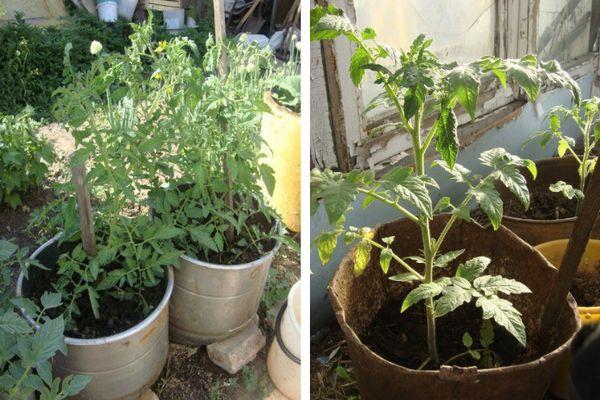
These varieties can produce a bountiful harvest, so the planting will be decorative while the tomatoes are ripening, but will quickly lose its beauty. However, for saving space, which early-ripening varieties take up briefly in greenhouses and gardens, this method is best.
Determinate varieties with extended fruiting are preferable. They will decorate the yard until the frost. tomatoes may turn out to be Berdsky large, De Barao and Damskie Fingers, etc. The bushes of these varieties are vigorous, and growing tomatoes in buckets will save time on staking and pinching.
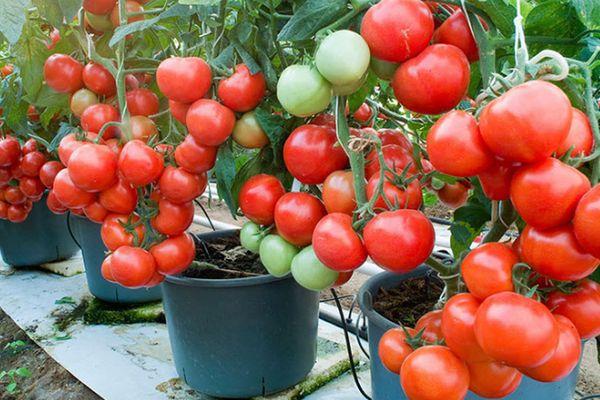
All kinds of exotic varieties with orange and yellow fruits will look very beautiful. Tall indeterminate tomatoes are often planted upside down, with a more compact bush placed on top. This saves space in the garden that would otherwise be taken up by these two bushes.
Related posts:
 What is the best way to feed tomato seedlings to make them plump?
 What is the best way to mulch tomatoes in open ground and greenhouses?
 What fertilizers and when to use for feeding tomatoes in a greenhouse
 The best eggplant varieties for growing in a polycarbonate greenhouse: planting and care
 How to prepare tomato seeds for planting seedlings
 Agricultural practices for growing tomatoes in greenhouses and open ground
 Hydroponic tomato growing technology, best varieties and fertilizers
 Growing cherry tomatoes in a greenhouse and open ground, when to plant seedlings