
- History of origin
- Description and Features
- Main characteristics of the variety
- Purpose
- Ripening time
- Productivity
- Taste qualities
- Frost resistance
- Bunch
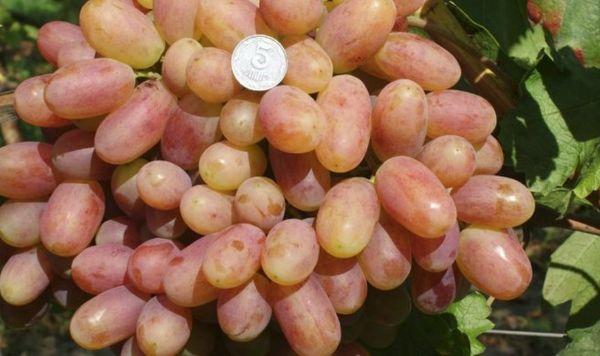
- Berries
- Disease resistance
- Methods of reproduction
- Cuttings
- By vaccination
- Layering
- How to plant correctly
- Recommendations for choosing deadlines
- Site preparation
- How to select and prepare planting material
- Planting diagram
- Care instructions
- Watering mode
- Top dressing
- Trimming
- Mulching
- Garter
- Preparing for winter
- Protection of birds and wasps
- Diseases and pests
- Oidium
- Mildew
- Anthracnose
- Chlorosis
- Bacteriosis
- Bacterial cancer
- Gray rot
- White rot
- Pros and cons of the variety
- Harvesting and storage
- Applications of berries
- Doubles and descendants
- Stable
- The Famous Troika
- Early
- Descendant
- Tips and advice from experienced gardeners
The Rizamat grape variety was developed in the 1970s, but thanks to its excellent characteristics, it still occupies a leading position among farmers and gardeners.
Not every grape variety thrives in temperate climates. But thanks to breeders, more and more varieties of fruit crops adapted to temperate climates are being developed every year.
History of origin
The hybrid grape Rizamat hails from sunny, hot Uzbekistan. The variety was developed by professional breeders at the Samarkand Research Institute of Horticulture and Viticulture by crossing the Kattakurgan and Parkent grapes. The new fruit crop is named after a renowned Uzbek winegrower.
After receiving state certification, the Rizamat grape was recommended for cultivation in Turkmenistan, Uzbekistan, and Georgia. A little later, the new hybrid began to be successfully cultivated in the southern regions of Kazakhstan, Ukraine, and Russia.
Description and Features
The table grape variety Rizamat ripens 135-140 days into the growing season. In Uzbekistan, the berries ripen early, reaching maturity in mid-August. In the Russian climate, bud break occurs a month later, and the harvest therefore matures by the end of September.
The fruit crop does not tolerate high humidity, which results in cracked berries.
Note! With careful care and proper agricultural practices, the Rizamat grape variety can be grown even in temperate climates.
Main characteristics of the variety
This fruit crop isn't known for its resistance to frost, disease, or pests, but any shortcomings are easily forgotten once the large, high-quality harvest of delicious and healthy berries is harvested.
Purpose
The Rizamat grape is registered as a table fruit variety. Its berries produce high-quality raisins.
Ripe bunches of grapes are left hanging on the branches for 2-3 weeks. During this time, the berries have time to dry and wither in natural sunlight. Only then are the fruits removed from the branches and dried.
Ripening time
The ripening of grape clusters directly depends on the climatic and weather conditions of the region, proper care, soil composition, and timely pruning of the bushes.
In southern regions, the growing season begins earlier, so grapes are harvested from mid-August. In the temperate climate of the central zone, the fruit ripens fully by the end of September.
Productivity
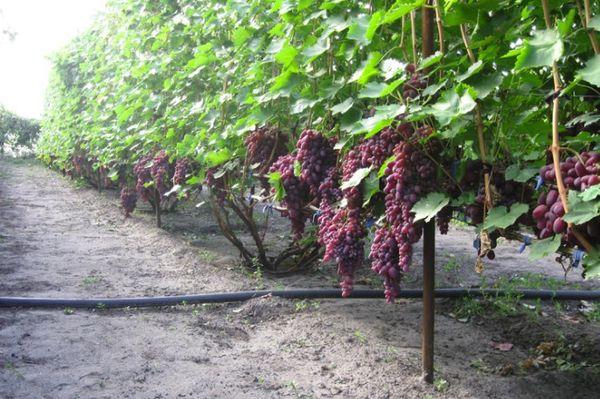
Experienced gardeners and farmers consider the Rizamat grape variety to be the benchmark for yield. On average, a single plant yields up to 30 kg of berries. There have been cases of up to 70 kg of fruit being harvested from a mature 15-year-old plant.
In industrial volumes, up to 25-30 tons of fresh produce are obtained from 1 hectare.
The yield and taste of the berries depend on the amount of sunlight and heat received by the grape bushes during the growing season.
Taste qualities
According to experts, the taste of Rizamat grapes is rated as very high, exceeding 9 points on a 10-point scale. The berries contain up to 25% sugars and 4 to 6% acids.
The berries are completely free of any flavors or aromas specific to different grape varieties, allowing you to enjoy the refreshing, sweet taste of large, crisp fruits.
Frost resistance
The fruit crop has poor tolerance to low temperatures. The maximum frost the plant can tolerate is -18 degrees Celsius. Even in southern growing regions, grape vines are covered before winter dormancy.
Bunch
Light-brown fruit-bearing shoots with green, medium-sized leaf blades grow on powerful bushes.
During the flowering period, grape-like inflorescences form on the shoots, in which berry ovaries are formed.
Important! Rizamat grapes are self-pollinating and do not require neighboring pollinators.
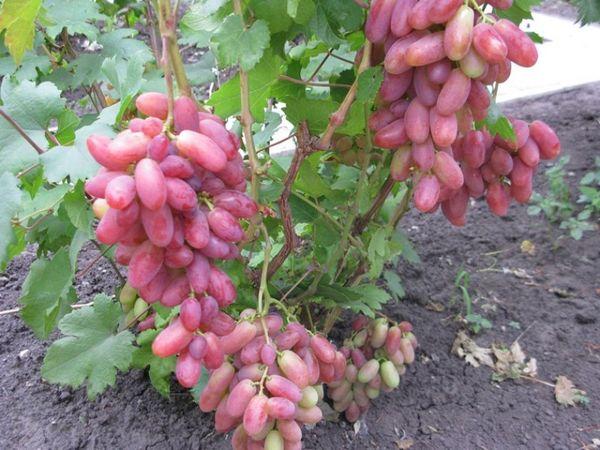
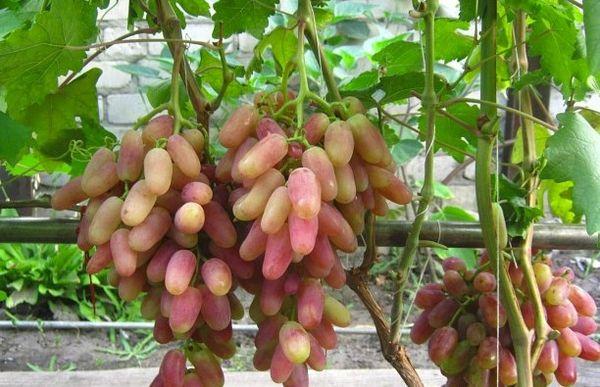
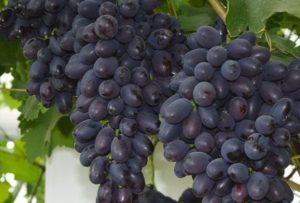
The bunches ripen large, weighing up to 1 kg, up to 18 cm long, cylindrical in shape, with berries weighing from 6 to 14 g.
Berries
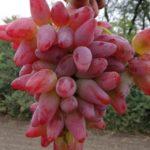
The elongated, cylindrical fruits acquire a beautiful pinkish hue by the end of ripening. The skin is thin, firm, and covered with a protective waxy coating. The flesh is dense, juicy, crisp and sweet, with 2-3 small seeds.
Disease resistance
The main prevention of diseases and pests is proper planting of seedlings and timely agricultural practices.
The Rizamat grape variety is not resistant to fungal and viral infections on its own. Annual preventative treatments are given to the vines.
Methods of reproduction
The hybrid variety of fruit crop is propagated exclusively by vegetative means.
Cuttings
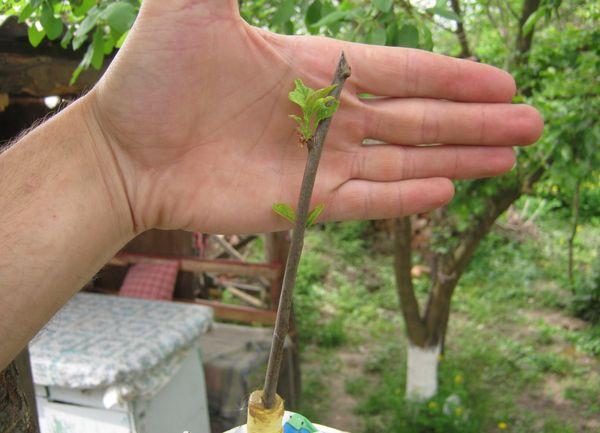
A method of propagating grapes using cuttings, a simple way to obtain new plant seedlings.
- The activities are carried out in spring or summer to give the plants time to grow and develop.
- From an adult bush, a strong, healthy shoot is selected and cut off.
- The shoot is divided into equal parts of 15-20 cm, each cutting must have buds or leaves.
- The cutting is treated with a growth stimulator and planted in a container with fertile soil.
- In autumn, the rooted seedling is transferred to open ground or a greenhouse.
During the rooting process of the cutting, the plant is watered and fed generously.
By vaccination
The Rizamat grape variety does not tolerate grafting well. Cuttings grafted onto rootstock fail to take root and die. Therefore, propagation and rejuvenation of this fruit crop by grafting cuttings onto rootstock is only available to breeders and experienced gardeners.
Layering
Propagating grape bushes by layering is the easiest and fastest way to obtain new berry seedlings.
- At the beginning of summer, a strong, healthy lower shoot is selected from an adult bush.
- The branch is bent to the ground and secured.
- The top of the layering is covered with fertile soil.
- The top of the shoot remains above the soil surface.
- The cuttings are watered and fed throughout the season.
- In autumn, the shoot is dug up and separated from the mother plant along with the formed roots.
In the fall, the finished seedling is transferred to a separate planting hole.
How to plant correctly
When planting seedlings of the hybrid grape Rizamat, it is necessary to take into account the large size of the bushes.
For planting, choose sunny areas that are well protected from gusty winds and drafts.
Groundwater should be at least 2.5-3 m from the soil surface.
Recommendations for choosing deadlines
The start of planting work is determined by the climatic features of the region where the fruit crop grows.
In temperate climates, berry bushes are planted in the spring, as soon as the soil warms to 15 degrees Celsius. The seedlings will have time to root over the summer and grow before winter.
In southern latitudes, autumn planting of seedlings is permitted. This work is carried out 4-6 weeks before the first frost.
Important! After autumn planting, plants must be carefully insulated.
Site preparation
Rizamat grapes prefer to grow and develop in loose, fertile soils with low acid content and moderate humidity.
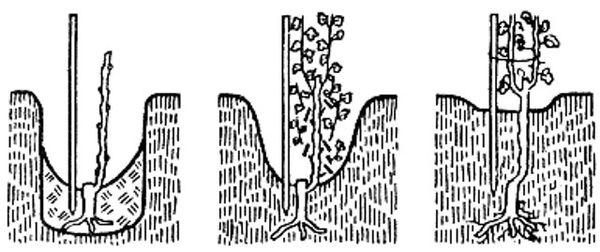
The site is prepared 5-6 weeks before the planned planting of seedlings.
- The soil is dug to a depth of 80 cm.
- The area is cleared of debris, weeds, and loosened.
- Organic matter and a balanced mineral complex are added to the soil.
- Planting holes are dug on the prepared area.
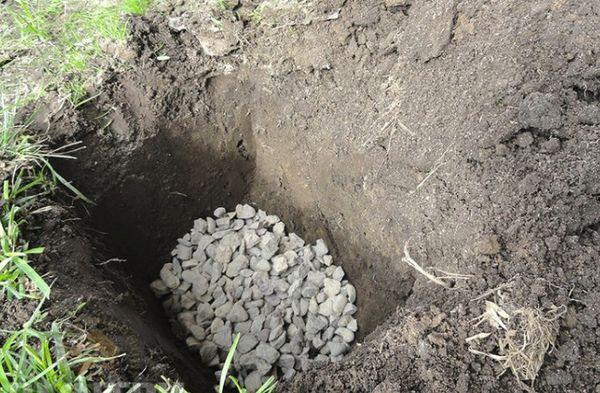
- The depth and width of the holes are not less than 70-80 cm.
- The distance between plantings is maintained from 3 to 4 m, between rows up to 5 m.
- A drainage layer of crushed stone and fertile soil is placed at the bottom of the hole, and a peg is driven in.
After the preparatory work, the holes are watered generously.
How to select and prepare planting material
A healthy and strong seedling is the key to a high-quality and abundant harvest in the future.
- It is best to purchase planting material from reputable nurseries or specialized centers.
- The seedling is examined for damage and infestation by diseases and pests.
- The trunk of the plant is straight, uniform in color with fruit buds or green leaves.
- The roots are well developed and moisturized, without putrefactive plaque, tubercles or damage.
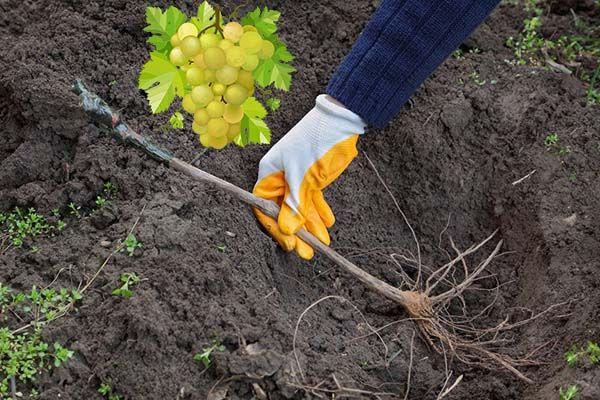
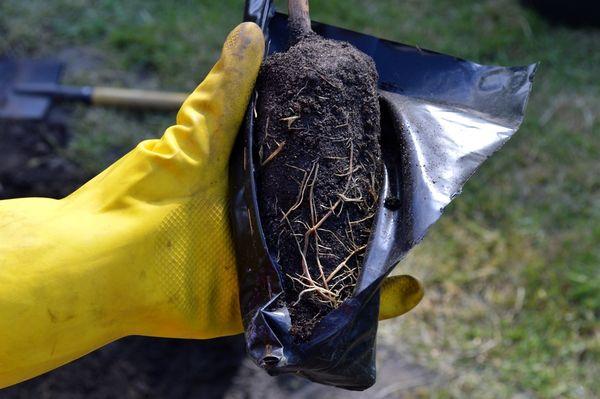
Before planting in open ground, plants are placed in warm water and left for 12-15 hours.
Planting diagram
The roots of the prepared plants are trimmed, leaving the longest and healthiest branches. The rhizomes are treated with a weak solution of potassium permanganate or antibacterial agents.
- The seedling is placed in the center of the prepared planting hole.
- The roots are evenly distributed in the hole and covered with fertile soil mixture.
- The soil is compacted and the seedling is tied to a support peg.
- The planted grape bush is watered generously.
After completing planting work, the tree trunk circle is mulched with humus or straw.
Care instructions
Caring for the Rizamat grape variety is not difficult; it requires timely watering, fertilizing, preventative treatments, and pruning of the bushes.

Watering mode
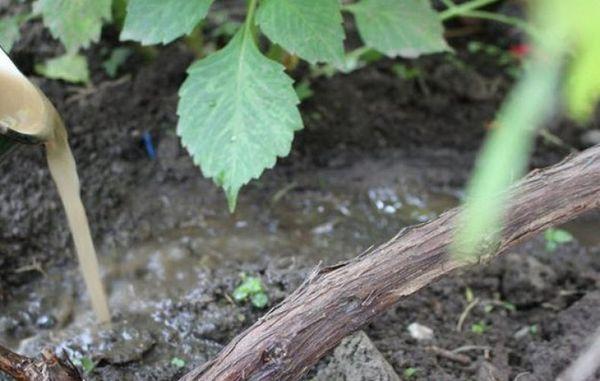
For watering, a drainage ditch is dug under the bushes, into which warm, settled water is poured.
Irrigation is carried out 3-5 times throughout the season. The plant's need for water is particularly high at the beginning of flowering and fruit set. The last time the grapes are watered generously is after the harvest.
Pour 30 to 50 liters of water under each bush. If the summer has been dry, increase the watering amount to 100-150 liters per bush.
Top dressing
Grape bushes expend a lot of energy to ripen fruitful vines and fruits, therefore, the plants require additional nutrition in the form of fertilizers and supplements.
- In spring, before flowering, the berry crop is fertilized with organic matter.
- 7-10 days after the beginning of flowering, grapes need potassium and phosphorus.
- The same complex is used to feed the bushes at the stage of ovary formation.
- The last time the grapes are fertilized is after harvesting, using organic and mineral fertilizers.
Tip! To increase yields, use foliar mineral fertilizers containing iodine, copper, and other plant-beneficial substances.
Trimming
Pruning grape vines is a key step in caring for this fruit crop. Proper and timely pruning is essential for the growth, development, fruiting, yield, and taste of the grapes.
It is best to shape the grape bush in the fall; in the spring, sanitary pruning of the plants is carried out, removing frozen, broken and damaged branches and shoots.
To form bushes, you will need supporting structures in the form of arches or trellises; it is to these that the fruit-bearing vines are attached.
The lower shoots are cut back to 10-15 buds, and multiple stepsons are pinched.
Important! The permissible load on one fruit bush is no more than 35 buds; otherwise, the berries become smaller and the ripening period increases.
Mulching
Weeding, loosening, and mulching the tree trunk area not only provides the roots with nutrients, oxygen, and moisture, but also protects against the spread of diseases and pests.
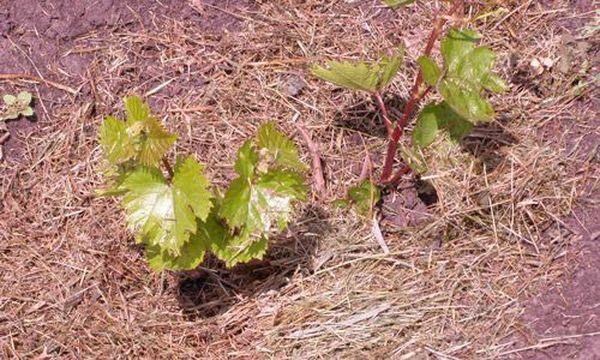
Mulching is carried out after irrigation activities, using organic materials.
Garter
Hybrid grapevines grow very tall and spreading. High arches or trellises are used for support, to which the branches and fruiting shoots of the bush are tied.
Preparing for winter
The Rizamat grape is native to Central Asia, where frosty winters are rare. With the arrival of autumn, the berry bushes are prepared for the long winter.
- The bushes are watered generously and pruned.
- The soil around the tree trunk is mulched with a thick layer of humus, and dry leaves or spruce branches are laid on top.
- The shoots are carefully removed from the supports and bent down to the soil surface.
- The bush is wrapped in film, burlap or special materials, covered with dry leaves and a layer of soil on top.
- As soon as snow falls, high snowdrifts are raked over the bushes.
The hybrid crop has low frost resistance; bushes are protected even in southern regions.
Protection of birds and wasps
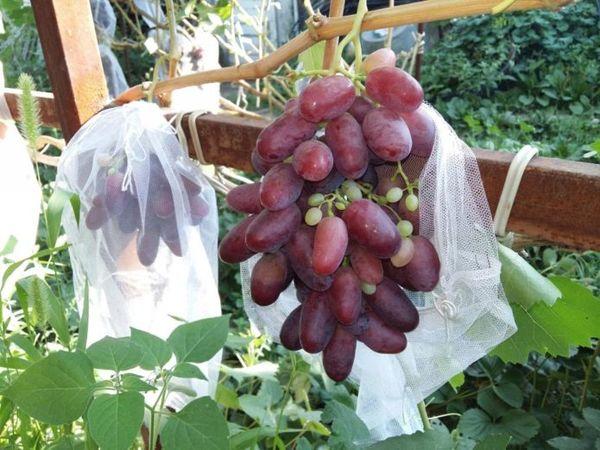
Birds and wasps pose a threat to ripening berries.
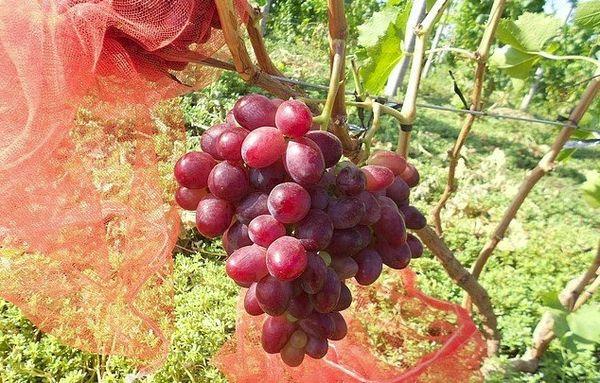
To protect against birds and insects, small nets are used, which are placed on top of the grape bunches.
Diseases and pests
Proper care and agricultural practices significantly reduce the risk of disease and pest spread. However, due to weak natural immunity, grapevines are often affected by fungal and bacterial diseases.
Oidium
A common fungal infection of grape buds, fruits, leaves, and ovaries. It manifests as a grayish, powdery coating. The berries crack and rot, emitting an unpleasant odor.
For treatment, preparations based on sulfur and fungicides are used.
Mildew
The fungus appears as light-colored spots on leaves, flowers, ovaries, shoots, and fruits. Leaves and ovaries turn black, and the berries rot and fall off.
Treatment is carried out with fungicide-based preparations.
Anthracnose
The fungus attacks the entire above-ground portion of the plant. It appears on the leaves as brown spots that grow and develop into holes. The plant gradually withers and dies.
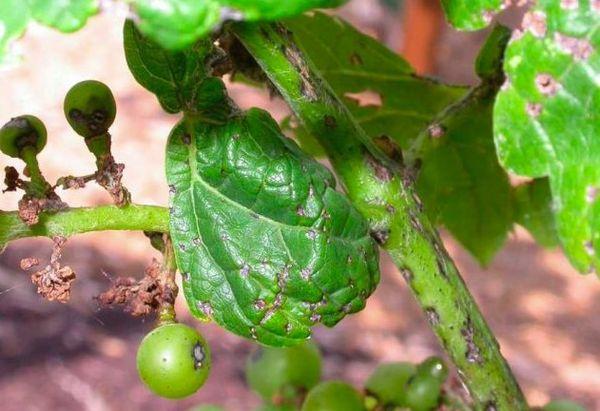
For treatment, fungicides containing copper are used.
Chlorosis
The disease manifests itself as yellowing of the leaves. As a result, the foliage dries up and falls off.
Additional feeding and iron-based preparations are used as treatment.
Bacteriosis
The disease manifests itself as pigment spots on leaves, flowers, shoots and grape berries.
The disease is transmitted through soil, water, and damaged areas of plants by pests.
To combat the disease, preventative measures are taken, including the use of biological control agents. Severely affected plants are uprooted and destroyed.
Bacterial cancer
The disease affects the entire plant, manifesting as tumors and light-colored growths on all parts of the vine.
It is not possible to completely cure the plant, but at the initial stage you can try to prolong the life and fruiting of the grape bush.
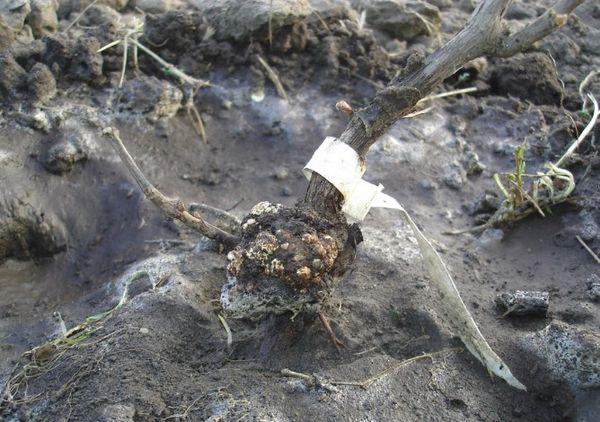
The growths are cut off, and the cut areas are treated with copper sulfate. Severely affected plants are dug up and destroyed.
Gray rot
A fungal disease that affects shoots, berries, ovaries, and buds. On leaves, it appears as brown spots with a grayish bloom, and on berries, as purple spots.
Copper-based preparations and fungicides are used for treatment and prevention.
White rot
A fungal infection of the shrub, characterized by yellow spots on the leaves and a gray coating on the berries. As a result, the foliage dries out, the berries rot, burst, and fall off.
For treatment and prevention, plants and soil are treated with fungicides.
Pros and cons of the variety
Before planting Rizamat grapes in your garden, you need to understand all the strengths and weaknesses of the fruit crop.
Advantages:
- High yield rates.
- In the southern regions, berries ripen early.
- Excellent taste of fruits.
- Possibility of long-term storage and long-distance transportation of berries.
Another advantage of this variety is the delicious, high-quality raisins produced from the berries.
Flaws:
- When humidity is high, cracks appear on the berries.
- Low cold resistance.
- The variety is susceptible to diseases and pests.
- Preventive treatment of bushes is required several times a year.
The identified shortcomings of the fruit crop quickly fade into the background when large, tasty, and most importantly healthy berries appear on the bushes.
Harvesting and storage
Harvest depends on the weather and climate conditions in the growing region. The ripening time of the berries is also affected by the load on the vines. The more bunches ripen on a vine, the longer it takes for the berries to reach their full ripeness.
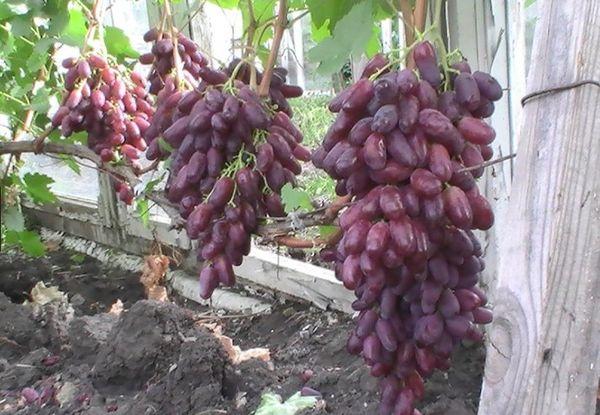
The first berries ripen in the southern regions by mid-August.
After harvesting, the grapes are dried and placed in special boxes or containers.
In a standard refrigerator, grapes retain their marketable appearance and flavor for up to 3 weeks. In specialized refrigerators, they can last up to 3 months.
Applications of berries
Grapes are best eaten fresh. Ripe grapes make delicious juices, nectars, compotes, jams, and marmalades. They are also widely used in cooking to make various sauces, salads, desserts, homemade wines, and liqueurs. This variety is excellent for making raisins.
Doubles and descendants
The development of clones and varieties of the Rizamat grape variety confirms the fruit crop's great popularity among gardeners, vegetable growers, and farmers.
Stable
The result of the work of Ukrainian breeders. This lookalike is completely unrelated to the Rizamat variety. The only similar characteristics are the bush size.
The berry crop is not capable of bearing fruit on its own, and the berries are white with a slight pink tint.
Late ripening period.
The Famous Troika
The variety was developed by the famous breeder Kraynov by crossing three different grape varieties.
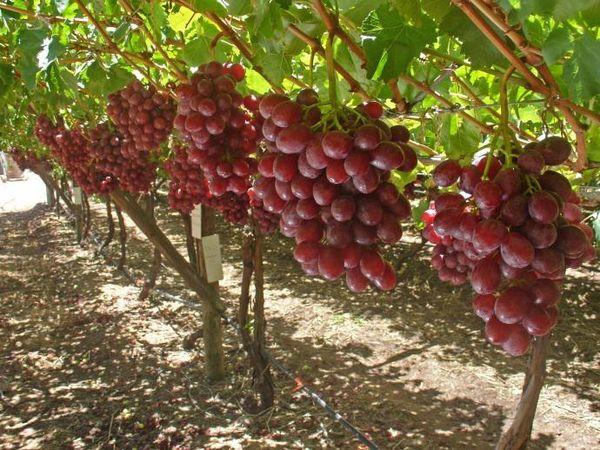
The bunches and berries are large, similar to the Rizamat grape, but the variety is completely independent and exists independently of the Central Asian fruit crop.
Early
The fruit is of Moldovan selection and has berries similar in color to the Rizamat variety, but has no relation to it.
Descendant
The Rizamat and Talisman grapes were indeed used in the development of this fruit crop. The hybrid was successful, with large, tasty berries in large clusters. Initially, the new variety was called "Descendant of Rizamat," but was later renamed "Yuliana."
Tips and advice from experienced gardeners
Experienced gardeners and farmers recommend planting the Rizamat grape variety away from other crops to ensure proper growth, development, and fruit production.
The berry bush has excellent decorative properties, decorating gazebos and garden arches with its beautiful shoots.
Related posts:
 Description of 30 grape varieties for Siberia, planting and care for beginners
 Description of 30 varieties and types of Muscat grapes, planting, cultivation and care
 The ripening time of grape vines by variety, how to speed up the process, and what to treat the plant with
 Beginner's Guide to Growing Grapes in Open Ground in Central Russia
 How to grow grapes in the Moscow region in open ground without a greenhouse
 Description of the Nizina grape variety, planting and care in open ground
 Description of the Julian grape variety, planting and care instructions
 Description and characteristics of the Original grape variety, planting and care