
- Common causes of foliage discoloration and deformation
- Depending on the season
- Spring
- Summer
- Tree diseases
- Signs of infection
- Treatment of an apple orchard
- Pests: symptoms and control methods
- Groundwater level
- Lack or excess of fertilizers
- Violation of agricultural technology
- What to do if the leaves of an apple tree seedling turn yellow?
- Other reasons for leaves turning yellow
- The leaves are drying up
- Localized yellowing of wood
- They curl up
- Leaves turning pale
- Preventive measures
The growth and development period of fruit trees is often accompanied by adverse external influences. Temperature and humidity fluctuations, insect pests, and various diseases can cause damage to the trunk and crown. It's helpful for beginning gardeners to know why apple tree leaves turn yellow and what preventative measures should be taken.
Common causes of foliage discoloration and deformation
Deformation and discoloration of apple tree foliage can occur for a variety of reasons, including seasonal factors, improper care, and pest and disease infestations.
Depending on the season
Seasonal yellowing of leaves is a common problem for inexperienced gardeners. Different methods for eliminating the problem apply to different seasons.
Spring
In early spring, yellowing leaves can be caused by scab or brown spot. Another cause is an excess of micronutrients in the soil where apple trees are grown. The solution is to remove all fallen leaves and treat the tree with Bordeaux mixture—a solution of copper sulfate in lime milk.
Summer
During the summer heat, apple tree leaves turn yellow due to:
- deficiency of useful elements or their excess;
- physiological disturbances in tree development;
- incompatibility of rootstock and scion.
In addition, in summer, apple tree foliage may turn yellow due to freezing of the root system.
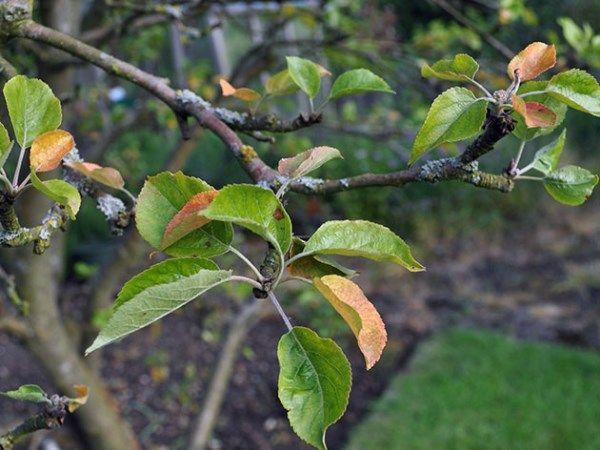
The problem can be solved by adding nutrient supplements and organizing proper watering.
Tree diseases
The apple tree is susceptible to diseases such as fruit rot, ascochyta leaf spot and chlorosis.

Signs of infection
When affected by fruit rot, yellowing of leaves appears in early June. Ascochyta leaf spot appears as distinct yellow-orange spots against the overall green background. The first sign of chlorosis is uniform yellowing between the leaf veins.
Treatment of an apple orchard
If signs of infection of apple tree foliage are detected, the trees must be treated:
- in early spring before flowers form - with a solution of copper sulfate and calcium hydroxide;
- after flowering is complete - with the preparations "Difenoconazole" or "Trifloxystrobin".

Pests: symptoms and control methods
The pulp of apple leaves is attractive to insect pests, which suck out all the essential nutrients. The result is premature yellowing of the leaves.
Pest damage to leaves is indicated by a yellow color, dryness, and the presence of black dots or holes on the leaf blades.
In case of minimal damage, it is enough to spray the apple tree with strong decoctions of plants - in particular, wormwood and tansy.
If the scale of the damage is larger, ferrous sulfate, Bordeaux mixture, Malathion, Cypermethrin and other insecticides should be used.
It is desirable to have birds in the garden that will eat harmful insects.
Groundwater level
Due to excessive groundwater accumulation where apple trees are planted, root rot begins. The roots lose their ability to breathe. Furthermore, a gley horizon forms, accumulating manganese and iron compounds that are harmful to plants. Gradually, the upper part of the tree is also affected, causing the leaves to turn yellow.

In this situation, it is recommended to carefully dig up the apple tree along with the root ball and transplant it to a new, favorable location. In the future, when planting apple tree seedlings, you should carefully select the site, and if the groundwater table is high, create effective drainage.
Lack or excess of fertilizers
A lack of fertilizer hinders shoot growth and foliage formation. The soil in which apple trees grow should be enriched with phosphorus- and potassium-based fertilizers. Excessive fertilization is also detrimental: not only will the tree's leaves turn yellow, but the fruit will also fall off.
To avoid such consequences, you must strictly adhere to the dosages indicated on the fertilizer packaging.
Violation of agricultural technology
By following the rules of agricultural procedures, you can prevent yellowing of apple tree leaves.

Trees need drip irrigation. Per 1 m2 From three to eight buckets of water are used in the trunk circle, depending on the age of the plant.
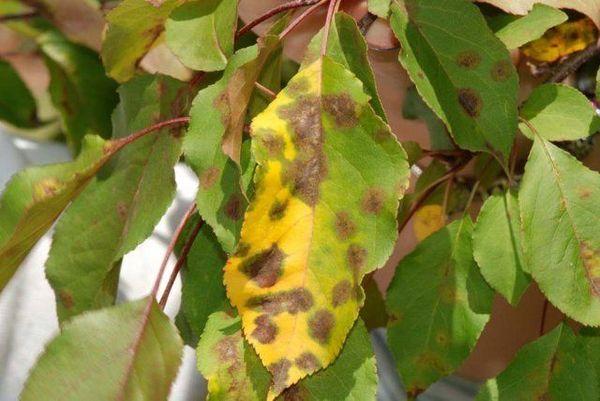
To nourish the roots, a thick layer of compost or humus must be placed around the tree trunk.
What to do if the leaves of an apple tree seedling turn yellow?
Yellowing of leaves on young apple tree seedlings can be caused by an incorrect choice of planting site or by deep rooting.
In such cases, it is necessary to replant the plant, choosing a well-lit, sunny area with light, loose and breathable soil.
The seedling may also be affected by chlorosis. This disease is caused by a lack of iron in the soil. Treatment is recommended by spraying the tree's crown with iron chelate-based products.
Other reasons for leaves turning yellow
Yellowing foliage is sometimes caused by other factors that every gardener should be aware of.
The leaves are drying up
If the apple tree leaves turn yellow and are drying out, the culprit may be extreme heat, which deprives the root system of moisture. In such cases, increased watering intensity is required.

Localized yellowing of wood
In some cases, yellowing is observed on individual branches. There are several factors that can cause this problem:
- aphid infestation;
- nutritional deficiencies;
- local fungal infection of the plant;
- attack by insect pests that extract nutrients from the plant.
Regular preventative procedures will help prevent damage.
They curl up
Leaf curling and subsequent death are caused by aphid colonies sucking the sap from the foliage. Control requires a full insecticide treatment.

Leaves turning pale
Apple tree leaves are wilting and turning pale due to chlorosis. This disease is treated by spraying the plant with a copper sulfate solution.
Preventive measures
You can avoid yellowing of leaves by following several rules:
- careful selection of the site (it should be illuminated by the sun, and there should not be large shading objects nearby);
- compliance with planting recommendations (drainage equipment, seasonal application of complex fertilizers);
- insect and disease control;
- arrangement of a reliable shelter for the wintering period.

Related posts:
 Signs and treatment of apple tree cancer, varieties resistant to the disease
 Description of the Chudnoe apple variety, planting and caring for a dwarf tree
 What to do if apple tree leaves are wilting and what is the best treatment?
 Description of the ornamental Nedzvetsky apple tree, cultivation technology
 Description and subtleties of growing the Sverdlovsk Beauty apple tree variety
 Description of the Red Early apple tree variety, agricultural technology and specific care
 Description and characteristics of the columnar apple tree President, planting and care
 Description and varieties of the Sinap apple tree, planting and care rules