
- Propagating apple trees by branches: advantages and disadvantages
- Which branch should I take?
- The specifics of obtaining a seedling from an old apple tree
- When should I prepare planting material?
- In the spring
- In the fall
- Methods of rooting cuttings
- In the water
- Directly in the ground
- How to prepare cuttings for planting
- We decide on a location
- Soil preparation
- Dimensions and depth of the planting hole
- We bury the seedling in the soil
- Further care
- Common mistakes when propagating apple trees
Many people wonder how to grow an apple tree from a branch. There are several effective methods for this propagation method. To achieve tangible results, it is recommended to properly prepare the planting material, carefully select a site, and provide the young plant with comprehensive and high-quality care. This will help you achieve good results quickly.
Propagating apple trees by branches: advantages and disadvantages
Experienced gardeners often grow apple tree seedlings from branches. These branches have a high survival rate of 80-90%.
For rooting, select one-year-old shoots. It's recommended to bend them down to the ground and place them in a small trench 10 centimeters deep. Then secure them with a pin and cover with soil.
This procedure is recommended in early spring. During the summer, the soil should be regularly moistened. After one year, it is recommended to separate the seedlings from the main plant. This is done in early summer. The plant can be replanted in the fall.
Propagating apple trees by branches has many advantages:
- good survival rate at 80-90%;
- excellent rooting of the cuttings.
However, this method does have certain drawbacks. It's a labor-intensive process, taking quite a long time. Furthermore, the procedure must be carried out with extreme care to avoid damaging the bark of the branch.
Which branch should I take?
Experienced gardeners claim that a broken cutting roots more easily. It's recommended to break the shoot so that there's a heel at the bottom. To do this, first make a small cut in the branch and only then break it.
To ensure proper root formation, it is recommended to split the heel into several fragments with a sharp knife. It should be trimmed and cleaned slightly beforehand.
The specifics of obtaining a seedling from an old apple tree
In winter, two months before the sap begins to flow, break off strong branches with wood no more than two years old. This should be done in a manner that does not damage the integrity of the bark. The cutting should be 20 centimeters long.
It's recommended to wrap the broken area with grafting film or electrical tape. If possible, place a wire around the branch to act as a splint.
In spring, recovery processes are activated, which will ensure that the plant gains strength.
During the period of active sap flow, it is recommended to cut the cuttings and place them in a dark plastic container. Fill the container with 6 centimeters of water or snow.
You can add two activated charcoal tablets to the water and place the container in a warm, bright place. After 3-4 weeks, you'll be able to get so-called seedlings. They can be moved outdoors when the root system reaches 6-7 centimeters.
When should I prepare planting material?
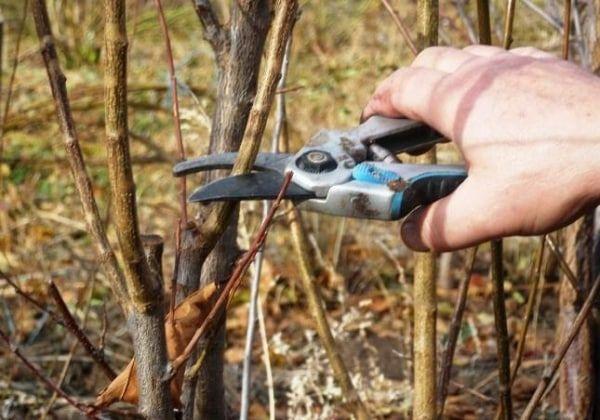
For propagation, it's best to use one-year-old branches. It's best to make the cut near the base, slightly below a node.
In the spring
For spring harvesting, cuttings should be taken in winter. To do this, it is recommended to slightly break the desired branch without damaging the bark. Wrap the affected area with electrical tape. It is recommended to use woody shoots.
At the end of March, the wrapping should be removed and the cuttings trimmed along the fracture line. By this time, the affected tissues have accumulated the elements necessary for development. The prepared cuttings root well.
In the fall
In late autumn, suitable branches can be cut. They can be stored in a snowdrift or cellar. Planting material can also be stored in the refrigerator. In the spring, it's time to begin growing the cuttings. It's important to choose woody shoots that are free of mechanical damage.
Methods of rooting cuttings
To ensure the seedling develops fully rooted, the cuttings should be germinated. To ensure rooting, the planting material can be immersed in water or soil. The plant can be transplanted to its permanent location once its roots have grown to at least 7 centimeters.
In the water
To germinate a cutting, you should follow this algorithm:
- Take a dark plastic bottle and cut off the top. The height of the container should be slightly shorter than the length of the cuttings.
- Place the branches in the bottle and fill it with water to a depth of 5-6 centimeters. Make sure the bottom bud is covered with water.
- Add natural or store-bought growth stimulants to the water. Aloe vera juice or Kornevin can be used as growth stimulants.
- Change the water every 2 weeks. During this time, a thickened area will appear at the bottom of the cutting.
- By the end of the 3rd week, root shoots will form on the material.
Directly in the ground
Rooting the plant in soil is also possible. To do this, follow these steps in early spring:
- Fill a plastic container with a special substrate. For this, combine peat, black soil, and sand in equal proportions.
- Plant the cuttings 5-6 centimeters deep in the soil. Water the soil thoroughly.
- To achieve a greenhouse effect, it is recommended to cover the container with film.
- When the weather becomes consistently warm, the container with cuttings should be taken outside.
- When roots appear, the seedlings can be transplanted into open ground.
How to prepare cuttings for planting
The branch should have 2-3 internodes. It is recommended to remove the bottom leaf. The remaining leaves are shortened by 2/3. Then, the cutting should be soaked in a growth stimulant for 12 hours. Kornevin, Zircon, or Kornerost are used for this purpose.
We decide on a location
To plant the apple tree in its permanent location, choose a well-lit spot. It should be well protected from cold winds or drafts. It's best to place the apple tree on a slightly elevated site.
It's important that its roots aren't constantly in wet soil. The groundwater table should be at least 2-2.5 meters deep.
Soil preparation
Apple trees thrive in light, well-drained soil with moderate acidity. Loamy soil or black soil are considered optimal.
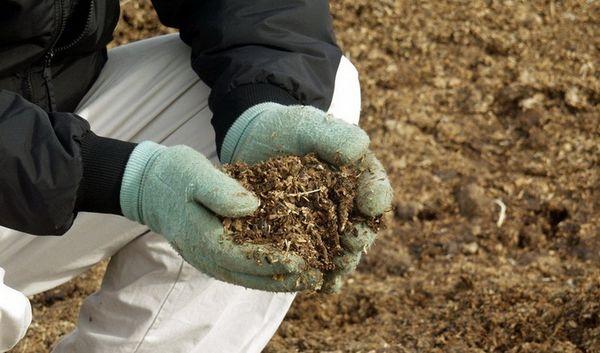
When planting in hard clay soil, it's worth adding peat and river sand. Liming is also crucial. If the soil is highly sandy, consider using humus, clay, and minerals.
Dimensions and depth of the planting hole
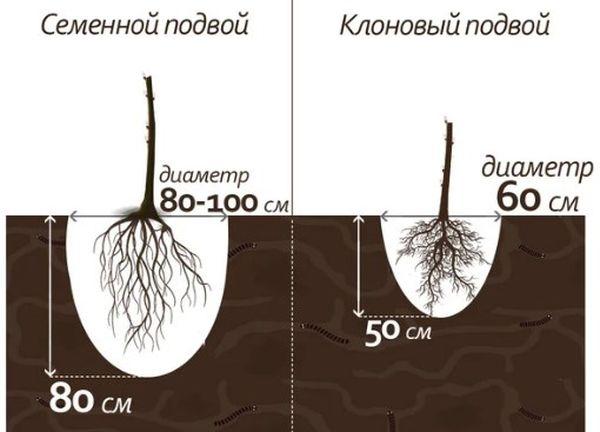
Before planting, it's important to prepare a hole. Its size directly depends on the crop variety:
- for tall plants, it is worth using a hole measuring 80x120 centimeters;
- for medium-sized trees, 50x100 centimeters is enough;
- for dwarf species, a depression measuring 40x90 centimeters is sufficient;
- For columnar crops, make a 50x50 centimeter hole.
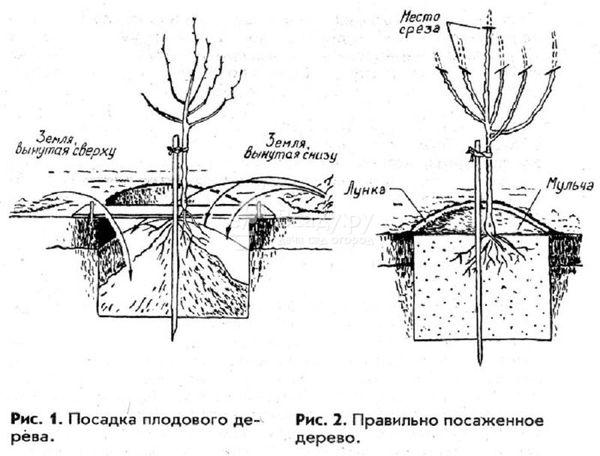
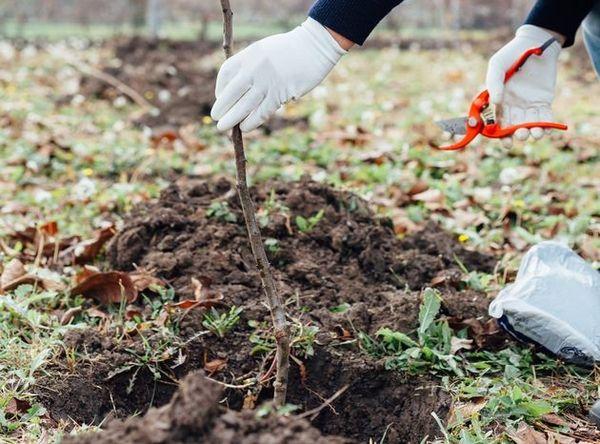
We bury the seedling in the soil
To germinate a seedling, it is recommended to perform the following steps:
- make a trench 40 centimeters in size;
- on the south side, make a sloping border;
- place the seedling in a ditch at an angle;
- sprinkle the roots with soil layer by layer;
- water each layer well;
- cover the furrow with spruce branches and spunbond.
Further care
For cuttings to root fully, they require timely and high-quality care. During the first year, seedlings are very weak. Therefore, they require comprehensive care. This should include the following elements:
- Watering. Regular watering is recommended. The top layer of soil should not be allowed to dry out. Weeds should be removed from the soil before watering.
- Fertilizers. During the first two years of life, the seedling should be given a full fertilization regimen. This will help it establish roots and begin fruiting. Apple trees require organic and mineral nutrients. Apply organic matter sparingly to avoid damaging the fragile roots. In spring, nitrogen-containing fertilizers or a urea solution should be used. During the summer, apply a mixture of water, superphosphate, urea, and bird droppings several times.
- Disease and pest prevention. Young plants have weak immune systems. To prevent disease and pest attacks, use fungicides and insecticides. Apply them several times during the season.
- Winter insulation. Regardless of the climate, apple trees should be protected for the winter during the first two years. Before the cold weather sets in, the trunk should be whitewashed and wrapped in a thick cloth, such as burlap. It is recommended to cover the soil around the tree with a layer of mulch. Straw or hay are good options. Sawdust is also an excellent choice.

With proper care, the plant will be fully established within three years. If necessary, it can be repotted again.
Common mistakes when propagating apple trees
Many inexperienced gardeners make common mistakes when propagating apple trees:
- incorrectly selected branch for propagation;
- do not use a growth stimulator to root the cuttings;
- use unsuitable soil for the plant;
- violate the temperature regime during the germination period of the crop;
- the wrong site is chosen for the crop;
- violate the watering regime;
- the plant is not fed in a timely manner.
Propagating apple trees from branches is a popular method. To achieve success, it's important to properly cut the cutting and carry out all the necessary preparatory work. Once the plant has taken root, it needs to be provided with comprehensive care. This care should be comprehensive.
Related posts:
 Methods for planting and propagating cherries at home
 The best eggplant varieties for growing in a polycarbonate greenhouse: planting and care
 The best methods for growing grapes from seeds at home
 Growing and caring for hazelnuts in open ground, rules for planting hazelnuts
 Rules for planting and caring for pears in open ground, how to grow them correctly
 Conditions for growing mandarin at home and rules for caring for the tree
 The best grape varieties for growing in the Urals, planting and care rules in summer
 Timing and rules for propagating blueberries at home