
- History of the Orlinka variety selection
- Pros and cons: is it worth planting?
- Characteristic
- Tree dimensions
- Root system
- Fruiting
- Flowering and pollinators
- Fruit yield and taste
- Transportability and use of apples
- Resistance to drought and frost
- Susceptibility to diseases
- Planting an apple tree
- Deadlines
- Site selection and preparation
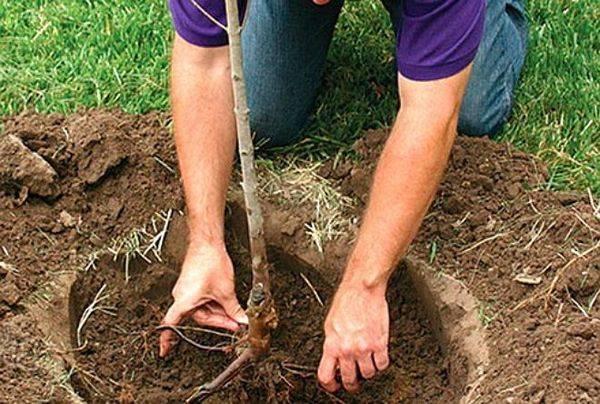
- Preparation of seedlings and planting technology
- Plant care rules
- Watering
- Fertilization
- Caring for the tree trunk circle
- Pruning and crown shaping
- Seasonal treatments
- Protecting trees in winter
- Subspecies of the hybrid
- On a semi-dwarf rootstock
- On a dwarf rootstock
- Methods of reproduction
- Gardeners' reviews
Every year, new apple varieties are developed and old ones are improved. One of the best hybrids is the Orlinka apple variety. This variety has many advantages and few disadvantages, which is why it is so popular with many gardeners.
History of the Orlinka variety selection
The Orlinka variety was created by crossing the Stark Erliest Prekos and Salut apple trees. The new hybrid was developed in 1978 at the All-Russian Research Institute of Fruit Crops. In 1994, the Orlinka variety was accepted for testing, and in 2000, it was added to the State Register.
Pros and cons: is it worth planting?
The advantages of the Orlinka variety include:
- Taste qualities of fruits.
- Precocity.
- Productivity.
- Scab resistance.
- Frost resistance.
One of the drawbacks is the extended fruiting period. The apples don't all ripen at once; the ripening period lasts several weeks.
Characteristic
Before purchasing a seedling, you should study the characteristics and description of the tree so as not to be disappointed with your choice later.
Tree dimensions
The tree is tall, with a rounded, spreading crown. The branches are straight, long, and compactly arranged on the tree. The ends of the branches point upward.
Root system
The root system is powerful and spreading.
Fruiting
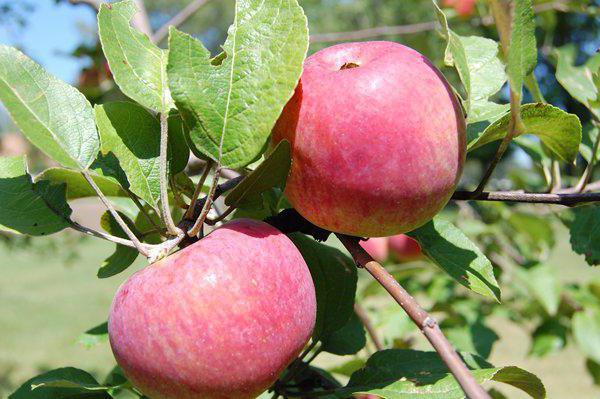
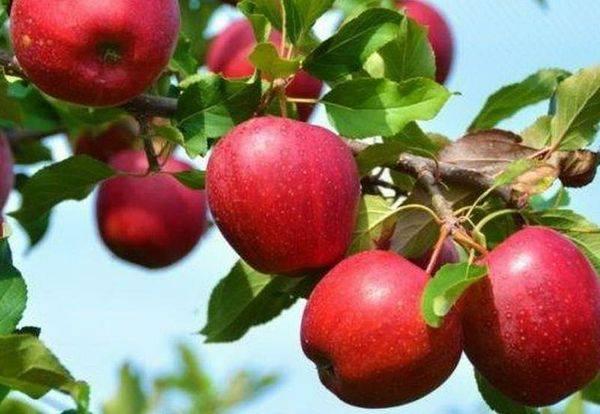
Fruiting is abundant, but the harvest ripening period is extended. The variety is considered early summer ripening, the harvest ripens by mid-August. The harvested crop can be stored until early September. The apples are large, weighing up to 200 g.
Flowering and pollinators
The flowers are large, up to 2 cm in diameter. The petals are light pink. The Orlinka variety is self-fertile and is often planted as a pollinator for other apple trees.
Fruit yield and taste
A single mature tree can yield up to 25 kg of fruit. Ripe fruits are delicious, with sweet flesh and a pleasantly tart tang. If the apples hang on the tree for too long, the flesh becomes watery and tasteless. Tasting score: 4.2 out of 5.

Transportability and use of apples
Harvested fruit transports well, but not over long distances. Damaged fruit should be discarded immediately. They don't keep well and begin to mold, which can spread to healthy apples. It's recommended to store the harvested fruit at temperatures up to 7 degrees Celsius.
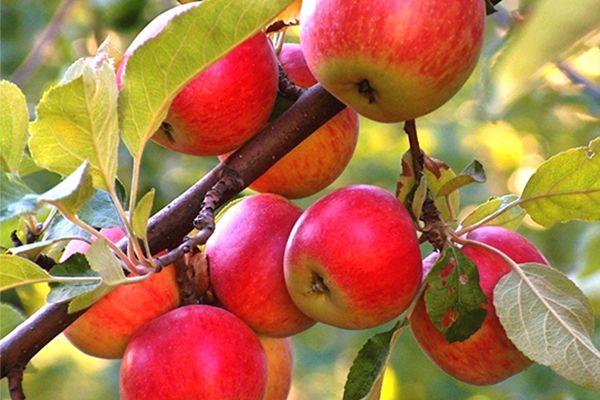
Apples have a wide range of uses. Thanks to their excellent flavor, they are eaten fresh, used in compotes, preserves, and baked goods.
Resistance to drought and frost
Frost resistance is good; the tree tolerates temperatures down to -25 degrees Celsius. The apple tree also tolerates short-term droughts well.
Susceptibility to diseases
One of the advantages of the Orlinka variety is its resistance to scab and a number of other fruit diseases. With proper care, you can completely forget about the apple tree's illnesses.
Planting an apple tree
One of the most important aspects of growing an apple tree is planting. Before planting a seedling in open ground, it's essential to prepare the soil in advance and determine the timing and location.
Deadlines
Apple tree seedlings are planted in spring or fall, depending on the growing region. In regions with moderate and cold climates, spring planting is preferable, when the outside temperature reaches above zero. This will give the seedlings time to establish themselves over the summer, and there will be no risk of freezing in winter. In southern regions, apple trees are planted in the fall.
Site selection and preparation
Apple trees prefer to grow in open, sunny areas protected from cold drafts. Light, fertile, well-drained soil is ideal for planting.
Preparing the site for planting begins in the fall. The soil is dug over, and all growing weeds are pulled out. The soil is then mixed with well-rotted manure and a complex mineral fertilizer is added.
In the spring, dig the soil again and, if necessary, pull out more weeds. After these steps, you can begin planting.
Preparation of seedlings and planting technology
To speed up the rooting process, the seedlings' roots are dipped in a growth activator a few hours before planting. Then, immediately before planting, to protect the root system, they are dipped in a liquid clay solution. The seedling should be planted immediately afterward, before the clay has time to dry.
The process of planting a seedling in open ground:
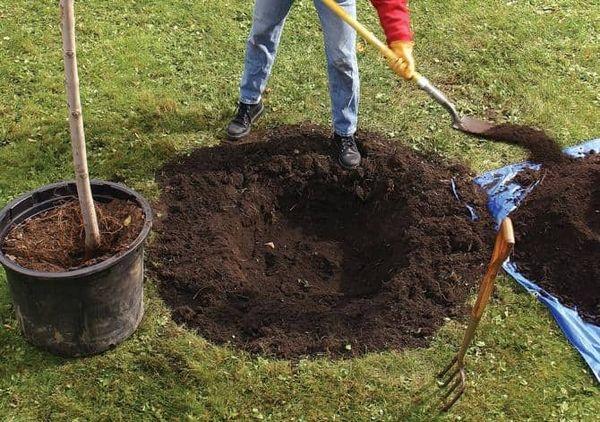
- Dig a hole 1 m deep and 90 cm wide.
- Add fine drainage material to the bottom.
- Plant the seedling and bury it.
- Lightly compact near the root collar.
- If necessary, drive a wooden stake nearby and tie the seedling to it until it gets stronger.

At the end of planting, the apple tree seedling is watered generously. If several apple trees are to be grown nearby or other fruit trees are already growing, leave a distance of up to 4 meters between them.
Plant care rules
With proper tree care, the tree will produce a good harvest every year and will rarely get sick.
Watering
Apple trees don't require frequent watering. Only young seedlings require regular watering, 2-3 times a week. Mature trees are watered for the first time in the spring, before bud break. Then, during fruit set. Further watering is as needed. One tree requires 50 liters of water.
Fertilization
Fertilizers are first applied to the soil before sap begins to flow and buds begin to open. During this period, the tree requires nitrogen-containing fertilizers. These are applied before fruit formation begins. After this, phosphorus and potassium are added to the soil. For example, superphosphate, potassium salt, ammonium phosphate, and potassium metaphosphate.
These fertilizers increase the number of ovaries and improve the taste of the fruit.
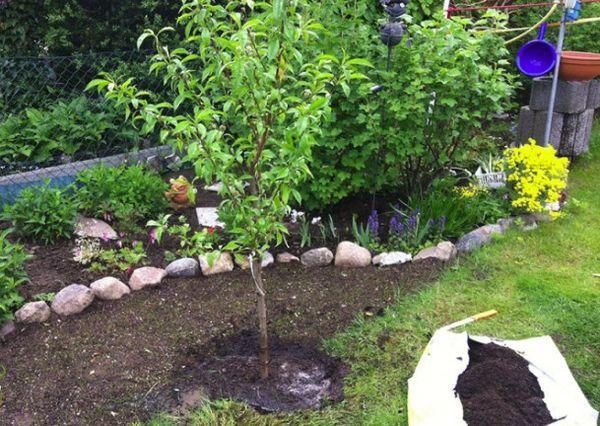
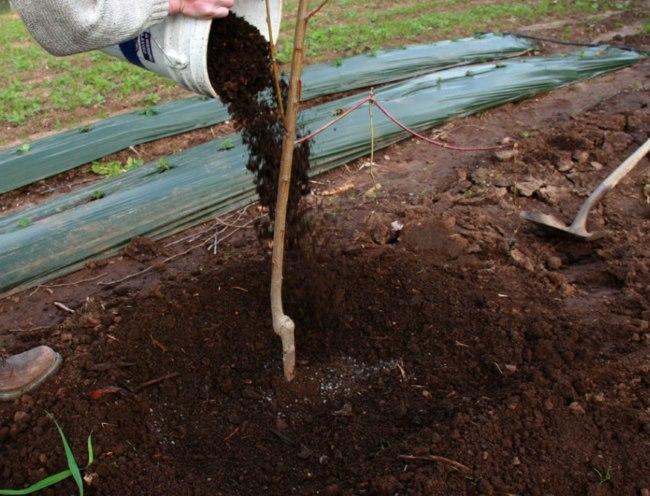
In addition to mineral fertilizers, organic ones are also important. Once per growing season, the soil is mixed with rotted manure or compost. Wood ash is sprinkled on the soil before watering.
Caring for the tree trunk circle
The soil around the tree trunk is loosened several times a week and weeds are pulled out.
Pruning and crown shaping
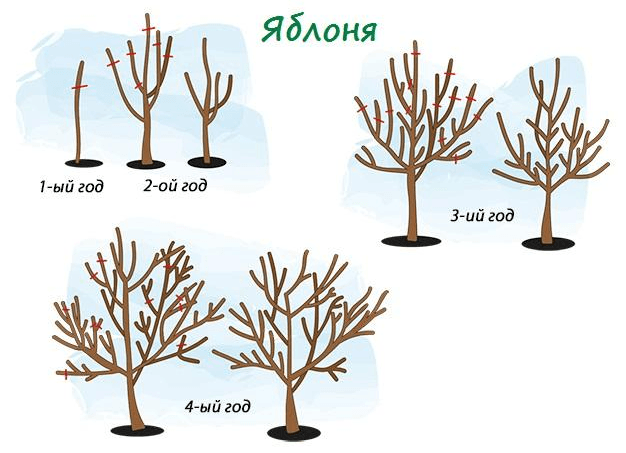
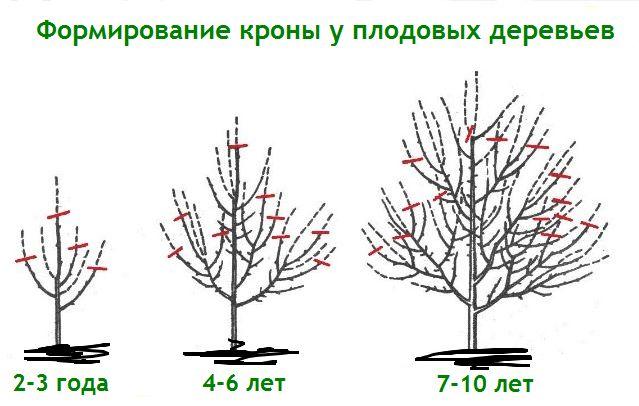
The crown is formed immediately after planting the seedling in the ground. In the first year, the top is pruned. In the second year, the three strongest branches are left. In the third year, the tops of these branches and the weaker ones are pruned.
By the fourth year the crown will be formed.
Every fall, sanitary pruning is performed, during which dry and damaged branches are removed. In the summer, thinning pruning of dense crowns is performed if necessary.
Seasonal treatments
In early spring, to prevent pests, trees are sprayed with Bordeaux mixture or copper sulfate. The same can be done in the fall, after the harvest. Also in the fall, the soil is dug to a depth of 15-20 cm to prevent insects from appearing in the spring.
Protecting trees in winter
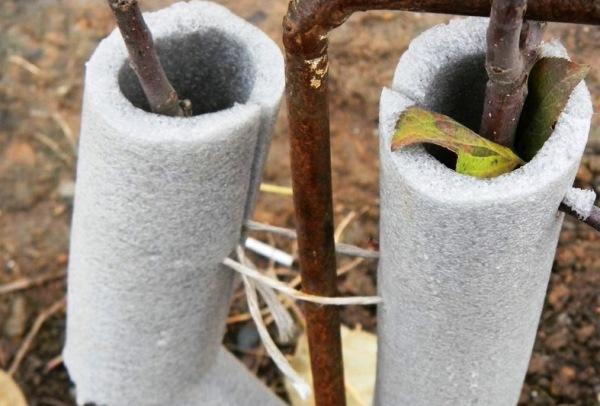
Frost-hardy varieties don't need to be prepared for winter. Simply mulch the soil and wrap the lower part of the trunk with burlap to prevent mice from gnawing the bark.
Subspecies of the hybrid
There are several subspecies of the Orlinka apple tree. Dwarf rootstocks begin fruiting earlier and produce higher yields. However, they also have a shorter lifespan of 2-3 years than taller rootstocks. Also, due to the nature of their root system, these subspecies are less frost-resistant.
On a semi-dwarf rootstock
If you use a semi-dwarf rootstock, the tree will reach a height of up to 4 m. The tree will begin to bear fruit in the 3rd or 4th year.
On a dwarf rootstock
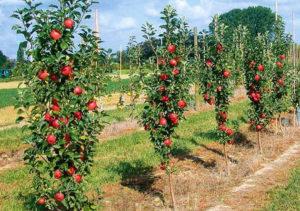
The tree will reach a height of up to 3 m. The crown is moderately spreading and oval in shape. The first apples will appear on the tree in the second or third year.
Methods of reproduction
Methods of apple tree propagation:
- seedlings;
- cuttings;
- young growth.
For propagation by cuttings, they are prepared in the fall. One-year-old shoots with four large buds are cut. They are stored in a cool place until the end of February. Around March, the cuttings are rooted indoors, and when the weather warms up, they are transplanted outdoors.
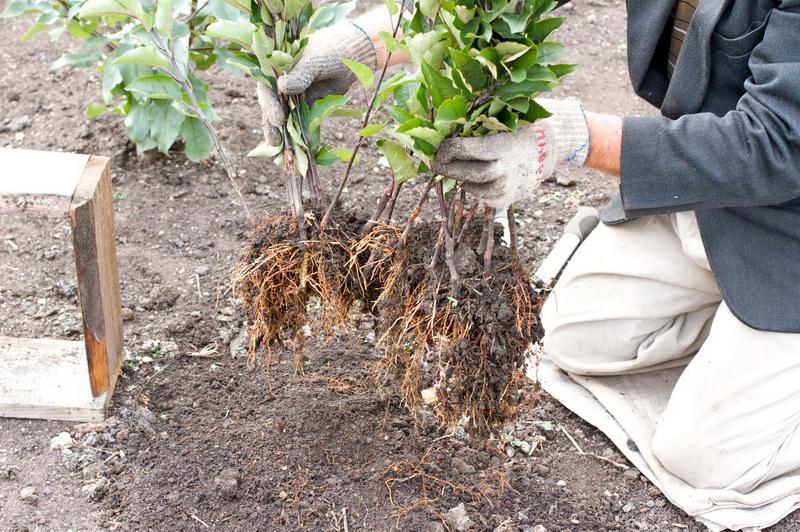
Another option is to dig up a shoot growing near the tree and plant it. However, in this case, the resulting trees don't always retain all the characteristics of the parent plant. However, the easiest way is to buy a ready-made seedling from a reputable nursery.
Gardeners' reviews
Marina, 41: "A good, productive variety. The apple tree always bears fruit abundantly. We pick the apples as early as the end of July. They're very tasty and sweet, though they don't keep for long. Overall, an excellent variety, one of my favorites."
Konstantin, 30: "It's a good variety, I can't complain about the yield. The apples are also delicious, though it's a shame they don't keep very long. The tree tolerates frost well; we live in the north, so sometimes the bark freezes a little, but it's not critical."
Related posts:
 Description of the Chudnoe apple variety, planting and caring for a dwarf tree
 Description and characteristics of the Orlovim apple variety, cultivation nuances
 Description and varieties of the Sinap apple tree, planting and care rules
 Signs and treatment of apple tree cancer, varieties resistant to the disease
 Description and characteristics of the Champion apple tree variety, cultivation technology
 Description and characteristics of the Spartan apple variety, cultivation tips
 Description and subtleties of growing the Sverdlovsk Beauty apple tree variety
 Description and planting of the Dream apple tree variety, care and propagation