
Trees and shrubs growing in forests, clearings, and meadows shed their leaves in winter, which help keep the soil warm the following season and protect against insects and adverse weather. Root crops won't grow well if weeds choke out the plantings. After weed control, bare soil remains around the bushes, which dries out in hot weather and doesn't retain nutrients. Mulching potatoes helps retain moisture in hot weather and prevents the topsoil from being washed away during rain. This agricultural practice also inhibits weed growth.
What is potato mulching?
The method of covering the soil with organic or artificial materials helps fertilize the soil and increase crop yields and is called mulching. This technology is also suitable for growing potatoes, although many gardeners and summer residents prefer to simply hill up the bushes.
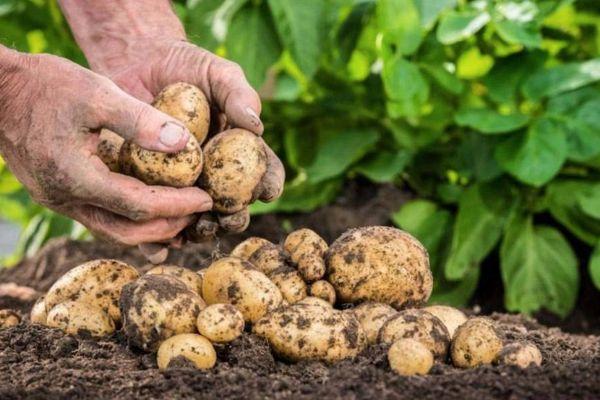
Thanks to mulching:
- The tubers do not overheat in the heat.
- No crust appears on the ground.
- An environment for the reproduction of beneficial worms is created.
You can cover all plants with a layer of covering material or leave a small portion. This agricultural technique requires additional costs and effort, but the positive effects are obvious.
Objectives of the procedure
Potatoes thrive in loose soil. Mulching with organic matter helps solve the problem, even when the soil is very compact. This method is used:
- to retain moisture;
- to prevent weed growth;
- to improve soil fertility.
The plant doesn't tolerate heat well and suffers from constant fluctuations in soil moisture. A substantial layer of mulch helps maintain its moisture level in both hot and cold weather. Organic matter retains heat at night and prevents the soil from drying out, as it forms a barrier between the soil and the atmosphere, reducing evaporation.
Potato growth is delayed at low temperatures, and development stops when temperatures exceed 30°C. A thick layer of hay or sawdust stabilizes growth. However, mulch can also prevent water from penetrating the soil, absorbing it.
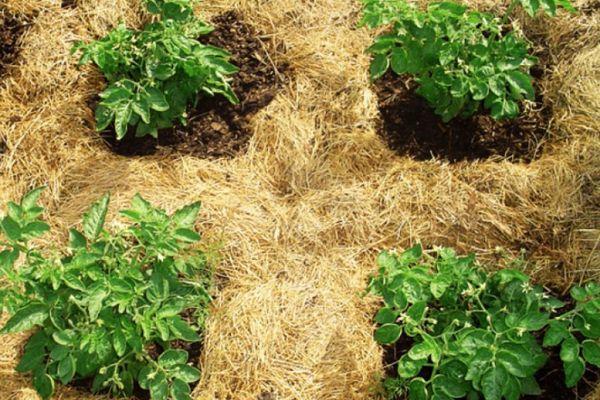
To reduce the likelihood of negative impacts from a dense layer of artificial or organic material, cover the crop in the spring, when the weather is getting warmer every day, but there is still moisture in the soil.
Mulching methods
Gardeners who have been growing potatoes for years tend to reduce the area they plant, as caring for them is quite labor-intensive. Not everyone resorts to mulching, and those who do use this technique use the following as a covering material:
- film and agrofibre;
- humus and peat;
- green manure and straw;
- compost and pine cones;
- leaves and sand.
Some types of organic matter can be mixed. The effect of such a combination is even greater. After harvesting, some materials are removed completely, while others are left as fertilizer.
With straw and hay
Covering potato plants with mown grass has been around for a long time. It was mown and dried regularly in villages, as everyone kept livestock. Mixing this mulch with leaves creates compost, which contains nitrogen, phosphorus, and potassium, reducing the need for fertilizer.
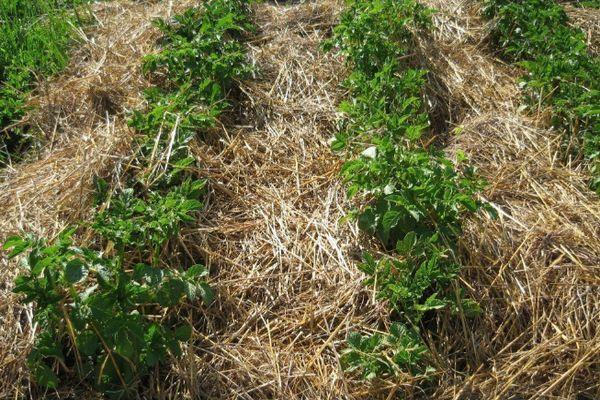
Hay decomposes quickly, preventing mold and unpleasant odors. Mulching with straw removes weed seeds from the soil, but maintains an acceptable moisture level. Potatoes are not affected by high temperatures, but are susceptible to frost.
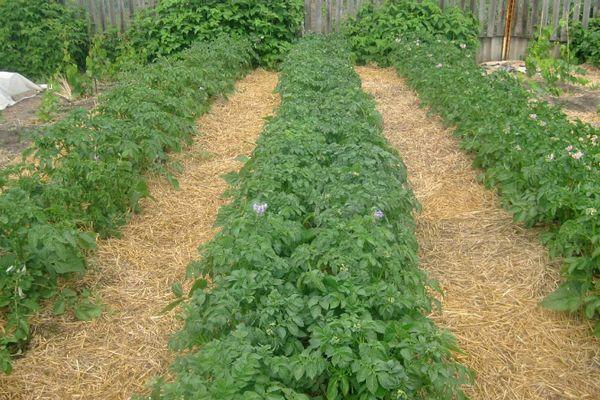
After planting the tubers, keeping the distance between the holes and rows, cover the soil with straw or hay to a depth of about 20 cm. Once the seedlings emerge and reach 50 mm, apply another layer of mulch. Leave the mulch in place until the potatoes are dug up. The plants are not hilled, weeds are not removed, and watering is only done during droughts.
Film
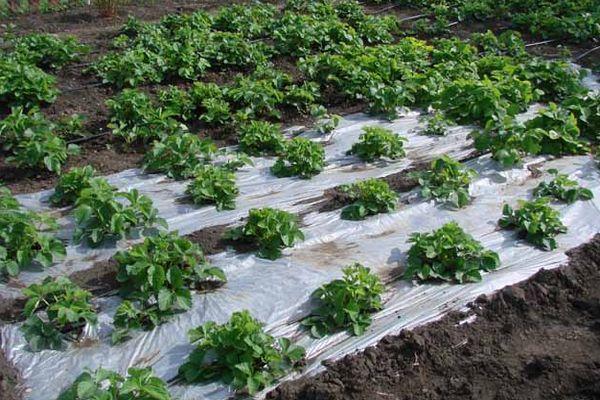
For growing early varieties, a different mulching method is used, the main purpose of which is to create a greenhouse effect and prevent the plants from being killed by late frosts. The soil is covered with dark plastic film and sprinkled with soil to prevent it from being blown away by the wind. This material increases the temperature inside the plant by a couple of degrees, but after removing the mulch, which should be done when the sprouts emerge, the potatoes must be earthed up.
Peat
Cover the plant bushes with ready-made natural fertilizer; the porous biomaterial retains heat and prevents the soil from drying out. Using peat improves aeration of the soil. It should not be used in its pure form; rather, it should be mixed with grass or sawdust. This mulching loosens the soil and enriches it with nutrients.
The biomaterial is not collected from the garden bed, which helps increase crop yields for the following season.
Humus
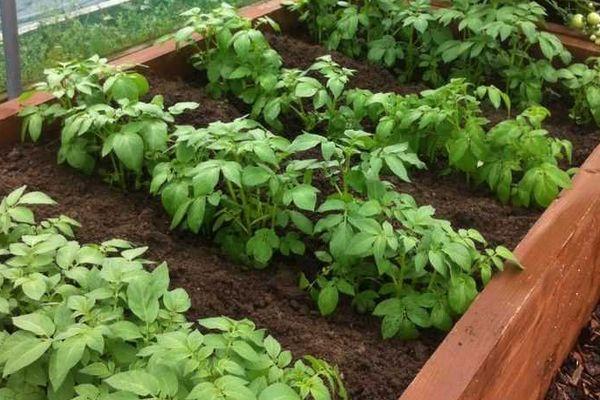
Another fertilizer is perfect for mulching potatoes; it doesn't harm the crop and protects it from adverse conditions. Before using humus:
- They dig up the ground.
- They prepare holes in which to plant tubers.
- Lay down a 15 cm thick biomaterial.
Mulch prevents weeds from growing and has a negative effect on bacteria that cause potato diseases. However, combining humus with nitrogen fertilizers is not recommended; the tops will grow, but few tubers will form.
Sawdust
In the northern regions of the country, where straw or peat is not abundant, gardeners also find ways to cover potatoes. Mulching accelerates germination if sawdust is used. Before mulching, the soil is prepared, fertilizer is applied, and the tubers are placed in the holes. Once the soil has formed a crust, cardboard is laid between the rows and topped with sawdust. You cannot take fresh material, because it will rot and air will not be able to reach the roots.
With cones
Summer residents and gardeners whose plots are located near forests and plantings can collect material for mulching, which looks unusual in potato beds.
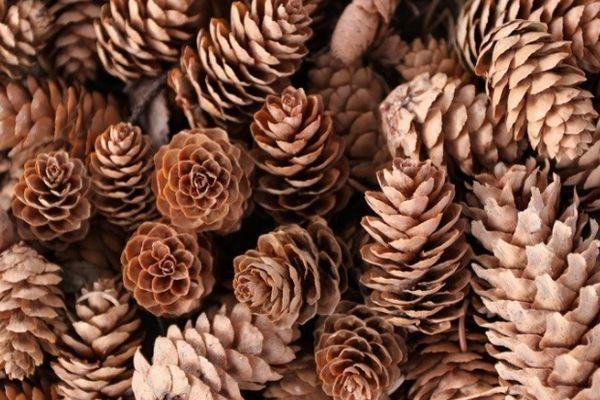
When using pine or fir cones:
- The soil is protected from the hot rays of the sun.
- The earth cools less in winter.
- Water passes easily through the mulch layer.
Weeds have a hard time getting through this material, so weeding is unnecessary. The cones are placed in a layer no thicker than 7 cm.
Green manure
Green manures, such as mustard, oilseed radish, alfalfa, clover, and lupine, which are planted to improve soil structure, can be used as mulch, but only after drying. Covering the soil with green manure protects it from overheating and provides micronutrients to the plants. They are mown before the seeds appear.
With cardboard
Even without organic matter, gardeners still find ways to prevent weed growth. They cover crops with newspaper or cardboard. They first make cuts in the material, then lay it on the bed, and cover it with straw. This mulching method prevents plant diseases. At harvest time, the tubers are dug up so clean that they don't need to be washed.
Landing Guide
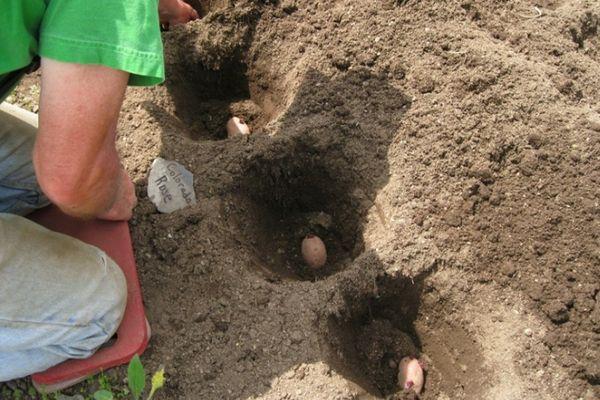
The area under mulch must be prepared. To do this, weeds must be pulled out by the roots and the bed must be thoroughly watered. The soil must be loosened to a depth of 50 mm, and then fertilizer must be applied. Planting potatoes Cover with organic matter after a few days, when the top layer of soil has aired out and is no longer compacted.
Possible errors
Sometimes gardeners ignore mulching recommendations and are then surprised when the potato harvest isn't as expected. The main mistakes they make include:
- The thickness of the soil layer is more or less than necessary.
- There is no space between the material and the tops.
- Fresh sawdust is used without combination with nitrogen fertilizers.
Some gardeners cover their beds when the ground has not yet warmed up, and the potatoes grow worse.
Harvesting
Mulching allows you to grow large tubers with minimal time and labor, as it protects the crop from unfavorable conditions such as extreme heat, drought, and excess moisture.
When harvesting, the compost is simply dug into the soil, leaving the peat in the garden bed. Cones, straw, and sawdust are raked away. This material can be used the following year.
Related posts:
 Why potatoes aren't growing well in the garden, and what to do to ensure a bountiful harvest
 Description and treatment of potato diseases, methods of control using folk and chemical means
 Description and treatment of potato pests, control measures
 How to properly prepare planting material and when to plant potatoes to get a rich harvest
 The best eggplant varieties for growing in a polycarbonate greenhouse: planting and care
 Description and characteristics of the Rodrigo potato variety, cultivation and care
 Reasons why potatoes don't bloom, and what to do to ensure a good harvest
 Description of the best potato varieties of domestic and foreign selection